Randy in a post asked the question I think many ask here. Why do I champion the trans community so forcefully? Nan asked me a few years ago if I was feeling like I was trans, and no I am a cis gay male and happy in it. Although if not for my past I would have liked to be free to explore a more feminine side of myself. Ron and I do have trans people in our family but I have never met them. The truth is in the page why I do this. I want to give a voice to those that have no voice and right now the most targeted unfairly groups are trans people / kids and brown skinned people ICE is going after. Why do I put so much effort in to giving them a voice? Because as an abused little boy people in my town knew I was being abuse but no one gave me a voice, no one spoke up for me. Hugs.
How Americans are manipulated by online misinformation and political rhetoric.
Joseph McConville’s first memory of being online was at 13 years old when he started playing Neopets, a virtual pet game, at his home in Boynton Beach, Fla. At the time, he had no clue that just months later, the internet would suck him into the alt-right.
As a young, white man, McConville says he was taught to believe that he’d have everything he wanted.
He started to realize this dream wouldn’t come to fruition when he was pulled out of private school as his parents struggled during the 2008 recession.
McConville quickly graduated from kids games to popular social media sites like Myspace and Facebook. But it was when he found FunnyJunk.com in ninth grade that he started being exposed to alt-right content.
The website gave users the ability to upload memes and upvote popular content. When McConville began using it, he was initially exposed to dark humor and edgy right-wing memes.
He then migrated to 4chan, a website known for hosting anonymous, fringe, right-wing communities, where he started engaging with content used to stoke extremist meaning —pushing us vs. them narratives that alienated McConville from his multicultural South Florida community.
“Everyone else is wrong. … These guys are right. These guys get it,” says McConville. The deeper he got, the more anger he felt—especially towards transgender people.
“It’s all a psyop … there’s a big trans psyop to destroy manhood,” McConville remembers believing for nearly a decade. “It’s all about making men hate themselves, to become women, to weaken the American hegemony.”
McConville, now 30, eventually found his way out of the alt-right world around 2018 when he was deradicalized by a friend who had previously been a part of the community.
But since then, the pervasiveness of this thinking has grown. What was once conspiratorial thinking on fringe websites has now become commonplace. “The [2016] Trump election changed a lot of things, it all became serious,” McConville told Uncloseted Media and GAY TIMES. “You feel like, ‘Wow, we’re actually being listened to—we’re changing the mainstream talking points.’”
Transgender Americans have been one of the biggest targets of this alt-right rhetoric, and it’s effective. Since 2022, Americans have increased their favorability towards laws limiting protections for trans people and have become less favorable towards policies safeguarding them.
The site of Charlie Kirk’s assassination after it took place. (KSL News Utah)
This change in public perception may be because of the growing claims that falsely link transgender people as perpetrators of mass violence and domestic terrorism. After Charlie Kirk’s death in September, these narratives reached a boiling point.
But how did Americans get taken to believe this anti-LGBTQ lie? And what does it say about how people can be brainwashed to hate?
Who’s Pushing the False Link Between Trans People and Domestic Terrorism?
One reason many Americans began to believe that trans people are more likely to be linked to terrorism is because trusted sources in mainstream conservative spaces are telling them it’s true. Even though the overwhelming majority of mass shooters are cisgender men, the Heritage Foundation, notably behind Project 2025, recommended the FBI create a category of domestic terrorism called Transgender Ideology-Inspired Violent Extremism, which suggests transgender people pose an imminent threat.
“I think some people know that this is false, but push it,” Thekla Morgenroth, a professor of psychology at Purdue University, told Uncloseted Media and GAY TIMES. “It’s worth giving false information if you get people on your side and support your opinion, and I think that is malicious.”
Unlike when McConville was in the alt-right, many of the people behind the rhetoric today hold powerful positions in the government. After a shooting in August at a Minnesota Catholic school perpetrated by a transgender person, Rep. Lauren Boebert falsely said there was a “pattern of transgender violence in our country.” Trump officials and other members of Congress used this as an excuse to attack gender-affirming care. And Harmeet Dhillon, an assistant attorney general at the Department of Justice, has insisted that hormone replacement therapy played a role in the shooting, although officials do not believe the perpetrator was using hormones.
This narrative has bled into the mainstream media who are used to trusting government sources. Just a few hours after Kirk was pronounced dead, The Wall Street Journal and other media outlets picked up claims from the Bureau of Alcohol, Tobacco, Firearms and Explosives that the bullet case engravings pointed to a motive related to “transgender ideology,” a term coined by transphobic commentators. The bullet casings ultimately did not have any reference to transgender people.
Nevertheless, suspicions around this shooter being connected to the transgender community spread like wildfire.
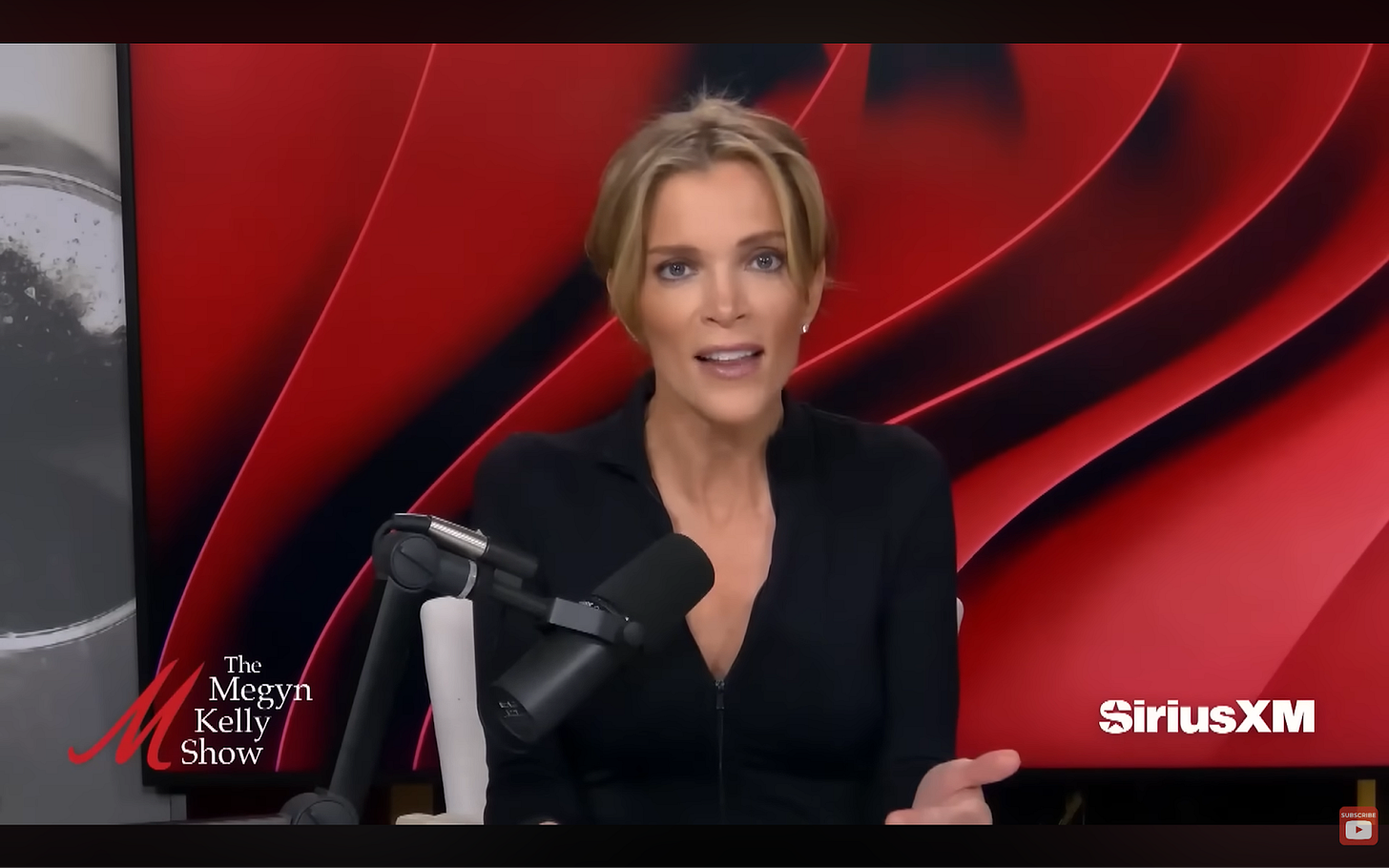
Megyn Kelly in her video. (Megyn Kelly on YouTube)
Former Fox News personality Megyn Kelly posted a video titled “Megyn Kelly Reveals the Truth About the ‘Trans’ Phrases Found on Ammo of Gun Which Shot Charlie Kirk,” to YouTube on Sept. 11, 2025, where she falsely told over 4 million subscribers, “There’s a particularly high percentage [of transgender people] committing crimes these days and it is responsible and important to say so.” The video now has 2.1 million views and Kelly has not retracted these comments.
Her followers—who believed her false claims—began calling for extreme action in the video’s comment section. @WonkoTheDork wrote, “Trans insanity needs to end. I don’t care how, this has to stop.” And @kathleenbarton-m6c wrote, “As an American, I completely agree that this [Trans] movement needs to be completely eradicated.”
Referencing Kirk as a martyr, Texas Attorney General Ken Paxton took it a step further, writing in a press release that “corrupted ideologies like transgenderism and Antifa are a cancer on our culture and have unleashed their deranged and drugged-up foot soldiers on the American people.”
The Social Psychology of Transphobia
Morgenroth thinks many people who endorse rhetoric around transgender domestic terrorism are threatened or afraid of otherness and of the breaking of traditional gender norms.
“People are very attached to the way that they think about gender because it gives them a sense of certainty—it gives them a sense of who they are and who they’re not,” they say.
Morgenroth says people come up with justifications for their discomfort, even if they don’t make sense.
“‘Here’s an explanation for why I should be scared. I’m gonna endorse that and I’m gonna believe that regardless of whether that makes logical sense or not,’” they told Uncloseted Media and GAY TIMES. “I think that’s what’s happening and why people are so willing to endorse these conspiracy beliefs or theories about trans people.”
Joseph Vandello, a psychology professor at the University of South Florida, says that when influential figures ramp up a threat, it triggers an emotional response of fear or anger, which leads to a desire to punish or exclude people.
“This is the same playbook that people were using against gay people going back to the 1970s or against other kinds of marginalized or minority groups like Jews,” Vandello told Uncloseted Media and GAY TIMES, referencing the gay panic of that era. “I think there’s this idea that if you frame the issue in terms of a threat, then it becomes an issue of moral protection of the community.”
Another One Down the Rabbit Hole
Vandello says many young men fall for anti-trans narratives because they confirm their place of privilege in the world and validate their insecurities. He coined the term “precarious manhood,” which is the idea that manhood is a social status that has to be won and can be lost. His research indicates that threats to one’s sense of manhood—like trans and queer identities—provoke not only insecurity, but aggression.
Jordan Peterson (right) being interviewed by Sean Hannity in 2025. (Fox News)
Ten years ago, Justin Brown-Ramsey became a case study of precarious manhood, lashing out when he began thinking that trans people were a threat. At 18 years old, and in search of an escape from his parents’ divorce, he started binge-watching YouTube lectures from Jordan Peterson, a clinical psychologist who’s best known as an outspoken anti-trans thought leader and has said that using someone’s preferred pronouns is the road to authoritarianism.
“He has a degree, he’s working at an institution, it seems like if that’s the kind of guy that has this opinion, I should probably also have that opinion,” Brown-Ramsey told Uncloseted Media and GAY TIMES.
This intellectualized version of transphobia appealed to the sense of insecurity Brown-Ramsey faced growing up in a household with strictly enforced gender roles.
Eventually, Brown-Ramsey became an active participant in anti-trans rhetoric. As an anonymous keyboard warrior, he’d fight in the YouTube comments against the #MeToo, feminist and trans rights movements.
Near the end of his senior year of high school, Brown-Ramsey brought this hatred into the real world against another classmate.
“They mentioned they were trans, and I recall always taking issue with that for seemingly no reason, and being just generally antagonistic about that,” says Brown-Ramsey, now 28.
He purposefully misgendered the student in class and started lashing out against friends, family and romantic partners until he was almost totally isolated.
“I think over time, the less acceptable my behavior was for people in person, the more it became acceptable to lean into the online version of that,” he says. “It went from those lecture videos to watching long rant videos about trans people and gay people, or seeking out stuff that was more 4chan-adjacent.”
Brown-Ramsey, who eventually left the alt-right after deeply engaging with U.S. history in college, believes he was manipulated to hate trans people because it helped him displace his anger about other elements of his life. “I think it was the fact that I was lower working class or lower middle class, and didn’t have an economic future ahead of me,” he says. “I was like, ‘Well if the world is that way then I just might as well be hateful and try to be more powerful than somebody.’”
Undercover in the Alt-Right
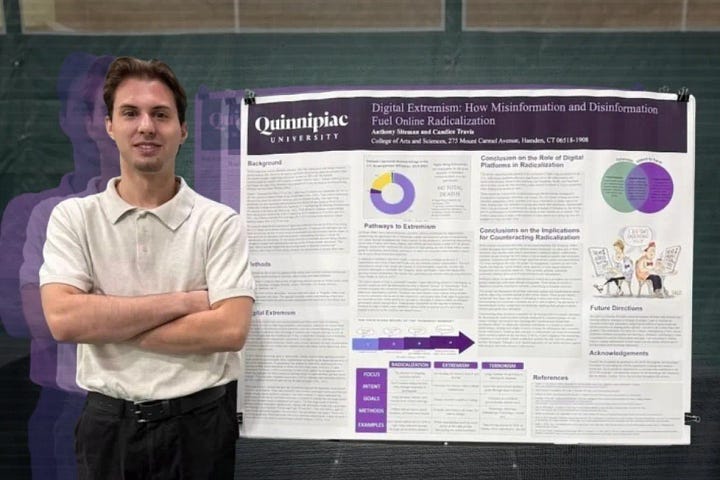
Anthony Siteman (Photo courtesy of Siteman, design by Sam Donndelinger)
This phenomenon of young men getting drawn in by alt-right algorithms fascinated 21-year-old Anthony Siteman, who started investigating online extremism ahead of the 2024 presidential election.
“My main goal was to understand how and why people became radicalized,” Siteman, a senior at Quinnipiac University, told Uncloseted Media.
Siteman immersed himself on right-wing sites like Rumble and Gab as well as encrypted messaging apps like Telegram where he joined channels that included Proud Boys. He noticed trends that draw people in: all caps text, red alarm emojis and inflammatory language, which all trigger a sense of urgency and concern.
He saw constant racist, sexist and transphobic language, but also violent videos and memes created from the livestreamed footage of the 2019 mosque shootings in New Zealand that left 51 people dead.
Even though he entered this project to learn about indoctrination, sometimes he felt his own views slipping. “ I was really questioning myself and what I believed,” he says, adding that he had to turn to his professor to keep him grounded. “They make you really question all of reality.”
“Social media companies are feeding people more extreme content, more emotional content,” Vandello says. He explained that emotionality is what has made the online alt-right successful at manipulating users against transgender people.
Siteman agrees: “ It’s always framed about fear, anger, and just some sense of belonging.”
The Way Out
Siteman believes that to exit these spaces, people outside the alt-right should use empathetic communication to help those in their network who have been radicalized.
For Brown-Ramsey, it was a professor that pulled him out.
“Unlike online spaces, where I curated the information that I wanted to see, and the algorithm fed me more of the same bigoted, hateful content, college was perhaps the first time I was required to engage with media outside of my usual diet,” Brown-Ramsey published in an essay about his experience.
Brown-Ramsey had to read books aloud in class like “Narrative of the Life of Frederick Douglass,” which detailed the abolitionist’s experience being born into slavery. “The narrative turned a mirror onto me and, in upsetting detail, showed me that my inclinations toward antagonizing those who looked, acted, or believed differently than myself [were the same beliefs that] led to Douglass’ dehumanization,” he wrote.
“That trajectory is really just me learning, ‘Why should I be at odds with a trans person if both of us work crappy jobs and can’t pay our bills?’ Obviously, that’s not who I should be angry at, but it took a while to get around to that,” Brown-Ramsey says.
If objective, nonpartisan, rigorous, LGBTQ-focused journalism is important to you, please consider making a tax-deductible donation through our fiscal sponsor, Resource Impact, by clicking this button:
I am not sure if I need to say this but this is a total fraud attack on a real US hero. This is fascism up close and clear. tRump and his people are scared of the truth and a drunken Christian Nazi nationalist is trying to demote a real US hero military man because he told the truth. The truth every military person learns in what ever basic training they went through and often during their time in service. Remember the Mỹ Lai massacre in Vietnam and the shit that followed? https://en.wikipedia.org/wiki/My_Lai_massacre . Hugs
Arizona Sen. Mark Kelly is firing back after the Pentagon moved to censure him over last year’s video urging service members to refuse illegal orders.
Full disclosure. Ron was working for tRump at Mar-a-largo as his nighttime butler and nighttime house supervisor. He knew all about this and told me of it. Sadly he couldn’t do anything about it other than give the doctor and staff comfort and support.
Meredith Kile is a Digital News Writer-Editor at PEOPLE. She has been an entertainment and political journalist for more than a decade, previously working for Entertainment Tonight, VICE and Al Jazeera America.
The report, which cites unnamed former Mar-a-Lago and Epstein employees, claims that Trump’s spa would send masseuses, manicurists and other spa workers to Epstein’s nearby residence.
“Epstein wasn’t a dues-paying member of the club, but Trump told staff to treat him like one, the employees said,” according to the report.
It also alleges that workers “warned each other about Epstein, who was known among staff for being sexually suggestive and exposing himself during the appointments.”
White House Press Secretary Karoline Leavitt said in a statement to the Journal that the publication was “writing up fallacies and innuendo in order to smear President Trump.”
“No matter how many times this story is told and retold, the truth remains: President Trump did nothing wrong and he kicked Jeffrey Epstein out of Mar-a-Lago for being a creep,” Leavitt said in a text message.
Leavitt’s claim about Trump kicking Epstein out seems to align with the Journal’s reporting, which goes on to say that, in 2003, an 18-year-old worker returned to Mar-a-Lago from an Epstein house call and said the billionaire had “pressured her for sex.”
“A manager sent Trump a fax relaying the employee’s allegations and urged him to ban Epstein, some of the former employees said,” the report claims. “Trump told the manager it was a good letter and said to kick him out.”
The incident was not reported to police, according to WSJ. However, two years later, Epstein would be investigated after a parent alleged that he sexually abused her 14-year-old daughter. Ultimately, he pleaded guilty to solicitation of prostitution and solicitation of prostitution with a minor under the age of 18.
That conviction preceded the 2019 charges of sex trafficking, for which Epstein was awaiting trial when he died in prison. The billionaire’s friendships with many high-profile celebrities and businessmen have been highly scrutinized in recent months as Trump’s Department of Justice — which was ordered to release all evidence in the Epstein case by Dec. 19 — has continued to release documents and photos one batch at a time.
One of the documents, dated Oct. 27, 2020, appeared to be an FBI intake report that featured the account of a former limo driver, who claimed to have met Trump in 1995, when he said he drove the real estate mogul to Dallas Fort Worth International Airport.
The document read, “[Driver] reported some of the things President Trump had spoken about during the ride while on his cell phone were very concerning. [Driver] reported he was ‘a few seconds from pulling the limousine over on the median and within a few seconds of pulling him out of the car and hurting him, due to some of the things he was saying.’ “
Donald Trump, Melania Trump, Jeffrey Epstein and Ghislaine Maxwell at Mar-a-Lago in 2000.Davidoff Studios/Getty
While telling the story to an unnamed woman years later, the driver alleged that the woman went “stone cold.”
“[Woman] stated, ‘He raped me,'” the FBI intake report read. “[Driver] said, ‘What?’ as [Woman] replied ‘Donald J. Trump had raped her along with Jeffrey Epstein.’ “
The Department of Justice took proactive measures against the claims while releasing the new batch of documents. In a Tuesday, Dec. 23, statement on social media, they wrote, “The Department of Justice has officially released nearly 30,000 more pages of documents related to Jeffrey Epstein. Some of these documents contain untrue and sensationalist claims made against President Trump that were submitted to the FBI right before the 2020 election.”
“To be clear: the claims are unfounded and false, and if they had a shred of credibility, they certainly would have been weaponized against President Trump already,” the statement continued. “Nevertheless, out of our commitment to the law and transparency, the DOJ is releasing these documents with the legally required protections for Epstein’s victims.”
Community (This content is not subject to review by Daily Kos staff prior to publication.)
Wednesday, January 07, 2026 at 2:15:25p EST
The US officially acknowledged Denmark’s rights
On 4 August 1916, Denmark’s rights to Greenland were confirmed by the United States, as part of a deal that facilitated the American purchase of the Danish West Indies. That deal, the Treaty of the Danish West Indies was signed at the Biltmore Hotel in New York City. The US got the Danish West Indies, now known as the US Virgin Islands. Denmark got US$25,000,000 in gold and the United States’ recognition of Denmark’s rights over Greenland. [Those rights had been in some dispute with Norway because Greenland had been a colony of the monarchy of Denmark and Norway which broke apart in 1814.]
Some later history from Mikkel Runge Olesen:
“After the Second World War, the United Nations pushed for decolonization in Greenland. In 1953, the former colony was incorporated into Denmark and granted two seats in the Danish Parliament. In 1979, Greenland achieved Home Rule, which included the formation of the Greenlandic Parliament, and it gained self-rule in 2009 through the passage of a law that included a ‘blueprint’ for seeking independence. The 2009 law firmly established that the decision to go for independence from Denmark would now rest with the Greenlandic people.”
The middle of the video shows the ICE thug not giving the woman time to do as ordered. She was told to move her car and leave she was trying but got cut off by another auto, the ICE thug grabbed the door handle as she was starting to pull out and he already had his gun out. He stuck the gun into the open window and shot her point blank. He was in no danger as he was beside the car not in front of it. When Ron saw the video as I was watching the show on the kitchen TV while doing dishes and he broke down in tears over it. I was also very upset. Gang thugs rampaging in cities with no restraint on what they are allowed to do. These are gang members, militia members, and Jan 6th insurrectionists. They are Stephen Millers brownshirts and Gestapo. You know Miller the guy who said on national TV that the president must never be questioned and is a white supremacist Jewish Nazi. He has claimed he doesn’t consider him self a Jew but I be the Nazi’s do. Hugs
PLEASE buy from people who have not filled their goals!
Did you know that for a long time, Girl Scouts has openly included transgender and nonbinary individuals in its membership? I first learned of this five years ago while searching for a source for my annual Girl Scout cookie purchase. At that time, a wave of anti-trans sentiment was intensifying, prompting me to seek out transgender Girl Scouts from whom to order. One major benefit of their online ordering system is that it allows for trans girl scouts to sell their cookies with relative privacy and no contact between the scout and the purchaser when it comes to online orders.
My initial effort was a success, meeting the goals of every single scout featured on the page. The achievement felt wonderful during what seemed like one of the most severe legislative attacks on transgender children in recent memory. Unbeknownst to us, each subsequent year would bring greater such attacks. Since then, every year I’ve repeated this initiative, we’ve surpassed our previous sales, leading to coverage in multiple major media outlets. Last year, scouts on our list sold 50,000+ girl scout cookies!
It is that time of year again. Please consider choosing a trans girl scout to get your cookies from this year – the kids are under attack this year more than ever, so lets give them some joy. And for those of you who have a trans scout yourself, you can submit your scout’s info here.
Note: When purchasing from one of these trans girl scouts, please choose the “ship the cookies” option and not the “deliver the cookies” by hand option. And make sure to refresh the page, more will be added every few days. I will also be rearranging their order periodically.
With no further adieu, here are the scouts! Please check back as many more often request to be added after publication, and I will keep this post updated with any that join in:
Troop 65426: Troop 65426 is an inclusive troop with two trans scouts and two nonbinary scouts (Junior and Cadette levels). They’re raising funds for an educational trip to Europe and to support a local agency that trains service dogs for people with autism, PTSD, and other disabilities. You can buy cookies from them here!
Yaz: Yaz is working on their Silver Award by running self-defense classes for local LGBTQIA+ youth. They’re also creating an LGBTQIA+ Acceptance patch. You can buy cookies from them here!
Omri: Omri is a Brownie Girl Scout who loves gymnastics, figure skating, and swimming. She also enjoys researching the Titanic and mythical creatures, and her troop is saving cookie money for a trip to Rollhouse! You can buy cookies from her here!
Wxy: Wxy is an 11-year-old nonbinary scout who loves cats (current obsession: Garfield). They helped start a kids filmmaking program for their troop’s Bronze Award project so everyone can tell their story, and they’re fundraising to replace seven refrigerators at Camp Hoover. You can buy cookies from them here!
Phoenix: Phoenix is a first-year Junior, and their troop is saving up for a big Savannah trip next year. They’re also excited for horseback riding, camping, Sea World, and service projects. You can buy cookies from them here!
Ace: Ace is an out-and-proud nonbinary scout who’s active with their troop, service unit, and council, and also shows up for their local LGBTQ youth group. They’re currently working on their Silver Award and leadership hours, always ready to support their rainbow friends. You can buy cookies from them here!






















:max_bytes(150000):strip_icc():format(webp)/unnamed-5a4509546c9d4b8f90c4d383a353bc46.jpg)
:max_bytes(150000):strip_icc():focal(999x0:1001x2):format(webp)/Jeffrey-Epstein-Donald-Trump-072325-955f4eb4277f4c27956937b13e6c3f7c.jpg)
:max_bytes(150000):strip_icc():focal(749x0:751x2):format(webp)/donald-trump-jeffrey-epstein-4-071725-e21613d937dd4df7ab4a2c8d8f7fed70.jpg)


 Scottie's Playtime