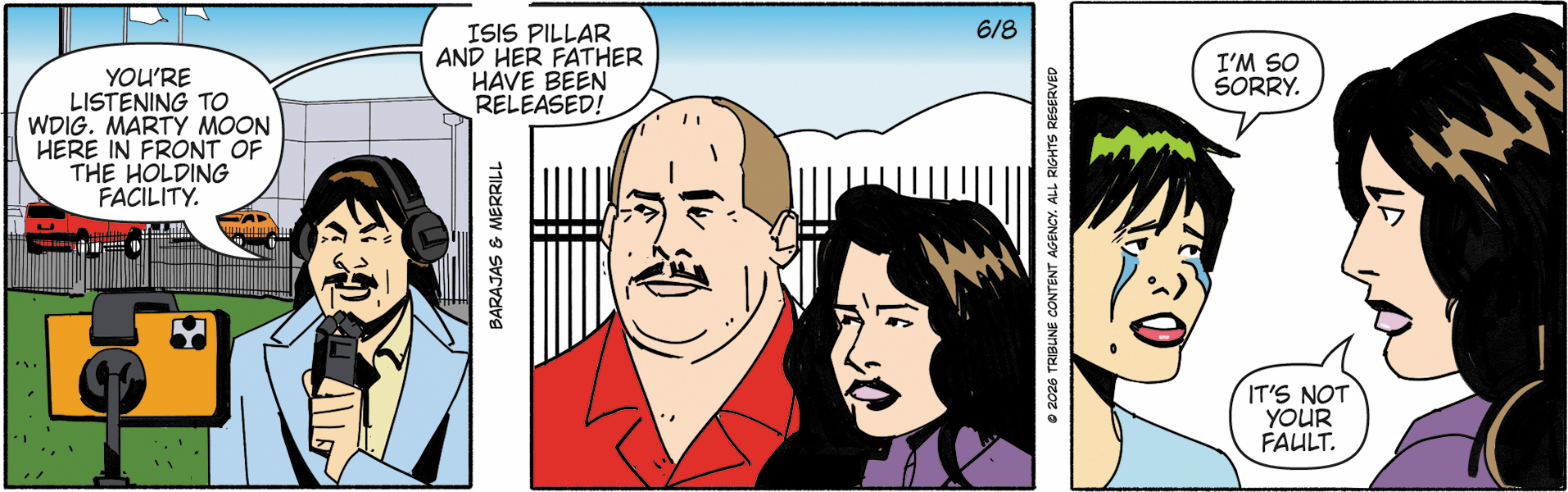
Isis, a Mudlark student-athlete, was taken by ICE earlier this year, and she’s now being released after much protest by fellow students, and this big local news story with national implications is being covered by … local podcaster Marty Moon, using the same iPhone camera streaming setup he uses to comment on high school golf? Honestly, I’ve never been more concerned about the health of the Milford media ecosystem.
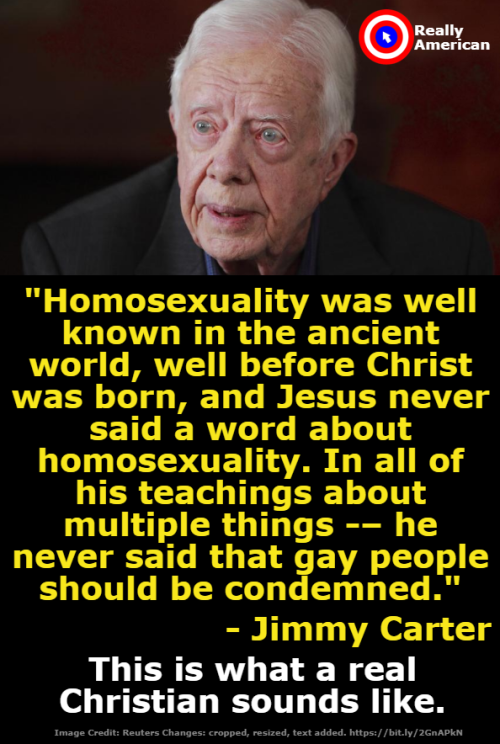
Dan McClellan explains why saying the bible is against homosexuality is wrong. The status of the male as the top of the hierarchy was of primary concern. Women were of a lower status than men. For a man to penetrate caused his status to fall to that of a woman. That was the sin of same sex acts in their society. So men were told not to penetrate other men as that lowered them to the position of women in their society. He points out that they felt that a man who wanted to be penetrated was thought to have a mental illness. He points out how the people of that time were not worried about female same sex acts because they did not lower anyone status because no penis was involved and no male was emasculated. McClellan points out that the bible really was only concerned with one side of the same gender act so it was not homosexuality that it condemned but the lowering of a male’s top position in society that was the issue. I have watched and posted a lot of his videos on sexuality in the bible and those who use the bible as a club to bash LGBTQ+ people with. He is a scholar so he gets into the weeds of the real meanings of the words that make up the text. He can be difficult to follow sometimes because of that. He also used the example of slavery in the bible and how it was used to justify owning another person as property. It is an interesting video that gets easier to understand towards the end as he wraps it all together and warns those who use the bible in this manner that they are causing a lot of harm to those who do not believe or think as they do on same sex acts. Hugs
The religious right in the US salivates over being able to do this here in the US. The goal is to enshrine being straight and cis into law so it makes being LGBTQ+ illegal. These people want to eradicate the entire LGBTQ+ community. They want desperately to return to a time when heteronormaty was assumed the only correct and natural way to present sexual attraction and gender. Why these people are so butt hurt over other people’s sexual attractions and gender feelings makes no sense. Arre straight men angry that lesbians don’t want to have sex with them? Are religious straight men terrified that they find the woman attractive only to learn she is trans which makes them hornier? And as always attacks on the LGBTQ+ follow the same script which is that LGBTQ+ are a threat to children, society, and family values. Family values mean what? That same sex people don’t have accidental pregnancies? What is not family about same gender couples? Oh right it doesn’t look like adam and eve to the hateful religious groups and it doesn’t look like mommy and daddy to the bigots. Hugs
On Wednesday, 11 members of the Turkish rights group Young LGBTI+ were tried over charges of “obscenity” and “violating the protection of the family,” their lawyer told Agence France-Presse.
The defendants face three years in prison for violating an article in the Turkish constitution that prosecutors say undermines “family values.” Among the activists’ offenses: posting images to social media that show same-sex couples kissing, a display deemed “obscene” by the government.
The trial in the western city of Izmir could result in prison time for the defendants and the suspension of their civil rights. It coincides with an appeal against another court ruling issued in December ordering Young LGBTI+’s dissolution based on the same charges.
While homosexuality isn’t illegal in Turkey as it is in most neighboring Muslim-majority countries, authoritarian President Recep Tayyip Erdogan has made the LGBTQ+ community a frequent target when it suits him. He blames Turkey’s low birthrate in part on gay people.
“This trial arises from a policy of excluding LGBT+ people from the public sphere,” said Kerem Dikmen, who is the Young LGBTI+ group’s lawyer and also a defendant in the case.
“This is not about obscenity. Activities that are perfectly legitimate, legal and in line with the Constitution are being criminalized. It is a form of dehumanization,” he said.
Turkey’s tenuous ties to Europe once moderated the country’s official treatment of LGBTQ+ Turks, but with Erdogan’s rise, the country’s integration with the West stalled. Talks on EU membership, first proposed in 1999, effectively ended in 2016 over European concerns on human rights, migration issues, and Erdogan’s democratic backsliding.
“Legislators could be considering the criminalization of any expression of LGBTI identities, consensual same-sex sexual activity, and access to vital gender-affirming healthcare,” Dinushika Dissanayake, Amnesty’s Deputy Director for Europe, said at the time. “Under these proposals, people could face jail terms based on gender stereotypes, how they present themselves, and who they chose to be in a relationship with.”
“These proposals present a grave threat to the rights of LGBTI people and those who advocate for LGBTI rights, and they must never see the light of day,” he warned.
While the legislation was withdrawn in November, the new case is testing the limits of current law to the same ends.
“We will not give up defending human rights,” said Young LGBTI+’s lawyer. “But they are trying to send a message to society through us.”
Subscribe to the LGBTQ Nation newsletter and be the first to know about the latest headlines shaping LGBTQ+ communities worldwide.
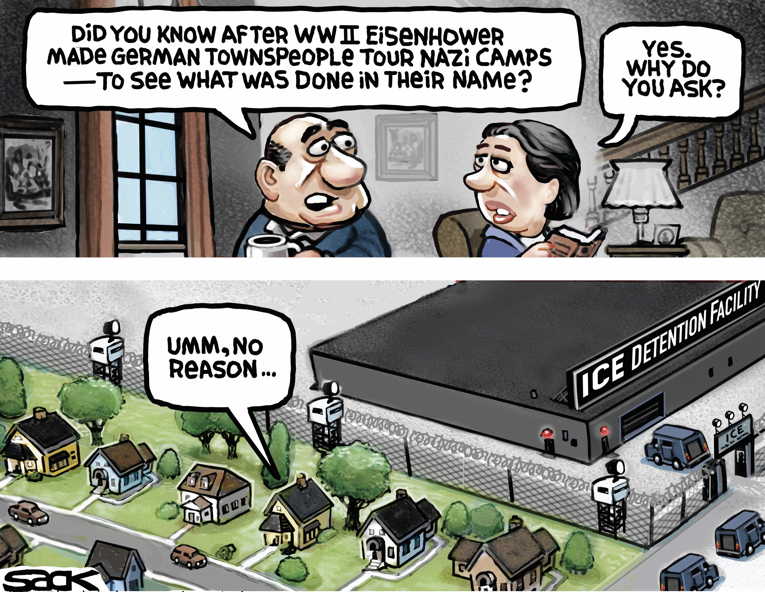
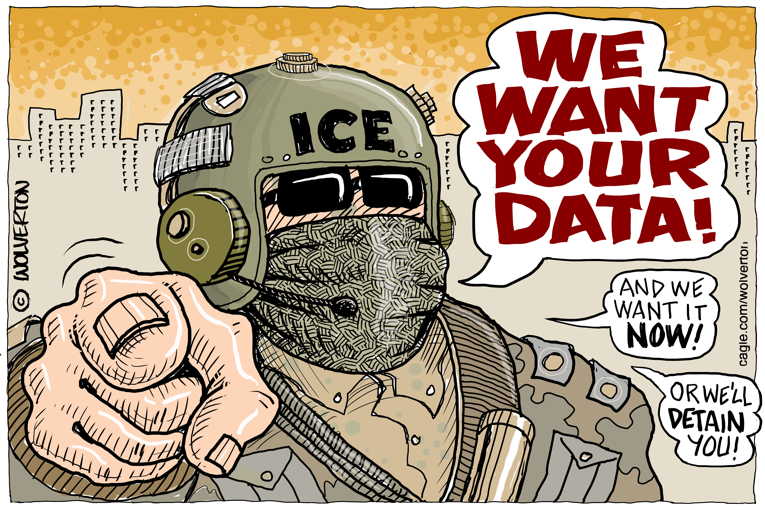
This clip was with a reporter detailing the abuses in ICE detention facilities and the illegal actions of ICE agents and for profit prison staff. Profit over people as these ICE and prison staff do not see the detainees as humans like themselves. What is concerning is ICE is learning how to use existing laws to make the local law enforcement work against the will of the people. This young man wont admit he was attacked by ICE agents instead saying he thinks he hit a tree limb in the confusion but I showed Ron the video and he said the guy looks to him like he was hit repeatedly and hard in the head and possibly the body as well. When will we as a people see that these abuses are so very similar to the abuses suffered by the minorities in 1930s Geermany. Hugs
I heard someone say the best thing they could do is offer their hand to those in need of a hand to grab on to, give support to those in need, to be the person I need others to be sometimes for me. Hugs
When approaching recent historical events, where the scope of destruction and loss can be unfathomable in scale, oral history can bring both connection and immediacy through individual stories of loss, grief, rescue, or triumph that would otherwise disappear in the grand sweep of “Great Men and their Deeds.”
[T]he method enables the documentation of certain aspects of historical experience that are often missing from other kinds of historical sources. Oral historians not only interview and engage in conversation with living sources, they also find themselves challenged in a unique way—the historian is transformed into a protagonist in the dialogue. Oral history is perhaps the only field where the sources talk back to the historian, confronting, disputing, disrupting, and sometimes resisting the historian’s understanding of the past (Frisch 1990; Shopes 2012). Oral history works with the interviewee as a partner in dialogue and the verbal form historical truth can take is always co-constructed (Cook and Goodall 2013; Goodall and Cadzow 2009; Portelli 1991).
Some of the most effective (and affecting) projects using this approach concern communities that may be far outside of the audience’s experience, whether due to time, geography, or identity. Works like Shoah by Claude Lanzmann, Hard Times by Studs Terkel, and Boots of Leather, Slippers of Gold by Elizabeth Lapovsky Kennedy document their subjects through the voices of those who lived through specific moments and events that can be overwhelming or remain unknown without a more interpersonal method.
“Many of the best works about this disease have been produced by people at various stages of HIV infection.”
The history of the HIV/AIDS epidemic has recently become the subject of numerous oral history projects, where the stories of survivors, caregivers, activists, and health care professionals have been collected and made available online, traditionally published, and edited into documentaries.
One such collection, Visual Arts and the AIDS Epidemic, was begun in 2015 by the Smithsonian Archives of American Art after receiving a grant from The Keith Haring Foundation. Haring founded the foundation in 1989, a year before his death from HIV-related illness, to maintain his artistic and philanthropic legacy. The project interviewed forty artists about their lives, their work, and how the AIDS crisis intersected and permeated both.
The interviews in the Visual Arts and the AIDS Epidemic collection cover wide ranges of personal and creative history, ranging from insider gossip and “name-dropping” to theoretical discussions of method and art history. They benefit from interviewers who bring their own experience as artists, art scholars, and historians to the conversation, with questions and insights that make this collection a rich multifaceted history of AIDS, the arts, and activism.
as if the artist were immersed in dealing with the epidemic—as so many are. Many of the best works about this disease have been produced by people at various stages of HIV infection. Perhaps they have lost a lover, nursed a dear friend, or attended a dozen funerals at a young age, and feel themselves to be, in every sense, set apart by the experience. They are implicated. Their art signifies a collective trauma—mass death in the midst of life.
Reveal Digital, an initiative “to amplify important, long-overlooked voices of the twentieth century,” has made these histories, and more, available in their developing open access collection HIV, AIDS and the Arts.
Artists in The Early Years of the Epidemic
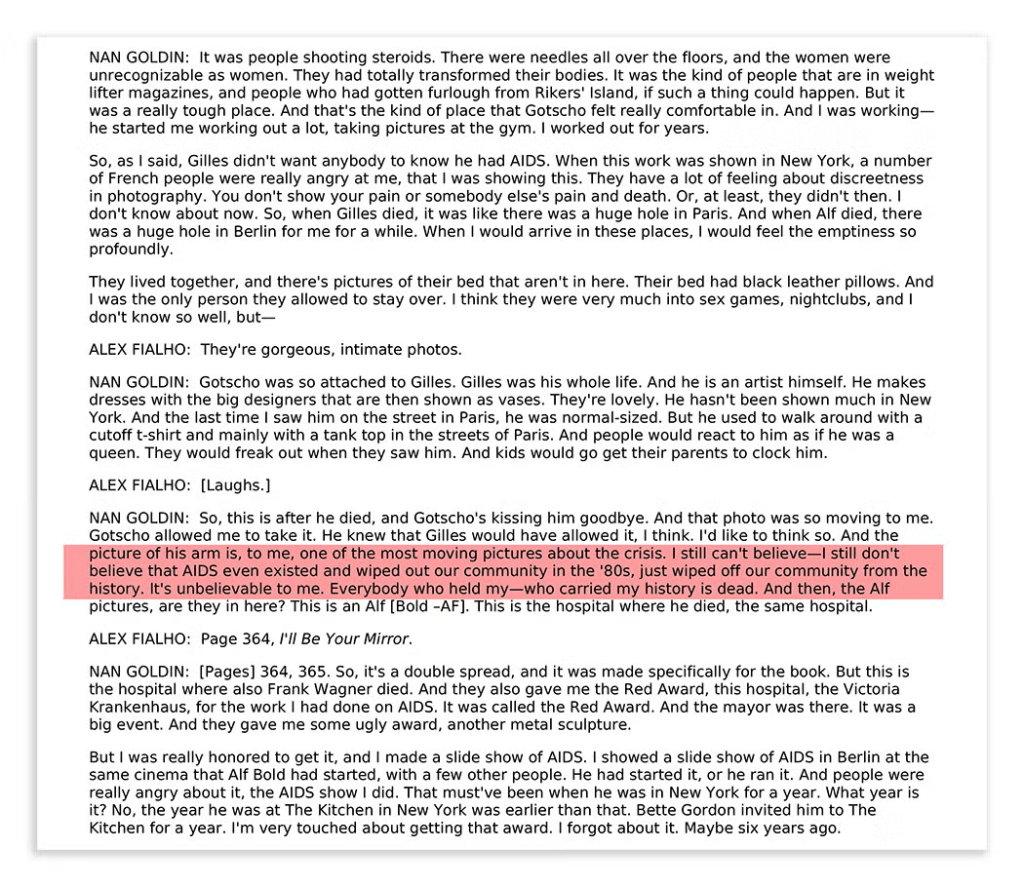
“I still can’t believe—I still don’t believe that AIDS even existed and wiped out our community in the ’80s, just wiped off our community from the history. It’s unbelievable to me. Everybody who held my—who carried my history is dead.” —Nan Goldin
One year later, William F. Buckley published a New York Times op-ed calling for HIV-positive people to be tattooed on the upper arm and buttocks to protect others (assuming that would protect both future sexual partners and intravenous drug users who might share needles). News reports about the disease largely focused on fear of contagion, the promiscuity and danger of gay men, and the threat of HIV to “normal” Americans.
In the interviews gathered in the Visual Arts and the AIDS Epidemic collection, artists describe how they first became aware of AIDS: from a loved one diagnosed after an illness; from hearing of a friend’s passing after not seeing them for a while; from a doctor telling them to stay with a partner because “there’s something going around”; or by learning of their own diagnosis. Friends were lost to the disease, and surviving family members denied the illness or sometimes actively excluded partners from funerals.
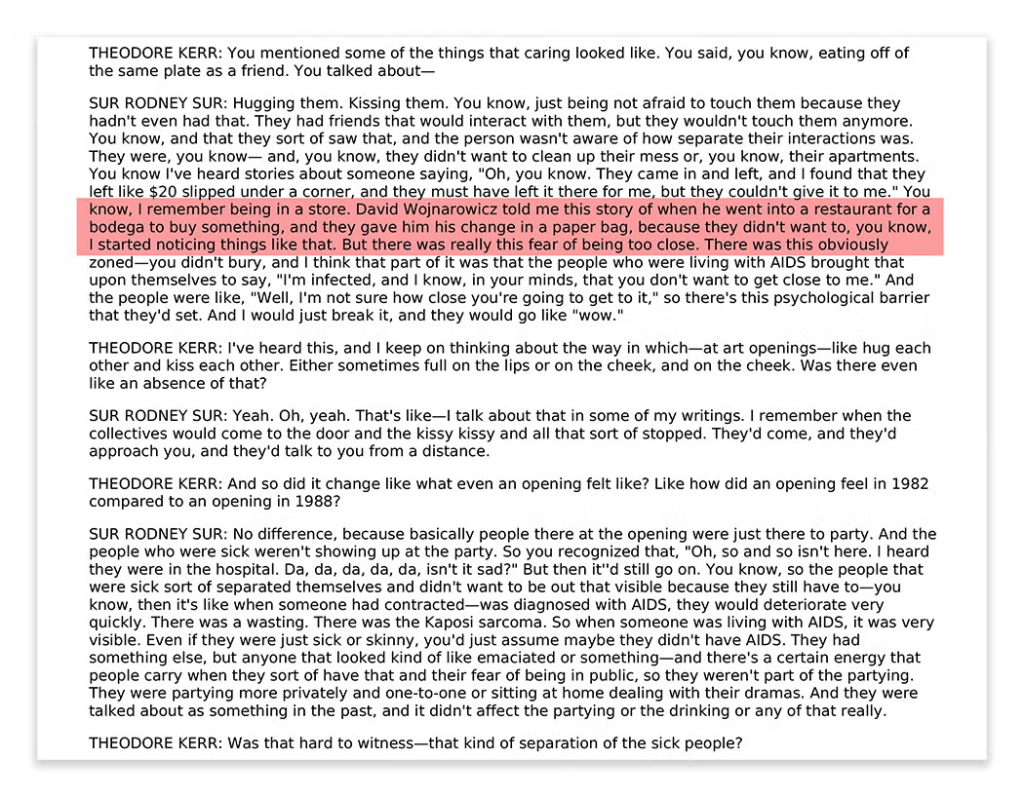
Sur Rodney (Sur), a New York City-based writer, gallery co-director, and archivist, relates that the late artist David Wojnarowicz would go to his local bodega in New York City where the clerks returned his change in a paper bag, out of fear. He describes his own anxieties when stepping in after a friend’s death to help save and archive their artworks and collections so they wouldn’t be destroyed (before there were nonprofit organizations to do so).
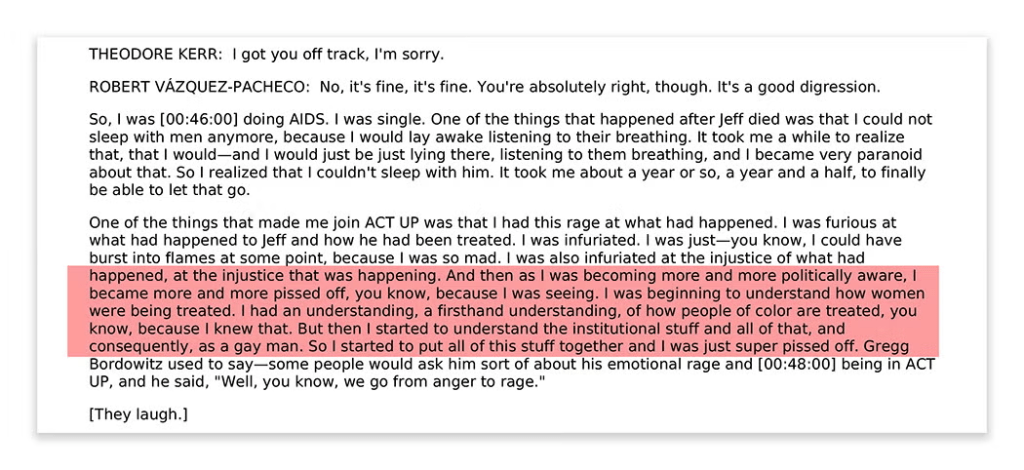
These personal experiences unfolded within the larger context of governmental indifference, active discrimination against people with the disease (or belonging to groups that were deemed “at risk”), and a growing consciousness of the political landscape of the epidemic. Robert Vasquez-Pacheco, a member of ACT UP and Gran Fury, recounts,
as I was becoming more and more politically aware, I became more and more pissed off, you know, because I was seeing. I was beginning to understand how women were being treated. I had an understanding, a firsthand understanding, of how people of color are treated, you know, because I knew that. But then I started to understand the institutional stuff and all of that, and consequently, as a gay man. So I started to put all of this stuff together and I was just super pissed off.
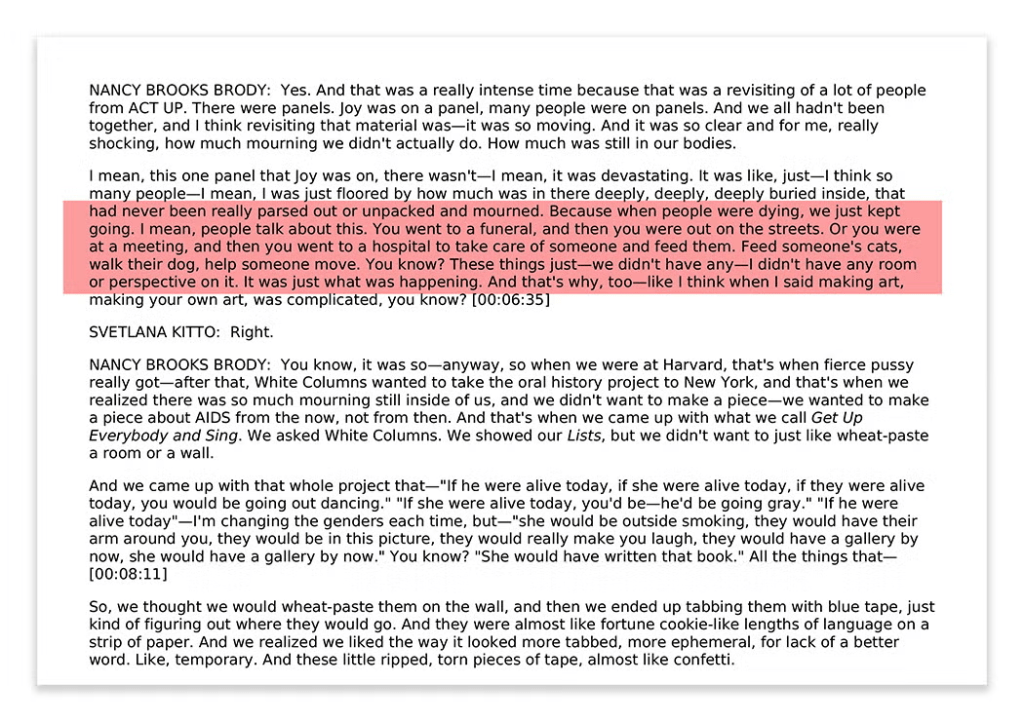
Some version of this process, repeated for many of the subjects, led people to activism, whether through art, volunteer work, protest, or sometimes all three. Nancy Brooks Brody (1962-2023), a visual artist and member of the fierce pussy collective, describes the progression in her interview.“Because when people were dying,” she explains,
we just kept going. […] You went to a funeral, and then you were out on the streets. Or you were at a meeting, and then you went to a hospital to take care of someone and feed them. Feed someone’s cats, walk their dog, help someone move. You know? These things just—we didn’t have any—I didn’t have any room or perspective on it. It was just what was happening.
The meetings she, and others, refer to were those of ACT UP New York (The AIDS Coalition to Unleash Power), which began in 1987 at a community meeting where Larry Kramer asked, “How long does it take before you get angry and fight back?” Kramer, a playwright and essayist who had been covering AIDS since the beginning through journalism, had co-founded the non-profit Gay Men’s Health Crisis in 1982. His play The Normal Heart, an impassioned call to action, spurred members of the audience to meet and subsequently take part in one of the most significant and effective activist movements of the twentieth century.
Creating Art in an Epidemic
The artistic works of those interviewed are diverse, both in media and approach: photographing people living with AIDS, using détournement to turn existing works into calls to action via graphic design, or using their body to confront audiences with the existence of the disease through performance. In some cases, their illness became an essential component of their art: John Dugdale, a former commercial photographer, began using nineteenth-century methods to capture and produce his work after HIV-related retinitis and a stroke left his sight significantly impaired. Ron Athey, one of the NEA Four, used his own HIV-positive body to create work exploring sex, trauma, and desire. The place of the artist within (or outside) a community could become a contentious issue, especially at a time when representation of people with AIDS was so fraught.
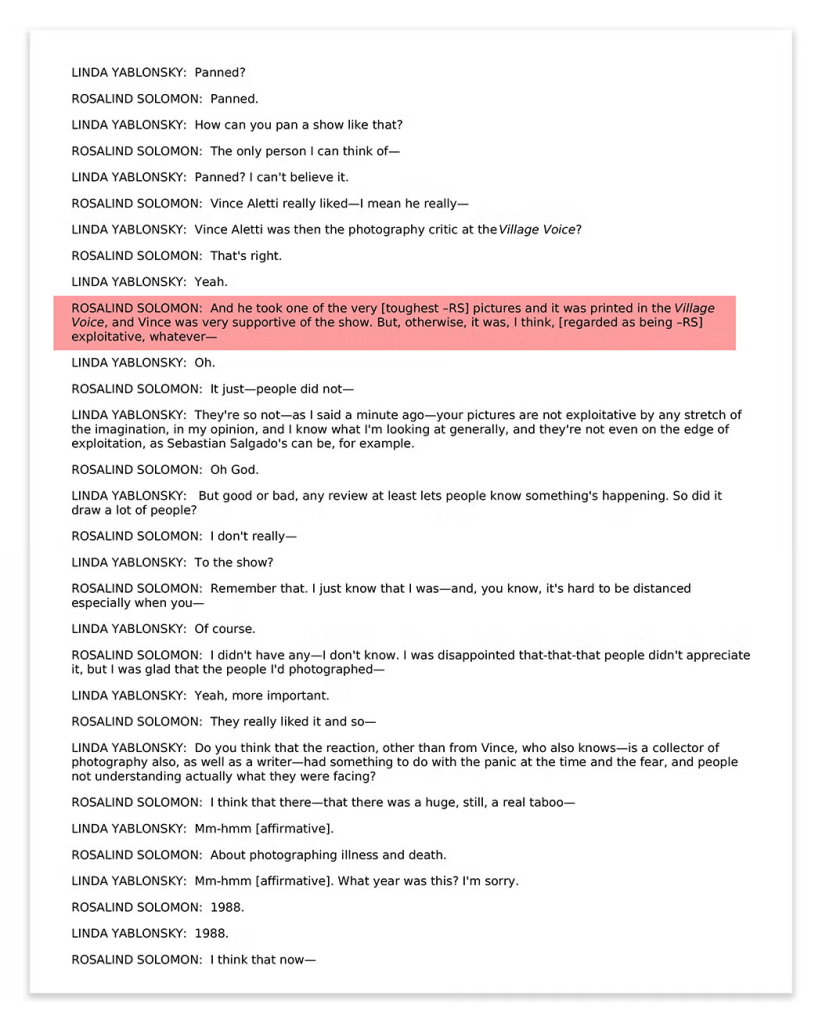
Rosalind Fox Solomon, whose 1988 show Portraits in the Time of AIDS featured photographs of the subject alone or with loved ones, some with visible lesions or in the hospital, relates that her project was critically panned and called “exploitative” at the time.
Some of the most vibrant, and now iconic, images of AIDS were created as (and for) protest: Silence = Death, the work of the Silence = Death Collective (and not ACT UP, as Avram Finkelstein relates in his interview) became the primary pictorial representation of ACT UP and a rallying slogan for the fight against the disease. Keith Haring did his own take on it for a poster, adding “Ignorance = Fear” to a “See No Evil, Hear No Evil, Speak No Evil” scene.
Collectives like Gran Fury and fierce pussy, which organized inside the ACT UP activist group, created posters for wheat-pasting that served as art, education, and calls to action around AIDS, homophobia, health care, and visibility. Whether newsprint works of text, guerrilla-installed bus station “ads,” or rolls of stickers of bloody hands announcing “One AIDS Death Every 10 Minutes,” the art of AIDS activism used any means available to communicate the urgency of the crisis.
The Visual Arts and the AIDS Epidemic collection demonstrates the power of oral history to preserve not just historical events, but what it felt like to live in the moment and survive it when so many people did not. Together with Reveal Digital’s HIV, AIDS, and the Arts archive, the collection ensures that these voices, experiences, and creative histories continue to be available to inform and educate future generations.
Remember this is a Christian nationalist who wants to push his version of religion on everyone else. He has denied promotion to women and black people. He is a radical religious crusader, which I know because he has a crusader tattoo. Years of trying to make the US military of which I was one and my dog tags read pagan for religion more inclusive are being destroyed by an administration that is filled with people who are driven to promote and push a religious domination on the military and country. It has long been known that religious zealots infected the Air Force Academy and were pushing the evangelical version of the Christian religion. In Germany I had to spend an uncomfortable 8 months when a fundamentalist religious group in our unit decided that as it was an open secret in the unit I was one of the gay members of the unit that was more open about it they needed to save me from my sins. Every time I went to the chow hall one of them cornered me at a table and started to preach at me. Not talk to me, not to offer friendship, but to tell me all about hell and how horrible I was and that their god hated how I was and that I was in willful disobedience to their great deity. They could save me from their already determined fate if I just joined them and gave my life to their god instead of the heathen sin some demons had infected me with.
I got so damn frustrated with them. Then my friends who had started eating with me to drive them away came up with a plan. We created a religion based on greek mythogoly that we called the “House of Aphrodite”. We drew up a few tenets of the region, one of which was that it was a sex religion and to worship everyone needed to do so with each other nude. The last time they saw me at the chow hall and several of them tried to sit with me and my friends, my friends sprung the trap. They told the guys we would gladly go to their church meetings and pray with them but only if they went to one of our religious meetings first. They did not know we were religious they claimed but we assured them we were very devout. Thinking we were talking about a “liberal” church they readily agreed and then my friends sprung the trap. They told them about our religion The House Aphrodite and the tenets. My friends emphasized how we all worshiped in the nude and some rituals enacted required people to touch each other even on their sexual organs to honor the goddess. My friends played it up and I could hardly keep from laughing at the horrified looks on their faces. Needless to say they declined our invitation to join us in worship. But after that they never bothered me again. Hugs
As I have written about before I had to remove hate from my system. Because of what I experienced growing up and the toxic nature of those I was raised by / around I developed a deep anger building to intense hate. It was consuming me as I had no outlet for that poison it was ruining the being I was / could be. I saw Ron starting to pull away from me as he saw the effects of my inner struggle with hate even as he did not know why I had such deep emotions and intense reactions. I had a choice. I could go with the hate, give into it and make it all I was. That would make me like those I grew up with. Or I could excise it, leave it behind, look for and crave something far different that might be like cold water on blistered skin. A balm to help me heal and to build the person I wanted to be, not that they wanted me to be. I went from the “slave” name they called me to being Scottie. It was not easy, it still is not. I am not and never will be perfect. I struggle not to be easily angered, to look for the good in others, to not to imagine faults. But by making those first steps I was able to keep Ron and he guided me forward not even understanding he was doing it. Happy hugs. Scottie



























































 Shutterstock





















































 Scottie's Playtime