tRump treats the White House the official residence and working office of the president. The longest any resident may live there is normally 8 years or 10 years if the vice president takes over after 2 years of the president’s term. A federal judge told tRump’s administration that he was only holding the White House in trust for the people and next person to hold the office. It did not give him the right to change it or do what he wanted with it as if it was Mar-a-Lago or one of his other properties. That judge ordered a stop to the ballroom until congress authorized it, which the people do not want at a time when all their social services are being cut. tRump is deluded into thinking the more gold in a room the fancier and wealthier the person seems. He is trying to keep up with other dictators palaces. Now he is talking about replacing the front of the white house, the iconic columns. It is almost like he thinks he won’t be leaving. And that every other president will share his clearly in his mind superior tastes in decorating. However most people will see it as tacky and pretentious, which both describe tRump. Hugs
President Trump has discussed turning the White House Treaty Room, historically a meeting place for diplomats and statesmen, into a guest bedroom with an en suite bath. He has added gold flourishes to the East Room of the Executive Residence in a style similar to the gilded trimmings he installed in the Oval Office. And he has affixed “challenge coins” that celebrate his presidency — including the newest medallions in red and gold — to the walls inside the West Wing.
The Treaty Room is one of the most historic rooms in the White House. Presidents Ulysses S. Grant and William McKinley used it as a Cabinet room, and it was where the Spanish-American War peace protocol of 1898, and the nuclear test ban treaty of 1963, were signed. Once known as the “Monroe Room,” because it was where President James Monroe worked, it also has been the setting for major wartime addresses by presidents George W. Bush and Joseph R. Biden Jr.
The sharply conservative Supreme Court that Trump's three appointees remade is the first since at least the 1950s to reject civil rights claims in a majority of cases involving women and minorities, according to a detailed analysis conducted for The Washington Post.
*** Personal Note. By Monday things here should be back to normal. Ron will be in Texas driving his sister home. I will have had the weekend to rest. Ron is on his last full day of doing no exertion not even house work. They went into a major artery in his wrist. He had a wrist board to keep the wrist from flexing for 24 hours, shower lightly but leave the large bandaid on. Change the bandaid after showering for 72 hours. Call 911 if it starts to bleed. On Saturday morning he is off restrictions and flies to Texas. Then he and his sister will drive to Florida. She will stay with us for a few days as her house here is emptied and then she will settle her stuff and go to New Hampshire. She is flying up there. Hugs ****
Trump administration health officials are giving serious consideration to a plan that would make injuries from COVID-19 vaccines a formal diagnosis that can be coded in medical records. Increasing documentation of what’s still a loosely defined condition could help lay the groundwork for future lawsuits against vaccine manufacturers.
The ICD-10 system already covers general vaccine injuries and reactions to some specific vaccines, but it doesn’t have a designation for the COVID shot, whose safety has become a major point of contention within the administration.
The new code could allow providers “to identify, track, and study patients who experience adverse effects specifically related to COVID vaccines,” Mary Stanfill, a CDC health information specialist, said during a public meeting on code proposals last week.
Read the full article. You will recall that the cult has claimed that COVID vaccines cause the human body to become literally magnetic, and that they cause “turbo cancer,” autism, miscarriages, myocarditis, pericarditis, hearing loss, and taste loss. Oh, and the vaccines also supposedly contain graphene nanobots meant to connect people to the internet for the purpose of mind control.
At a New York party, attendees spent Trans Day of Visibility dancing, DJing, and learning how to become less visible online.
Imani Thompson, digital security trainer and organizer of the event / Photo by Janus Rose
It’s Trans Day of Visibility, and I’m at an event space in the heart of New York City’s Commie Corridor to learn how to become less visible online.
The crowd gathered at the aptly-named Trans Pecos in Ridgewood, Queens is here for “404: Deadname Not Found,” a digital self-defense workshop which promises to teach trans people how to find and remove their sensitive personal information from the internet (and which also has no relation to this website). The vibe is giving OpSec rave happy hour—attendees sip colorful drinks, groove to DJ sets, and huddle around laptops using online tools to track down their own digital footprints.
The goal of the exercise is to find holes in your digital defenses, a practice cybersecurity folks call “red-teaming.” A slide deck guides participants through this “self-doxing” ritual, instructing them to use websites like IntelBase, PimEyes, and haveibeenpwned to find addresses, selfies, passwords, old names and aliases, and other personal info that might have been left sitting around on the open internet.
It makes for great cocktail party banter. One participant raises their arms in triumph upon receiving a clean bill of health while checking if their information was leaked in a data breach. Others swivel laptop screens and compare notes on the various places their digital detritus had cropped up. In my case, I was lucky: I mostly found data brokers with incorrect information, a long-forgotten MySpace page, and a woman whose spam calls I’ve been receiving for the past 10 years. Finally, participants are directed to various pages where they can request data to be removed, or sign up for discounted services like Kanary and DeleteMe that do the removals on your behalf.
Behind the fun and light atmosphere, everyone here knows the unspoken reality that drives tonight’s activities: an unrelenting wave of discriminatory bills and executive orders that are rapidly demolishing trans rights across the US. “Trans Visibility” is a nice idea, but it turns out it really sucks to be visible in a fascist surveillance state where the highest levels of government are obsessively trying to destroy your ability to live.
“In this world of hyper-surveillance, I want to make sure all my stuff is safe and that no one is trying to harvest my data for anything,” Anna, a workshop participant, told 404 Media. Anna asked to use a pseudonym to protect her identity, which is not surprising given that the goal of the workshop is to make it harder to be doxed. “Especially now that there’s lots of incentives for the federal government to get into that business, I just wanna make sure all of that is under wraps.”
Like the event’s name suggests, many attendees are looking for traces of their “deadnames,” which is how some trans folks refer to the names they were given pre-transition. Trans people face a disproportionatelyhigh risk of being doxed online, and deadnames and other sensitive info are frequently dug up on right-wing hate forums like KiwiFarms and social media sites like Elon Musk’s X, where harassment campaigns and hate speech are allowed and even encouraged.
“We have to protect ourselves,” said Ryan, who also used a pseudonym. “It’s great to know how to find stuff like this, because you never know what’s still out there.”
Imani Thompson, a digital security trainer who organized the event as part of her series Cache Me Outside, says she started hosting the free workshops at queer bars in Brooklyn a year ago, after noticing trans and intersex friends who were noticeably shaken by the opening salvos of the second Trump administration.
“I hadn’t seen cybersecurity events that looked like they would attract or resonate with the crowds I felt needed this information the most,” she told 404 Media. “I wanted to make this fun and un-intimidating and doing digital security training at the bar is kind of silly and fun and gives us a built-in VPN and protection from sensitive convos being recorded.”
There are specific reasons many trans people are anxious about their personal data and online presence these days. For one, trans identities often don’t fit neatly into government boxes, and the name and gender they are assigned at birth may or may not match their government-issued IDs. Recently, a new law in Kansas resulted in hundreds of trans people being told that theirdrivers licenses and IDs had been invalidated overnight, forcing them to obtain new documents that revert to the sex marker assigned at birth. JournalistMarissa Kabas later reported that the 300 trans IDs in question had been flagged and not immediately invalidated, but the goal of the law and its ensuing chaos was clear: requiring trans people to have IDs that don’t match their appearance or lived reality, forcing them to out themselves and introducing friction and discrimination into their everyday lives.
The same Kansas law also implemented the first state-level “bathroom bounty,” making it a crime for trans people to use appropriate bathrooms and changing rooms and promising rewards to random passersby who feel “aggrieved” by someone they think might be trans. Lawmakers in Idaho have passed an even harsher bill, which would charge repeat trans bathroom-users with a felony and up to 5 years of jail time. These bills threaten not only trans people, but anyone whose appearance might fall outside of someone’s normative expectations of “male” and “female.” And they are especially dangerous at a time when facial recognition can near-instantly identify someone with a quick search.
Thompson also worries about the information that queer folks can reveal while asking for help online. Trans people experienceunemployment,housing insecurity, andviolence at exponentially higher rates than cis people, and it’s not uncommon to see Gofundme pages and Venmo accounts flooding social media feeds. These posts will sometimes include personal details like a person’s name, face, transition status, location, immigration status, and even how much they have in their bank account—great for getting donations, but not so great for the doxable breadcrumbs they leave behind.
“I think the risk is tenfold for the dolls and Black trans siblings because of disproportionate scrutiny in light of these bathroom bills and also how we do mutual aid,” said Thompson. “Whenever I see a mutual aid request being reposted or processed it makes me nervous, because we’re basically doxing our most vulnerable friends.” To reduce risk, she recommends people take down mutual aid posts as soon as needs are met and set their Venmo activity to private. “I feel like the intention in listing off how all these systems of oppression impact our friends are meant to create a sense of urgency and care, but then months later it’s still floating around and is a goldmine for someone who wants to claim they were made to feel unsafe in a bathroom so they can claim $3k or further an agenda.”
The privacy attitudes on display at the event contrast with the dominant media narratives about trans communities a decade ago. Fresh off the Supreme Court victory in Obergefell vs. Hodges that legalized same-sex marriage, many at that time were convinced that trans visibility would pave the way to equality, as glossy magazine covers featuring stars like Laverne Cox declared a “Trans Tipping Point.” But while conditions for some trans people marginally improved, we all know what happened next: a wave of reactionary anti-trans state laws, culminating in the re-election of Donald Trump and a series of executive orders aimed at destroying trans peoples’ access to healthcare, sports, bathrooms—essentially the ability to live a normal life.
At the same time, protection can’t be a retreat back into the closet. “It’s still important for trans voices to be heard in online spaces,” said Anna. “It’s not like I wanna go into the shadows or anything. I just don’t want people to know my personal data, my personal records, any of that.”
“Being Black, I also understand the distinction between visibility and hypervisibility and the precarity and lack of agency that hypervisibility creates,” said Thompson. “It’s tricky to find language around digital security that doesn’t imply queerness is something to hide or a shameful thing, because of course it’s not. I think having agency and purpose in how we can show up online and interact with tech as well as literacy around how technology and surveillance operates makes us better equipped.”
Janus Rose is New York City-based journalist, educator and artist whose work explores the impacts of A.I. and technology on activists and marginalized communities. Previously a senior editor at VICE, she has been published in digital and print outlets including e-Flux Journal, DAZED Magazine, The New Yorker, and Al Jazeera.
Erin In The Morning is a reader-supported publication. To receive new posts and support my work, consider becoming a subscriber.
In the latest episode of their podcast A Touch More, all-star athletes Megan Rapinoe and Sue Bird denounced the International Olympic Committee’s new rule requiring sex testing for athletes competing in the women’s category.
The anti-trans policy will subject athletes competing in the women’s division—and only women’s, not men’s—to invasive sex testing to determine whether they have an SRY gene. Why this is where the International Olympic Committee chose to draw the gender line is arguably arbitrary.
No major medical organization endorses this litmus test as a reliable marker of athletic skill or “biological sex.” Even the scientist who discovered the SRY gene has slammed this practice in sports, saying “science does not support” this “overly simplistic” approach. Rather, it’s an arbitrary line in the sand used to cram unscientific ideas about gender and sex into manmade, binary boundaries.
Nonetheless, if a woman tests positive for the gene, she could be forced to compete in the “male” category. This has had dire consequences the last few times it was deployed against women’s athletes. From 1992 to 1999, cisgender women were forced into testing and found out, on the world stage, that they had intersex conditions they never knew about. The spectacle led to ostracization, disqualification, and at least one suicide before such testing was abolished.
“What we’re doing is subjecting everybody, all women and all people who are identifying as women, to this really invasive testing that only to me just says like, oh, so we’re just trying to whittle it down to a certain type of woman,” Rapinoe said.
Rapinoe is one of the most high-profile athletes in the country, a soccer player with three Olympic competitions under her belt and a decorated career in the U.S. Women’s National Team (USWNT). Bird, meanwhile, is among the most successful athletes in history—the retired WNBA legend spent her 20-season professional career as a point guard for the Seattle Storm, and is a record-breaking Olympian in her own right. The athletic power couple has been engaged since 2020. Together, they’ve long been outspoken advocates for the LGBTQ community.
Rapinoe connected the anti-trans vitriol in sports to the right wing’s broader attacks on queer and trans people, calling the push for sex testing “hateful.”
“They sort of like, lost the battle on gay marriage,” Rapinoe said. “So, it’s just like, we’re going to have this whole campaign for all these years to just hate trans people, which is such a small percentage of the population.”
Countless women, cisgender and transgender alike, have faced harassment and persecution because of the anti-trans athlete witch hunt.
“It’s just a total acquiescence to the Trump Administration,” Rapinoe said. “It’s just horrible, and I’m just sickened by it.”
The IOC rule is part of a broader pattern. In the United States, sports bans have served as a Trojan Horse for more sweeping anti-trans policies. The DOJ’s recent lawsuit over “women’s sports,” for example, also demands that transgender students be banned from bathrooms and locker rooms.
“Can we please stop obsessing over trans people and, I don’t know, maybe focus our time, energy, and resources into real problems women’s sports face?” Bird chimed in. She rejected the idea that sex testing, as the IOC claims, “protects women,” instead calling it a “fear-mongering” political ploy meant to generate support from conservative voters.
“That’s all this is,” Bird said. “If you crack this door open, it gets blown open. You’re now policing women’s bodies across the board.”
Erin In The Morning is a reader-supported publication. To receive new posts and support my work, consider becoming a subscriber.
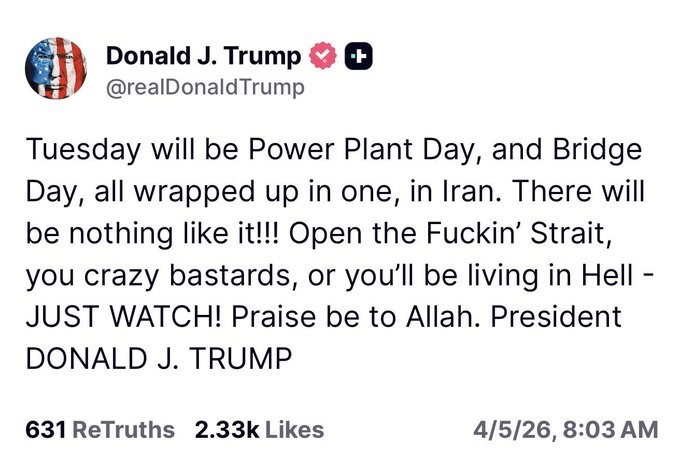
Ann Arbor (Informed Comment) – On Easter Sunday, God’s chosen in the White House issued a vulgar and unbalanced posting on his “Truth Social” that epitomizes the insanity of his Iran War. Attending to it closely will help us understand how Trump has strengthened the government of the Islamic Republic and put it in control of global energy. Trump fondly imagines that he can dislodge Iran from this new ascendancy, but he is wrong, since it depends on sabotage, a sabotage that cannot be policed.
This is embarrassing, Delete it, President @realDonaldTrump – unless you want everyone to think you’ve lost your marbles.
The foul language and clear mental imbalance visible in this announcement sparked a further round of calls for Trump’s removal under Article 25 of the Constitution, which is nothing more than an internet meme since Trump has surrounded himself on his cabinet with people even more certifiable than he is, and who wouldn’t dare move against him.
Trump, having imbibed whatever substance it is that makes him manic, announced that “Tuesday will be Power Plant Day, and Bridge Day, all wrapped up in one, in Iran. There will be nothing like it!!!”
He is repeating a threat he made previously, to bomb Iran’s civilian electricity-generating plants as well as its civilian bridges.
Iran has 98 major power plants fueled by fossil gas, which generate 85% of the country’s electricity. The largest, the Damavand power plant south of the capital, Tehran, has a generating capacity of over 2.8 gigawatts.
One of Iran’s power plants is nuclear, at Bushehr. If Trump or Israel bombs it, the consequent radiation pollution will deeply harm the Arab Gulf states, not only through airborne particles but also by contaminating sea water, which is drawn on by the region’s desalinization plants. This exposure to radiation would certainly increase cancer risk in the region. There are mountains between Bushehr and the Iranian interior, so the radioactive particles would be blown west toward other countries such as the United Arab Emirates, Saudi Arabia and Qatar.
Striking civilian power plants, and above all nuclear ones, endangers the noncombatant population of children, women and unarmed men and violates International Humanitarian Law.
In fact, the International Criminal Court in the Hague issued “warrants of arrest for two individuals, Mr Sergei Kuzhugetovich Shoigu and Mr Valery Vasilyevich Gerasimov, in the context of the situation in Ukraine for alleged international crimes . . .” on June 24, 2024. They were indicted for “for the war crime of directing attacks at civilian objects (article 8(2)(b)(ii) of the Rome Statute) and the war crime of causing excessive incidental harm to civilians or damage to civilian objects (article 8(2)(b)(iv) of the Rome Statute), and the crime against humanity of inhumane acts under article 7(1)(k) of the Rome Statute.”
Among the “civilian objects” that these Russian officials ordered attacked in Ukraine were power plants and structures such as the Kryukovsky Bridge.
So Trump is talking like a war criminal, which tells you why he has placed sanctions on International Criminal Court judges.
Trump already struck the unfinished B1 bridge linking Tehran to Karaj. Since it was not finished, it could not possibly have had a military purpose, contrary to the lies of the lying liars in the Trump administration who gave that as the excuse for hitting it.
Trump continued, “Open the Fuckin’ Strait, you crazy bastards, or you’ll be living in Hell– JUST WATCH!
It is not clear how a body of water such as a strait could copulate. However, it can engender revenue, and does so for Iran. A lot of revenue.
Iran has not actually closed the Strait of Hormuz entirely. It is exporting its own petroleum through that narrow aperture, mainly to China. Trump has been forced by the global oil shortage to lift sanctions on the Iranian tankers, and so Iran is also selling again to India. Before Israeli Prime Minister Benjamin Netanyahu rushed Trump into war on Iran on February 28, Iran was exporting about 1.4 million barrels a day to China. The price of petroleum was about $67 a barrel then, but Iran had to offer a steep discount to offset American sanctions, and so was probably only getting $57 or less a barrel. So Iran was getting something like $29 billion a year for its petroleum from China and a few other customers (90% goes to China).
China is now likely having to pay $110 a barrel for Iranian petroleum.
Iran’s oil income just went up to $55 billion a year if these prices and this volume of trade persists, which is plausible. So the “crazy bastards” in charge of Iran have nearly doubled their income off the Netanyahu-Trump war because of the fertility, under their control, of the “fuckin’ Strait.” The Iranian oil industry is state-owned, so all the money goes to the clerics and the Iranian Revolutionary Guards Corps, as well as to the conventional army and the elected institutions, the parliament and president. This extra income helps the government tamp down resistance, strengthening it against civil society. In any case, many Iranians under foreign attack are rallying around the flag. Of course there are also tax losses from the economic disruption of the war, but the vastly increased oil income helps make up for them as far as the government is concerned. If the price of oil goes to $200 a barrel, as it may well, Iran’s government could get $100 billion a year for its petroleum.
Not only that, but Iran has instituted a toll system, wherein countries that have good relations with Iran and pay a fee can transit the Strait without fear of an Iranian drone attack. In contrast, countries that Iran believes contribute to the American war effort against Tehran such as the Emirates and Kuwait, are blockaded by the threat of such strikes. These tolls could be an ongoing and lucrative source of income for the government. Before the war, 138 ships transited the Strait daily. If that traffic resumes but each has to pay Iran a $2 million toll, that would bring in $96 billion a year, i.e. four times what Iran was getting for its petroleum before the war.
So here’s the thing. With the advent of Iran’s Shahed drones, which can be manufactured inexpensively and of which it has tens and thousands, there is no way for anyone, including Trump and the US military, to stop Iran from sabotaging ships that won’t pay the $2 million. At least, I don’t see how it could be done. You’d need tens of thousands of interceptors, and we hardly have any left. Moreover, interceptors cost $1.5 million apiece, so it makes much more sense to allow each ship to pay Iran the $2 million.
Container ship in Strait of Hormuz. (U.S. Navy photo by Mass Communication Specialist 2nd Class Indra Beaufort).Public Domain. Via Picryl .
Trump has shown Iran how it can go into the protection business in the Gulf for the long term. Nice oil shipping industry you have here, it would be a shame if anything happened to it. And off that, Iran actually increases its GDP substantially.
If Trump takes out Iran’s electricity and bridges, he can interfere with its economy and its society in a big way. But he can’t stop the drones or the protection racket that way. Moreover, Iran has made it clear that its response will be to take out the power plants in the Gulf Arab states as well as in Israel. Since the US and Israel are running low on interceptors, and since even small Shahed drones have great range and can do a lot of damage, Iran’s threat is credible.
If Trump takes out Iran’s petroleum-production capability, Iran will crash oil production in the Gulf, taking 20 million barrels a day off the market for years to come. That would certainly be another Great Depression and likely would spell the end of the oil industry, since everyone in the world would migrate to electric vehicles quickly.
So although Trump meant the phrase ironically and blasphemously, the Iranian authorities may well end up saying “Praise be to Allah” over Trump’s monumental stupidity.
Tomorrow is Ron’s heart catheterization. Today I have reached a breaking point. After I did the things that had to be done this morning I am dissociating. I find my mind simply shutting down. I am losing time not hearing or seeing anything. My mind keeps parking itself in neutral. I have to keep it together one more day. I made Ron his lunch and got him into bed making sure he had his CPAP on. I took out a pork tenderloin for supper, and I will make potatoes and what ever vegitable Ron wants for supper. I am so tired and sore. Hopefully one more day. Hugs
tRump couldn’thelp himself but he had to attack Obama making claims of how bad Obama’s library is. Then Sam describes tRump’s grift / scam on his library, using tax free dollars to build a hotel that he will make money from. Then Sam talks about the citizenship birthright case. Hugs
Because of Mamdani’s policies being for the people to help the people and his huge popularity is going to affect or should affect how other democrats run their races. The people respond to taxing the wealthy more and using those funds to help the lower incomes. Maybe the young today don’t remember how it was before Reagan slashed the taxes on the wealthy when infrastructure was maintained, services for the public were available, when schools were properly funded and higher education was inexpensive and government offices to serve the public were fully staffed along with so much more. But the more the upper incomes take of the country’s money the less is available for the rest of the people. A large part of the democratic party became addicted to that big money from corporate and wealthy donors so they did not fight for the people as they should have instead helping companies and businesses to make more profit. The people saw the shift by the democrats and stopped supporting them. Mamdani has shown how to get the voters back on the democrats side again. Hugs












 Scottie's Playtime