As I keep repeating these bathroom bills hurt cis women because it is based solely on how someone looks to some other people. If as in this case a cis woman did not look feminine enough for the server and so this woman was forced to show her breasts. How is that feminism work going TERF people. These bathroom bills and the hype of fake false stories of danger to women only make all women less safe. See now people that look like men legally might have to use a female’s bathroom, so all a cis man has to say is he is trans and they can legally be in the woman’s bathroom. Same for any female that wants to go into the men’s room only needs to claim to be a trams women. All due to hate and bigotry making a problem where none existed. Think of it, the only assaults I have heard about in female restrooms is from cis people attacking cis females because they think they are trans. Hugs
The 18-year-old high school student said she unzipped her hoodie to show she had breasts after a Buffalo Wild Wings server didn’t believe she is a woman.
A Minnesota teenager filed a charge of discrimination against a Buffalo Wild Wings restaurant Tuesday, alleging a server followed her into the women’s restroom and demanded she “prove” she was a girl.
Gerika Mudra, 18, went to dinner in April with a friend in Owatonna, about an hour south of Minneapolis. When she went to the restroom, a server followed her inside and banged on the stall door while saying: “This is a women’s restroom. The man needs to get out of here,” according to Gender Justice, a Minnesota gender-equality organization that filed the charge on Mudra’s behalf.
Gerika Mudra, 18, says she was harassed by a server who accused her of being a boy in the girls’ bathroom.Gender Justice
Mudra, a biracial lesbian who isn’t transgender, said that she has been in similar situations before, when people have suggested she’s in the wrong restroom, but that when she tells them she’s a woman they leave her alone. However, when she came out of the stall at Buffalo Wild Wings and told the server, “I am a lady,” she said, the server responded, “You have to get out now,” Gender Justice said in a statement.
Mudra said she felt she had to prove to the server that she is a woman, so she unzipped her hoodie to show she has breasts. The server didn’t say anything in response but left the restroom, Mudra said.
“She made me feel very uncomfortable,” Mudra said. “After that, I just don’t like going in public bathrooms. I just hold it in. … I want to be able to use the bathroom in peace.”
Inspire Brands, which represents Buffalo Wild Wings, didn’t immediately respond to a request for comment.
Buffalo Wild Wings in Owatonna, Minn.Google Maps
Gender Justice filed the charge of discrimination with the Minnesota Department of Human Rights, arguing that what happened to Mudra violates the state’s Human Rights Act, which protects people from discrimination based on gender identity and sexual orientation, among other protected statuses.
Sara Jane Baldwin, senior staff attorney at Gender Justice, said at a news conference Tuesday that even though Mudra isn’t trans, the server’s actions “were based on assumptions that she made about” Mudra, and that Minnesota’s law protects against discrimination based on stereotypes or assumptions about protected characteristics like gender identity.
“Businesses have a legal obligation not to just have antidiscrimination policies on paper, but to train staff and ensure that those policies are followed in real time,” Baldwin said. “When that doesn’t happen, the business is liable for the harm caused.”
Gender Justice said Mudra’s experience “reflects a broader climate of fear and suspicion aimed at anyone who doesn’t conform to narrow expectations of what girls and women ‘should’ look like.” That suspicion has been driven largely by the wave of state legislation targeting trans people, particularly their access to school sports and bathrooms that align with their gender identities, though Minnesota hasn’t enacted any such legislation.
Nineteen states have laws that prohibit trans people from using bathrooms that align with their gender identities in K-12 schools, and in many of those states the restrictions apply to other government-owned buildings, as well, according to the Movement Advancement Project, an LGBTQ think tank. Twenty-seven states prohibit trans people from playing on school sports teams that align with their gender identities.
“This kind of gender policing is, unfortunately, nothing new,” Megan Peterson, executive director at Gender Justice, said in a statement. “And yet, in our current climate we have to ask: What if Gerika had been a trans person? Would this story have ended differently? That’s the terrifying reality too many trans people live with every day.”
Even if Mudra had been trans, she would be able to file a discrimination complaint under state law in Minnesota, which is one of 21 states and Washington, D.C., that explicitly prohibit discrimination based on sexual orientation and gender identity in public accommodations, according to the Movement Advancement Project. Two states explicitly prohibit discrimination based on sexual orientation only, and six additional states interpret existing measures against discrimination based on sex to also include discrimination based on sexual orientation and gender identity. Twenty-one states don’t have explicit protections from discrimination based on gender identity in public accommodations.
Black Indigenous Chefs Are Reclaiming Identity Through Food — One Dish at a Time by Michael Harriot
Black Native food workers are passing down culinary traditions, restoring lost connections and feeding body and soul. Read on Substack
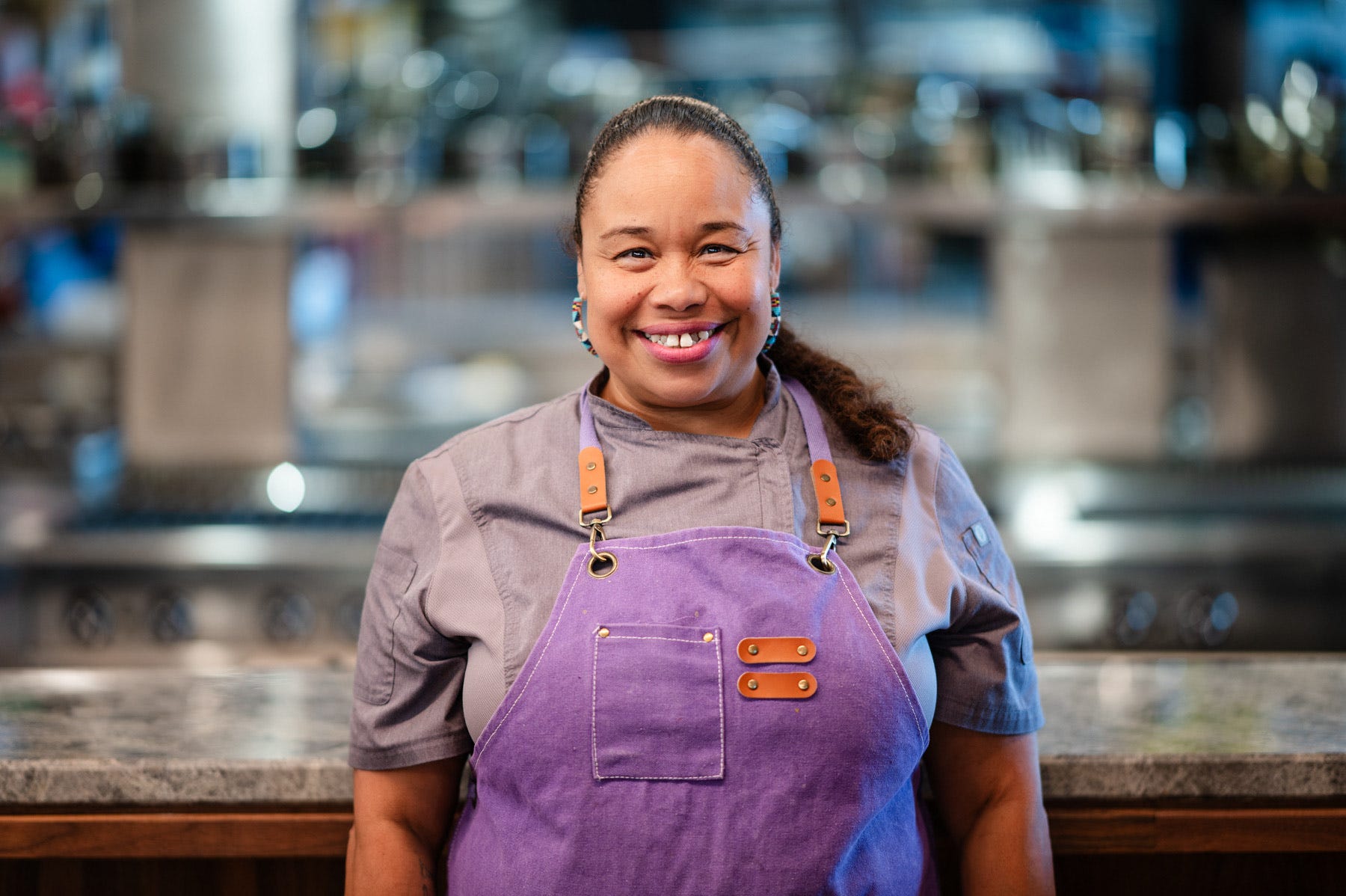
Crystal Wahpepah (Photo courtesy of Crystal Wahpepah)
The Indigenous food movement has seen a renaissance in North America, with restaurant openings, cookbook releases and community initiatives that announce the presence, expertise and heritage of Indigenous food workers. Amidst this moment, Black Native food workers have seen both the beauty and the harshness of living at the intersection of Blackness and Indigeneity, as the dominant settler colonial culture of the United States often tries to erase or flatten all parts of their identities.
But those attempts at erasure have also provided moments of reflection and insight, and a realization that the mission of Black Indigenous food workers is profoundly spiritual and political healing work. For Stephan Oak, a Black and Lakota forager and woodworker who lives in Detroit, the threads of connection that Black Indigenous people hold in their family stories that are “steeped in violence, but also steeped in love and resistance” are also guides that allow them to connect in the past, present, and future — a shared cosmology.
Crystal Wahpepah, who is Black and Kickapoo and the executive chef and owner of Wahpepah’s Kitchen in Oakland, Calif., says that often, through representation and education, Black Native people in the food industry come to a deeper peace about their identity and heritage. At Wahpepah’s Kitchen, over cornbread dishes from the Ute and Kickapoo people, wild rice from the Great Lakes tribes and bison from the Great Plains, people often find themselves.
“I meet so many people who are Black and Native but never felt connected to their Indigenous side, and when they meet me, they start talking about it, about culture, about those things that have been lost,” she says. Wahpepah is also opening a new restaurant, A Feather and a Fork, which is also the title of her upcoming cookbook.
That loss is something felt in both Black and Indigenous communities and can often feel pronounced because of family separation through residential schools, land expulsions, the trans-Atlantic slave trade and the domestic slave trade that broke up Black families across the country. “Because of colonial violence, there’s a fractured relationship to home or your connection to your ancestors,” says Oak. “The intent of the colonizer is to stop you from looking … to accept the identity of the conditions they’ve placed on you.”
Food is one of the ways Oak and others are reclaiming autonomy over their identities, especially as governments use food as a weapon by depriving communities of affordable, culturally relevant food. Oak points out that even amidst food deserts on reservations and urban Black communities, people find ways to be more self-sufficient and connect back to the land, which helps them reconnect with the essence of who they are. (snip-MORE; lots more but not too long)
Crystal Wahpepah’s wild rice salad with strawberries and pecans (Courtesy of Crystal Wahpepah)
After over 21 months of Israel’s brutal assault on Gaza, the humanitarian crisis in the Strip has reached its worst point yet. 94% of Gaza’s hospitals have been destroyed or damaged. Dozens of children have died from malnutrition. And Israeli troops continue to kill scores of Palestinians as they try to receive food from the so-called “Gaza Humanitarian Foundation.”
In this second part of Zeteo’s live ‘Unshocked,’ Dr. Yasser Khan – a Canadian ophthalmologist and plastic surgeon who has traveled twice to Gaza since October 7, 2023 – describes to Mehdi and Naomi how Israel’s humanitarian assault on Gaza has turned injuries and disabilities in Gaza into, “a death sentence.”
Dr. Yasser Khan: “It was horrific, the most horrific things that I’ve ever seen.”
In the interview, Dr. Khan shares the stories of his many patients, the vast majority of whom he says were women and children.
Dr. Khan also discusses how upon returning from Gaza, many of his colleagues in the medical field refused to believe such stories, with some even going out of their way to tell him that, “‘he’s done nothing to be a hero.’”
Dr. Khan explains how he came to the conclusion that what he was seeing in Gaza was indeed a genocide and why he takes so much inspiration from the people in Gaza. Mehdi, Naomi, and Dr. Khan also take questions from a live audience.
Do consider becoming a paid subscriber so you can get early access to exclusive content like this.
Also, if you are interested in learning more about Israel’s assault on Gaza’s healthcare system, check out Zeteo’s most recently acquired documentary, ‘Gaza: Doctors Under Attack.’
There are videos at the link below. I don’t know where we are a species right now. It seems more and more people are willing to give in to the lowest of our natures while mocking those who try to live up to the best we could be. The Christians trying to keep books that have LGBTQ+ characters out of schools can’t be bothered by the shooting of starving people including kids trying desperately to get something to eat. They are not doing anything to help, just everything they can to lash out bashing a minority group just for existing using their god to do it. Yet did not their god say to feed the hungry? To help the immigrants among you? They are so desperate to control others sexuality but they don’t care about those acting cruelty to the ones most needing help. Hypocrites, which side of god do they get to sit on? Hugs
American contractors guarding aid distribution sites in Gaza are using live ammunition and stun grenades as hungry Palestinians scramble for food, according to accounts and videos obtained by The Associated Press.
Two U.S. contractors, speaking to the AP on condition of anonymity because they were revealing their employers’ internal operations, said they were coming forward because they were disturbed by what they considered dangerous and irresponsible practices. They said the security staff hired were often unqualified, unvetted, heavily armed and seemed to have an open license to do whatever they wished.
They said their colleagues regularly lobbed stun grenades and pepper spray in the direction of the Palestinians. One contractor said bullets were fired in all directions — in the air, into the ground and at times toward the Palestinians, recalling at least one instance where he thought someone had been hit.
“There are innocent people being hurt. Badly. Needlessly,” the contractor said.
He said American staff on the sites monitor those coming to seek food and document anyone considered “suspicious.” He said they share such information with the Israeli military.
Videos provided by one of the contractors and taken at the sites show hundreds of Palestinians crowded between metal gates, jostling for aid amid the sound of bullets, stun grenades and the sting of pepper spray. Other videos include conversation between English-speaking men discussing how to disperse crowds and encouraging each other after bursts of gunfire.
The testimonies from the contractors — combined with the videos, internal reports and text messages obtained by the AP — offer a rare glimpse inside the Gaza Humanitarian Foundation, the newly created, secretive American organization backed by Israel to feed the Gaza Strip’s population. Last month, the U.S. government pledged $30 million for the group to continue operations — the first known U.S. donation to the group, whose other funding sources remain opaque.
A spokesperson for Safe Reach Solutions, the logistics company subcontracted by GHF, told the AP that there have been no serious injuries at any of their sites to date. In scattered incidents, security professionals fired live rounds into the ground and away from civilians to get their attention. That happened in the early days at the “the height of desperation where crowd control measures were necessary for the safety and security of civilians,” the spokesperson said.
Aid operation is controversial
Gaza’s more than 2 million Palestinians are living through a catastrophic humanitarian crisis. Since Hamas attacked Israel on Oct. 7, 2023, setting off the 21-month war, Israel has bombarded and laid siege to the strip, leaving many teetering on the edge of famine, according to food security experts.
For 2 1/2 months before GHF’s opening in May, Israel blocked all food, water and medicine from entering Gaza, claiming Hamas was stealing the aid being transported under a preexisting system coordinated by the United Nations. It now wants GHF to replace that U.N. system. The U.N. says its Gaza aid operations do not involve armed guards.
Over 57,000 Palestinians in Gaza have been killed since the war erupted, according to the territory’s Health Ministry, which does not distinguish between civilians and militants.
GHF is an American organization, registered in Delaware and established in February to distribute humanitarian aid during the ongoing Gaza humanitarian crisis. Since the GHF sites began operating more than a month ago, Palestinians say Israeli troops open fire almost every day toward crowds on roads heading to the distribution points, through Israeli military zones. Several hundred people have been killed and hundreds more wounded, according to Gaza’s Health Ministry and witnesses.
In response, Israel’s military says it fires only warning shots and is investigating reports of civilian harm. It denies deliberately shooting at any innocent civilians and says it’s examining how to reduce “friction with the population” in the areas surrounding the distribution centers.
AP’s reporting for this article focuses on what is happening at the sites themselves. Palestinians arriving at the sites say they are caught between Israeli and American fire, said the contractor who shared videos with the AP.
“We have come here to get food for our families. We have nothing,” he recounted Palestinians telling him. “Why does the (Israeli) army shoot at us? Why do you shoot at us?”
A spokesperson for the GHF said there are people with a “vested interest” in seeing it fail and are willing to do or say almost anything to make that happen. The spokesperson said the team is composed of seasoned humanitarian, logistics and security professionals with deep experience on the ground. The group says it has distributed the equivalent of more than 50 million meals in Gaza in its food boxes of staples.
GHF says that it has consistently shown compassionate engagement with the people of Gaza.
Throughout the war, aid distribution has been marred by chaos. Gangs have looted trucks of aid traveling to distribution centers and mobs of desperate people have also offloaded trucks before they’ve reached their destination. Earlier this month, at least 51 Palestinians were killed and more than 200 wounded while waiting for the U.N. and commercial trucks to enter the territory, according to Gaza’s Health Ministry and a local hospital. Israel’s military acknowledged several casualties as soldiers opened fire on the approaching crowd and said authorities would investigate.
Videos, texts, internal reports document havoc at food sites
AP spoke to the two contractors for UG Solutions, an American outfit subcontracted to hire security personnel for the distribution sites. They said bullets, stun grenades and pepper spray were used at nearly every distribution, even if there was no threat.
Videos of aid being dispensed at the sites seen by the AP appear to back up the frenetic scenes the contractors described. The footage was taken within the first two weeks of its distributions — about halfway into the operations.
In one video, what appear to be heavily armed American security contractors at one of the sites in Gaza discuss how to disperse Palestinians nearby. One is heard saying he has arranged for a “show of force” by Israeli tanks.
“I don’t want this to be too aggressive,” he adds, “because this is calming down.”
At that moment, bursts of gunfire erupt close by, at least 15 shots. “Whoo! Whoo!” one contractor yelps.
“I think you hit one,” one says.
Then comes a shout: “Hell, yeah, boy!”
The camera’s view is obscured by a large dirt mound.
The contractor who took the video told AP that he saw other contractors shooting in the direction of Palestinians who had just collected their food and were departing. The men shot both from a tower above the site and from atop the mound, he said. The shooting began because contractors wanted to disperse the crowd, he said, but it was unclear why they continued shooting as people were walking away.
The camera does not show who was shooting or what was being shot at. But the contractor who filmed it said he watched another contractor fire at the Palestinians and then saw a man about 60 yards (meters) away — in the same direction where the bullets were fired — drop to the ground.
This happened at the same time the men were heard talking — effectively egging each other on, he said.
In other videos furnished by the contractor, men in grey uniforms — colleagues, he said — can be seen trying to clear Palestinians who are squeezed into a narrow, fenced-in passage leading to one of the centers. The men fire pepper spray and throw stun grenades that detonate amid the crowd. The sound of gunfire can be heard. The contractor who took the video said the security personnel usually fire at the ground near the crowds or from nearby towers over their heads.
During a single distribution in June, contractors used 37 stun grenades, 27 rubber-and-smoke “scat shell” projectiles and 60 cans of pepper spray, according to internal text communications shared with the AP.
That count does not include live ammunition, the contractor who provided the videos said.
One photo shared by that contractor shows a woman lying in a donkey cart after he said she was hit in the head with part of a stun grenade.
This photo, provided by an American contractor on condition of anonymity because they were revealing their employers’ internal operations, shows a woman slumped over in a donkey cart after the contractor said she was hit in the head with part of a stun grenade at a food distribution site in Gaza run by the Gaza Humanitarian Foundation in June 2025. (AP Photo)
An internal report by Safe Reach Solutions, the logistics company subcontracted by GHF to run the sites, found that aid seekers were injured during 31% of the distributions that took place in a two-week period in June. The report did not specify the number of injuries or the cause. SRS told the AP the report refers to non-serious injuries.
More videos show frenzied scenes of Palestinians running to collect leftover food boxes at one site. Hundreds of young men crowd near low metal barriers, transferring food from boxes to bags while contractors on the other side of the barriers tell them to stay back.
Some Palestinians wince and cough from pepper spray. “You tasting that pepper spray? Yuck,” one man close to the camera can be heard saying in English.
SRS acknowledged that it’s dealing with large, hungry populations, but said the environment is secure, controlled, and ensures people can get the aid they need safely.
Verifying the videos with audio analysis
To confirm the footage is from the sites, AP geolocated the videos using aerial imagery. The AP also had the videos analyzed by two audio forensic experts who said they could identify live ammunition — including machine-gun fire — coming from the sites, in most cases within 50 to 60 meters of the camera’s microphone.
In the video where the men are heard egging each other on, the echo and acoustics of the shots indicate they’re fired from a position close to the microphone, said Rob Maher, a professor of electrical and computer engineering at Montana State University and an author and research expert in audio forensic analysis. Maher and the other analyst, Steven Beck, owner of Beck Audio Forensics, said there was no indication that the videos’ audio had been tampered with.
The analysts said that the bursts of gunfire and the pop sequences in some of the videos indicated that guns were panning in different directions and were not repeatedly aimed at a single target. They could not pinpoint exactly where the shots were coming from nor who was shooting.
GHF says the Israeli military is not deployed at the aid distribution sites. Lt. Col. Nadav Shoshani, an army spokesman, said the army is not stationed at the sites or within their immediate proximity, especially during operating hours. He said they’re run by an American company and have their own security.
One of the contractors who had been on the sites said he’d never felt a real or perceived threat by Hamas there.
SRS says that Hamas has openly threatened its aid workers and civilians receiving aid. It did not specify where people were threatened.
Palestinians carry boxes containing food and humanitarian aid packages delivered by the Gaza Humanitarian Foundation, a U.S.-backed organization approved by Israel, in Rafah, southern Gaza Strip, Tuesday, May 27, 2025. (AP Photo/Abdel Kareem Hana,File)
American analysts and Israeli soldiers work side by side, contractors say
According to the contractor who took the videos, the Israeli army is leveraging the distribution system to access information.
Both contractors said that cameras monitor distributions at each site and that American analysts and Israeli soldiers sit in a control room where the footage is screened in real time. The control room, they said, is housed in a shipping container on the Israeli side of the Kerem Shalom crossing into Gaza.
The contractor who took the videos said some cameras are equipped with facial recognition software. In live shots of the sites seen by the AP, some videos streams are labeled “analytics” — those were the ones that had the facial recognition software, said the contractor.
If a person of interest is seen on camera — and their information is already in the system — their name and age pops up on the computer screen, said the contractor. Israeli soldiers watching the screens take notes and cross-check the analysts’ information with their own drone footage from the sites, he said.
The contractor said he did not know the source of the data in the facial recognition system. The AP could not independently verify his information.
An internal SRS report from June seen by the AP said that its intel team would circulate to staff a “POI Mugs Card,” that showed photos of Palestinians taken at the sites who were deemed persons of interest.
The contractor said he and other staff were told by SRS to photograph anyone who looked “out of place.” But the criteria were not specified, he said. The contractor said the photos were also added to the facial recognition database. He did not know what was done with the information.
SRS said accusations that it gathers intelligence are false and that it has never used biometrics. It said it coordinates movements with Israeli authorities, a requirement for any aid group in Gaza.
An Israeli security official who was not named in line with the army’s protocol, said there are no security screening systems developed or operated by the army within the aid sites.
I made some mistakes in the way I talked about the steps and things I put into the mix. I was very tired by the time I got ready for this video. Best wishes and hugs.
As some may already know I have been struggling recently. Hopefully soon things will get better. But some of the problems are my eyesight, Ron being in NH, the van has a tire that is leaking air badly, other issues like the house renovations leaving the bathrooms torn up and two rooms unusable, also I am hurting, tired, and I noticed recently I was getting depressed over everything.
Yesterday I had an appointment with my pain doctor. I have to by Florida law see them every two months. It used to be 3 months but the people in the state legislature felt poor people needed pain help should pay for more frequent visits and jump through ever stringent and needless requirements. I filled the tire with air, went to the appointment, my back muscles were so spasmed that I needed 12 shoots into the muscles on both sides of my spine from my shoulders down to my butt cheeks. The muscles were so hard the provider struggled to get the needle in and each shot hurt a lot.
I left the office and had to fill the tire with air. It had gone from 36 psi to 20. Thankfully I took the small battery operated compressor with me. But lifting it from the passenger side of the van then carrying it to the driver’s front tire, kneeling to fill the tire, then carrying it back was enough to cause me so much pain I was crying. I drove went quickly to the store next to our home, got the stuff to make the sauce, and drove home. I again had to fill the tire back to 36.
I was so down I sat here in my Pink Palace office and broke down. Then after a while I decided I needed to break these feelings so I dried my eyes and started to cook. I made short videos of it as I went along. I had no plan for the recordings and just stumbled my way through them. I knew that I had to keep them short as before I tried to email them to WordPress and they were too large of a file. But I figured out I can hook my phone to my computer and transfer the files to the computer and then to WordPress. So the videos are not great, I made verbal mistakes and I repeated some of the same things I already said without realizing it. I start out rather shaky, but as I went along I felt a lot better. The sauce came out great. I used the rest of the peppers and the celery, but did not add more onion. Not a fan of strong onion flavor. So I combined them into a short video to post here.
My plan this morning is to go for a walk, fill the tire go to the vet and get the cat medications, come home and rest / blog. Tomorrow I will take the van to a nearby tire shop and see what the issue is with the tire. Thanks for reading and maybe watching the video. As always comments are welcome. I wish I could share the sauce. I sure made enough. Hugs
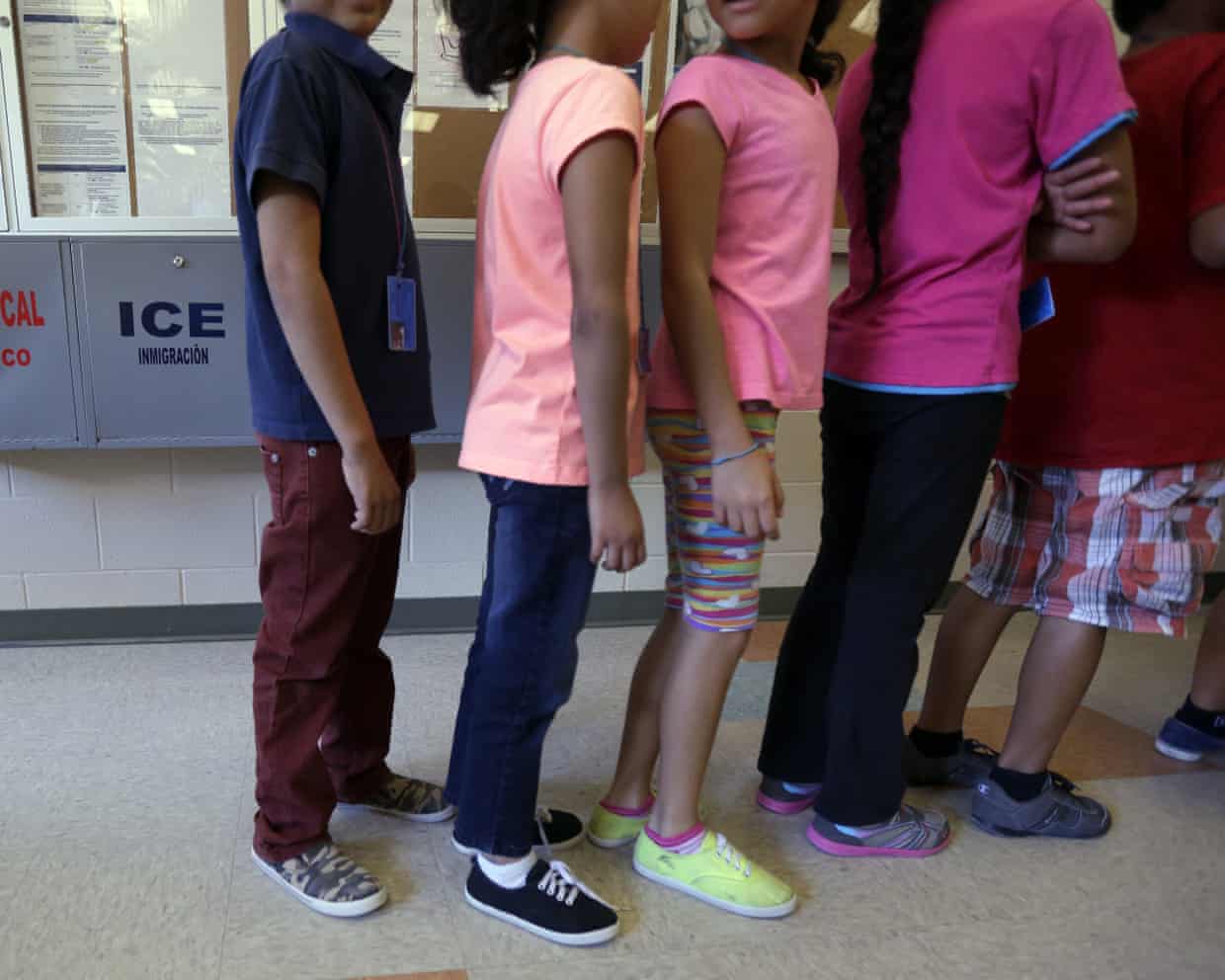
Detained children line up in the cafeteria at the Karnes County Residential Center in Karnes City, Texas, on 10 September 2014. Photograph: Eric Gay/AP
The Trump administration is trying to end a cornerstone immigration policy that requires the government to provide basic rights and protections to child immigrants in its custody.
The protections, which are drawn from a 1997 consent decree known as the Flores Settlement Agreement, limit the amount of time children can be detained by immigration officials. It also requires the government to provide children in its custody with adequate food, water and clean clothes.
The administration’s move to terminate the Flores agreement was long anticipated. In a court motion filed Thursday, the justice department argued that the Flores agreement should be “completely” terminated, claiming it has incentivized unauthorized border crossings and “prevented the federal government from effectively detaining and removing families”.
Donald Trump also tried to end these protections during his first term, making very similar arguments.
Ice arrests at immigration courts across the US stirring panic: ‘It’s terrifying’
Read more
The move to end protections follows a slew of actions by the Trump administration that target children, including restarting the practice of locking up children along with their parents in family detention. Immigration advocacy groups have alleged in a class-action lawsuit filed earlier this month that unaccompanied children are languishing in government facilities after the administration unveiled policies making it exceedingly difficult for family members in the US to take custody of them. The president and lawmakers have also sought to cut off unaccompanied children’s access to legal services and make it harder for families in detention to seek legal aid.
“Eviscerating the rudimentary protections that these children have is unconscionable,” said Mishan Wroe, senior attorney at the National Center for Youth Law. “At this very moment, babies and toddlers are being detained in family detention, and children all over the country are being detained and separated from their families unnecessarily.”
The effort to suspend the Flores agreement “bears the Trump administration’s hallmark disregard for the rule of law – and for the wellbeing of toddlers who have done no wrong”, said Faisal al-Juburi of the Texas-based legal non-profit Raices. “This administration would rather enrich private prison contractors with the $45bn earmarked for immigrant detention facilities in the House’s depraved spending bill than to uphold basic humanitarian protections for babies.”
The Trump administration in 2019 asked a judge to dissolve the Flores Settlement Agreement, but its motion was struck down. During the Biden administration, a federal judge agreed to partially lift oversight protections at the Department of Health and Human Services, but the agreement is still in place at the US Customs and Border Protection (CBP) and US Immigration and Customs Enforcement agencies.
“Children who seek refuge in our country should be met with open arms – not imprisonment, deprivation and abuse,” said Sergio Perez, executive director of the Center for Human Rights and Constitutional Law.
The settlement is named for Jenny Flores, a 15-year-old girl who fled civil war in El Salvador and was part of a class-action lawsuit alleging widespread mistreatment of children in custody in the 1980s.
Since the settlement agreement was reached in 1997, lawyers and advocates have successfully sued the government several times to end the mistreatment of immigrant children. In 2018, attorneys sued after discovering unaccompanied children had been administered psychotropic medication without informed consent.
In 2024, a court found that CBP had breached the agreement when it detained children and families at open-air detention sites at the US southern border without adequate access to sanitation, medical care, food, water or blankets. In some cases, children were forced to seek refuge in portable toilets from the searing heat and bitter cold.
Today I want to introduce you to a friend of mine from years ago, a community leader in Beirut Lebanon, a man named Kamal Mouzawak.
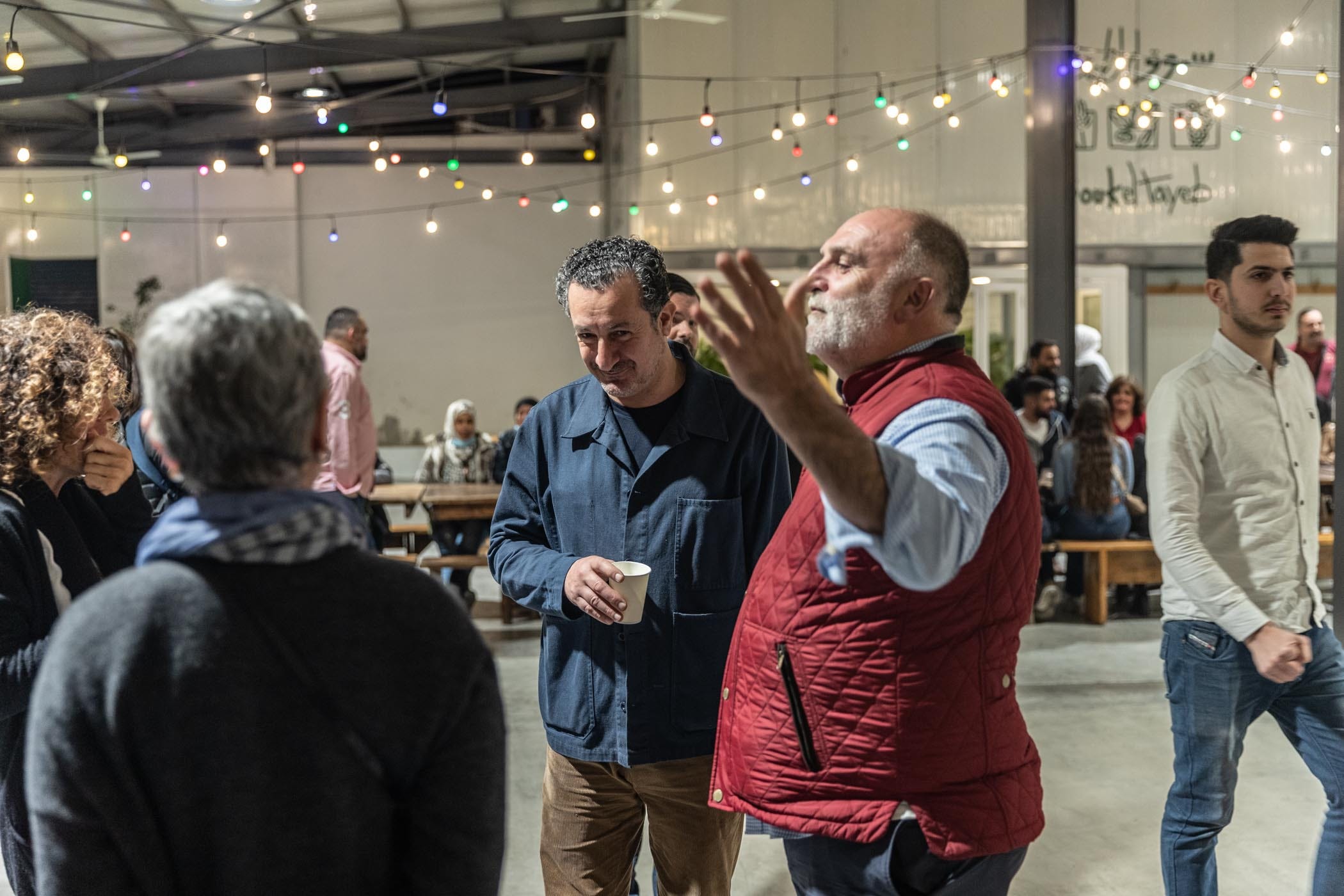
Kamal and me at Souk el Tayeb a couple of years ago (photo Thomas Schauer)
I’m proud to know Kamal and his team, and to have spent time with them after the horrific 2020 explosion that rocked Beirut and destroyed so many lives. The World Central Kitchen team, who arrived in Beirut to help with the recovered, joined up with Kamal’s team at Tawlet, a kitchen in the city serving foods from around Lebanon (more about that later), along with our mutual friend Aline Kamakian—a brilliant chef, food writer, and culinary advocate. Together, we worked to feed the people of Beirut who were the ones cleaning up the streets. It was a difficult time, but also an amazing one, to see the incredible efforts of Beirutis helping their neighbors get back on their feet, to clean up their neighborhoods, and to make sure they were all fed. (snip-a little video I can’t get a link or embed.)
Kamal has for many years been a leader in the community. In 2004 he started a farmers market in Beirut called Souk el Tayeb, working with farmers from around the rural areas of the country to reach the people of the city. From there his mission has expanded…well, why am I telling you, when I could let Kamal do it? My team had a moment to talk to him recently, since Kamal and Souk el Tayeb were the recipients of a grant from my Longer Tables Fund—specifically to support a new vision for the market, transforming it into a community space. I am so thrilled to be able to support my dear friend Kamal in his work to bring fresh produce to more of his community.
So friends, now I want to give the floor to the super thoughtful Kamal:
Longer Tables: First of all…what is Souk el Tayeb, and what is Tawlet?
Kamal: The whole story has been an evolution since the beginning, in 2004.
Souk el Tayeb is what we call a farmers’ market and Tawlet we call a farmers’ kitchen (“Souk el Tayeb” means “good market” and “tawlet” means “table” in Arabic). That naming is intentional, to stress the fact that this is not another store, and it’s not another restaurant. It’s not about selling vegetables. It’s not about cooking food and serving food in a restaurant or in whatever we want to call it. It’s about changing the world, making the world a better place.
And it was for people to understand is that food is not just a commodity that you buy on a supermarket shelf but something that someone planted, produced, cooked, transformed—and it’s an exchange between you and him or her through money, but the idea is Why not meet the producers of our food? It was a move for farmers to come from rural to urban in order to be where there’s a demand and purchasing power. It was about farmers coming to meet people who would buy their produce. (snip-MORE, and it’s really nice)
No, really, it is. The history of the Tenth Amendment explains [almost] everything happening in politics and government today.
But before I get to the [scintillating] topic of the Tenth Amendment, I have an announcement: Today is the birthday of Rebels, Robbers, and Radicals: The Story of the Bill of Rights.
(I have created birth announcements on publication day for every one of my books beginning with my firstborn novel in 2001.)
And now . . . all about the Tenth Amendment.
* * *
The Tenth Amendment consists of a single sentence:
The powers not delegated to the United States by the Constitution, nor prohibited by it to the States, are reserved to the States respectively, or to the people.
The Supreme Court has described the Tenth Amendment as stating a simple “truism”—“all power is retained which has not been surrendered.”
The problem with calling the Tenth Amendment a “truism” is that, since the start of the nation, there has been bitter disagreement over how much power has been retained by the states, and how much has been surrendered to the federal government. In fact, we fought a Civil War over that question. The Confederacy’s slogan “states’ rights!” was grounded in the Tenth Amendment.
* * *
The drafters of the Constitution debated whether to insert the word “explicitly” into the Tenth Amendment, so that it would read like this:
The powers not explicitly delegated to the United States by the Constitution, nor prohibited by it to the States, are reserved to the States respectively, or to the people.
The anti-Federalists (the party of Thomas Jefferson), wanted to insert the word “explicitly,” which they understood would sharply limit the power of the federal government. At one point during the early debates on the Constitution, Thomas Jefferson suggested that the federal government should consist of a committee. The Federalists (the party of George Washington and Alexander Hamilton), on the other hand, didn’t want to place such a limitation on federal power because they worried that a situation requiring a national response might arise that they could not foresee.
The Federalist won. The word “explicitly” was not included. Had the word “explicitly” been inserted, the United States most likely would have become a loose coalition of independently governed states sharing a Post Office, armed forces, and not much more.
* * *
Shortly after George Washington was elected president, he appointed Alexander Hamilton as secretary of the Treasury. This was a key post because the Revolutionary War left the nation almost bankrupt, and Hamilton understood commerce and finance. As a teenager in the Caribbean, he worked as a clerk in a trading company. After the Revolutionary War, he and a handful of other New Yorkers helped establish the Bank of New York, which allowed New York to grow into a hub of commerce and trade.
One of Hamilton’s first acts as secretary of the Treasury was to propose a plan that would allow the federal government to assume state debt. There was much resistance to the idea, even by the states that were heavily in debt from the Revolutionary War. Many saw this as a federal power grab because it gave the federal government powers not “delegated” and thus violated the Tenth Amendment.
Hamilton got his way. The federal government assumed state debt. He next proposed a national bank to help the United States prosper the way the Bank of New York helped New York prosper.
The resistance to Hamilton’s proposed national bank was fierce. At stake was the kind of nation the United States would become. Thomas Jefferson and the other anti-Federalists believed a national bank would turn the United States into another Great Britain, which at the time was a vast and powerful financial empire governed by a strong central government. Jefferson believed the way to liberty was for power to reside locally. For Jefferson, the point of the Revolutionary War was for Americans to free themselves from a faraway, out-of-touch, commerce-oriented government.
Slavery, of course, was the underlying issue. The economy of the South and the wealth of people like Thomas Jefferson was built on slave labor. They were afraid that if the federal government grew too powerful, it would end slavery.
It’s Really All About John Locke
To understand how Jefferson reconciled his demand for freedom as an unalienable right with his belief that local governments should decide whether to legalize slavery, we need some John Locke, who — like Thomas Jefferson — was full of contradictions. At the time of his death in 1704, Locke was the most famous philosopher in Europe. Thomas Jefferson took his ideas and much of his famous language from John Locke. The idea that it is a self-evident truth that we all possess unalienable rights is pure John Locke, as is the idea that, to prevent a tyrant, power should be divided between independent branches of government. To quote Steven B. Smith, a political science professor at Yale, “Locke’s writings seem to have been so completely adopted by Thomas Jefferson in the Declaration of Independence that Locke is often thought of as almost an honorary member of the American founding generation.”
Recall Thomas Hobbes’s theory about how government evolved: According to Hobbes, in the state of nature before government, there was violence and chaos. Government arose as a way to create order. For Hobbes, absolute monarchy is the best form of government because only a ruler with absolute power can maintain order. Government arises as a kind of social contract: People give up their freedom and submit to the rule of a king in exchange for protection and order.
John Locke offered a competing theory. In his view, in the state of nature before government, people lived in perfect freedom with unalienable rights. Moral law (or natural law) reigned supreme.
Among our inalienable rights, according to Locke, is the right to own property and a chief function of government is to protect private property rights, which, according to John Locke, derive from natural law. This immediately raises questions. In a state of nature without government, how do we know which property belongs to which person? Can I just claim the river for my own? Locke’s answer is that, “Our claim to property derives from our own work; the fact that we have expanded our labor on something gives us title to it. Labor is the source of all value.”
Okay, so I suppose this means that if a person in the state of nature gathers natural materials and uses their labor to make the material into a house, the person owns the house and has title to that property. But what if one person finds minerals in the earth and uses their labor to extract the minerals. Does the person then own the minerals? What about a forest? If I expend labor to cut down all the wood, does that mean I own it all? What about the servant who expends labor cleaning the master’s house. Does that servant now have claim to the master’s property? As Karl Marx later pointed out, the factory worker does not own the product of his own labor.
Liberty for John Locke was another unalienable right. Here is how Jefferson (and others) reconciled slavery with the belief that all people are born with an unalienable right to liberty: They believed it was part of natural law that Black people were inferior and best suited to laboring for others, which brings us to another problem with the entire idea. Different people will have different ideas of what is ‘moral.’ Locke’s answer is that rational people will all see things the same way, and irrational people are the ones we need government to protect us from.
See the problem? See how this leads to “Some people have unalienable rights and others do not.” It also leads to, “People who agree with me are rational. The purpose of government is to protect our freedom and property rights from those who are irrational.” This, combined with an ‘if I grab it first, I have title to it’ mentality, leads to the idea that one purpose of government is to protect the property rights of the wealthy.
Make no mistake — the idea of unalienable rights and checks on governmental power was a liberal idea and a step toward self-determination and dignity. My point is that the specifics of how this might be applied in the real world wasn’t very well thought out.
Another Lockean innovation is the movement away from feudalism — with its emphasis on a static social hierarchy — toward a market economy with opportunities for all. Locke said, “The world was created in order to be cultivated and improved” and “the world was given to the industrious.” He also believed that government should not stand in the way of industriousness, which you could say makes him the original free market capitalist. The problems here are the same: The idea that in the state of nature people lived happily in an unregulated market economy is fantasy.
Locke also says that people have the right to rebel against a tyrannical government, which raises even more questions. How do the people decide when rebellion is appropriate? What if people have different ideas about what is tyrannical? Wouldn’t this put us in an almost constant state of rebellion and civil war?
Locke’s ideas are naive, but, he did not have the benefit of modern neuroscience and modern psychology. He didn’t know what we know today about brain differences, and how these brain differences lead to personality differences. What is more important: Locke had never seen what actually happens in a world without positive law. Hindsight is always clearer.
And now . . . Back to the Story of the Tenth Amendment
Because George Washington and most members of Congress agreed with Hamilton about the need for a national bank, Hamilton got his way again. Hamilton’s bank did indeed allow the country to recover from years of war, but it remained controversial. Andrew Jackson, the country’s seventh president, dismantled the national bank because he believed it was unconstitutional under the Tenth Amendment. The national bank was reinstated in 1863 to help the North with the Civil War effort. In 1913, the Federal Reserve—the national bank we have today—was established. (In the end, Hamilton won.)
* * *
On December 20, 1860—less than two months after Lincoln was elected—South Carolina declared itself no longer part of the United States. The leaders of South Carolina ordered the U.S. Army to abandon its forts and military bases within South Carolina’s borders. The U.S. Army refused to budge. Within four months, the Civil War broke out. Mississippi, Florida, Alabama, Louisiana, Texas, and Georgia also seceded.
The leaders of the Confederate States of America argued that the Constitution says nothing about whether states have the power to secede or whether the federal government has the power to stop them. Under the Tenth Amendment, any powers not delegated to the federal government are retained by the states. Therefore, they argued that whether to remain part of the United States is up to the states.
Locke’s ideas thus underpinned some of the rationale of the Confederate States of America.
The Civil War ended after the South surrendered, but defeat on the battlefield did not persuade many of the Confederates that they were wrong as a matter of constitutional interpretation. Legal historian Cynthia Nicoletti suggested that the idea of “trial by battle” was inherently problematic. To this day, people believe self-governance means that states should be able to secede if their values cease to align with the nation.
* * *
In 1900, approximately two million children were working in mines, fields, and factories across the United States, often doing hard labor and performing dangerous jobs. As people became aware of the conditions children worked under, activist groups formed to address the problem. In 1908, a group called the National Child Labor Committee hired a photographer to visit fields, factories, and mines to report on child labor. More people became aware of the problem and pressured Congress to do something about it.
The Constitution gives Congress the power to regulate commerce between the states, so in 1916 — under the power of the commerce clause — Congress passed a law known as the Keating-Owen Child Labor Act, which sought to prevent child labor by banning the sale of any products that were produced by children under the age of fourteen, or by children between fourteen and sixteen who were forced to work more than eight hours per day.
The Supreme Court struck down the Keating-Owen Act as unconstitutional on the grounds that regulating how products were created was reserved by the Tenth Amendment to the states. Specifically, the Court said, “It was not intended as an authority to Congress to control the States in the exercise of their police power over local trade and manufacture, always existing and expressly reserved to them by the Tenth Amendment.”
The idea was that if states wanted to allow child labor, that was up to the states, and the federal government did not have the power to interfere. If people didn’t like it, they could refuse to buy products produced by child labor. Obviously, this was a poor solution. What would prevent the factories from exporting their goods to markets where people didn’t know the goods had been produced by child labor?
Some see the late 19th and early 20th century as a glorious time when industry and the economy boomed. There were almost no federal regulations. Business tycoons could do as they pleased. Tycoons — also called robber barons — grew wealthy. Income inequality widened. There was no minimum wage, no 40 hour workweek, no social security.
You might say that the business tycoons of the late 19th century lived in a state of nature without government. Did they follow natural law and behave rationally? Of course they didn’t. They cheated. Their wealth then gave them power. They monopolized huge industries through the formation of trusts, exploited workers, and engaged in unethical business practices. For example, a group of well-respected investors would agree to buy a lot of a particular company’s stock on a given day. Others would see what they did, assume the stock was valuable, and also buy it, pushing the price higher. When the price was artificially high, the speculators would sell their stock at a large profit. Soon the prices would fall again. The people who had been duped into buying when the price was artificially inflated would lose their money, and the people who duped them would grow wealthy.
Then in 1929 the market crashed, ushering in the Great Depression. Franklin D. Roosevelt believed that the solution to the nation’s financial woes, and the way to prevent future financial crises, was to regulate businesses and commerce to create fairness and protect investors. He ran for president in 1932 promising what he called a New Deal—a series of federal laws designed to get the United States out of the Depression, offer protections for workers, and regulate commerce to stop unfair business practices such as manipulating markets and fixing prices.
After Roosevelt was elected, he and Congress set to work to enact his New Deal.
During Roosevelt’s first several years in office, the Supreme Court repeatedly invalidated the New Deal legislation as unconstitutional under the Tenth Amendment. Then, in 1938, the Court did an about face and stopped invalidating New Deal legislation. Congress tried again to outlaw child labor and, in 1938, passed the Fair Labor Standards Act, which established among other things a minimum working age of sixteen, except in certain industries outside of mining and manufacturing. In a case called United States v. Darby, the Supreme Court held that the new labor laws were constitutional under Congress’s power to regulate commerce between the states. The Supreme Court thus overturned its previous 1918 case that had declared federal child labor laws unconstitutional.
Historians and scholars have offered various reasons for the Supreme Court’s sudden change of mind. It appears that the Court saw that Roosevelt and the New Deal were exceedingly popular and that Roosevelt was looking for ways to get around the Court, so the Court finally gave in.
The New Deal legislation created numerous federal regulatory agencies including the Securities and Exchange Commission, an independent federal agency designed to protect investors by regulating the sale of financial products such as stocks. Roosevelt signed into law the Public Utility Holding Company Act of 1935, which allowed the government to regulate utilities such as electricity and water to make sure those companies didn’t unfairly raise prices for people who depended on their services. Roosevelt’s 1935 Social Security Act offered a way for workers to pay into a pension so that they would have something to live on in their old age. The nation got a forty-hour workweek and worker protection laws.
Among the most far-reaching of Roosevelt’s programs was the G.I. Bill, formally known as the Servicemen’s Readjustment Act of 1944. It gave soldiers returning from duty the right to a government-paid college education, allowing ten million soldiers over a twelve-year period to attend college, thus helping lower-income families break out of poverty.
The New Deal had its critics. Right-wing activist Elizabeth Dilling denounced the New Deal as a piece of communism. One of the most famous journalists of the era, H.L. Mencken likened Roosevelt actions to a dictatorship. The New Deal critics not only despised the expansion of the federal government, they saw the New Deal as redistributing wealth, which — as they saw the situation — meant taking wealth from the people who expended their labor and were “industrious” and gave it to people who were not. This is the “makers and the takers” argument. The makers, of course, are business owners. Takers are those who accept government assistance.
Indeed, if your view is that, in the natural state, people lived free and happy, and government regulations infringe on liberty (which they do) you will despise the New Deal. You will hate agencies such as the CDC or the FDA. You will resent vaccine mandates because they infringe on your “liberty.” (You won’t consider the liberty of others not to be infected in public places and schools, because Locke’s idea that “each person is free” and the purpose of government is to protect our personal liberty was appealing, but not well thought out. One person’s “freedom” will often infringe on another’s.)
Roosevelt’s New Deal dramatically increased the size and complexity of the federal government and marked the beginning of what has been called the federal administrative state—a vast network of federal departments and regulatory agencies that has grown steadily since Roosevelt’s time.
* * *
While Roosevelt’s legislation helped create America’s first true middle class, the new suburbs were mostly white because of racial segregation. Among other things, legalized segregation meant that Black Americans found it difficult to get loans from banks, making it impossible for them to buy houses. Some sellers simply refused to sell them homes. Some neighborhoods made it clear that Black people were unwelcome.
Then, in 1954, the Supreme Court sent shock waves through the American South when it declared racial segregation unconstitutional. There was massive resistance on the grounds that the federal government, in telling people how they must live, was overreaching its authority.
A decade later, President Lyndon B. Johnson signed into law three key pieces of legislation: the Civil Rights Act of 1964, the Civil Rights Act of 1965, and the Voting Rights Act of 1965. This legislation further enlarged the size and power of the federal government because they gave the federal government the task of ensuring that all Americans were offered the opportunity to participate in civil and public life. Racial discrimination continued, but it was now illegal, so people who were wronged could bring their cases to federal court.
Those opposed to these new laws argued that the federal government overstepped its authority under the Tenth Amendment. In fact, when the Supreme Court invalidated part of the Voting Rights Act decades later, it did so by finding that the required procedures violated the Tenth Amendment.
The Republican Party’s opposition to the New Deal solidified in the 1930s. During the decades since, the opposition to the New Deal has been steadily gaining power. And here we are. A president — backed by Congress — working to roll back the authority of regulatory agencies.
Most of this material is from Chapter 10 of my new book, Rebels, Robbers, and Radicals.
And now a moment of reflection on my latest book’s birthday: After so many books (and several decades of writing) I understand that writing books is my way to leave my footprint on the earth. My contribution: Books that go to schools and libraries.
(Not that I am going anywhere. I intend to live forever. But occasionally I suppose we all think about mortality.)