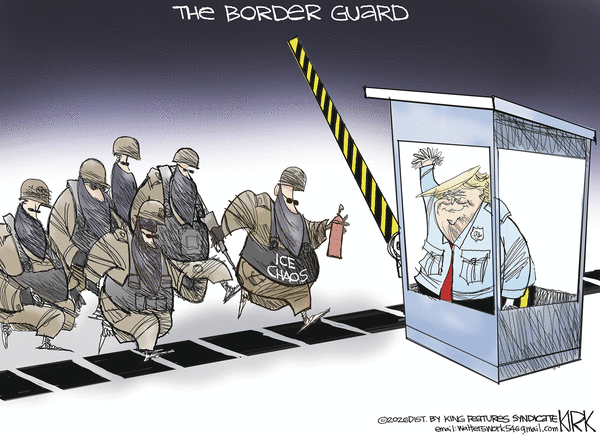
In the video below we learn that ICE is now disappearing people. Simply taking them and not documenting where they are taken or what happened to them. Families missing loved ones simply can’t find them in the ICE system anywhere. Hugs
The public doesn’t like the lawless gang thugs actions of racist Christian nationalist ICE and is demanding action from their elected representatives, many of whom are either racists or Christian nationalists themselves, to act to stop the actions of illegal assault ICE is making on the civil rights of the US public. We can see both the right and the left elected members don’t really want to and I can only think it is something to do with big money donors, many of whom are highly racist and make a great profit off the situation we have currently. Hugs
As Democrats across the country propose state law changes to restrict federal immigration officers after the shooting death of a protester in Minneapolis, Tennessee Republicans introduced a package of bills Thursday backed by the White House that would enlist the full force of the state to support President Donald Trump’s immigration crackdown.
Democratic Gov. Kathy Hochul wants New York to allow people to sue federal officers alleging violations of their constitutional rights. Another measure aims to keep immigration officers lacking judicial warrants out of schools, hospitals and houses of worship.
Oregon Democrats plan to introduce a bill to allow residents to sue federal officers for violating their Fourth Amendment rights against unlawful search and seizure.
New Jersey’s Democrat-led Legislature passed three bills Monday that immigrant rights groups have long pushed for, including a measure prohibiting state law enforcement officers from cooperating with federal immigration enforcement. Democratic Gov. Phil Murphy has until his last day in office Tuesday to sign or veto them.
California lawmakers are proposing to ban local and state law enforcement from taking second jobs with the Department of Homeland Security and make it a violation of state law when ICE officers make “indiscriminate” arrests around court appearances. Other measures are pending.
“Where you have government actions with no accountability, that is not true democracy,” Democratic state Sen. Scott Wiener of San Francisco said at a news conference.
State Sen. Scott Wiener speaks during the San Francisco Congressional District 11 candidate forum in San Francisco on Wednesday, Jan. 7, 2026. (Scott Strazzante/San Francisco Chronicle via AP)
Democrats also push bills in red states
Democrats in Georgia introduced four Senate bills designed to limit immigration enforcement — a package unlikely to become law because Georgia’s conservative upper chamber is led by Lt. Gov. Burt Jones, a close Trump ally. Democrats said it is still important to take a stand.
“Donald Trump has unleashed brutal aggression on our families and our communities across our country,” said state Sen. Sheikh Rahman, an immigrant from Bangladesh whose district in suburban Atlanta’s Gwinnett County is home to many immigrants.
Democrats in New Hampshire have proposed numerous measures seeking to limit federal immigration enforcement, but the state’s Republican majorities passed a new law taking effect this month that bans “sanctuary cities.”
Georgia state Sen. Sheikh Rahman, D-Lawrenceville, speaks during a news conference at the Georgia State Capitol in Atlanta, Tuesday, Jan. 13, 2026. (Matthew Pearson/WABE via AP)
Tennessee GOP works with White House on a response
The bills Tennessee Republicans are introducing appear to require government agencies to check the legal status of all residents before they can obtain public benefits; secure licenses for teaching, nursing and other professions; and get driver’s licenses or register their cars.
They also would include verifying K-12 students’ legal status, which appears to conflict with a U.S. Supreme Court precedent. And they propose criminalizing illegal entry as a misdemeanor, a measure similar to several other states’ requirements, some of which are blocked in court.
“We’re going to do what we can to make sure that if you’re here illegally, we will have the data, we’ll have the transparency, and we’re not spending taxpayer dollars on you unless you’re in jail,” House Speaker Cameron Sexton said at a news conference Thursday.
Trump administration sues to stop laws
The Trump administration has opposed any effort to blunt ICE, including suing local governments whose “sanctuary” policies limit police interactions with federal officers.
Federal immigration officers confront protesters outside Bishop Henry Whipple Federal Building, Thursday, Jan. 15, 2026, in Minneapolis. (AP Photo/Adam Gray)
States have broad power to regulate within their borders unless the U.S. Constitution bars it, but many of these laws raise novel issues that courts will have to sort out, said Harrison Stark, senior counsel with the State Democracy Research Initiative at the University of Wisconsin Law School.
“There’s not a super clear, concrete legal answer to a lot of these questions,” he said. “It’s almost guaranteed there will be federal litigation over a lot of these policies.”
That is already happening.
California in September was the first to ban most law enforcement officers, including federal immigration officers, from covering their faces on duty. The Justice Department said its officers won’t comply and sued California, arguing that the laws threaten the safety of officers who are facing “unprecedented” harassment, doxing and violence.
The Justice Department also sued Illinois last month, challenging a law that bars federal civil arrests near courthouses, protects medical records and regulates how universities and day care centers manage information about immigration status. The Justice Department claims the law is unconstitutional and threatens federal officers’ safety.
Targeted states push back
Minnesota and Illinois, joined by their largest cities, sued the Trump administration this week. Minneapolis and Minnesota accuse the Republican administration of violating free speech rights by punishing a progressive state that favors Democrats and welcomes immigrants. Illinois and Chicago claim “Operation Midway Blitz” made residents afraid to leave their homes.
Homeland Security spokesperson Tricia McLaughlin accused Minnesota officials of ignoring public safety and called the Illinois lawsuit “baseless.”
___
Bauer reported from Madison, Wisconsin. Associated Press writers John O’Connor in Springfield, Illinois; Sophie Austin in Sacramento, California; Mike Catalini in Trenton, New Jersey; Anthony Izaguirre in Albany, New York; Claire Rush in Portland, Oregon; and Jeff Amy in Atlanta contributed.
There is a video at the link below. But when the law breaks the law is there a rule of law? In nearly 100 court cases ICE just ignores the rulings against them. But nothing changes, no contempt. Do you think you could just ignore the orders of a court? But ICE and DHS / tRump admin have been doing this since they were told during the Cecot issue to just say fuck you to the courts. Total dictatorship authoritarian rule. The only recourse the people have is the US court system and the republican right along with Stephen Miller say to their thugs, Ignore court rulings you don’t like as they restrict your the civilian’s personal civil rights / liberties. Hugs
In a court order, Judge Patrick Schiltz wrote that 96 court orders were violated in 74 cases.
MINNEAPOLIS — In a court order, Minnesota’s chief judge wrote that the U.S. Immigration and Customs Enforcement (ICE) has violated nearly 100 court orders this month.
“The extent of ICE’s noncompliance is almost certainly substantially understated, ” the order reads. “This list is confined to orders issued since January 1, 2026, and the list was hurriedly compiled by extraordinarily busy judges. Undoubtedly, mistakes were made, and orders that should have appeared on this list were omitted.”
Lyons was scheduled to appear in court to face contempt charges after he failed to provide a bond hearing for a man who was detained. Schiltz, who was appointed by George W. Bush in 2006, ordered Lyons to testify unless the man was released. The man was released late Tuesday, and the hearing was canceled.
Schiltz wrote, however, that it didn’t end the court’s concerns.
“This list should give pause to anyone—no matter his or her political beliefs—who cares about the rule of law,” Schiltz’s order reads. “ICE has likely violated more court orders in January 2026 than some federal agencies have violated in their entire existence.”
He continued: “The Court warns ICE that future noncompliance with court orders may result in future show‐cause orders requiring the personal appearances of Lyons or other government officials. ICE is not a law unto itself. ICE has every right to challenge the orders of this Court, but, like any litigant, ICE must follow those orders unless and until they are overturned or vacated.”
I am reading / hearing clips of a lot of pushback, especially in sports media that ICE is not going after the worst of the worst and instead is going after only hardcore murderers, rapists, predators, or other violent criminals. These people reject any mention or idea that ICE is targeting people who came here legally or have asylum, or even that they are detaining children. They simply watch only their right wing media bubble which lies to them or they are paid / make their clicks supporting the right wing talking points. So I post this with the question what crime did this child do against others? Because we can see the crime being committed against him. There is a video at the link below. Hugs
Ramos’ mother addressed his deteriorating health earlier this week: “Liam is getting sick because the food they receive is not of good quality,” she told MPR News on Monday. “He has stomach pain, he’s vomiting, he has a fever and he no longer wants to eat.”
Liam Conejo Ramos, the pre-school student who ICE agents in Minneapolis nabbed last week and shipped off to a Texas detention facility with his dad, is in poor health now, according to his school’s superintendent.
Zena Stenvik, the superintendent for Ramos’ Columbia Heights public school district, told HuffPost that she spoke to the 5-year-old’s mother on Tuesday.
“Unfortunately, Liam’s health is not doing great right now,” said Stenvik. “He’s been ill. I’ve been told he has a fever. So I’m very, very concerned about his well-being in that facility.”
His mother is also “incredibly distraught,” she said.
Ramos’ mother addressed his deteriorating health earlier this week: “Liam is getting sick because the food they receive is not of good quality,” she told MPR News on Monday. “He has stomach pain, he’s vomiting, he has a fever and he no longer wants to eat.”
Marc Prokosch, the family’s attorney, did not immediately respond to a request for comment.
Ramos and his father, Adrian Alexander Conejo Arias, are being held at the South Texas Family Residential Center in Dilley, Texas. This is despite Arias entering the country legally and having no criminal record, according to Prokosch. Late Tuesday, a federal judge temporarily blocked federal immigration officials from deporting Ramos and Arias, for now.
The conditions at the Texas facility where Ramos is being held are “absolutely abysmal,” according to attorney Eric Lee, who represents other families being held there.
“They mix baby formula with water that is putrid. The food has bugs in it. The guards are often verbally abusive,” Lee told Minnesota Public Radio on Monday. “One of my clients had appendicitis, collapsed in the hallway, was vomiting from pain, and the officials told him, ‘Take a Tylenol and come back in three days.’”
Five-year-old Liam Conejo Ramos was detained Jan. 20, 2026 in a suburb of Minneapolis.
Columbia Heights Public Schools
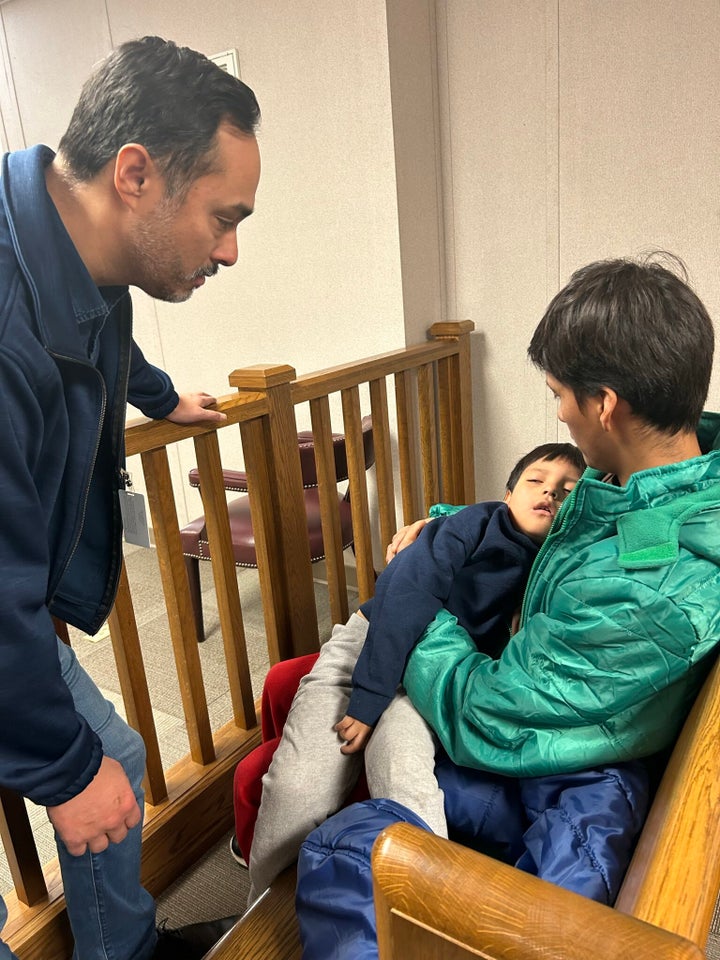
Reps. Joaquin Castro (D-Texas) visited the Texas ICE facility on Wednesday to meet with children and families being held there, including Ramos and his dad.
He posted a photo on social media after meeting with them. It shows Ramos either sleeping or lying weakly in his father’s arms, as Castro stands with them:
Rep. Joaquin Castro (D-Texas) visits Liam Conejo Ramos and his father in a Texas detention center, a week after ICE agents detained them outside their home in Minneapolis.
Congressman Joaquin Castro
“Just visited with Liam and his father at Dilley detention center,” Castro wrote. “I demanded his release and told him how much his family, his school, and our country loves him and is praying for him.”
In a separate video, the Texas Democrat said he spent 30 minutes with Ramos and his dad. He said the 5-year-old “wasn’t in any kind of emergency or anything, physically,” but that he shared the photo of them together so people could see the state he’s in.
“His dad said he hasn’t been himself and he’s been sleeping a lot, because he’s been depressed and sad,” said Castro. “Liam actually was not awake during our visit.”
Senate Minority Leader Chuck Schumer (D-N.Y.) on Wednesday laid out his party’s demands for voting for Homeland Security funding: End roving patrols by Immigration and Customs Enforcement (ICE); tighten rules governing use of warrants by officers targeting migrants; establish a universal code of conduct governing federal law enforcement officers’ use of force; prohibit federal officers from wearing masks; and require officers to wear body cameras and proper identification.
Yes lower court judges are on the side of the public and the laws but the appellate courts have been stacked with conservative hacks and they overrule the lower courts. Then you have the SCOTUS which has been bought by the wealthiest republicans in the country. Hugs
Well I had hoped to hear from Schumer but at least he is demanding the reforms be in writing. He is getting a lot of pressure to do something this time. But he wanted to end the last shut down with a loss because he was afraid the republicans would destroy the filibuster. He settled for a vote that meant nothing and was totally performative. Will he do the same here? Hugs
Well at least he can articulate the points that need to be made in a strong manner. I liked him better clean shaven. My view on a beard is either grow one big, bushy, and long or don’t grow it. Scruffy is a sad look I think and reminds me of teenagers getting their first facial hairs. I wonder what political job he will run for next. I think Senate, or governor. Hugs
Daily Kos Staff Emeritus (This content is not subject to review by Daily Kos staff prior to publication.)
Wednesday, January 14, 2026 at 2:03:31p EST
Courts provide extraordinary protection to the police. Courts provide extraordinary protection to agents of the federal government. Is it still possible to prosecute ICE agents for assault and murder?
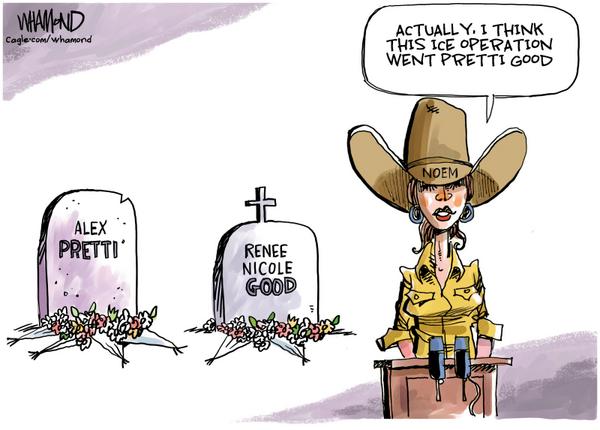
For anyone who has watched the many videos showing ICE agent Jonathan Ross shooting and killing Minnesota mom Renee Nicole Good, the conclusion is obvious: This is murder.
Under ordinary circumstances, the Department of Justice would be investigating this incident, and Ross would be suspended awaiting the outcome of that investigation. But we are nowhere near ordinary circumstances. Instead, Department of Homeland Security Secretary Kristi Noem has labeled Good a “domestic terrorist” and blessed Ross’s shooting without bothering to conduct any review, talk to any witnesses, or apparently watch any of the videos clearly showing that Ross was never under any conceivable threat.
Both Donald Trump and J.D. Vance have issued statements that are completely at odds with what happened on January 7. Noem has also stated that Ross “followed his training protocol” and was justified in his actions.
As far as the White House is concerned, Good is a dead terrorist and Ross is a hero. Fortunately, Noem and Trump don’t have the final say on who gets prosecuted.
Good’s tragedy—a young mother killed for no reason after dropping off her 6-year-old at school—is not a solitary event. Since Trump reentered the White House and began his immigrant pogrom, ICE agents have fired their weapons at civilians at least 16 times. As The Trace notes:
Renee Good was one of four people who have been killed. Another seven people have been injured.
At least 15 other civilians have been held at gunpoint. In addition, ICE has routinely brutalized both protestors and bystanders. That includes incidents such as shooting a priest in the head with pepper balls and teargassing infants.
Every day, ICE agents seem determined to show that they sincerely believe American citizens have no recourse but to submit to their abuse.
What’s most disheartening about all this is that so far … ICE is right. While several agents have been arrested for off-duty crimes, abusive behavior and deadly force have earned only praise from Trump, Noem, Vance, and other Republicans. Attorney General Pam Bondi has taken up none of these cases for review, and Trump has made it clear that he expects Americans to surrender their First Amendment rights … or else.
Q: "Do you believe that deadly force was necessary?"Trump: "It was highly disrespectful of law enforcement. The woman and her friend were highly disrespectful of law enforcement…Law enforcement should not be in a position where they have to put up with this stuff."
But if no one in the Justice Department will stand up for the Constitution—and they won’t—what’s left? Can state and local officials bring a rogue agency to heel?
Minnesota Attorney General Keith Ellison and Hennepin County Attorney Mary Moriarty have announced that they are investigating Good’s death. This is being made much more difficult because the FBI has taken apparently unprecedented action to block access to any evidence collected by federal officers.
Moriarty is soliciting additional videos and statements from witnesses. Ross or other ICE agents do not appear to have been made available to speak to state or county officials. How likely is it that charges will be leveled against Ross, or any of the other ICE agents involved in incidents of deadly force, assault, and abuse? What are the odds of any of them being convicted?
This is seriously difficult to determine.
First, there’s the question of whether or not an ICE agent involved in an immigration raid qualifies as a “peace officer.” It may seem like an obvious question, but relevant case law is pretty thin on the ground. ICE agents are federal officers, but the Venn diagram of their authority doesn’t cover the general enforcement powers of FBI agents or federal marshals. Their training is on immigration enforcement, and doesn’t include general public safety or community policing. They are not agents under the Department of Justice, but facilitators under DHS.
As an employee of ICE, Ross’s role is limited to carrying out immigration arrests. He’s certainly not empowered to stop or arrest people for partially blocking a street for a few minutes. The whole initial basis of the encounter is unjustifiable.
Best guess? No. ICE agents are not “peace officers,” no matter how many times they stencil “POLICE” on their vests. However, in any case against Ross or another ICE agent, the “peace officer” status is likely to draw a fresh review from the courts. That question will get definitively resolved, but probably only after working its way to the Supreme Court.
Even assuming that Ross is a peace officer under Minnesota state law, that doesn’t cut off the chance of prosecution.
In general, to bring charges against any law enforcement officer for using deadly force, the State has to show that the officer’s use of force was not justified. Justification can include any circumstance where the officer is under threat, or others may be under threat without immediate action. This alone is an enormous hurdle, because courts have repeatedly ruled that this doesn’t just protect officers who were genuinely under threat, but also those who felt threatened.
However, in a rare instance of the current Supreme Court not making things worse, last year’s Barnes v. Felix ruling tossed a decision from the hyper-conservative Fifth District. This ruling restricted the circumstances in which an officer can apply deadly force—or, at least, kept those circumstances from ballooning absurdly.
The description of the case by the Cato Institute makes it clear why Barnes may be very relevant to Good’s shooting.
In 2016, Ashtian Barnes was killed by Harris County, Texas, Deputy Constable Roberto Felix, following a traffic stop for unpaid tolls. As Barnes apparently tried to drive away, Felix jumped onto the moving car and indiscriminately opened fire, killing Barnes instantly.
The Fifth Circuit cleared Felix’s actions, writing that in the “moment of threat,” the officer was clearly in danger and was justified in shooting Barnes. However, the Supreme Court reversed that ruling.
Last spring, the Supreme Court unanimously held that a full review of the “totality of the circumstances,” including the nature of the offense and the events leading up to the incident, is relevant to determining the reasonableness of force.
In Barnes, the initial charges were barely sufficient to warrant a traffic stop in the first place, and Felix was under no threat until he placed himself in peril by grabbing onto Barnes’ car. He may have been frightened in the moment, and for the Fifth Circuit, that was enough, but in the totality of circumstances, it’s not enough.
That “totality of circumstances” requirement also happens to align with Minnesota law.
The circumstances in Barnes seem to almost perfectly overlap with what happened with Renee Good. As multiple videos have shown, Good’s car had only partially obstructed a residential street for a handful of minutes. Other vehicles were still getting by. She was already in the process of moving completely out of the way when Ross and other ICE agents approached the car, and would have been gone had she not stopped to wave another vehicle to pull around her. Her last exchange with Ross was, at worst, snarky, but non-confrontational and contained no threats.
It’s hard to believe that an actual police officer, authorized to deal with traffic situations, would have retained Good.
Assuming Ross was in front of her vehicle at all, he was only there because he violated DHS procedures by placing himself in front of the vehicle after Good was already attempting to leave the area. Good was traveling at low speed, was turned away from Ross and other officers, and had barely begun to move when Ross opened fire.
Good’s offense, if any, was minor. The threat against Ross, if any, was of his own making. The totality of circumstances in this case is not in Ross’s favor. That’s especially true of additional shots he fired at Good from beside or behind the vehicle. There are no reasonable grounds for these shots.
Hennepin County police, like those in many other jurisdictions, are actually forbidden from shooting into a moving vehicle in any circumstance. under the very reasonable understanding that a vehicle in motion doesn’t automatically stop if the driver is dead. The DHS issues these same guidelines to its agents.
This doesn’t mean that a Grand Jury might not still determine that Ross had a reason for his action. The number of cases in which officers have walked away from the use of deadly force seems almost limitless.
Another potential complication comes from the discovery that this is not the first time Ross has been involved in an incident with a car. Federal court records show that last June, Ross approached a car driven by a Guatemalan man, Roberto Carlos Muñoz, and attempted to apprehend him.
According to court testimony, Ross arrived in an unmarked vehicle, approached Muñoz, and ordered him to exit his car. When Muñoz didn’t respond, Ross punched through the side window and attempted to wrest control of the car. Muñoz responded by hitting the gas. As NBC News reported, Ross claimed to have used a taser in an attempt to stop Muñoz.
“I was yelling at him to stop,” Ross testified of Robert Muñoz-Guatemala, who was found guilty last month of assault on a federal officer with a dangerous or deadly weapon. “Over and over and over again at the top of my lungs.”
Ross said in his testimony that he feared for his life and fired his Taser repeatedly at Muñoz-Guatemala.
“It didn’t appear that it affected him at all,” Ross said.
“That very ICE officer nearly had his life ended, dragged by a car six months ago with 30 stitches in his leg, so he’s a little sensitive about being rammed by an automobile,” Vance said at the White House on Jan. 8.
However, what this testimony actually shows is that Ross already had a history of dealing poorly with people inside vehicles and of violating DHS guidelines. He either didn’t know how to properly and safely deal with such a situation or deliberately ignored the rules. If he was truthful in his claim that he attempted to use a taser in the earlier incident, this also shows an agent primed to skip over any attempt at non-lethal force and go straight for his gun.
Videos show that Ross pulled his gun before Good had begun to move forward, and fired even as he was still holding up his phone in his other hand. This could indicate that he was traumatized, or simply infuriated, by the earlier incident. In effect, he was primed to kill Good as retribution for the perceived wrong he had suffered from Muñoz.
In addition to murder, there are additional charges that could be levied against both Ross and other ICE agents on the scene—and these charges apply equally to peace officers and civilians.
Videos show that ICE agents refused to allow a doctor who was on the scene to approach the vehicle and blocked ambulance access to the area. Both of these are felony violations of Minnesota law with penalties up to five years imprisonment. If Good’s death was found to be connected to the delay of treatment, all involved could face additional charges of manslaughter.
However, there’s still one more hill to climb before charging Ross, and it’s a steep one.
Whether or not Ross is a peace officer, he certainly is a federal agent. Vance and others have claimed this gives him “absolute immunity” from state prosecution.
This is, in legal terms, utter bullshit.
Federal officers are broadly immune from state prosecution for taking actions specifically authorized by federal law in a case that goes back to an 1890 incident in which a federal agent shot a man who was threatening a member of the Supreme Court.
Neagle established a two-prong test for this type of immunity from state criminal law: (1) Was the officer performing an act that federal law authorized him to perform? (2) Were his actions necessary and proper to fulfilling his federal duties? If the federal officer satisfies this test, he or she is immune from prosecution for violation of state law.
The DOJ would certainly argue that Ross was acting to perform his duties as an ICE agent. Any State prosecution would need to show that Ross’s actions were excessive or unjustified.
This could be much harder than getting past the leeway given to police use of deadly force. Like the question of whether or not an ICE agent is a peace officer, there are few recent cases to reference, especially when it comes to an agent who was on duty. In short, States simply haven’t done much to test the immunity of federal officers, even when those officers have performed unnecessary acts of violence.
The murder of Good was clearly not required to enable the immigration enforcement actions of the ICE officers. That doesn’t mean a judge, jury, or federal court might not see a way to grant Ross his magic get-out-of-everything card.
Is Ross a peace officer? Probably not. Was this a justified shooting? No. Can he be prosecuted? Yes.
Will those charges survive federal challenges? Let’s find out.




















































 Georgia state Sen. Sheikh Rahman, D-Lawrenceville, speaks during a news conference at the Georgia State Capitol in Atlanta, Tuesday, Jan. 13, 2026. (Matthew Pearson/WABE via AP)






 Scottie's Playtime