This is why the administration is blocking legal oversight and demanding illegally to have three days prior warning for inspections. They are keeping these kidnapped victims in horrific conditions to force them to agree to deportation. The facility in Florida a former worker admitted that and said it worked.
“Under such conditions, some of those arrested are pressured into accepting voluntary departure,” the lawsuit stated.
——————————————————————————————————————
Dakota Smith
5 min read
Rep. Jimmy Gomez (D-Los Angeles) stands outside the Edward R. Roybal Federal Building downtown earlier this summer. On Monday, he was allowed to enter the ICE processing facility in the basement. (Carlin Stiehl / Los Angeles Times)
More
For two months, several Democratic members of Congress have been unable to enter a downtown L.A. processing center run by U.S. Immigration and Customs Enforcement, prompting widespread complaints and a federal lawsuit.
On Monday, the Congress members got their first look at the basement facility known as B-18.
But Reps. Brad Sherman, Judy Chu and Jimmy Gomez said that they were left with more questions than answers — and accused the government of sanitizing the center.
Advertisement
“They wanted to show us nothing,” said Gomez, whose district includes downtown L.A. “It was nothing, it was like no one was there. It was deliberate so members of Congress cannot conduct oversight.”
Scores of migrants, as well as some U.S. citizens, have been taken from Home Depot parking lots, car washes and other locations by masked and heavily armed agents and brought to B-18 since early June. Some detainees have complained of overcrowding and being held for multiple days.
The facility can hold up to 335 migrants, but there were just two people in one of the holding rooms Monday, the members said at a news conference in downtown L.A. after their visit.
The group’s previously scheduled visit was canceled by ICE. Monday’s visit took days of planning and advance notice, according to the politicians.
They described a sparse scene inside B-18, with nine holding rooms, each with two toilets.
Chu, whose district includes Monterey Park, described the floors as concrete and said that there were no beds. She said ICE detainees are supposed to be held at the facility for only 72 hours, but she has heard stories of people kept there for 12 days.
Some detainees have reported receiving one meal a day, she said. On Monday, she visited the food pantry at B-18, which Chu described as “scanty.”
Advertisement
“I am deeply disturbed by what I saw and what I heard,” Chu said.
Chu also said she has been told that detainees have no soap or toothbrushes.
“It’s alarming that it’s taken so long for congressional members to gain access to this site,” said Sergio Perez, executive director of the Center for Human Rights and Constitutional Law, a nonprofit that seeks to protect the rights of immigrants.
Perez was able to visit Narciso Barranco, a Mexican national whose three sons are U.S. Marines, in June. Perez said he saw Barranco after he’d been held at the facility for three days. Perez said Barranco, who was punched and pepper-sprayed during his arrest, did not receive medical attention.
Advertisement
The Department of Homeland Security shared video of his arrest on social media and said Barranco attacked an agent with his gardening tool.
Barranco told Perez that each of the rooms held 30 to 70 people at the time and that some had to sleep standing up, Perez said. Food was scarce and they didn’t have access to showers.
The ICE facility was designed as a processing center, not a detention facility, Perez said.
Department of Homeland Security Assistant Secretary Tricia McLaughlin denied that individuals don’t receive medical care. She also disputed Chu’s suggestion that an individual was held at the facility for 12 days.
Advertisement
Addressing the politicians’ other complaints about B-18, McLaughlin wrote, “Now, politicians are complaining about ICE processing facilities being TOO CLEAN.”
McLaughlin said that claims of poor conditions at ICE facilities are false and that the agency “has higher detention standards than most U.S. prisons that hold actual U.S. citizens.”
“Ensuring the safety, security, and well-being of individuals in our custody is a top priority at ICE,” she said.
Sherman, who represents parts of the San Fernando Valley and Pacific Palisades, said that one of the two detainees at B-18 on Monday rested with his head on a table.
Advertisement
Sherman said he “illegally” took a picture during his visit and that he shouted out to several people being brought into the facility for processing, asking them whether they were U.S. citizens or green card holders. No one replied, he said.
Sherman, Chu, Gomez and Rep. Maxine Waters (D-Los Angeles), who joined the group after their visit, criticized the ongoing immigration enforcement, and in particular the use of masked, roving agents.
A federal judge last month temporarily barred the government from mass sweeps in Los Angeles and seven nearby counties without first establishing reasonable suspicion that the targets are in the U.S. illegally.
The American Civil Liberties Union of Southern California, which sued the federal government over the sweeps, described B-18 as “dungeon-like” and accused the administration of failing to “provide basic necessities like food, water, adequate hygiene facilities, and medical care.” Detainees were allegedly subjected to overcrowding and did not have adequate sleeping accommodations.
Advertisement
“Under such conditions, some of those arrested are pressured into accepting voluntary departure,” the lawsuit stated.
On Monday, Chu said that she asked ICE representatives during the tour why people were jumping out of vans with masks, and no identification.
She said the representatives replied, “That’s not us, and we go in if there’s probable cause, if there’s a warrant out there.”
Gomez, who has been repeatedly turned away from entering the B-18 facility since the crackdown started this year, is part of a group of Democratic House members suing the federal government over the lack of access.
Advertisement
The lawsuit, filed last month in U.S. District Court in Washington, said the individuals attempted to visit a detention facility, either by showing up in person or by giving Homeland Security Department officials advance notice, and were unlawfully blocked from entering.
ICE recently published new guidelines for members of Congress and their staff, requesting at least 72 hours’ notice from lawmakers and requiring at least 24 hours’ notice from staff before an oversight visit.
Times staff writer Andrea Castillo contributed to this report.
At an elementary school in Washington, D.C., the speaker at the podium wanted to talk about children’s health and the impact of childhood obesity.
“Our generation is facing so many devastating health problems because of how we live and how we eat — illnesses like diabetes and heart disease and cancer — that cause so much suffering and cost our economy billions,” the speaker said. “And today, we need to ask ourselves: Are we going to hand down these problems to our next generation? Or are we going to do what we’ve always done in this country and leave something better for our children and our grandchildren?”
Someone could mistake these words as being spoken in 2025 by a Trump administration official advocating to “Make America Healthy Again” — the catch-all agenda that has zeroed in on kids’ health and in particular, chronic disease and childhood obesity.
Obama was promoting “Let’s Move!,” her initiative aimed at improving children’s nutrition at home and school and encouraging them to exercise more. The initiative is credited with making improvements to school lunch standards, creating more transparency in food labeling and bringing more awareness to childhood obesity.
But the first lady drew widespread partisan backlash for her efforts, as right-wing media personalities and Republicans vehemently criticized related regulation as government overreach. They have been more muted as the Trump administration, led in part by Health and Human Services Secretary Robert F. Kennedy Jr., now adopts similar messaging about children’s health.
“I do think that there’s a double standard going on, especially with RFK Jr.,” said Sydney Carr-Glenn, a political science professor at the College of the Holy Cross in Massachusetts who studies the intersectionality of race and gender for Black women in politics, including in the media. “People seem to be a little bit more accepting or a little bit more on board with this whole ‘Make America Healthy Again’ initiative.”
Last month, President Donald Trump announced he would revive the presidential fitness test, a once ubiquitous staple of school gym class. Just a few years ago, Let’s Move! offered programming to educators to encourage physical activity at school for at least 60 minutes each day.
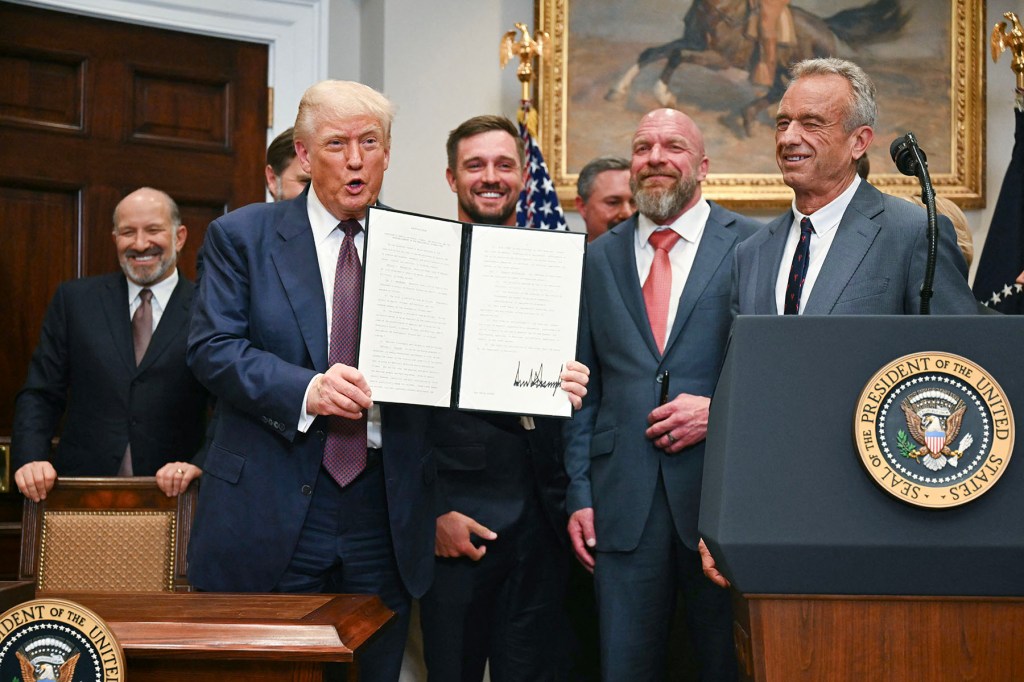
President Donald Trump stands, flanked by Secretary of Commerce Howard Lutnick, golfer Bryson DeChambeau, WWE CCO Triple H and Secretary of Health and Human Services Robert F. Kennedy Jr., after signing an executive order restarting the Presidential Fitness Test in public schools in the Roosevelt Room of the White House in Washington, D.C., on July 31, 2025. (JIM WATSON/AFP/Getty Images)
In some ways, Michelle Obama’s health policy efforts walked so MAHA could run. But you won’t find many Republicans acknowledging that.
“We live in such polarized times now that you would think the Trump administration would look at the things that Michelle Obama achieved and maybe try to build upon that,” said Sharon Wright Austin, a political science professor at the University of Florida. “But there is no collaboration. There are no coalitions. I’m sure if you were to say to Trump, ‘You’re doing the same thing that Michelle Obama originally started doing when Barack Obama was president,’ he would probably not only deny it, but he probably would be pretty offended.”
Obama’s motivation to launch Let’s Move!, the first lady explained, was rooted in her experience as a working mother trying to feed her kids nutritious food. The self-described “mom-in-chief” recognized that if she struggled with what to feed her children, other families with fewer resources might, too.
Within months of moving into the White House, the first lady started a vegetable garden to help teach children about locally grown food and to start a conversation about their health. She launched “Let’s Move” in early 2010, and her husband issued a directive to establish a task force on childhood obesity. Michelle Obama was present months later when the task force released a report assessing how to reduce childhood obesity within a generation. It included roughly 70 voluntary recommendations.
First Lady Michelle Obama and White House Chefs join children from Bancroft and Tubman Elementary Schools to harvest vegetables during the third annual White House Kitchen Garden fall harvest on the South Lawn, on October 5, 2011. (Chuck Kennedy/The White House)
Zinga A. Fraser studies African American history and gender politics as an associate professor at Brooklyn College of the City University of New York. She noted that while Obama’s nutrition plans worked within a domesticated and gendered framework, her garden and health initiative was also part of a long history of Black women taking care of their communities through food sustainability.
“She understood what being a Black woman in that space looked like,” Fraser said of Obama’s role as first lady. “How she had to navigate and what it would be perceived as.”
Let’s Move! had several areas of focus: providing information to families about healthy food, improving the quality of food in schools, expanding access and affordability of healthy foods in communities, and increasing physical activity for children.
The first lady sought buy-in from key stakeholders early on. The American Beverage Association, a government lobbying group representing soft-drink makers, committed immediately to member companies voluntarily putting front-of-pack calorie labels on cans, bottles and vending machines within two years. Food service companies that operated in schools pledged to reduce the amount of fat, sugar and salt they put in kids’ meals over the next five years.
But the first lady was also politically savvy in broadening her initiative’s appeal to the general public. She danced on “The Ellen Degeneres Show” and did “mom dancing” on “The Tonight Show” with Jimmy Fallon. She released a “focus group” video with kids that featured comedian Will Ferrell. She shared a fitness video of herself working out. She appeared with members of the Miami Heat, including dunking a ball with LeBron James.
“She was strategic,” said Fraser, who is also director of the Shirley Chisholm Project on Brooklyn Women’s Activism. “She strategically used her positionality in many ways to move a needle, whether people saw it as influential or important at the time or not.”
It didn’t seem that Michelle Obama was entering controversial politics at first. She had settled on an area of public interest — children’s wellness — that was politically viable for a first lady, said Laurel Elder, a political science professor at Hartwick College in New York who has researched public opinion about presidential candidates and their spouses. There had already been a history of first ladies with projects like an anti-drug campaign and expanding literacy.
Elder noted that Obama was promoting a form of “new traditionalism” in the role of first lady.
“[The public] wants them to be traditional, but also the ‘new’ part is they really do have an expectation that the first lady should be out there and visible and should be leading campaigns in appropriate areas,” she said.
But as regulation policy emerged, so did the criticism. A child nutrition law passed at the end of 2010 included a phase-in of new federal school nutrition standards for milk, whole grains and sodium. The narrative that emerged was that the government was telling people what health choices to make.
“Your America is turning into a nanny state thanks to the Obama administration’s efforts to rein in the junk food industry,” said Sean Hannity on Fox News in 2010.
Glenn Beck, also on Fox News, described Michelle Obama’s efforts in 2010 as the beginning of efforts to police people for not eating healthier.
“You’re going to have to tax, you’re going to have to make it more and more difficult. But when those options don’t work, how do you get people to stop eating french fries, because french fries still beat carrots. What’s left? Well, now you have to start thinking about punishments — maybe a fine, maybe even jail. But it always starts with a nudge,” he said.
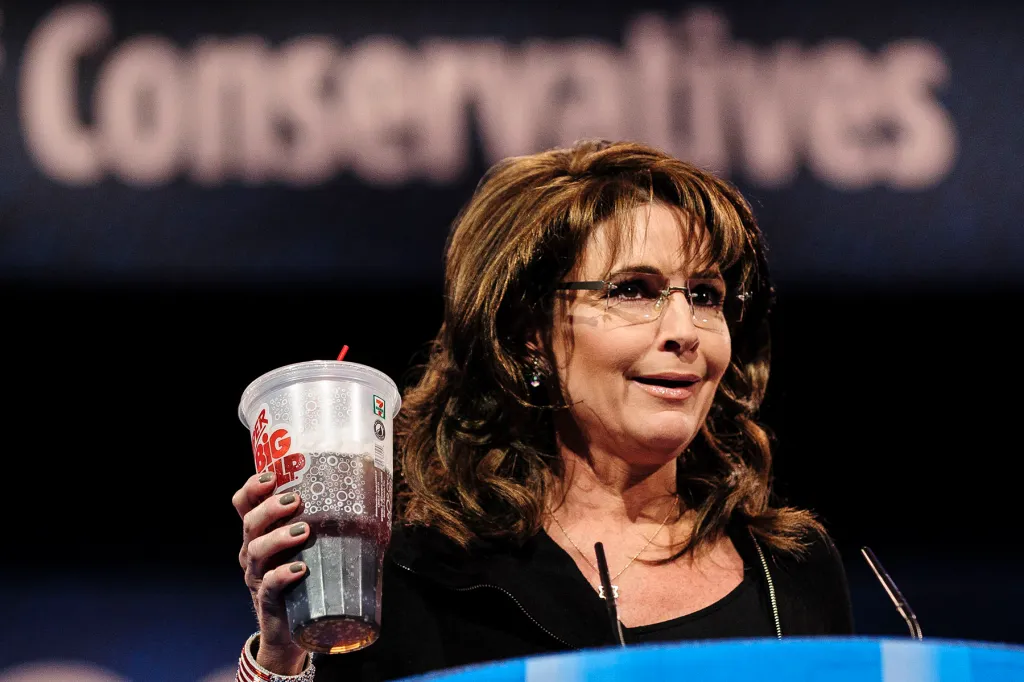
In 2013, former Republican vice presidential candidate Sarah Palin sipped a large soda during an appearance at the Conservative Political Action Conference, known as CPAC. She was responding to a proposed ban of large sodas by then New York City Mayor Michael Bloomberg, but the stunt became part of a larger commentary on the government’s role in people’s health choices.
Sarah Palin holds up a large soda as she speaks about New York City Mayor Michael Bloomberg’s proposed large soda ban, at the 2013 Conservative Political Action Conference, on March 16, 2013, in National Harbor, Maryland. (Pete Marovich/Getty Images)
A MAHA commission released a report this spring for addressing “the childhood chronic disease crisis.” Among its future policy focus will be poor diet, the “aggregation of environmental chemicals,” a lack of physical activity and chronic stress, and “overmedicalization.”
Kennedy told Fox News host Laura Ingraham earlier this year that while he didn’t want to take away “choice” from people, he believed in making changes to food assistance programs and school lunches. Several Republican-led states have recently begun restricting whether people on food assistance programs can buy processed foods and soda.
“We shouldn’t be subsidizing people to eat poison,” said Kennedy, who has separately started promoting that people should track their health metrics via “wearable” technology.
“You can’t cut benefits — Medicare, Medicaid, SNAP benefits, all of those things — to children and families and then still have an initiative where people are saying that they are about creating healthy environments for Americans,” Fraser said.
Natalia Mehlman Petrzela, a history professor at The New School in New York City, noted that when Beyoncé shot a related music video for the Let’s Move! initiative in 2011, she surrounded herself with young children dancing in a school cafeteria. It was common imagery for the first lady as well, as Michelle Obama swayed with kids to get them excited about nutrition and health. Trump’s recent announcement about the presidential fitness test featured former WWE wrestler and current Chief Content Officer Triple H doing a signature water spit at the White House.
First Lady Michelle Obama exercises with students and Olympic athletes during a “Let’s Move” event at the River Terrace Elementary School in Washington, D.C., on April 21, 2010. (Samantha Appleton/The White House)
“To me, that arc kind of says a lot about what’s changed in our wellness and fitness environment,” said Petrzela, who is author of “Fit Nation: The Gains and Pains of America’s Exercise Obsession.” “That now there’s this highly individualistic, ‘strong man’ approach to things, and I think, even more interestingly, it’s tied to that anti-institutional critique, which used to be coded as really left, and in the intervening years, has become, almost completely seen as right wing.”
Austin at the University of Florida said that while Michelle Obama has never been an elected official, she held immense power in her role as first lady and left the White House with high polling. Austin believes the first lady balanced the political challenges of intersectional identities, and her mission to help children continues to resonate 15 years later — even though the messengers have changed.
“It just goes to show that as a Black woman, you’re never going to get the respect that you deserve,” she said.
August 9, 1943 Franz Jägerstätter, an Austrian conscientious objector who reported for induction but refused to serve in the army of the Third Reich, was executed by guillotine at Brandenburg-Gorden prison. An American, Gordon Zahn, wrote about Jägerstätter while researching the subject of German Roman Catholics’ response to Hitler. Zahn’s book, In Solitary Witness, influenced Daniel Ellsberg’s decision to stand against the Vietnam War by bringing the previously secret Pentagon Papers to public attention. Against the Stream by Erna Putz, the story of the courage of Franz Jägerstätter
August 9, 1945 The second atomic bomb, “Fatman,” was dropped on the arms-manufacturing and key port city of Nagasaki. The plan to drop a second bomb was to test a different design rather than one of military necessity. The Hiroshima weapon was a gun type, the Nagasaki weapon an implosion type, and the War Department wanted to know which was the more effective design. Responsibility for the timing of the second bombing had been delegated by President Harry Truman before the Hiroshima attack to Colonel Paul W. Tibbets, the commander of the 509th Composite Group on Tinian, one of the Northern Mariana Islands in the western Pacific. Scheduled for August 11 against Kokura, the raid was moved forward to avoid a five-day period of bad weather forecast to begin on August 10. English translation of leaflet air-dropped over Japan after the first bomb [excerpt]:“We are in possession of the most destructive explosive ever devised by man. A single one of our newly developed atomic bombs is actually the equivalent in explosive power to what 2000 of our giant B-29s can carry on a single mission. This awful fact is one for you to ponder and we solemnly assure you it is grimly accurate.” Of the 195,00 population of the city (many of its children had been evacuated due to bombing in the days just prior), 39,000 died and 25,000 were injured, and 40% of all residences were damaged or destroyed.“ What on earth has happened?” said my mother, holding her baby tightly in her arms. “Is it the end of the world?” Hear an eyewitness account of this terrrible event Photographic exhibit of the aftermath
August 9, 1956 20,000 women demonstrated against the pass laws in Pretoria, South Africa. Pass laws required that Africans carry identity documents with them at all times. These books had to contain stamps providing official proof the person in question had permission to be in a particular town at a given time. Initially, only men were forced to carry these books, but soon the law also compelled women to carry the documents.
August 9, 1966 Two hundred people sat in at the New York City offices of Dow Chemical Company to protest the widespread use in Vietnam of Dow’s flammable defoliant Napalm . Napalm in use in Vietnam Read more about Dow Chemical and the use of napalm
August 9, 1987 Hundreds were arrested in an all-day blockade of the Rocky Flats nuclear weapons plant in Golden, Colorado. Protests at Rocky Flats had been going on for some years.
Today’s Zoom talk is with Ed Wexler, who draws for Cagle Cartoons. Join us as we talk about cartoons, art supplies, caricatures, SoCal weather, and Duck Tales.
(The Zoom chat is on the page, linked at “Read On Substack” above. It’s an hour & 15 min.–A.)
On Tuesday, it was announced that the Trump Regime, which is a petri dish of conspiracy theories, is canceling almost $500 million in contracts to develop mRNA vaccines to protect the nation against future viral threats.
The federal Biomedical Advanced Research and Development Authority (BARDA, which is also the noise Pete Hegseth makes when throwing up in a back alley dumpster), which oversees the nation’s defenses against biological attacks, is terminating 22 contracts with university researchers and private companies to develop new uses for the mRNA technology, because the Health and Human Services Secretary, Robert F. Kennedy Jr., is not a doctor or medical expert, but a conspiracy-theorist whack job.
Lunatics who believe vaccines cause autism and come with tracking chips so the Deep State Illuminati baby-eating reptillians can keep track of you are ecstatic. Actual scientists, doctors, and public health experts, not so much.
Showing evidence that the brain worm may have eaten more than we first believed, RFK Jr. said, “Let me be absolutely clear: HHS supports safe, effective vaccines for every American who wants them. That’s why we’re moving beyond the limitations of mRNA vaccines for respiratory viruses and investing in better solutions.”
This is like when Trump tried to get rid of Obamacare with “something better.”
The first COVID vaccine was developed during the first Trump regime, but that administration never had a plan to roll it out to the public. They were planning to hide it all behind a toilet at MAGA-Lardo. Thankfully, Joe Biden won the 2020 election and made the vaccines effective. Now, the same regime that took credit for the vaccine is trying to destroy it.
Michael Osterholm, who runs the Center for Infectious Disease Research and Policy at the University of Minnesota, said, “This may be the most dangerous public health judgment that I’ve seen in my 50 years in this business. It is baseless, and we will pay a tremendous price in terms of illnesses and deaths. I’m extremely worried about it.” He’s worried.
Every single MAGAt who yelled “Go get another booster, soy boy” during a losing argument responded with, “Yee-hay, yee-haw, yee-haw.”
Mary Holland, the president and CEO of The Children’s Health Defense, said, “While we believe the mRNA vaccines should be taken off the market, the announcement is a positive move towards protecting public health.” By the way, the Children’s Health Defense was founded by RFK Jr, but I’m sure the people running that organization are totally credible (insert rolling eyes here).
I had a feeling it was bad to make the nation’s top health official a guy who believes in chemtrials and likes to tool around town in a car with a whale’s head strapped to it. (snip-MORE, and it’s good/not good. Clay’s commentary is what’s good; the news is not.)
August 8, 1974 President Richard M. Nixon resigned from office, the first U.S. president ever to do so. The House Judiciary Committee had, with bipartisan support (the Democrats and one-third of the Republican members), voted for three articles of impeachment: obstruction of justice, abuse of power, and contempt of Congress.A week later, one of the White House tapes was finally made public, showing the President’s direct involvement in the Watergate scandal cover-up: “…call the FBI and say that we wish, for the country, don’t go any further into this case, period…” – Nixon to Chief of Staff Haldeman, June 23, 1972 (six days after the Watergate break-in) He officially left office August 9, and was fully pardoned one month later by his successor, President Gerald Ford. Asked years later about some of his administration’s questionable activities, Nixon said, “Well, when the president does that, it isn’t illegal.” The headlines in Washington that day
August 8, 1999 A 53-mile peace walk commemorating the bombing of Hiroshima and Nagasaki ended near Clam Lake, Wisconsin, at the site of the U.S. Navy’s Project Elf (extremely low frequency) submarine communications transmitter. Twelve of the demonstrators were arrested for trespassing, adding to the nearly 500 previously arrested for sit-ins, Citizen Inspections, blockades and disarmament actions at the transmitter site in Ashland County.
Velentina Boulter – Velentina Boulter is science journalist based in Melbourne.
Common dormouse. Credit: Michel VIARD/Getty Images
New research has identified specific regions of DNA that regulate hibernation by tweaking metabolism. The findings could offer pathways to new treatments for metabolic disorders like type 2 diabetes in humans.
When hibernating animals wake, they reverse dangerous health changes similar to those seen in type 2 diabetes, muscle atrophy, Alzheimer’s disease and stroke. Researchers hope that unlocking hibernation regions in the human genome could help develop treatments for these potentially fatal health conditions.
“If we could regulate our genes a bit more like hibernators, maybe we could overcome type 2 diabetes the same way that a hibernator returns from hibernation back to a normal metabolic state,” says Elliot Ferris, a bioinformatician at the University of Utah (U of U) Health in the US.
Ferris is co-author of 2 newstudies which pinpointed that DNA regions near a gene cluster called the “fat mass and obesity (FTO) locus” play a crucial role in the ability to hibernate. While the FTO locus also appears in humans, hibernating animals use it in a different, and potentially more advantageous way.
“What’s striking about this [FTO] region is that it is the strongest genetic risk factor for human obesity,” says senior author of the study, Chris Gregg, a professor in neurobiology at U of U Health.
According to the World Health Organization, 1 in 8 people worldwide were living with obesity in 2022. Obesity can lead to an increased risk of type 2 diabetes, heart disease and other health implications, which illustrates the importance of preventing and treating the condition.
“Humans already have the genetic framework,” says Susan Steinwand, a research scientist at U of U and co-author of the studies. “We just need to identify the control switches for these hibernator traits.”
To locate the hibernation-specific regions of the genome, the team used multiple independent whole-genome technologies to compare mammals that do and don’t hibernate.
“If a region doesn’t change much from species to species for over 100 million years but then changes rapidly and dramatically in 2 hibernating mammals, then we think it points us to something that is important for hibernation, specifically,” says Ferris.
The hibernator-specific DNA regions (located close to the FTO locus) weren’t genes but DNA sequences called “cis–regulatory elements” (CREs) which contact nearby genes to either turn up or down their expression, almost like a film director coordinating cinematographers, set designers and actors. The researchers found the CREs regulated the activity of neighbouring genes, including those involved in metabolism.
When they mutated these regions in mice, the researchers observed changes in weight and metabolism. Some of the mutations the researchers performed sped up the weight gain, while others slowed it down. Other mutations affected the body’s ability to recover body temperature after hibernation.
They suggest that this is what allows animals to gain weight before entering hibernation and then slowly release the energy in their fat reserves during the winter.
This means that mutating a single hibernator-specific region has wide-ranging effects extending far beyond the FTO locus, says Steinwand.
“It’s pretty amazing,” she says. “When you knock out one of these elements – this one tiny, seemingly insignificant DNA region – the activity of hundreds of genes changes.”
The studies suggest that CREs might also play a role in regulating human metabolism.
While understanding this flexibility could lead to better treatments for disorders like type 2 diabetes, the study also helps indicate which DNA elements should be explored in future studies.
“There’s potentially an opportunity – by understanding these hibernation-linked mechanisms in the genome – to find strategies to intervene and help with age-related diseases,” says Gregg.
“If that’s hidden in the genome that we’ve already got, we could learn from hibernators to improve our own health.”
The research has been published in the journal Science.










 Scottie's Playtime