James Prigioni makes popular gardening videos on YouTube. In one, he wanted to see if he could grow a whole tomato plant by planting the seeds from a tomato on a McDonald’s burger. He picked up a Deluxe Quarter Pounder with cheese, pulled out a tomato slice, and removed two seeds. After rubbing the seeds on a paper towel to remove the protective coating, which can inhibit sprouting, they were ready to plant.
Trying out different seed-planting methods
But like any good scientist, Prigioni wanted to try a different method for testing McDonald’s tomato seeds. So he pulled a slice of tomato from a second Quarter Pounder and, instead of extracting the seeds, planted the entire slice.


With the help of a heat mat and a grow lamp, both sets of seedlings germinated and sprouted in soil-filled red Solo cups in about a week. After they were fully established, Prigioni separated the plants so they could thrive individually before being planted outside.
He planted one of the plants in the ground outside and another in a 5-gallon bucket. He then showed how he culled the lower leaves as they developed blight and used a tomato cage to support the plants as they produced fruit and grew heavier. He also added extra fertilized soil and mulch to the bucket plant.
The harvest was unexpected
After three months, the plants were producing abundant fruit. The bucket plant didn’t perform as well as the in-ground plant, which Prigioni said was due to insufficient watering during very hot days. The bucket plant also ripened faster, likely due to the stress it had been under. Still, it was an impressive harvest, especially for a plant that started on a McDonald’s burger.
The in-ground McDonald’s plant was even more incredible, with dozens of tomatoes dripping from it.
“I expected this tomato to grow,” Prigioni said, “but I did not expect this.”
The fruit from both plants tasted good and sweet, he said. By the fourth month, the in-ground plant was starting to struggle with its health, but not with its fruit production.
“The plant had so many tomatoes on it that it seemed like it was having a little difficulty ripening that much fruit at one time,” Prigioni said. “I mean, I have had some plants with a lot of tomatoes on them, but never in my life have I seen a single tomato plant with this much fruit on it. I was completely blown away.”
How the McDonald’s tomatoes compared
He said one of his favorite parts of the experiment was seeing what kind of tomatoes would grow from the seeds. He thought it might be a beefsteak variety, but it turned out to be a Roma type. However, he surmised that the McDonald’s tomato was likely a hybrid, based on its ripening characteristics.
Prigioni also shared how the McDonald’s tomato plants compared with his other tomato plants.
“In another area of the garden, I grew Roma tomatoes that I got from Lowe’s, and I planted them at the same time as the McDonald’s tomatoes,” he said. “The harvest from them wasn’t quite as large, but the fruit ripened way more evenly, and I was able to harvest a lot more fresh fruit right off the vine that was ripe.”
“Overall, I was shocked with the level of production,” he continued. “And this is probably my favorite experiment that I’ve ever done. I mean, to be able to take a cheeseburger, grab a tomato from it, then grow a tomato plant, and then harvest pounds and pounds of tomatoes from it is just such a unique and refreshing experience.”
Perhaps an unexpected result, but a great way to challenge our assumptions and demonstrate the power of nature, even in the context of fast food.
There’s a theory that most men, and people in general, intuitively understand “urinal etiquette.” It’s the art and science of where to stand in relation to other men when using a public restroom. Stand too far away, and you risk coming across as standoffish or rude. Stand too close, and you’ll make the other person uncomfortable.
Most people prefer to have a “buffer” between themselves and strangers, and it’s not limited to urinals or public restroom stalls. When given the option, most of us will sit at least one seat away from the nearest stranger in a movie theater or auditorium. We’ll leave a bench or treadmill between ourselves and a fellow gym-goer.
The buffer may seem like common decency and consideration for the people around us, but there could be more to it than that, according to a decades-old research study.
Scientists put theory to the test
In 1976, a team of researchers actually got the idea to test whether the proximity of a stranger had an effect on the way men urinated. Yes, really.
More specifically, they wanted to test what happens when someone invades your personal space. Do you just feel awkward or uncomfortable, or are there more measurable things happening in the body.
For the experiment, researchers began with a pilot study in a men’s public restroom. An observer stood by the sink, appearing to busy himself with washing and grooming, all while secretly keeping tabs on the men who entered. The published study takes it from there:
“When a potential subject entered the room and walked to a urinal, the observer recorded the selected urinal and the placement of the next nearest user. He also noted (with a chronographic wristwatch) and recorded the micturation delay (the time between when a subject unzipped his fly and when urination began) and the micturation persistence (the time between the onset and completion of urination). The onset an cessation of micturation were signaled by the sound of the stream of urine striking the water in the urinal.”
Ethical concerns about observing unsuspecting men in a restroom aside, the study found that none of the 48 subjects chose to stand directly next to another “user” at the urinal banks. The data also showed that men urinated longer the farther they were from the nearest person.
The study was repeated, but this time, confederates were involved. Volunteers were stationed at specific distances from unsuspecting bathroom users, while another observer hid in a nearby stall and used a “periscope” to get a clear sightline of the urine stream.
The surprising findings
Once again, the data was extremely conclusive: men who stood directly next to a confederate while urinating took longer to begin and also urinated for longer overall.
“These findings provide objective evidence that personal space invasions produce physiological changes associated with arousal,” the authors noted in their abstract.
It was an important, if controversial, study in advancing the field of proxemics—the study of physical space in human nonverbal communication. Research like this unusual bathroom study has helped us understand “intimate distance,” a space very close to our bodies that we reserve for romantic partners, children, and close friends.
Research in the field has also mapped the “personal bubble,” or “personal distance,” typically reserved for family members and friends. However, when strangers invade this space—in a crowded elevator, a packed subway car, or by standing next to us at the urinal—that’s when things get really interesting.
Our bodies respond, and MIT Press notes that people often deal with an invasion of personal space by “psychologically removing themselves from the situation” by listening to music or staring blankly at a wall.
Now we know a little more about the physiological response behind this aversion, and it makes urinal etiquette make much more sense. It’s not just “machismo” or homophobia—it’s a way of avoiding a serious stress and anxiety trigger. Or, at the very least, a way to have a much more satisfying pee.
The largest medical association in the United States supports gender-affirming care — a stance it has reiterated in different ways over the last 10 years. But as Republicans press leading medical organizations on health care for transgender youth, the American Medical Association (AMA) is the latest group caught between political rhetoric and the complex realities of specialized care that few people receive.
As patients, families and doctors navigate this care in an increasingly confusing and hostile landscape, what medical groups say matters. But lately, what they’ve had to say — and how politicians interpret it — has only caused more uncertainty.
The AMA’s stance was already in question after a January meeting between leaders of major medical groups and Dr. Mehmet Oz, the head of the Centers for Medicare and Medicaid Services. After that meeting, which was first reported by The New York Times, one group in attendance — the American Society of Plastic Surgeons (ASPS) — muddied the waters about whether it had taken a more restrictive stance on gender-affirming care.
Questions soon followed for the AMA, the nation’s most prominent organization representing doctors.
Twenty Republican state attorneys general are pushing for the AMA to broadly oppose gender-affirming care for minors, in response to news coverage about their recommendations around youth surgeries. The attorneys suggest that the AMA may be violating state consumer protection laws by confusing, or even misleading, medical providers and patients about their stance. They mention wanting to “avoid a formal investigation” into the issue.
The attorneys, led by Steve Marshall in Alabama, wrote a letter in February asking whether the group recommends hormone therapy or puberty blockers to treat gender dysphoria in minors.
“If you agree that there is insufficient evidence to support using surgical interventions to treat gender dysphoria in minors — as your recent statement indicates — we do not understand how you can find that there is sufficient evidence to support using hormonal interventions to treat gender dysphoria in minors,” their letter reads.
This is an escalation of a familiar tactic, said Khadijah Silver, director of gender justice and health equity at Lawyers for Good Government. And if it works, it will be a major weapon in the political fight to delegitimize gender-affirming care, they said.
“If you can convince the public that they have shifted stance, that’s extremely powerful,” they said, referring to the AMA.
In some ways, that impact is already being felt.
In a recent congressional hearing on rising health care costs, the board of trustees chair for the American Medical Association was asked about how patients across the country are struggling to find doctors. Two hours into the hearing, he was also asked about gender-affirming care for trans youth — a topic that affects few Americans, but takes up a lot of political air.
Rep. Erin Houchin, a Republican from Indiana, asked why the medical group changed its position on surgeries for trans youth.
But the AMA maintains that it has not changed its position.
“In surgery and minors, our belief is that it should generally be deferred until adulthood. But, we respect the physician-patient-family relationship in determining that,” Dr. David H. Aizuss answered in response to the question from the congresswoman.
That exchange took only a few minutes out of a hearing that spanned the gamut of crises facing the U.S. health care system, like skyrocketing insurance premiums and a worsening physician shortage. But it represents a growing tension between Republicans and medical groups, as elected officials who oppose gender-affirming care push for major health care organizations to do the same.
The American Medical Association declined to comment on the attorneys general’s letter, which had asked for a response by March 25. In a broader statement, the medical group said it supports gender-affirming care.
“We support evidence-based treatment for medical care, including gender affirming care,” an AMA spokesperson said in an email. “Currently, the evidence for surgical intervention in minors is insufficient for us to make a definitive statement. In the absence of clear evidence, surgical interventions in minors should be generally deferred to adulthood. Treatment decisions should be made between the physician and the patient (and family) based on the best medical evidence and clinical judgment.”
That position aligns with the World Professional Association for Transgender Health (WPATH), an authority on medical care for trans people. WPATH recommends that patients generally wait until adulthood before seeking surgery. Trans youth rarely undergo surgery of any kind; of the small number performed on adolescents, the majority are mastectomies.
If an adolescent does need surgery, WPATH recommends they meet extensive criteria — including a full understanding of reproductive side effects, a year’s worth of hormone therapy, sustained gender incongruence, plus emotional and cognitive maturity.
The questions surrounding surgery come on the heels of the American Society of Plastic Surgeons’ response to the January meeting with Oz. In what the Times described as a “tense” meeting, Oz pressed leaders of organizations including the AMA and the ASPS on why they recommend gender-affirming care for trans youth. At that meeting, the surgeons group said it would be changing its position, per the Times.
Weeks after the meeting, ASPS released a nine-page statement saying that gender-affirming surgery should be delayed for minors until a patient is at least 19. The surgeons’ group cited insufficient evidence that benefits for surgery outweigh risks, and pointed to a controversial report created by the Trump administration to back its position.
The surgeons group noted that it still opposes criminalization of such medical care. The Trump administration celebrated the announcement.
“Today marks another victory for biological truth in the Trump administration,” said former Deputy Health and Human Services Secretary Jim O’Neill, in a press release. Oz, who has compared gender-affirming care for minors to lobotomies, applauded the American Society of Plastic Surgeons “for placing itself on the right side of history.”
In the following days, the surgeon’s group appeared to backtrack. The American Society of Plastic Surgeons reportedly told NPR that its position “does not include a blanket recommendation for surgery for minors.” The ASPS did not respond to a request for comment on this story.
The AMA has had its own trouble communicating its position. In a recent internal newsletter from the board chair, the association said that its policy on gender-affirming care has not changed at all; and that it requested a correction from The New York Times in response to the outlet’s coverage of its initial statement on youth surgeries. However, the Times says it has received no such requests.
This back-and-forth is taking place against an intense political backdrop: Six states have made it a felony for doctorsto provide gender-affirming care to trans youth. Hospitals across the country have shuttered gender clinics in response to pressure from the administration. As a result, some young patients are cut off in the middle of treatment and medical professionals are grappling with how the law impacts them.
And despite ample news coverage, gender-affirming care is still not widely understood.
Very few transgender youth seek and access surgeries. More rely on hormone therapy and puberty blockers to treat gender dysphoria, which is a medical condition that can cause significant distress for trans people.
Puberty blockers delay the hormones that cause kids to go through puberty, which can be an intense and emotionally fraught time for trans youth. Many families say this treatment is crucial for their child’s wellbeing and prevents distress caused by dysphoria. There are potential risks, like decreased bone density, which is monitored by medical providers. Some providers recommend weight-bearing exercise or diet optimization to boost calcium and vitamin D levels while on puberty blockers.
Hormone therapy, which involves taking testosterone or estrogen to cause physical changes that align one’s body with their gender identity, is another treatment that some trans youth receive to alleviate dysphoria. As with puberty blockers, clinics require a mental health assessment as well as parental or guardian consent for the treatment.
The Endocrine Society and the American Academy of Pediatrics are under federal investigation over their support for gender-affirming care. Both medical groups have sued, as the government seeks information to determine if they have made “false or unsubstantiated representations” regarding the care.
The attorneys’ general letter to the American Medical Association is leveling up that pressure on medical groups, Silver said.
“Because the care is so politicized, any association that stands up and asserts its support for physicians who provide the care, will be made an example of,” they said.
The Least Flycatcher is a small but fierce bird of North American forests, known for its fearlessness in confronting birds much larger than itself, including formidable foes like Blue Jays and even hawks. They often share habitat and compete with American Redstarts, a fly-catching warbler, which they exclude from the best habitat through repeated chases and attacks. Of course, Least Flycatchers defend their territories from their neighbors as well.
However, despite their intense territoriality, these flycatchers are widely known to form dense clusters of breeding territories, even in areas with plenty of suitable habitat. Interestingly, the males closest to the center of a cluster are the healthiest, and the first to find mates. Conversely, birds that don’t join a cluster usually do not mate at all that season. While other factors may contribute to this pattern, the main influence seems to be that it facilitates birds mating with their neighbors in addition to their social mate.
Least Flycatchers are socially monogamous, pairing with a single bird during the breeding season with whom they defend a territory and raise young. But these birds are also quite promiscuous. More often than not, the nest of a mated pair will have at least one nestling sired by another male. “Spreading the love” in this way benefits both males and females — females end up with more genetic diversity in their nests, while males don’t have all their eggs in one “basket,” in case a nest fails. This breeding system, where territories are clustered together, females seek matings outside of the pair, and paired males compete for each other’s mates, has been described as a “hidden lek.” In some ways, this system is quite similar to the communal display areas, or leks, where birds like Lesser Prairie-Chicken and Greater Sage-Grouse defend small arenas to display for females.
One big difference between a classic lek and the so-called “hidden lek” of Least Flycatchers is that both the male and female in a pair are looking to mate with other birds without their own mate knowing about it. Also, the displays are a bit less dramatic. Rather than elaborate plumages, dances, and bizarre methods of sound production, these drab males instead opt to sing the same monotonous two-note song several thousand times an hour.
Threats
Though fairly common in appropriate habitat, Least Flycatcher populations have been declining since the 1970s. There are now a little over half as many Least Flycatchers as there once were. As such, Partners in Flight lists them as a Common Bird in Steep Decline. More research is needed to better understand the causes of this decline, but factors affecting the structure and health of forests probably play an important role. (snip)
Due to the Stephen Miller pogrom against anyone not white and the red states wanting to prove they are more maga than everyone else, but really it is just about how very unpopular Republican policies are that they are on a restrict voting to republicans only drive. I have been talking about how I would need a passport to vote.
Ron has been pushing for us to get passports and has been looking into it. One of the things he read was if you had a prior passport all the massive amount of information wouldn’t be needed. Ron told me he remembered I had a passport. I told him I had to have a red diplomatic passport due to the sensitive nature of my military job but I had to return it when I left the military.
He said Scottie you have an old blue passport. I said, Really?. Yes I remember seeing it he replied. The more he talked the more it jogged my memory and I did remember having a blue passport. I was not sure if I needed it to go to Germany or if it was issued after I turned in the red one. I had forgotten about all of this. But Ron is excellent at keeping our files and he remembered it. The thing that is a problem is that my passport has my prior to marriage name. But Ron says it is better to have this as the needed paperwork is not needed. I hope so. I am so tired these days. Ron is worried. Normally I jump out of bed at 3 or 4 and an charged up for the day. I am barely able to drag my self out of bed now at 5 and I am going to bed early.
Right now the cat screams at me to get up and feed him. I fell into a deep sleep last night and Ron got up and made his side of the bed and went out to the livingroom. Normally I hear Ron’s every move and wake up and if needed talk to him. But an hour later the cat was upset I was not up came to the bedroom and howled until I woke up. Then he got on the bed and purred. Ron claims he never heard him. But I got up and went to my office with the cat following me. I sat at my desk and Tupac jumped up on the desk on his towel and purred madly happy to have his desk time with me.
But this being so tired and going back to bed more often during the day and sleeping not just resting my back, is upsetting to me. I have been getting up early like 3 or 4 am and going to bed between 7 or 8 pm most of my life unless required to not do it. I would jump out of bed so energetic it would upset Ron and his sister laughed at how when she visited every time she got up I was already up. Now I am so tired Ron can get up and out of the bed get dressed and not wake me. When I do get up I feel I am dragging my body along. I have no energy to even think. Something has changed in my body and it scares me at how hard this shift has been. My doctor did not seem concerned about the blood results, saying since I have struggled with anemia before, it is likely I am facing it again making me tired. Plus there is the stress I am under. He did mention a screening for colon cancer and that asked if I struggled with depression. His nurse came in an asked me a bunch of questions resulting in the fact that I struggle with depression more than 2 days a week. He said he will have me check the results in 3 months and then he will go at it because by then my stress should be decreased. Hugs
I think the article is self explaintary and clear. The hate directed against the LGBTQ+ seems irrational and immoral. Why is it immoral if it is being done by religious groups? Because they have no qualms about lying, giving false and misleading information, and forcing their church doctrines on others who don’t agree with those doctrines. Below are just a few quotes from the article. The last one from florida would make pointing out the truth about how a person is acting or speaking illegal, but doing the racist bigoted stuff would stay legal. Hugs
Anti-trans bathroom bans made a comeback, with four passed in Alabama, Idaho, Ohio and South Carolina.
Policy changes enacted barriers to gender markers and name changes for IDs/personal documents in Arkansas and Florida.
Florida introduced a bill that limited free speech, making public accusations, whether true or false, of a person being homophobic, transphobic, racist or sexist equivalent to defamation and punishable by fine. The bill did not pass.
A central theme of anti-LGBTQ+ organizing and ideology is the opposition to LGBTQ+ rights or support of homophobia, heterosexism and/or cisnormativity, often expressed through demonizing rhetoric and grounded in harmful pseudoscience that portrays LGBTQ+ people as threats to children, society and often public health.
Top Takeaways
In 2024, the number of anti-LGBTQ+ groups increased by about 13% from the previous year. Anti-LGBTQ+ groups maintained a trend in heavy mobilization across multiple strategies with increasing political and financial support from the hard right.
Anti-trans narratives were instrumental to the 2024 election at all levels of government, especially at the local level where anti-LGBTQ+ and anti-inclusive education activism continue to heavily overlap. The politicization of gender-affirming health care and LGBTQ+-inclusive school curricula contributed to what has been characterized as the “most Anti-LGBTQ election in decades.” Republicans spent almost $215 Million on TV ads to smear trans people, surpassing ads on rival issues such as economy, immigration and housing. Another wave of anti-LGBTQ+ legislation broke records at state and federal levels, but such bills were not as nearly as successful as last year.
Anti-LGBTQ+ groups are heavily invested in the courts and pushing policy change by judicial decision. Hard right and anti-LGBTQ+ extremists on social media continue their campaign to “make pride toxic” by targeting inclusive business and marketing practices while anti-LGBTQ+ legal groups take up administrative law and lobbying strategies to eliminate diversity, equity, and inclusion practices in the public and private sectors under the guise of “viewpoint diversity” and “religious freedom” advocacy.
Key Moments
Throughout the state legislative sessions, anti-LGBTQ+ movement organizations continued their facilitation of a decades long effort to foment anti-trans moral panic in public discourse. Legislative assaults broke records for the fifth consecutive year, albeit with fewer successes.
Several factors slowed the trend, including coordinated community responses and reporting, such as the SPLC’s Project CAPTAIN, on the networks that perpetuate anti-LGBTQ+ talking points and legislation. Legislation trends of concern include:
A Florida bill promoted insurance coverage conversion therapy for detransition. The bill passed the House, but died in the Senate.
Anti-trans bathroom bans made a comeback, with four passed in Alabama, Idaho, Ohio and South Carolina.
Policy changes enacted barriers to gender markers and name changes for IDs/personal documents in Arkansas and Florida.
Florida introduced a bill that limited free speech, making public accusations, whether true or false, of a person being homophobic, transphobic, racist or sexist equivalent to defamation and punishable by fine. The bill did not pass.
In February 2024, anti-trans influencers spun a disinformation campaign to exploit the tragic shooting at Lakewood Church in Houston by alleging the shooter was trans. Hard-right social media influencers, equipped with talking points that help fuel gun purchases, used this and other mass shootings in 2024 to perpetuate anti-immigrant and anti-trans conspiracy theories. Despite claiming anti-trans activism helps “protect children,” the SPLC reported that in the wake of mass shootings, anti-trans extremists divert attention from meaningful reforms to prevent gun violence, which is the leading cause of death for children in the United States.
In response to online campaigns by hard-right social media personalities, many major brands scaled back Pride merchandise in 2024. Armed Conflict Location and Event Data (ACLED) reported anti-LGBTQ+ protests at Pride events decreased in 2024; however, GLAAD documented 110 anti-LGBTQ+ incidents during June 2024. In addition, the SPLC monitored at least 74 bomb threats targeting LGBTQ people and events between January 1 and June 30, 2024.
The Colorado Republican Party posted “Burn all the #pride flags this June” and shared a video clip titled “God Hate F__s.” There was no shortage of vandalism: In Poulsbo, Washington, 14 Pride banners were slashed, and over 200 pride flags were stolen from the town center in Carlisle, Massachusetts. Throughout June, SPLC tracked dozens of protests, bomb threats and harassment campaigns directed at civil society groups like Pride committees and LGBTQ+-inclusive religious congregations. Hate groups including MassResistance, Gays Against Groomers, Protect Texas Kids, White Lives Matter, and Aryan Freedom Network were active at Pride events in June 2024.
In July and August 2024, anti-trans influencers manufactured controversy over the gender identity of Olympic athletes Imane Khelif and Lin Yu-ting. This anti-trans controversy exclusively targeted Taiwanese and Algerian athletes, scrutinizing the legitimacy of their womanhood. The crux of arguments made by the anti-trans actors re-animated misogynoir stereotypes to exclude women of color from being considered women based on white Eurocentric beauty standards of femininity. The series of events suggests eugenics and racism underlie transphobia and exhibited how anti-trans hysteria disproportionately impacts women of color on an international scale.
In September 2024, the anti-LGBTQ+ hate group Family Research Council held its annual Pray Vote Stand conference. FRC hosted a variety of anti-immigrant commentary ranging from Katy Faust, president of the anti-LGBTQ+ hate group Them Before Us, urging attendees to “breed out” immigrants and trans people. At the conference, Oklahoma superintendent of public instruction Ryan Walters alleged illegal immigrants were bringing fentanyl into schools; and the summit featured population control myths espoused by both anti-abortion and anti-vax panelists. FRC devoted multiple plenary sessions to anti-trans, anti-abortion and anti-immigrant coded topics.
The election of the first trans member of congress, Sarah McBride, was immediately met with a trans bathroom ban on all restrooms on the House side of the Capitol complex. The resolution was introduced by Nancy Mace and supported by House Speaker and former Alliance Defending Freedom attorney Mike Johnson. Mace posted anti-trans slurs on X following a bathroom sit-in at the Capitol in protest of the bathroom ban. The protesters were arrested and taken to the Capitol Police station; Mace then posted a video showing her outside the stations saying, “Some tr——s got arrested protesting my ban.” She then began reading them their Miranda rights along with demeaning commentary about the protesters.
States will continue to be labs for experimenting with anti-LGBTQ+ public policy. The legislative early filing period in Texas shows 32 anti-trans bills already filed for the 2025 legislative session. This year will show a continued pressure on erasing trans people from public life. With Donald Trump’s re-election, federal civil rights enforcement litigation will likely swing against LGBTQ+ inclusion.
Authors of Project 2025 are being tapped as cabinet picks for the second Trump administration. Project 2025 is an authoritarian and theocratic road map, and anti-trans scapegoating makes up key policy recommendations.
Background
Anti-LGBTQ+ groups in the United States oppose LGBTQ+ rights but also generally support heterosexism, an ideology that assumes heterosexuality is the only “normal” sexuality, and/or cisnormativity, an ideology that assumes one’s gender identity always matches the sex one was assigned at birth. Anti-LGBTQ+ groups primarily consist of Christian Right groups but also include such organizations as the National Association for Research and Therapy of Homosexuality (NARTH) that purport to be scientific. Anti-LGBTQ+ groups in America have employed a variety of strategies in their efforts to oppose LGBTQ+ rights or support heterosexism and/or cisnormativity, including engaging in the crudest type of name-calling.
Anti-LGBTQ+ groups on the SPLC hate list often link being LGBTQ+ inherently to criminal behavior; claim that the marriage equality and LGBTQ+ people in general are dangers to children and families; contend that being LGBTQ+ itself is dangerous and support the criminalization of LGBTQ+ people and transgender identity. These groups also believe in a false conspiracy that LGBTQ+ people seek to destroy Christianity and the whole of society. More recently, hard-line anti-LGBTQ+ groups have promoted their discriminatory laws and policies that limit the rights of LGBTQ people under the guise of religion, blurring the lines between the separation of church and state and discarding anti-discrimination civil rights policies. These same groups have promoted legislative models to push anti-trans legislation into law under a conservative religious assumption that gender can only be understood as either “male” or “female.”
Many leaders and spokespeople of SPLC-designated anti-LGBTQ+ groups have used degrading and derogatory language to describe LGBTQ+ people. Others disseminate disparaging information about LGBTQ+ people that are simply untrue – an approach no different from how white supremacists and nativist extremists propagate lies about African American people and immigrants to make these communities seem like a danger to society. Viewing LGBTQ+ people as unbiblical or simply opposing marriage equality does not qualify an organization to be listed as an anti-LGBTQ+ hate group.
2024 Anti-LGBTQ+ Hate Groups
* – Asterisk denotes headquarters.
Abiding Word Baptist Church, Revival Baptist Church
Orange Park, Florida
Advocates Protecting Children
Arlington, Virginia
Alliance Defending Freedom
Scottsdale, Arizona
American College of Pediatricians
Gainesville, Florida
American Family Association
Indianapolis, Indiana
Tupelo, Mississippi *
Franklin, Pennsylvania
American Vision
Powder Springs, Georgia
Americans for Truth About Homosexuality
Columbus, Ohio
ATLAH Media Network
New York, New York
California Family Council
Fresno, California
The Campus Ministry USA
Terre Haute, Indiana
Center for Christian Virtue
Columbus, Ohio
Center for Family and Human Rights (C-FAM)
New York, New York*
Washington, D.C.
Chalcedon Foundation
Vallecito, California
Child and Parental Rights Campaign
Johns Creek, Georgia
Church Militant/St. Michael’s Media
Ferndale, Michigan
Concerned Christian Citizens
Temple, Texas
D. James Kennedy Ministries
Fort Lauderdale, Florida
Do No Harm
Glen Allen, Virginia
Faith2Action
North Royalton, Ohio
Faithful Word Baptist Church
Tempe, Arizona
Straight Paths Baptist Church
Tucson, Arizona
Family Action Council of Tennessee
Franklin, Tennessee
The Family Foundation of Virginia
Richmond, Virginia
Family Policy Alliance
Colorado Springs, Colorado
Family Research Council
Washington, D.C.
Family Research Institute
Colorado Springs, Colorado
Family Watch International
Gilbert, Arizona
First Works Baptist Church
Anaheim, California
Florida Family Voice
Orlando, Florida
Focus on the Family
Colorado Springs, Colorado
Frontline Policy Council
Atlanta, Georgia
Gays Against Groomers
Fountain Hills, Arizona
California
Georgia
Kansas City, Missouri
Monroe, North Carolina
Vancouver, Washington
Milwaukee, Wisconsin*
Generations
Elizabeth, Colorado
Genspect
Chicago, Illinois
Heterosexuals Organized for a Moral Environment (H.O.M.E.)
Downers Grove, Illinois
Illinois Family Institute
Tinley Park, Illinois
Liberty Baptist Church
Rock Falls, Illinois
Liberty Counsel
Orlando, Florida
Louisiana Family Forum
Baton Rouge, Louisiana
MassResistance
Torrance, California
Pocatello, Idaho
Idaho
Waltham, Massachusetts*
New Jersey
Fort Worth, Texas
Houston, Texas
Kenosha, Wisconsin
Gilette, Wyoming
Lander, Wyoming
Massachusetts Family Institute
Wakefield, Massachusetts
Mission: America
Columbus, Ohio
Montana Family Foundation
Laurel, Montana
Pacific Justice Institute
Sacramento, California
Santa Ana, California
Miami, Florida
Mississippi
Reno, Nevada
Salem, Oregon
Seattle, Washington
Partners for Ethical Care
Chicago, Illinois
Pass the Salt Ministries
Hebron, Ohio
Pennsylvania Family Institute
Harrisburg, Pennsylvania
Pilgrims Covenant Church
Monroe, Wisconsin
The Pray In Jesus Name Project
Colorado Springs, Colorado
Probe Ministries
Plano, Texas
Public Advocate of the United States
Merrifield, Virginia
Revival Baptist Church
Clermont, Florida
Ruth Institute
Lake Charles, Louisiana
Save California
Sacramento, California
Scott Lively Ministries
Springfield, Massachusetts
Society for Evidence-Based Gender Medicine
Twin Falls, Idaho
Stedfast Baptist Church
Oklahoma City, Oklahoma
Cedar Hills, Texas *
Strong Hold Baptist Church
Norcross, Georgia
Sure Foundation Baptist Church
Indianapolis, Indiana
Vancouver, Washington*
Seattle, Washington
Spokane Valley, Washington
Them Before Us
Seattle, Washington
Tom Brown Ministries
El Paso, Texas
True Light Pentecost Church
Spartanburg, South Carolina
United Families International
Gilbert, Arizona
Verity Baptist Church
Sacramento, California
Warriors for Christ
Mount Juliet, Tennessee
Westboro Baptist Church
Topeka, Kansas
World Congress of Families/International Organization for the Family
Rockford, Illinois
Remember a couple of things as you read this below. First there is nothing wrong with being LGBTQ+ and the feelings associated with those letters. Second most children are desperate to fit in to the majority, to be “normal”. The country was well on the way to reassuring these kids / adults that those feelings were normal and OK. That the child was not damaged not an abomination to god, and did not need to be fixed. Then the right wing religious hate machine managed to pass don’t say gay laws, bathroom bills, and “lets make those who are not straight or cis be attacked outcasts again” laws.
There are two errors not really mentioned here. Minors who are going to these “religious anti-LGBTQ+ be straight cis only” therapest / religious leaders are normally forced there by parents who have been convinced by religious leaders in their church that their child is damaged and needs to be fixed as they are sinning just for feeling as they do and so will be going to hell. (Side note Jesus never said anything like that. I remember being told that I was “acting gay / doing gay things” because I liked sinning. To which I replied, You have it backwards. I was born gay and I like doing / being gay and so I don’t care that it is sinning to you.) The child is often told this to the point where even if they don’t fully hate themselves they are willing to do anything their parents want to “be normal” or get their parents off their backsides about it. And often the child is threatened with being thrown out of the home if they don’t go to conversion therapy. And then the religious therapist reinforces the message that they are damaged, broken, that they cannot be as they are but must be fixed, must be healed of the sin / feelings. Every major medical association has reviewed and studied conversion therapy and they conclude it is harmful, has no basis in science and those kids who go through it are far more likely to try to end their lives so they recommend helping young people to accept themselves and their feelings except for the minor one started by a religious group that has rejected all the studies and findings for the religious belief that god wouldn’t create anyone that way and because we are not that so those people / kids that feel that way must be forced to change to make them and their god happy.
There are facts, and then there are religious beliefs that disregard those facts. The fact is that the data and medical studies show that helping non-straight non-cis children accept that they are normal also shows that gender afirming care is the most beneficial way to help young people who are LGBTQ+ and struggling with the idea of wanting to be “normal” or like the other students are. I did not want to be gay as a kid growing up. I knew my attraction perhaps sooner than most kids due to my childhood situation. But all the time growing up I heard about how bad and horrible people who had the feelings I did were and how doing what I was being forced to do made me the worst possible human. I was attacked at school even though I was not out but some thought I was different and that was enough. When I had to join the church to get to leave my abusive home to get to safety I heard constantly how bad / sinfull / an abomination I and people like me were to god who wanted mankind to wipe me out… wait why does god need mankind to do that, especially white Christian men to do that, can’t he just stop making gay people with out a demon in them?
At my church school a lot of the boys were flirting with same sex attractions as they were horny teen boys separated from girls. Similar to the situation I found in the military where I had a group of “straight” guys asking me to go on passes with them. And it was very fun, but they always claimed not to be able to remember what happened on those trips. But each of those kids and some of those adults I had consensual fun with blamed themselves for failing god and failing to be normal. I had one really cute fun guy who I would go on passes with who couldn’t wait to get into the hotel room to have sex. And it was not just one way either. He received as he gave and what he enjoyed he returned if you catch my trying not to be too explicit. But that was the same with all the guys, they were not hung up on straight norms while in a hotel room with me. But this one guy would always on the way back to base tell me we couldn’t do that again. It was wrong. It was something we shouldn’t do. I did not argue. But 3 weeks or a month later he was begging me to go on a four day pass with him.
My point was this guy was 18 / 19 like me. I had already long accepted who I was and how I felt. He had taken the be normal message to heart. He could have used therapy to accept his feelings and needs. But the one thing he did not need and would have been harmful was conversion therapy. That guy was with me in Germany, after a wonderful weekend he again said we couldn’t do that again, He got married and it lasted a year, then he got divorced. I lost touch with him. But lives were harmed because he just couldn’t face he was gay, couldn’t tell his religious parents he was gay, and would have been placed in conversion therapy if his parents had known as a teen he struggled with same sex attraction and was not straight. Hugs
The Supreme Court on Tuesday delivered a major win for the free speech rights of counselors and therapists, ruling in an 8-1 decision that a Colorado law prohibiting licensed counselors from engaging in talk therapy to help a person “reduce or eliminate unwanted sexual attractions, change sexual behaviors, or grow in the experience of harmony with [their] bod[ies]” unconstitutionally violated the First Amendment right to freedom of speech.
FRC President Tony Perkins called the decision “A Supreme Court win for free speech and biological reality.”
“I’m encouraged to see the muzzle removed from therapists seeking to help willing patients come to terms with, and be at peace with, how God created them,” reflected Perkins in a statement to The Washington Stand.
“The Left is using the levers of government to block families and individuals seeking help. Under Colorado law, a girl could legally seek a therapist’s help to change her gender but could not seek help from that same therapist to align her identity with her biological sex. Where is the fairness or logic in that? I commend the court for striking down this deeply invasive and unjust law.”
Read the full article. In 2013, Exodus International – then the nation’s largest ex-gay group – disbanded. Its longtime president Alan Chambers declared that not one of his group’s thousands of victims had ever become heterosexual.
Conversion therapy is discredited junk science that inflicts harm on LGBTQ youth.The Supreme Court’s decision is disappointing and puts vulnerable kids at risk.
Medicaid cuts threaten hundreds of hospitals, new report finds
Together, the hospitals provide care for nearly 7 million patients across the U.S., according to the analysis.
Across the country, hospitals have already warned they may need to lay off staff members or scale back care, including maternity and mental health care, because of Medicaid cuts.Image Source / Getty Images
More than 400 hospitals across the United States are at high risk of closing or cutting services because of the Medicaid cuts in President Donald Trump’s “big, beautiful bill,” according to an analysis from the progressive watchdog group Public Citizen.
The fallout could make it harder for millions of people to get care and put thousands of health care workers’ jobs at risk as hospitals lose a key source of federal funding. Medicaid covers about a fifth of all hospital spending.
The Medicaid cuts come in phases, with more significant changes, including work requirements, in 2027 and limits on how states raise funds in 2028. Overall, the law is expected to reduce federal Medicaid funding by roughly $1 trillion over the next decade.
“We’re seeing hospitals that are already under severe financial strain having to make decisions about how to stay financially solvent,” said Eileen O’Grady, a researcher in Public Citizen’s Congress Watch division and the report’s author. “That has pretty clear implications for people who live in that community. It also has ripple effects on other hospitals in those communities.”
The analysis draws on hospital financial data from the Centers for Medicare and Medicaid Services from 2022 through 2024, covering about 95% of U.S. hospitals. The group defined at-risk hospitals as those in which Medicaid and other low-income government programs made up at least 20% of revenue and that have been operating at a loss in recent years.
The report doesn’t estimate when hospitals could close or cut services.
“Closure is the worst-case scenario, but it also doesn’t preclude hospitals from having to make really tough decisions about cutting services that might be essential to those communities but are just no longer financially viable,” O’Grady said.
Across the country, hospitals have already made statements warning they may need to lay off staff or scale back care, including maternity and mental health care, because of the Medicaid cuts.
For many patients, hospitals are the last place to turn when there are few or no other options for care.
“When hospitals close, patients have less access to the care that they need,” said Gideon Lukens, director of research and data analysis on the health policy team at the Center on Budget and Policy Priorities, a nonpartisan research group. “They have to travel further or wait longer in other hospitals that become overcrowded. That additional time can be the difference between success and failure of time-sensitive, potentially life-saving treatments.”
The closures also add strain to the hospitals that take on the extra patients. O’Grady said doctors end up having “less patience, less time, less capacity to provide the highest quality care.”
“It can be very dangerous for hospitals to be under this kind of strain,” she said.
The analysis found a total of 446 at-risk hospitals, with at least one at-risk hospital in 44 states and Washington, D.C.
About 60% of the at-risk hospitals — 267 facilities — are in urban areas, even as much of the debate around Medicaid cuts has focused on rural hospitals. Black and Latino people stand to be the most affected by the cuts.
The hospitals span both Democratic and Republican-led states, though the states with the largest number of at-risk hospitals are California, New York, Illinois and Washington.
Republicans also represent several congressional districts with the highest number of at-risk hospitals. House Republicans who voted for the Medicaid cuts have 196 at-risk hospitals in their districts, while Senate Republicans — all of whom back the cuts — represent 146 at-risk hospitals in their states, according to the analysis.
The cuts could lead to a worsening crisis, especially for rural hospitals, said Zachary Levinson, the project director of the KFF Project on Hospital Costs.
He said that by his estimates, Trump’s law sets aside $50 billion to support rural communities, but could reduce federal Medicaid spending in rural areas by far more — about $137 billion over a decade.
James Jackson, the CEO of Alameda Health System in Oakland, California, said the Medicaid cuts represent an “existential threat.”
Alameda Health System, which gets 60% of its revenue from Medicaid payments, announced in December that it would lay off nearly 300 employees and lose more than $100 million annually by 2030. (The health network was not included on Public Citizen’s at-risk list, though the report notes its financial troubles.)
The layoffs, set to take effect in March, have since been delayed.
Proposed cuts included mental health services, care for patients with chronic conditions and an ambulatory plastic surgery program. Jackson said closing hospitals is not on the table, but the system has continued to look at scaling back services.
“I don’t think the impact is going to be a positive one,” he said. “We are often the provider of last recourse, so if we’re not able to provide a service, there will be a delay in receiving care at one of the other systems in the area or they may not provide it at all.”
Trinity Health, a Michigan-based hospital system with facilities in other states, said it’s projected to lose $1.5 billion due to “recent and future government policy changes.”
In January, it said it was laying off 10.5% of its billing staff. One of its hospitals, St. Mary’s Sacred Heart Hospital in rural northeast Georgia, announced last October it was closing its maternity unit.
In a statement, a Trinity Health spokesperson shared a previous statement that said in part that “more reductions” are being considered by the federal government and it’s “not possible to simply absorb such a significant financial impact without making thoughtful, forward-thinking changes.”
Berkeley Lovelace Jr. is a health and medical reporter for NBC News. He covers the Food and Drug Administration, with a special focus on Covid vaccines, prescription drug pricing and health care. He previously covered the biotech and pharmaceutical industry with CNBC.
I got up at 3 am this morning and was able to respond to almost all the comments. That gave me a few minutes while I ate some apple oatmeal for breakfast to read some news from Joe My God that he posted yesterday. Here they are in no particular order. Hugs
Yes it would make me want to sign up to work grueling hours and possibly die for a country that wants to use my graduation to arrest and deport my family members. Great move. Hugs.
I wonder what makes a person so hateful, bigoted, and racist. How much do you fear not being in a super majority and why? Do they worry that the new majority will treat them the way they treated the minorities when they were the majority? Hugs
More racism. This program they are now stopping claiming it is DEI and woke is because the first program illegally excluded black people in an attempt to be racist. Hugs
I was not sure whether to put this under corruption or racism. But as they are clearly using race, skin color, and language/accents to stop and detain people, racism won the toss. Hugs
OK more bigotry if not racism. The joy these people get from forcing kids to be cis or straight rather than let people just express themselves as they are is something I don’t understand. Seriously, why the need to go against all the medical science, medical studies that show conversion therapy to not only not work but to be very harmful to those who experiance it. It is torture and child abuse. Kids who are forced into it, who have to suffer through conversion therapy are much more likely to try to commit suicide. For what goal, to please their god? Their god created the trans / gay person as trans or gay.
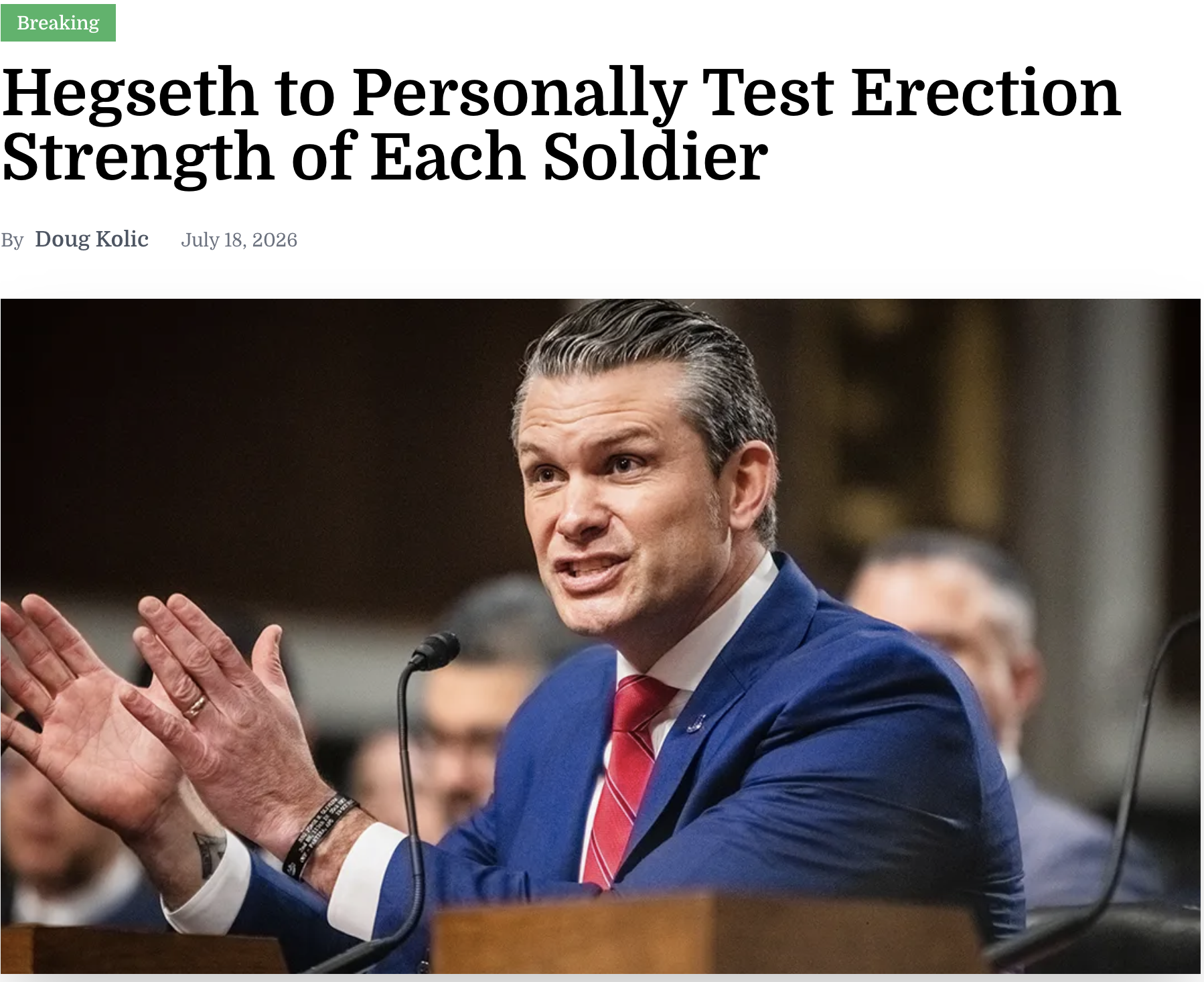
The Army felt it was important enough breach of regulations and rules along with a waste of taxpayer money to suspend and investigate those involved. Pete Kegseth our Fox host wannabe big time war general secretary of defense over ruled their decision and undermined their authority because it looked cool. He is acting like a 10 year old boy playing army with his toys. Kegseth also illegally removed 4 officers from being promoted to flag rank. Two because they were female and two because they were black. The rest he wanted to be promoted were white men of course. Hugs
More illegal actions by the wannabe dictator and his administration who believe anything tRump mumbles is the law of the land and they do not have to follow any rule or law. Hugs
tRump illegally deciding that his administration can decide who gets to vote and how voting is done. All by his decree. The dear leader has spoken. Hugs
More crime? Why am I surprised that people that rioted and attacked the US Capitol, breaking in and causing mass damage might not respect the laws? In that act they assaulted police, staff, and tried to kill congress members. Hugs
Spring is here, and so is a shift in what’s circulating. Flu season is officially behind us, tick season is just getting started, and a new Covid-19 variant is making the rounds in the news and on social media (but has not yet been felt in hospitals). And with Lyme disease season upon us, the news of a long-awaited vaccine couldn’t be more timely, though there are some real caveats worth understanding.
Here’s what’s going on and, more importantly, what it means for you.
Disease “weather” report: what’s spreading right now?
Good riddance, fluseason. We are officially out, as rates have now fallen below the “epidemic threshold.” Some states are still high, like New Mexico, but the trend is the same. The other main fall/winter viruses, including RSV and Covid-19 are all decreasing, too.
Odds are that if you get sick in the next month or two, it will be the common cold (the gray line below). This will continue to increase until May/June.
Percent of positive tests for respiratory viruses. Source: NREVSS; Annotated by Your Local Epidemiologist
Enter tick season. Emergency department visits for tick bites are low but climbing, which is normal for this time of year. Expect two waves: one peaking in May and another in mid-October. By year’s end, more than 500,000 people will likely be diagnosed and treated for Lyme disease.
Ticks thrive in warm, lush spring environments and can carry pathogens responsible for over a dozen diseases. Lyme is the most well-known. It can cause flu-like symptoms and, if untreated, serious complications including neurological and cardiac issues.
Not all ticks carry disease. Risk depends on the species, geography, and duration of a tick’s attachment. Currently, tick-borne illnesses are most concentrated in the Northeast, with emergency department (ED) visits at 13 per 100,000 people.
What this means for you: You can take several steps to protect yourself from ticks, including applying DEET or picaridin, treating clothing and gear with products containing 0.5% permethrin, and conducting thorough tick checks after engaging in outdoor activities. Here is a YLE deep dive on tick threats.
A new Covid-19 variant is getting attention. What’s going on?
Covid-19 continues to mutate, and the latest variant attracting attention is BA.3.2 (nicknamed “Cicada”), a descendant of Omicron that has been circulating globally for some time.
BA.3.2 now accounts for 11% of U.S. cases, but it’s too early to tell how quickly it’s growing. What is clear is that it has yet to trigger a surge. Wastewater levels, emergency department visits, and hospitalizations all remain low. Historically, a variant doesn’t drive a significant new wave until it reaches ~50% of cases.
% of circulating variants for Covid-19. Source: CDC; Annotated by Your Local Epidemiologist.
What’s drawing attention is the spike protein, which has 75 mutations compared with the strains included in last fall’s Covid-19 vaccines. The spike protein acts like a key that unlocks our cells, and when that key changes enough, existing antibodies struggle to recognize and block it. Lab studies confirm this is happening, but antibodies are just one layer of defense. The immune system has other tools that protect against serious illness, and current immunity is expected to hold up.
One thing researchers are actively tracking: early signals suggest BA.3.2 may be infecting kids at higher rates than previous variants. It’s hard to know whether this is real or just random chance, but if it is real, it’s likely due to a combination of many factors. For example, younger kids might not have seen as many Covid-19 variants or had as many coronavirus infections as adults, so they might be less immune to it.
Q: Could this cause a spring/summer wave? A: We have very little data on how fast this is growing, so time will tell. My guess is this will cause a spring/summer wave, but not a nothing burger or a tsunami.
Q: Should people over 65 get a spring Covid-19 shot? A: If it’s been at least three months since your last dose, a spring shot is a reasonable call. Timing it around May or June tends to align well with how Covid-19 seasons typically play out.
Q: Is a second shot within a year a booster? Or is it only a booster if the formulation is different? A: The term gets thrown around loosely. Generally, a booster means a repeat dose of the same vaccine, not necessarily a new formulation. The strains for the next updated Covid-19 vaccine haven’t been selected yet, so there’s no new version available right now. If a pharmacist tells you there’s no booster available, they may be thinking specifically of an updated formulation. A repeat dose of the current vaccine is still an option worth asking about.
Q: Could BA.3.2 spark the next pandemic? A: No. In fact, researchers have argued that another coronavirus pandemic is now less likely, not more, precisely because Covid-19 and the vaccines that followed built widespread, robust immunity across the global population.
A Lyme disease vaccine may finally be on the horizon
Ticks spread Lyme disease, one of the most common and debilitating infections in the country, and for the first time in over two decades, a vaccine to prevent it may finally be on the way. The only vaccine we had before, LYMErix, was pulled from the market in 2002. Not because it was unsafe (the FDA found no real problems) but because rumors about arthritis side effects, amplified by bad press and lawsuits, scared people.
Now Pfizer and French vaccine company Valneva have announced their new vaccine candidate worked in more than 70% of cases in a large late-stage trial of 9,400 people aged five and older.
How does the Lyme disease vaccine work?
The vaccine works differently from most other vaccines in a very cool way. Instead of just protecting you, it actually works inside the tick:
The vaccine trains your body to make antibodies against a protein (called OspA) found on Lyme-causing bacteria.
When a tick bites you, it drinks your blood along with those antibodies.
The antibodies neutralize the bacteria in the tick’s gut, stopping it from ever reaching its salivary glands and getting into you.
Graphic from Janet Loehrke at USA TODAY. Annotated by Your Local Epidemiologist.
But there are a few things worth understanding
The trial hit a statistical snag. The trial had fewer Lyme disease cases than expected, making the results too uncertain to be conclusive. Researchers had planned two ways to measure the vaccine’s effectiveness before the study began: one starting 28 days after the final dose, which fell just short of the required confidence threshold, and one starting the day after the final dose, which cleared it. Pfizer cited both results in deciding to seek regulatory approval.
The regulatory path is murky.The manufacturer will seek FDA approval, and if granted, the vaccine will go to ACIP for a policy recommendation. The problem: ACIP currently has no members. What happens next is genuinely unclear.
The bigger question is whether people will actually use it. The vaccine requires four doses over about a year, plus what looks like an annual booster before tick season. That’s a real commitment. Lyme disease is far better known today than it was in 2002, which gives people more reason to seek protection. But wanting a vaccine and completing every dose are two very different things.
Good news
Big Tech’s Big Tobacco moment. Last week, a Los Angeles court found Meta and YouTube negligent in the design of their platforms, ruling that features like infinite scroll and autoplay deliberately built addiction into the apps, and that executives knew it and failed to protect young users. The decision could set a precedent for more than 1,500 similar pending cases.
TB rates are falling after years of post-pandemic rise. New CDC data show that last year, 10,260 TB cases were reported, representing a 2% decline in the national rate compared with the year before. Cases fell across 26 states and Washington, D.C.
Birthday celebration! Remember that infant botulism outbreak? Amy Mazziotti, mother of Hank, who was hospitalized for 12 days for botulism after drinking ByHeart baby formula, just celebrated Hank’s first birthday. She received a letter from the public health response team that helped her. Each year, this public health team mails roughly 200 cards to babies who recovered from botulism. Program assistant Robin Hinks decorates them with drawings, like frogs in party hats and penguins with balloons. A small, loving, above-and-beyond act. Read more about this from Matt over at YLE CA.
Bottom line
The seasonal transition brings real shifts in disease risk, and a little awareness goes a long way. Have a wonderful week!
Love, YLE
Your Local Epidemiologist (YLE) is founded and operated by Dr. Katelyn Jetelina, MPH PhD—an epidemiologist, wife, and mom of two little girls. YLE reaches over 425,000 people in over 132 countries with one goal: “Translate” the ever-evolving public health science so that people will be well-equipped to make evidence-based decisions.