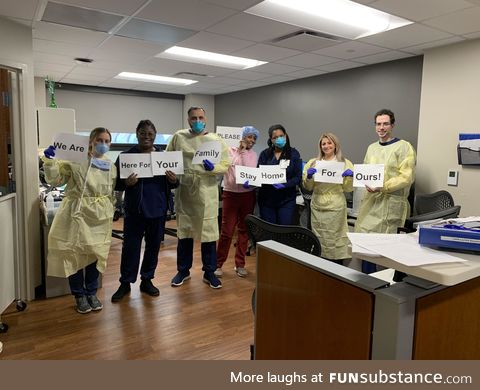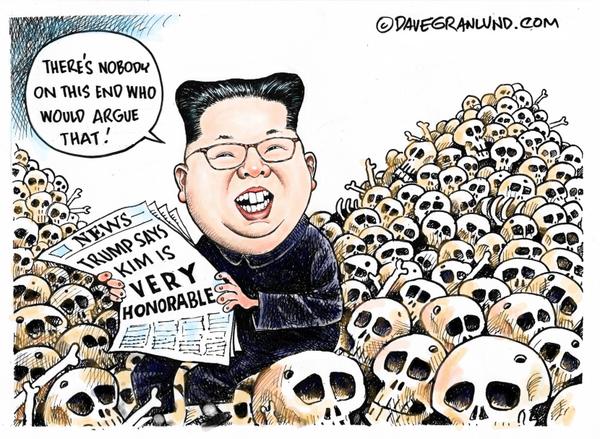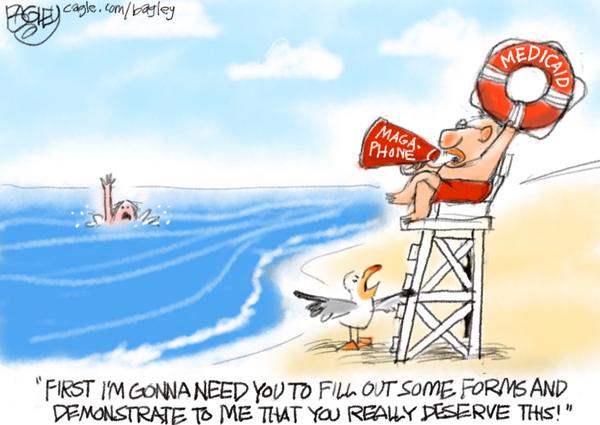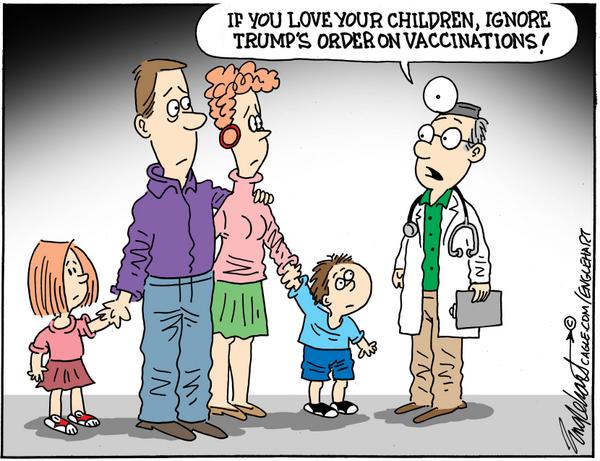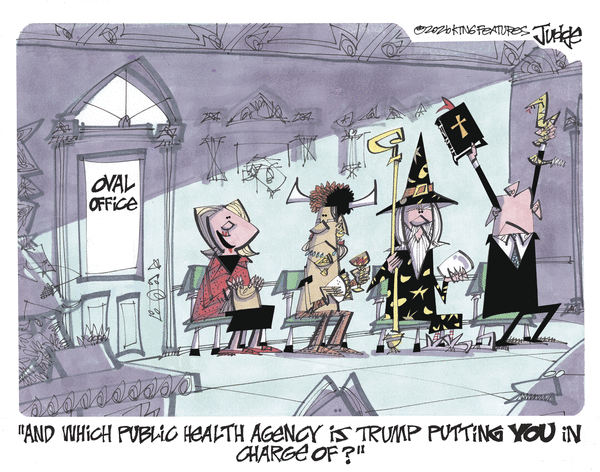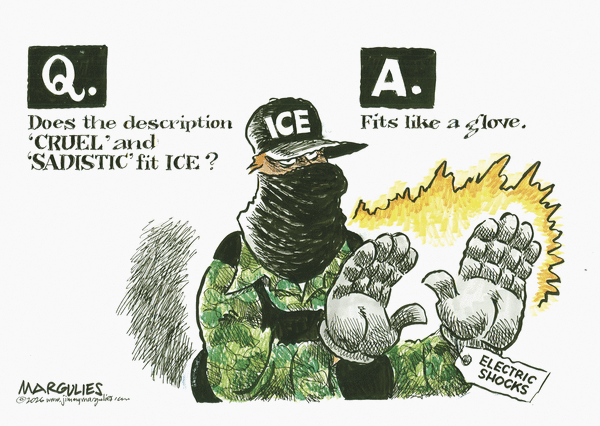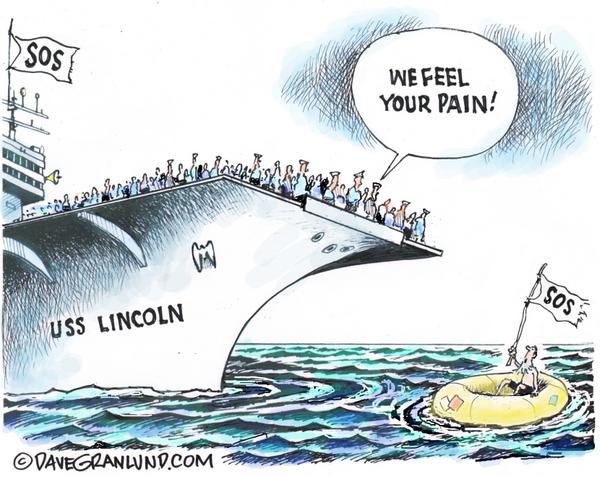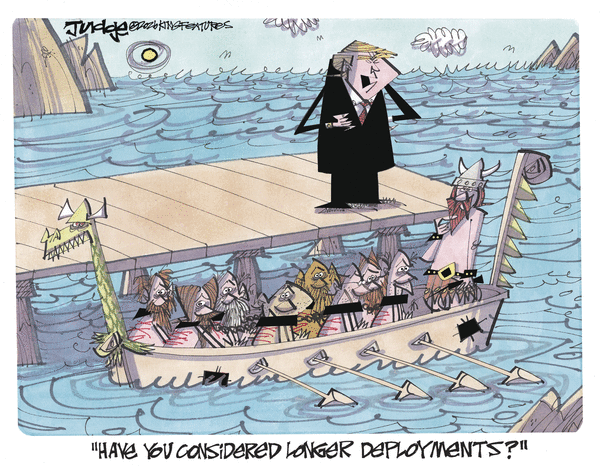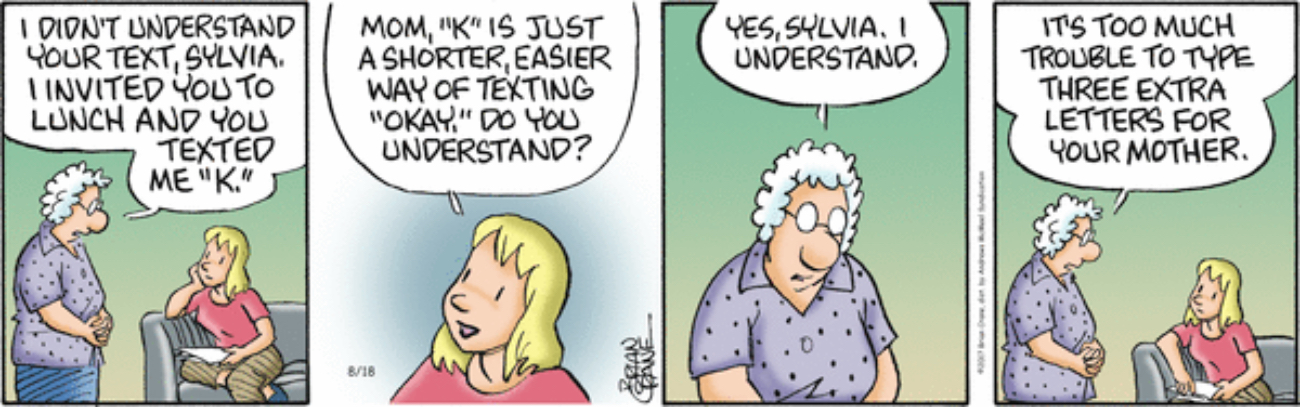



















Dr. Tarek Loubani, a Canadian emergency room physician who has been volunteering in Palestine joins the program from Gaza for a harrowing interview. If you can, please support Dr. Loubani’s Glia Project, a medical solidarity organization that empowers low-resource communities to build sustainable, locally-drive healthcare project.
Tag: Health
From Jenny Lawson, Between Tour Appearances
Mentally though, I’m here
Hello friend!
I am leaving for the second part of my book tour in 10 hours and I have not done laundry, packed, or (if I’m being honest) unpacked from the first leg of book tour. In spite of the fact that the first stops were so lovely and fun and filled with fellow weirdos who completely understood my anxiety, I am once again convinced that everyone will hate me and no one will show up and probably I will be eaten by sea lions. So right now I am writing this to you and reminding myself that everything will be okay.
I did lots of little drawings this week but Hunter S. Thomcat is laying on my sketch pad and I don’t want to move him so instead I’m sharing a drawing from the book because I drew it when I was having a high anxiety week and it feels fitting to come back to it now. Just a reminder that even when things feels scary, you can always make a little oasis in your mind. My spell check tried to change that to “you can always make a little oatmeal in your mind” and I’m feeling very relieved that I caught that because that’s even weirder than my normal letters to you.

WAIT, DID I TELL YOU HOW TO BE OKAY WHEN NOTHING IS OKAY IS #4 ON THE NYT BESTSELLER LIST?
Sorry. Didn’t mean to yell. It’s just late and my meds have worn off.
If you’re in California, Oregon or Austin, come join me?
Barnes & Noble in California
Powell’s in Oregon
Book People in Austin
I super crazy love you,
~ me
What leading Planned Parenthood is like now
Apr 08, 2026 Errin Haines
This story was originally reported by Errin Haines of The 19th. Meet Errin and read more of their reporting on gender, politics and policy.
This column first appeared in The Amendment, a newsletter by Errin Haines, The 19th’s editor-at-large. Subscribe today to get early access to her analysis.
When Alexis McGill Johnson took the helm as leader of Planned Parenthood in 2020, the nation’s largest provider of reproductive care and a major force in American politics was already at a critical juncture.
The organization’s last president had lasted just eight months; she followed Cecile Richards, the charismatic and connected leader who was in the role for a dozen years. The future of abortion rights looked potentially shaky, and Donald Trump was in his first term.
In the six years since, the U.S. Supreme Court ended federal protections for abortion, a major challenge both for providing care and for the organization’s political arm — then Trump won a second term and moved to take away federal funding, slashing a third of Planned Parenthood’s budget. Under the first Trump administration, Planned Parenthood had more than 600 health centers. Since the start of 2025, 53 have closed. More are threatened since Trump on July 4 signed into law a measure to block them from accepting Medicaid.
The end of federal abortion protections led to a surge in energy around the issue from Democrats and the left. It has faded since then as the president’s military actions and mass deportation strategy dominate attention — but McGill Johnson still has to figure out how to galvanize supporters; keep Planned Parenthood clinics serving patients; and elect Democrats in key races in states including Georgia, North Carolina and Ohio.
As one of the abortion rights movement’s key standard bearers, McGill Johnson is navigating expectations from activists, donors and voters who want a fighter and expect her to deliver. Their sense of urgency can obscure what it means to both lead the fight and provide essential care to millions of Americans in an intentionally overwhelming and chaotic news cycle.

“When I look at where Planned Parenthood is in this moment, we are navigating all of the chaos, but also looking for where the opportunities are inside that chaos,” McGill Johnson said. “Chaos is a strategy: throw everything at people so they don’t know where to look or how to fight.”
McGill Johnson describes her style as collaborative; those who know her best say she’s a master strategist, confronting a challenging political climate with courage, clarity and creativity.
The political climate in which McGill Johnson has led can really not be compared to any other past leader, said Fatima Goss Graves, president of the National Women’s Law Center.
“This isn’t something that’s happened over three decades; this has been the last six years,” said Goss Graves, who first met McGill Johnson in 2017 after Goss Graves became the first Black woman to head her organization. “Alexis was the right person at the right time. It is a big deal that surviving the level of attacks they have faced, that they are still here, they are serving patients, they are still committed, and they have had to make adjustments. The work is what she’s doing.”
Planned Parenthood is shorthand for dual entities: Planned Parenthood Federation of America, the nonprofit supporting affiliate clinics across two dozen states; and Planned Parenthood Action Fund, the group’s political arm, focused on organizing, advocacy and voter education.
McGill Johnson’s path to leading both came after a career working on voting rights and civil rights, and she approaches the work through a racial and gender lens. She is only the second Black woman leader in the organization’s existence of more than a century.
Her presence at the top of Planned Parenthood reflects a broader pattern in American institutions, in which Black women are often called on to lead in moments of crisis, with limited room for error and a lack of support.
McGill Johnson talked about the added weight of doing this work as a Black woman in a movement that has been largely White at the national level. She said that having lived and worked at the intersection of race and gender has been an asset in her current role.
McGill Johnson is familiar with leading in moments like the one Planned Parenthood is facing, “moments where our leadership is judged more harshly, where we may be granted more scrutiny, less grace.”
“Those are the places where I’ve had to find my center, to remind myself that I’m in this role to be unapologetic about fighting for the liberation of women of color, Black women, at the center of that liberation, because I think that actually transforms the liberation of everyone else,” she said.
Former Democratic U.S. Sen. Laphonza Butler, the first Black woman to head EMILY’s List, the political action committee focused on electing Democratic women, put it this way when asked about the challenges of leadership for Black women: “It is an expectation whose bumper sticker reads: ‘Fix it for us, please.’ When you look across the movement spaces where both crisis and care are on a collision course, it is Black women like Alexis who are stepping up.”
The Supreme Court’s 2022 decision in Dobbs v. Jackson Women’s Health Organization, which ended the nearly 50-year precedent of legal abortion access nationwide, angered many Democratic women and motivated them in record numbers in the 2022 midterm elections.
Then-Vice President Kamala Harris championed reproductive rights as a pillar of her 2024 presidential campaign — but her loss was criticized by some, in part, as prioritizing abortion access over the economy. Now, the Democratic Party’s uncertainty around whether and how to talk about abortion to voters adds to McGill Johnson’s challenges in this moment.
The stakes on the ground are still life and death for many Americans, but political strategists say the issue of abortion has proved less politically potent as the national spotlight has moved on.
“For someone fighting on this issue, the progressive movement that was so galvanized is less so because they’re focused on many of the other things that Trump is doing that are dangerous to the country,” said Democratic strategist Karen Finney.
Abortion can still be a motivating issue for Democrats — especially as it’s related to the two biggest issues at the moment, health care and affordability, said Democratic pollster Celinda Lake.
“It’s still motivating to voters for turnout,” Lake said. “Right now, everything is being pushed out by the war and the economy. I think it will reemerge as a much more powerful issue in 2028. Health is the number one issue, the number one pocketbook issue. When you talk about abortion and broaden it, it’s very powerful there.”
McGill Johnson worked to do just that, emphasizing Planned Parenthood’s presence particularly in communities with a lack of options for reproductive care. Politically, she has framed the issue as one of affordability and of democracy, and is focused on a message to voters about how the administration’s actions in recent years are impacting them.
“It may not feel as though abortion is as front and center as it was in the year or two after the Dobbs decision … but when you bring it to people and remind them that these things are happening, it taps directly into that rage,” McGill Johnson said.
She added that part of the job now also looks like acknowledging the concerns of those in the movement as a leader of a complex organization with little room for error. Supporters of abortion rights — and even supporters of McGill Johnson herself — have criticized her for not responding strongly enough to attacks on access, saying they don’t see her fighting in the way they want.
What does it mean when some on the left are more in the mood for a wartime general than a collaborator?
“In the day-to-day, it is a lot of navigating people’s frustrations, anxieties and hopes, and how to keep people focused on that hope and a strategy for how to get there,” McGill Johnson said. “We’re living in moments where philanthropy has pulled back from a number of institutions where there is a federal defund, which has impacted a lot of my colleagues. One day, you’re navigating ICE and the next day, the country’s at war, right? All within the same time period. I think my kind of special superpower is the ability to kind of keep myself at the 30,000-foot view to understand how all of these things are interacting with each other.”
McGill Johnson said the urgent question for her is: Who are we going to be now that we’re no longer defending Roe? It’s one that no other president of Planned Parenthood had to grapple with after the landmark 1973 case that made abortion the law of the land.
Since 2019 when she became interim leader, Planned Parenthood’s supporter base — which includes volunteers, donors, activists and email subscribers — has grown from 13 million to 20 million.
In addition to her focus on the campaign trail, McGill Johnson will also have to continue the work of reimagining Planned Parenthood’s network of clinics as part of the national health care infrastructure. According to the organization, 1 in 3 women in the United States has visited a Planned Parenthood clinic.
“I believe that Planned Parenthood could become the Cleveland Clinic of sexual and reproductive health care, because we have such great clinical excellence,” McGill Johnson said. “We are already a leader in standardizing best-in-class care, on sexual, reproductive health care, including abortion, so I think a lot about what it would mean for us to to focus on seeing as many patients as Planned Parenthood can, but to also export that influence into ensuring everybody else’s is standard of care is raised.”
To get there, McGill Johnson will have to endure and survive the current climate and the demands of the post-Roe era. Reproductive Freedom for All President Mini Timmaraju said meeting the multiple challenges at the local, state and federal level with diminished resources and competing areas of attention is daunting.
“We have to do more than we’ve ever done before, and the funding is not what it should be,” said Timmaraju, the first woman of color to lead her organization. “We are all scrambling to make sure that in the moment where abortion funds need funding, clinics need funding, we also have enough resources for advocacy at every single level, and that’s really challenging in an environment where donors are understandably a little frustrated with progressive entities right after 2024 so we’re having to prove ourselves again, and continually having to prove and reprove, over and over again, the salience of abortion electorally.”
A.I. In Telehealth-Yeah, That’ll Make It Better!
It was a yesterday’s Wonkette tab, but I just got to that email over lunch. It’s a horrible story. Of course, the hospital likely is understaffed thanks to policies and practices of our government, but still. Here is this-
Conor Hylton’s family alleges in a lawsuit that he was pronounced dead by a “provider on a video screen” who had been monitoring him remotely
Cara Lynn Shultz is a writer-reporter at PEOPLE. Her work has previously appeared in Billboard and Reader’s Digest. People Editorial Guidelines
NEED TO KNOW
- Conor Hylton’s family has filed a wrongful death lawsuit against Yale New Haven Health-Bridgeport Hospital
- The ICU where Hylton was treated had no on-site doctors and relied on off-site telehealth monitoring, the complaint alleges
- A representative for the hospital tells PEOPLE, “We are unable to comment on pending litigation”
A dental student died in a Connecticut ICU where he wasn’t being cared for by an on-site doctor, but instead, was monitored remotely by an off-site physician via video.
The family of Conor Hylton has filed a wrongful death lawsuit against Yale New Haven Health-Bridgeport Hospital after the 26-year-old died in the Milford Campus’s intensive care unit. According to the complaint obtained by PEOPLE, the site is a “tele-ICU meaning there are no qualified ICU intensivists on site.” The complaint further states, “ICU intensivists are located off-site at a centralized remote location, purportedly monitoring critically ill patients through a video screen.”
In a statement to PEOPLE, a representative for the medical group said, “Yale New Haven Health is aware of this lawsuit and is committed to providing the safest and highest quality of care possible, however, we are unable to comment on pending litigation.”
Hylton first arrived at the hospital at 11:08 a.m. on August 14, 2024, with abdominal pain and vomiting, per the complaint, which says he was admitted and diagnosed with “pancreatitis, dehydration, metabolic acidosis, and alcohol withdrawal.” His condition “continued to change and deteriorate over the evening.”
At 4:30 a.m., the complaint says, “Mr. Hylton slid down in bed, his eyes rolled back and he became unresponsive and exhibited seizure-like activity, vomited, became bradycardic and code was called. He was intubated, but he could not be resuscitated, and he was pronounced dead.”
The complaint states that although the pronouncement of Hylton’s death was said to be made by an on-site doctor, it was actually done by a ‘tele-health’ provider on a video screen.”
According to the complaint, an on-site doctor was called to intubate Hylton, but “the provider summoned to perform the intubation did not know how to find the ICU and had to find someone else to show him where it was located. This led to a delay in [care].”
An expert medical opinion included with the lawsuit wrote, “no on-site doctor assessed Mr. Hylton from the time he was admitted to the ICU until after he exhibited seizure activity at 4:30 a.m.”
Joel T. Faxon, partner at Faxon Law Group, which is representing Hylton’s family, said in a press release: “It’s alarming to think in a supposedly intensive care setting: Where is a doctor? Where are the nurses? How does the emergency doctor not know how to get to the ICU to provide life saving care?”
Faxon confirmed to PEOPLE that neither Hylton nor his family were informed there were no on-site doctors at the ICU. As Faxon told PEOPLE exclusively, “If the Hylton family knew that their son was being placed in a fake icu with no doctor present they would have demanded he be transferred to a hospital that could properly treat him. They were never given that option and, tragically, Conor died as a result.”
CDC Mulls Plan To Classify COVID Vaccine “Injuries”
*** Personal Note. By Monday things here should be back to normal. Ron will be in Texas driving his sister home. I will have had the weekend to rest. Ron is on his last full day of doing no exertion not even house work. They went into a major artery in his wrist. He had a wrist board to keep the wrist from flexing for 24 hours, shower lightly but leave the large bandaid on. Change the bandaid after showering for 72 hours. Call 911 if it starts to bleed. On Saturday morning he is off restrictions and flies to Texas. Then he and his sister will drive to Florida. She will stay with us for a few days as her house here is emptied and then she will settle her stuff and go to New Hampshire. She is flying up there. Hugs ****
Axios reports:
Trump administration health officials are giving serious consideration to a plan that would make injuries from COVID-19 vaccines a formal diagnosis that can be coded in medical records. Increasing documentation of what’s still a loosely defined condition could help lay the groundwork for future lawsuits against vaccine manufacturers.
The ICD-10 system already covers general vaccine injuries and reactions to some specific vaccines, but it doesn’t have a designation for the COVID shot, whose safety has become a major point of contention within the administration.
The new code could allow providers “to identify, track, and study patients who experience adverse effects specifically related to COVID vaccines,” Mary Stanfill, a CDC health information specialist, said during a public meeting on code proposals last week.
Read the full article. You will recall that the cult has claimed that COVID vaccines cause the human body to become literally magnetic, and that they cause “turbo cancer,” autism, miscarriages, myocarditis, pericarditis, hearing loss, and taste loss. Oh, and the vaccines also supposedly contain graphene nanobots meant to connect people to the internet for the purpose of mind control.
Olympic Athletes Rapinoe and Bird Slam IOC Trans Ban: “I’m Sickened By It”
https://www.erininthemorning.com/p/olympic-athletes-rapinoe-and-bird
“It’s just a total acquiescence to the Trump Administration,” Rapinoe said.
Just In Case A Reader Happens By With Some Idea, Or Knows Where To Share This One:
I am in the waiting room
Hi everyone. I am in the waiting room and they just took Ron into the OR. So we got up at 3:30 am. We showered and packed our stuff. I forgot the sandwiches but I do have my chips and pretzels. Of all the people waiting I am the only one eating. I did not eat at home because Ron couldn’t eat and I felt it would be mean as he couldn’t eat and it would’ve mean. I am not really hungry but I took my medications and I am diabetic so I need something in my stomach.
The good news is his OR nurse is a friend of ours from our ICU days. She is a really great nurse and it is grand Ron had someone he knew. The bad news is the doctor was not sure if stents were the best course of action. Instead of by pass surgery. He will check to see how bad it is and if stents would work as Ron is a diabetic and stents tend to clog in a few years. So once he gets in there he will measure the pressure. Then he will explain to Ron if stents are appropriate or if a bypass operation would be a better option. Pretty scary. Hugs

From The “MUTTS” Blog:
Helping Pets and People When the World Feels Uncertain

There are many ways in which the world feels uncertain, and with every news update, we ask ourselves questions: What role do we play? How can we help? We know many readers turn to Mooch and Earl for a daily dose of comfort and joy. Recently, someone told us MUTTS is their “place to go for a warm hug each day.” Will raising a particular issue interrupt that sense of refuge that readers value here?
Not long ago, we received a letter from a reader named Tyla. With her permission, we’re sharing part of it below.
“With recent ICE raids impacting Minneapolis and communities across the country, some families are being separated very suddenly, and in many cases this has meant pets are left without caregivers. Animal shelters and rescues have shared that they’re seeing more animals being taken in or surrendered unexpectedly, and in some situations, people have stepped in to foster or adopt pets whose families were detained.
“The health and well-being of both people and animals isn’t always part of the conversation when issues like this come up, even though both are affected. Animals, especially, rely entirely on their families for care and stability, and sudden disruptions can be very hard on them.
“I was wondering if this is something the [MUTTS] team might feel comfortable acknowledging this, specifically from the perspective of how animals are affected.
“I understand this is a sensitive and complicated topic … I also know that many readers, including myself, turn to MUTTS as an escape from the real world, and I truly respect that. I just wanted to offer this suggestion thoughtfully, since when people are affected in situations like these, animals are often affected too, and their needs can easily be overlooked.”
Tyla’s letter moved us. We’d been thinking about this, too. We started drafting a blog post based on one specific concern: What happens to pets when their families are detained or deported? We were discussing this internally, and considering ways to help, when the scope widened. The news headlines, unfortunately, have not slowed down.
The world feels increasingly uncertain, but one thing we know for sure is that pets depend on the humans who love them. They don’t understand geopolitics or political parties. And the truth is, preparing for any unexpected event — from a natural disaster to a family emergency or something else — is an act of love and responsibility.
At MUTTS, we believe in compassion for all creatures. With that spirit, here are practical ways we can all help our human and animal neighbors.
If You’re a Pet Parent: Plan Ahead
- Choose a backup caregiver. Identify a trusted friend, neighbor, or family member who could step in temporarily if you can’t be home. Make sure they’re willing and understand what would be involved. Share basic care information in advance so nothing is left to guesswork. If you’re comfortable with it, you may even want to give them a spare key to your home (or tell them where one is hidden).
- Keep identification current. Ensure your pet’s tags and microchip records are up to date. Consider listing a secondary contact (such as your backup caregiver) on file with your vet.
- Prepare a small “just in case” kit. Put together a bag with essentials: medications, vaccination records, feeding instructions, favorite comforts like a blanket or toy, and a short written profile of your pet’s personality and needs. Think of it as something you’d want ready in any unexpected situation.
If you currently need assistance caring for your pet, know that there are many community resources around the country that may be able to help. You can start your search with PetHelpFinder.org, which allows you to search for pet pantries, affordable veterinary services, and other resources in your area. You might also contact your local animal shelter for guidance. Many shelters offer community assistance — and even if yours does not, it’s very possible they can help point you in the right direction.
If You Want to Help In Your Community
- Volunteer at a local shelter. Many animal shelters are already stretched thin, and shelters across the country are receiving pets whose guardians were detained or unexpectedly displaced. Time, donations, and supplies all help.
- Consider fostering. This is an incredibly impactful way to help pets in your community, especially right now. Fostering gives an animal stability during a time of upheaval. In some cases, it provides time and space for an eventual reunion with their family. It also helps shelters by freeing up room so they can care for more animals.
- Offer to be a backup pet caregiver for friends, family, or neighbors. You don’t need a specific reason to make this offer. You can simply say you’ve been thinking about family preparedness and realized how comforting it would be to know someone nearby could step in for your own pet if needed. Sometimes people hesitate to ask for help, and by offering proactively (and gently), you can remove that barrier and replace it with reassurance.
- Create or strengthen local support networks. If your area doesn’t have a pet food pantry, consider starting one. Offer to deliver pet food or walk dogs for families facing temporary hardship. Some communities have organized quiet grocery or supply deliveries for neighbors who are unable to leave home. No pet should go hungry because their family is going through a difficult time.
Build Real Connections In Your Community
This may sound simple, but it really matters. Support systems don’t appear overnight. They grow from familiarity and trust. If you don’t already have a close-knit community, consider planting the first seed. For example:
- Start a “take one, leave one” table or box. This could include books, baked goods, even extra apples or herbs from plants in your own yard.
- Bring back front-yard or porch time. Read or drink your coffee outside. Smile and wave at anyone who passes. This invites casual conversation without any pressure.
- Check on neighbors during extreme weather. A quick knock before a storm or heat wave can go a long way.
Remember that when communities feel connected, pets are safer too.
Share Your Ideas to Help Pets and People
If you have ideas we haven’t mentioned, we would love to hear them. In the spirit of MUTTS, we ask that comments remain friendly and constructive, aimed at helping animals and strengthening compassion. That’s something we can all stand behind.
— Ali Datko
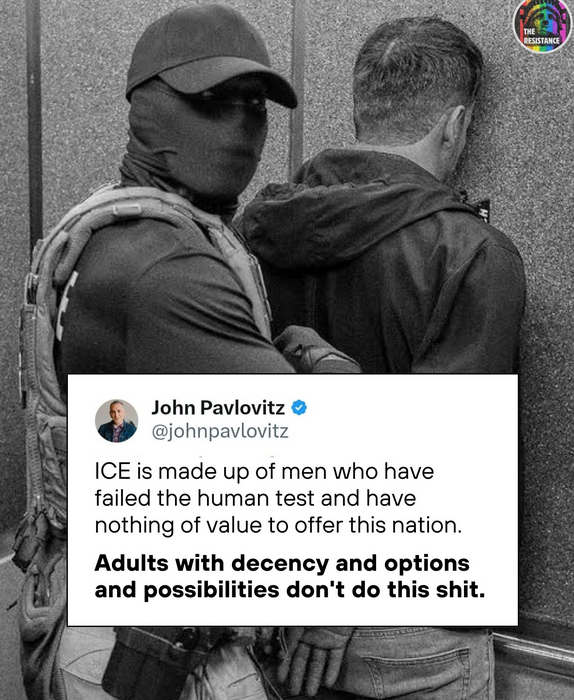
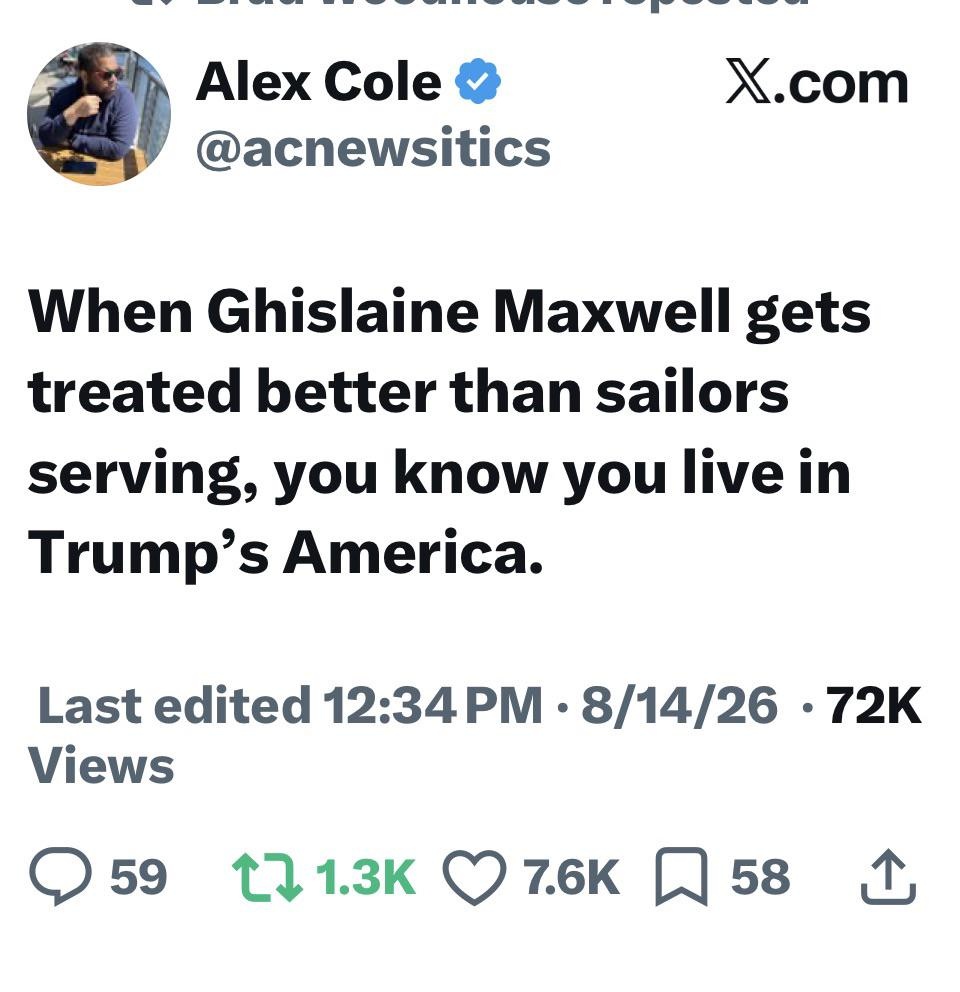
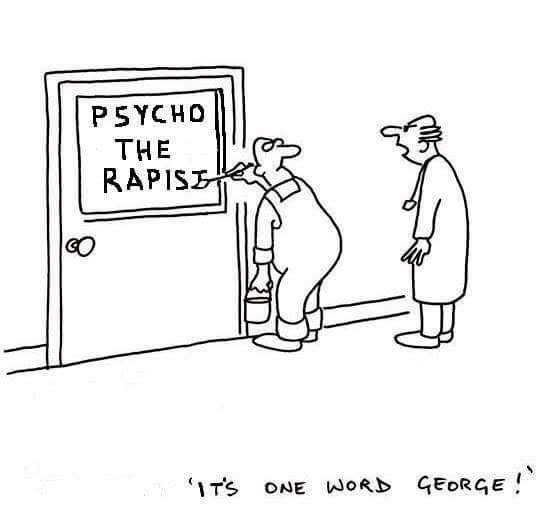
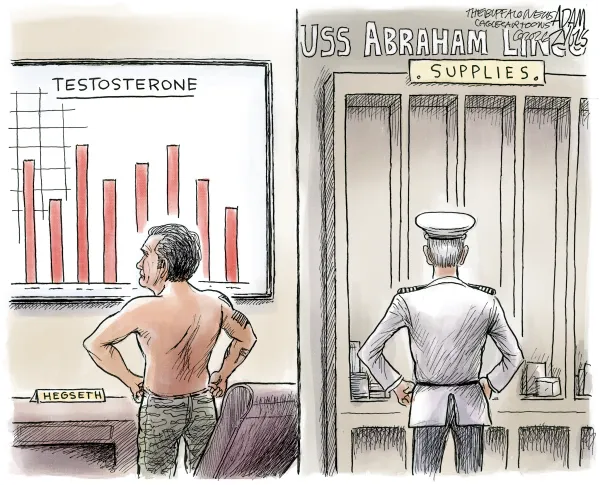
Political cartoons / memes / and news I want to share. 4-6-2026
Tomorrow is Ron’s heart catheterization. Today I have reached a breaking point. After I did the things that had to be done this morning I am dissociating. I find my mind simply shutting down. I am losing time not hearing or seeing anything. My mind keeps parking itself in neutral. I have to keep it together one more day. I made Ron his lunch and got him into bed making sure he had his CPAP on. I took out a pork tenderloin for supper, and I will make potatoes and what ever vegitable Ron wants for supper. I am so tired and sore. Hopefully one more day. Hugs