
Scottie and I each post from Pro Publica’s excellent news reportage; especially news that gets the barest mention everywhere else. Their excellent reporters can use a hand now. Please read and sign:
Tag: Human Rights
Stupid Is As Stupid Does
How Trump’s Vulgar, Criminal Easter Threat Enriches Iran
Juan Cole 04/06/2026
Ann Arbor (Informed Comment) – On Easter Sunday, God’s chosen in the White House issued a vulgar and unbalanced posting on his “Truth Social” that epitomizes the insanity of his Iran War. Attending to it closely will help us understand how Trump has strengthened the government of the Islamic Republic and put it in control of global energy. Trump fondly imagines that he can dislodge Iran from this new ascendancy, but he is wrong, since it depends on sabotage, a sabotage that cannot be policed.
This is embarrassing, Delete it, President @realDonaldTrump – unless you want everyone to think you’ve lost your marbles.

The foul language and clear mental imbalance visible in this announcement sparked a further round of calls for Trump’s removal under Article 25 of the Constitution, which is nothing more than an internet meme since Trump has surrounded himself on his cabinet with people even more certifiable than he is, and who wouldn’t dare move against him.
Trump, having imbibed whatever substance it is that makes him manic, announced that “Tuesday will be Power Plant Day, and Bridge Day, all wrapped up in one, in Iran. There will be nothing like it!!!”
He is repeating a threat he made previously, to bomb Iran’s civilian electricity-generating plants as well as its civilian bridges.
Iran has 98 major power plants fueled by fossil gas, which generate 85% of the country’s electricity. The largest, the Damavand power plant south of the capital, Tehran, has a generating capacity of over 2.8 gigawatts.
One of Iran’s power plants is nuclear, at Bushehr. If Trump or Israel bombs it, the consequent radiation pollution will deeply harm the Arab Gulf states, not only through airborne particles but also by contaminating sea water, which is drawn on by the region’s desalinization plants. This exposure to radiation would certainly increase cancer risk in the region. There are mountains between Bushehr and the Iranian interior, so the radioactive particles would be blown west toward other countries such as the United Arab Emirates, Saudi Arabia and Qatar.
Striking civilian power plants, and above all nuclear ones, endangers the noncombatant population of children, women and unarmed men and violates International Humanitarian Law.
In fact, the International Criminal Court in the Hague issued “warrants of arrest for two individuals, Mr Sergei Kuzhugetovich Shoigu and Mr Valery Vasilyevich Gerasimov, in the context of the situation in Ukraine for alleged international crimes . . .” on June 24, 2024. They were indicted for “for the war crime of directing attacks at civilian objects (article 8(2)(b)(ii) of the Rome Statute) and the war crime of causing excessive incidental harm to civilians or damage to civilian objects (article 8(2)(b)(iv) of the Rome Statute), and the crime against humanity of inhumane acts under article 7(1)(k) of the Rome Statute.”
Among the “civilian objects” that these Russian officials ordered attacked in Ukraine were power plants and structures such as the Kryukovsky Bridge.
So Trump is talking like a war criminal, which tells you why he has placed sanctions on International Criminal Court judges.
Trump already struck the unfinished B1 bridge linking Tehran to Karaj. Since it was not finished, it could not possibly have had a military purpose, contrary to the lies of the lying liars in the Trump administration who gave that as the excuse for hitting it.
Trump continued, “Open the Fuckin’ Strait, you crazy bastards, or you’ll be living in Hell– JUST WATCH!
It is not clear how a body of water such as a strait could copulate. However, it can engender revenue, and does so for Iran. A lot of revenue.
Iran has not actually closed the Strait of Hormuz entirely. It is exporting its own petroleum through that narrow aperture, mainly to China. Trump has been forced by the global oil shortage to lift sanctions on the Iranian tankers, and so Iran is also selling again to India. Before Israeli Prime Minister Benjamin Netanyahu rushed Trump into war on Iran on February 28, Iran was exporting about 1.4 million barrels a day to China. The price of petroleum was about $67 a barrel then, but Iran had to offer a steep discount to offset American sanctions, and so was probably only getting $57 or less a barrel. So Iran was getting something like $29 billion a year for its petroleum from China and a few other customers (90% goes to China).
China is now likely having to pay $110 a barrel for Iranian petroleum.
Iran’s oil income just went up to $55 billion a year if these prices and this volume of trade persists, which is plausible. So the “crazy bastards” in charge of Iran have nearly doubled their income off the Netanyahu-Trump war because of the fertility, under their control, of the “fuckin’ Strait.” The Iranian oil industry is state-owned, so all the money goes to the clerics and the Iranian Revolutionary Guards Corps, as well as to the conventional army and the elected institutions, the parliament and president. This extra income helps the government tamp down resistance, strengthening it against civil society. In any case, many Iranians under foreign attack are rallying around the flag. Of course there are also tax losses from the economic disruption of the war, but the vastly increased oil income helps make up for them as far as the government is concerned. If the price of oil goes to $200 a barrel, as it may well, Iran’s government could get $100 billion a year for its petroleum.
Not only that, but Iran has instituted a toll system, wherein countries that have good relations with Iran and pay a fee can transit the Strait without fear of an Iranian drone attack. In contrast, countries that Iran believes contribute to the American war effort against Tehran such as the Emirates and Kuwait, are blockaded by the threat of such strikes. These tolls could be an ongoing and lucrative source of income for the government. Before the war, 138 ships transited the Strait daily. If that traffic resumes but each has to pay Iran a $2 million toll, that would bring in $96 billion a year, i.e. four times what Iran was getting for its petroleum before the war.
So here’s the thing. With the advent of Iran’s Shahed drones, which can be manufactured inexpensively and of which it has tens and thousands, there is no way for anyone, including Trump and the US military, to stop Iran from sabotaging ships that won’t pay the $2 million. At least, I don’t see how it could be done. You’d need tens of thousands of interceptors, and we hardly have any left. Moreover, interceptors cost $1.5 million apiece, so it makes much more sense to allow each ship to pay Iran the $2 million.

Container ship in Strait of Hormuz. (U.S. Navy photo by Mass Communication Specialist 2nd Class Indra Beaufort).Public Domain. Via Picryl .
Trump has shown Iran how it can go into the protection business in the Gulf for the long term. Nice oil shipping industry you have here, it would be a shame if anything happened to it. And off that, Iran actually increases its GDP substantially.
If Trump takes out Iran’s electricity and bridges, he can interfere with its economy and its society in a big way. But he can’t stop the drones or the protection racket that way. Moreover, Iran has made it clear that its response will be to take out the power plants in the Gulf Arab states as well as in Israel. Since the US and Israel are running low on interceptors, and since even small Shahed drones have great range and can do a lot of damage, Iran’s threat is credible.
If Trump takes out Iran’s petroleum-production capability, Iran will crash oil production in the Gulf, taking 20 million barrels a day off the market for years to come. That would certainly be another Great Depression and likely would spell the end of the oil industry, since everyone in the world would migrate to electric vehicles quickly.
So although Trump meant the phrase ironically and blasphemously, the Iranian authorities may well end up saying “Praise be to Allah” over Trump’s monumental stupidity.
https://www.juancole.com/2026/04/trumps-vulgar-criminal.html
From The “MUTTS” Blog:
Helping Pets and People When the World Feels Uncertain

There are many ways in which the world feels uncertain, and with every news update, we ask ourselves questions: What role do we play? How can we help? We know many readers turn to Mooch and Earl for a daily dose of comfort and joy. Recently, someone told us MUTTS is their “place to go for a warm hug each day.” Will raising a particular issue interrupt that sense of refuge that readers value here?
Not long ago, we received a letter from a reader named Tyla. With her permission, we’re sharing part of it below.
“With recent ICE raids impacting Minneapolis and communities across the country, some families are being separated very suddenly, and in many cases this has meant pets are left without caregivers. Animal shelters and rescues have shared that they’re seeing more animals being taken in or surrendered unexpectedly, and in some situations, people have stepped in to foster or adopt pets whose families were detained.
“The health and well-being of both people and animals isn’t always part of the conversation when issues like this come up, even though both are affected. Animals, especially, rely entirely on their families for care and stability, and sudden disruptions can be very hard on them.
“I was wondering if this is something the [MUTTS] team might feel comfortable acknowledging this, specifically from the perspective of how animals are affected.
“I understand this is a sensitive and complicated topic … I also know that many readers, including myself, turn to MUTTS as an escape from the real world, and I truly respect that. I just wanted to offer this suggestion thoughtfully, since when people are affected in situations like these, animals are often affected too, and their needs can easily be overlooked.”
Tyla’s letter moved us. We’d been thinking about this, too. We started drafting a blog post based on one specific concern: What happens to pets when their families are detained or deported? We were discussing this internally, and considering ways to help, when the scope widened. The news headlines, unfortunately, have not slowed down.
The world feels increasingly uncertain, but one thing we know for sure is that pets depend on the humans who love them. They don’t understand geopolitics or political parties. And the truth is, preparing for any unexpected event — from a natural disaster to a family emergency or something else — is an act of love and responsibility.
At MUTTS, we believe in compassion for all creatures. With that spirit, here are practical ways we can all help our human and animal neighbors.
If You’re a Pet Parent: Plan Ahead
- Choose a backup caregiver. Identify a trusted friend, neighbor, or family member who could step in temporarily if you can’t be home. Make sure they’re willing and understand what would be involved. Share basic care information in advance so nothing is left to guesswork. If you’re comfortable with it, you may even want to give them a spare key to your home (or tell them where one is hidden).
- Keep identification current. Ensure your pet’s tags and microchip records are up to date. Consider listing a secondary contact (such as your backup caregiver) on file with your vet.
- Prepare a small “just in case” kit. Put together a bag with essentials: medications, vaccination records, feeding instructions, favorite comforts like a blanket or toy, and a short written profile of your pet’s personality and needs. Think of it as something you’d want ready in any unexpected situation.
If you currently need assistance caring for your pet, know that there are many community resources around the country that may be able to help. You can start your search with PetHelpFinder.org, which allows you to search for pet pantries, affordable veterinary services, and other resources in your area. You might also contact your local animal shelter for guidance. Many shelters offer community assistance — and even if yours does not, it’s very possible they can help point you in the right direction.
If You Want to Help In Your Community
- Volunteer at a local shelter. Many animal shelters are already stretched thin, and shelters across the country are receiving pets whose guardians were detained or unexpectedly displaced. Time, donations, and supplies all help.
- Consider fostering. This is an incredibly impactful way to help pets in your community, especially right now. Fostering gives an animal stability during a time of upheaval. In some cases, it provides time and space for an eventual reunion with their family. It also helps shelters by freeing up room so they can care for more animals.
- Offer to be a backup pet caregiver for friends, family, or neighbors. You don’t need a specific reason to make this offer. You can simply say you’ve been thinking about family preparedness and realized how comforting it would be to know someone nearby could step in for your own pet if needed. Sometimes people hesitate to ask for help, and by offering proactively (and gently), you can remove that barrier and replace it with reassurance.
- Create or strengthen local support networks. If your area doesn’t have a pet food pantry, consider starting one. Offer to deliver pet food or walk dogs for families facing temporary hardship. Some communities have organized quiet grocery or supply deliveries for neighbors who are unable to leave home. No pet should go hungry because their family is going through a difficult time.
Build Real Connections In Your Community
This may sound simple, but it really matters. Support systems don’t appear overnight. They grow from familiarity and trust. If you don’t already have a close-knit community, consider planting the first seed. For example:
- Start a “take one, leave one” table or box. This could include books, baked goods, even extra apples or herbs from plants in your own yard.
- Bring back front-yard or porch time. Read or drink your coffee outside. Smile and wave at anyone who passes. This invites casual conversation without any pressure.
- Check on neighbors during extreme weather. A quick knock before a storm or heat wave can go a long way.
Remember that when communities feel connected, pets are safer too.
Share Your Ideas to Help Pets and People
If you have ideas we haven’t mentioned, we would love to hear them. In the spirit of MUTTS, we ask that comments remain friendly and constructive, aimed at helping animals and strengthening compassion. That’s something we can all stand behind.
— Ali Datko
Political cartoons / memes / and news I want to share. 4-6-2026
Tomorrow is Ron’s heart catheterization. Today I have reached a breaking point. After I did the things that had to be done this morning I am dissociating. I find my mind simply shutting down. I am losing time not hearing or seeing anything. My mind keeps parking itself in neutral. I have to keep it together one more day. I made Ron his lunch and got him into bed making sure he had his CPAP on. I took out a pork tenderloin for supper, and I will make potatoes and what ever vegitable Ron wants for supper. I am so tired and sore. Hopefully one more day. Hugs








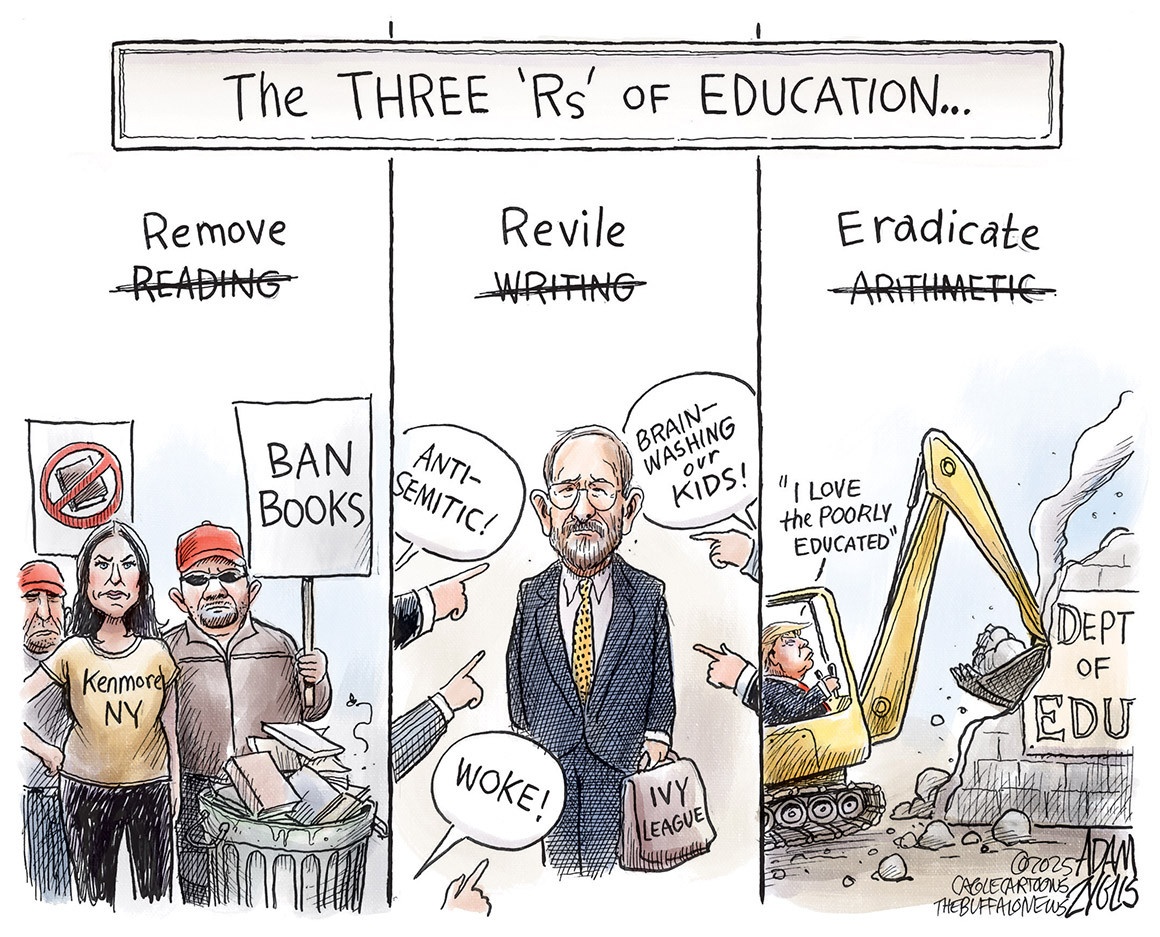


This Week, From Joyce Vance
The Week Ahead
The president of the United States greeted the country with this Truth Social post about his intentions in Iran on Easter Sunday: “Tuesday will be Power Plant Day, and Bridge Day, all wrapped up in one, in Iran. There will be nothing like it!!! Open the Fuckin’ Strait, you crazy bastards, or you’ll be living in Hell – JUST WATCH! Praise be to Allah. President DONALD J. TRUMP

No one seems to have got so far into the post as to notice that he said “Praise be to Allah,” which he would most certainly say was a jest, if asked. But imagine Joe Biden, or worse still, Barack Obama, saying that “in jest” and how Republicans would have responded. Trump is completely off the rails and Republicans are turning a blind eye, pretending it’s not happening.
Earlier this week, Trump’s “spiritual advisor” Paula White-Cain compared him to Jesus. Trump, too, was “betrayed and arrested and falsely accused,” she said. No one in the Republican Party seems to have believed they need to strenuously resist that characterization.
And so, we enter the new week with an unstable president at the helm in wartime. Meanwhile, at home, there are plenty of issues mounting. But Trump seems to have largely gotten away with knocking his connection to Jeffrey Epstein and allegations about his personal conduct off the front burner.
Laura Loomer is influencing policy changes at DOJ
After Trump fired Attorney General Pam Bondi, there appears to be another significant personnel change in the works at DOJ, this one inspired at least in part by Laura Loomer’s dislike of the number three official at DOJ, Associate Attorney General Stanley Woodward. Trump appears to be on the verge of replacing him with the current Assistant Attorney General for the Civil Rights Division, Harmeet Dhillon, who has upended its work and overseen a mass exodus of career personnel.
Woodward was the defense lawyer for one of Trump’s co-defendants in the Mar-a-Lago case, Walt Nauta. His client hung in there with Trump, instead of flipping and offering testimony against him in exchange for a deal. That worked out well for Nauta, but only because Trump won the election. Most lawyers acting in the client’s best interests in that type of situation would have worked toward a plea. Lost in the plot from that case was the conflict of interest Woodward had that could easily have kept him from representing Nauta and might have resulted in another lawyer voluntarily stepping aside. Woodward had previously represented one of the witnesses who decided to cooperate with the prosecution after receiving advice from a lawyer who wasn’t connected to other defendants. Judge Cannon permitted Woodward to represent Nauta despite that conflict, after Nauta waived it. Woodward has also represented White House adviser Peter Navarro, who was prosecuted for obstructing Congress when he ignored a subpoena from the January 6 committee, FBI Director Kash Patel when he testified before a grand jury about Trump’s retention of classified documents, and one of the defendants in the Oath Keepers prosecution.
All that to say, Woodward was a known quantity for Trump when he appointed him. But that doesn’t seem to have been enough to save his job, just over a year into it.
There’s been some suggestion on social media that Laura Loomer is, at least in part, responsible for the change. Loomer is a conservative activist and online influencer who has claimed the ability to impact Trump’s hiring and firing decisions in the past. Last August, Trump was asked about that and said, “She makes recommendations on things and people. And sometimes I listen to those recommendations, like I do with everybody. I listen to everybody. And then I make a decision.” Loomer has never been a fan of Woodward’s.

Her concerns center on Woodward’s wife, apparently, not Woodward. She has had them since before he was confirmed.

Woodward’s wife apparently has the audacity to have her own views on issues, and they are…not racist. Loomer reiterated her take just before Trump made his move at DOJ, also attacking Todd Blanche, the former Trump criminal defense lawyer who is now in charge of the Justice Department in an acting capacity. Blanche and Woodward may have been surprised to learn that, according to Loomer, they’re now Democrats.

That’s a lot of maneuvering, that benefits Dhillon, who has overseen the dismantling of much of the Civil Rights Division’s work, including voter and election protection, and gone on the attack for the administration. That might have made her an attractive candidate for the position to Trump without more. If confirmed by the Senate as “the Associate,” as the number three position at DOJ is called, Dhillon would supervise her old division, Civil Rights, as well as the Civil Division, the Antitrust Division, the Environment and Natural Resources Division, and an administrative division that oversees grant funding. It’s a substantial role and could be a stepping stone to a still higher office.
This is more than a personnel squabble within DOJ and warrants our close attention. Since taking over the Civil Rights Division, Dhillon has made a number of decisions with significant consequences that run contrary to the history of the Division, including:
- Setting priorities for the Division that included putting an end to DEI, supporting gun rights, protecting religious liberty by filing lawsuits challenging what DOJ views as anti‑Christian discrimination, and opposing transgender participation in women’s sports.
- Pressuring colleges and universities over DEI programs and allegations of antisemitism. In one notable instance, the president of the University of Virginia was forced out for failing to move quickly enough to end DEI.
- Ending, as her predecessor Jeff Sessions did, consent decrees with Police Departments. In her case, it was Minneapolis (George Floyd) and Louisville (Breonna Taylor), in cases involving systematic misconduct. She ended investigations in other jurisdictions, changing the environment to one that is far more tolerant of police misconduct.
- Abandoning employment discrimination cases, as well as the work of the disability section to protect access, and work combating housing discrimination.
- Countermanding early work in the U.S. Attorney’s office in Minneapolis to investigate ICE agent Jonathan Ross, who fired the shots that killed Renee Good. Much of the career leadership in that office resigned in the wake of that decision.
We don’t yet know who Trump will nominate to be the next Attorney General. Dhillon was confirmed 52-45 for the Civil Rights job, garnering no votes from Democrats but mustering support from every Republican. She’s been effective at pushing her priorities, which are Trump’s priorities, and at pushing career people out the door. A Justice Department under her leadership might make people long for Bondi’s simpering incompetence.
To come full circle, this was Dhillon’s response to Trump’s “Fuckin’ Strait” post this morning:

The Trump Administration appeals Anthropic’s victory.
Thursday morning, the government filed its notice of appeal after Anthropic won a victory against it in the lower court. That means it will try to overturn Judge Lin’s injunction, which prevents Trump/Hegseth’s designation of Anthropic as a supply-chain risk. We’ll likely see an effort to get an order from the Ninth Circuit to set that injunction aside while the litigation is underway this week
The federal civil rights investigation and prosecution we won’t see.
The Buffalo Medical Examiner ruled that the death of a legally blind elderly Burmese refugee dropped off by Border Patrol at a closed shop late at night in winter was a homicide. The facts of the case are terrible. And there’s a federal criminal law designed to address this kind of civil rights violation by federal agents acting “under color of law.”
NBC reported that Nurul Amin Shah Alam died of a burst ulcer caused by severe stress brought on by dehydration and hypothermia, which was brought on by the agents’ abandonment of him. The statute permits prosecution of agents who deprive a person of their rights because they are an alien. If DOJ were operating properly, there would be an open investigation. The potential charge is a serious one, based on the denial of rights, not a homicide. The punishment under the law, “if death results” from agents’ actions, can be life imprisonment or even the death penalty. Any other DOJ would be focused on getting this case and doing justice.
The DHS shutdown is still on.
The House failed to take action to pass the Senate’s bipartisan funding deal to reopen the Department of Homeland Security last week. That means the shutdown will continue at least until Monday, when Congress is back in Session. The Senate compromise withhold money the administration wanted to push Trump’s immigration agenda, but would fund DHS until the end of the fiscal year.
TSA workers in the Portland, Maine, airport cheerfully told me last week that they had received some back pay, but had no assurances of receiving paychecks going forward. Hard-working TSA employees are being forced to bear the brunt of Trump’s inability to run the government. It’s surprising Democrats aren’t driving this message every day. And, with hurricane and fire seasons approaching, FEMA funding is sure to be an issue soon, as well.
And, DOJ still hasn’t released all of the Epstein Files.
I have no intention of forgetting that there is more to that story.
Thank you for being here with me at Civil Discourse. It’s going to take all of us, staying informed and working together, to keep the Republic. If you’ve been enjoying the free posts, upgrading to a paid subscription is a great way to help keep the newsletter coming and to contribute to the time and resources it takes to stay on top of law, politics, and this administration.
We’re in this together,
Joyce
Clay Jones, Leading Kansas
I wish! 😄 Leading Kansas writes this time in regard to data centers, and about addressing our local governments in our own behalf. It works the same in every state.
He Has Risen
To vote yes
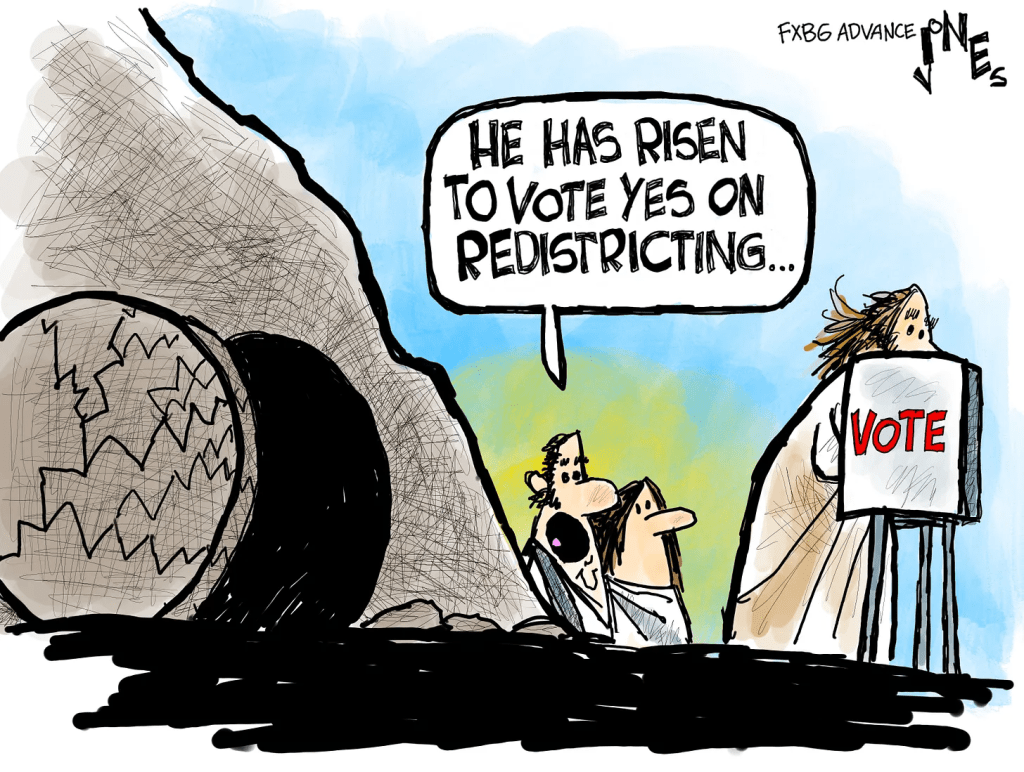
This cartoon was drawn for the Fredericksburg Advance. But don’t yell at them for it; you can yell at me.
If you live in Virginia, you have been bombarded with flyers about the special election on redistricting. And it’s not just flyers but also TV commercials, which are also popping up online. We are getting these things from both sides.
There is a special election in November on a state constitutional amendment that would give Democrats as many as four seats in Congress. The measure would also temporarily bypass the state’s redistricting commission to redraw maps in the middle of the decade.
The state’s Supreme Court approved the measure to be on the ballot less than a week before early voting began. State Republicans repeatedly tried to stop Democrats from moving forward with the referendum. The irony here is that Republicans claim that voting yes will disenfranchise voters, while they literally tried to keep this off the ballot so people couldn’t vote on it.
This is a direct response to Donald Trump and Republicans redistricting mid-decade to give themselves more seats. Donald Trump even said he was entitled to have more congressional seats. This is one reason why we need to No Kings protest. Donald Trump already believes he’s entitled to win elections he’s lost. (snip-MORE, and it’s on point)
The Parsons Project
by André Swartley
Key points at a glance
- Energy company Deep Fission is in the process of building a new and untested type of underground nuclear reactor in Parsons, KS
- The Trump administration has reduced regulations to encourage nuclear power production
- The reactor will likely power data centers for artificial intelligence
- Large data centers consume huge amounts of water and energy and produce different types of pollution, leading to health risks for nearby residents
In November 2025 a two-year-old energy company called Deep Fission broke ground in Parsons, Kansas. They hope this project will enable them to install the second ever energy producing nuclear reactor in the state, after Wolf Creek, potentially with more reactors on the way in the future. If the early “characterization” drilling goes to plan, they claim the reactor could begin pumping electricity into the grid in the near future.
Parsons is a city of 10,000 in southeastern Kansas, near the Oklahoma border. I’ve lived in Kansas for most of my life and I had not heard of Parsons until last week. So, why is Deep Fission in Parsons, Kansas, and why now? Not coincidentally, the Great Plains Industrial Park, also located in Parsons, has lately been advertised as a prime location for new data centers to power the trillion-dollar (yes, trillion with a T) artificial intelligence boom forced upon us by large technology corporations and their venture capitalist backers. Which means the Parsons nuclear reactor project would likely come as a package with one or more new data centers, along with potential economic prosperity and a host of legitimate concerns that community members have already raised.
Part 2: The New Nuclear Power
While the Department of Energy set a goal for the Parsons reactor to go online in July of this year, Deep Fission themselves are aiming to connect to the grid by 2027 or 2028. Two years is still an unusually rapid rollout for a nuclear power plant, which usually takes 6-10 years from groundbreaking to full operation.
This reduced timeline comes by way of the Trump Administration’s efforts to slow the national and worldwide adoption of renewable energies like wind and solar power. In February of this year alone, Trump’s Department of Energy halted the approval of “168 projects – those that focused on renewable energy projects” while allowing nearly 11,000 other energy projects to proceed as planned, including new nuclear energy projects. Executive Order 14301 in May of 2025 provided Deep Fission with the means to build their experimental nuclear reactor on such a short timetable.
Nuclear energy is typically labeled as “clean” energy compared to coal, oil, and natural gas, meaning that it releases fewer pollutants into the air and water than fossil fuel consumption. Still, there are two main concerns. First is the disposal of nuclear waste, which ranges from the lightly contaminated clothing of plant workers to the lethally radioactive spent fuel a plant produces over time. This latter “accounts for just 3% of the total volume of waste, but contains 95% of the total radioactivity.”
A relatively new method in the US and Europe for disposing of our most dangerous nuclear waste is to bury it very deep underground, so that it can be surrounded by solid rock to provide the same level of pressure containment as required at structure at a surface nuclear reactor facility. The father-daughter team that eventually founded Deep Fission originally created Deep Isolation to dispose of nuclear waste. Deep Fission takes their concept a step further by placing the entire reactor, and therefore its most dangerously radioactive elements, into a borehole drilled one mile underground.
The second main concern related to nuclear energy production is, of course, accidents or attacks. It is true that large-scale nuclear accidents are very rare, but when they happen, they become instant, globally recognized disasters whose names we all know: Chernobyl, Three Mile Island, Fukushima. The effects are so widespread as to be practically impossible to quantify. The reactor explosion and meltdown in Chernobyl, for example, caused several dozen deaths directly related to radiation exposure, but various studies have predicted anywhere from thousands up to a million eventual additional cancer deaths. Not to mention the environmental and economic cost to the entire region around Chernobyl. And radioactive boars still terrorize people and farmland in the region around the Fukushima plant in Japan.
But those issues are known, and regulations have historically attempted to shore up potential dangers posed by new plants. In contrast, nothing like the underground nuclear reactor in Parsons, Kansas has ever been attempted before, and thanks to Executive Order 14301, will not need to go through long established design and testing phases that other types of nuclear reactors have been subject to in the past. John Young, a mining environmental regulatory specialist who lives in Sedgwick County, asks, “Why abandon the current regulatory process for something created out of whole cloth with no public input? And no one can define the current regulatory pathways for Federal and State authorizations.
“What,” Young asks in frustration, “could possibly go wrong?”
Part 3: Data Centers and Artificial Intelligence
So that is a glimpse into the nuclear energy side of things. Next we must address concerns around data centers and artificial intelligence. Data centers come in different sizes, like the smaller center being proposed in Wellington, KS, which would reportedly “use roughly 30% of the city’s electrical capacity while generating an estimated $1.3 million in annual electric utility revenue” while consuming only two gallons of water per day. Larger data centers consume resources less modestly. “Around the country, and the world, there is a land race among the big tech companies for sites for their data centers,” claims a November 2024 investigative report by Rolling Stone. Data centers are much newer than nuclear energy technology, yet the ways in which they harm communities near them have already become apparent.
Water: “Large data centers can consume up to 5 million gallons per day, equivalent to the water use of a town populated by 10,000 to 50,000 people,” according to a June 2025 study by the Environmental and Energy Study Institute (EESI). And data centers built explicitly to power AI represent the fastest growing portion of the market.
Last year, researchers at the University of California, Riverside calculated that ChatGPT—one of several popular Large Language Models (LLMs) vying for marketplace dominance—answered about 10,000 queries per second. The processing load to do so guzzled about 6,000 liters (or about 1,000 toilet flushes) of fresh water per second, all day, every day. That is only generating written text. AI photos require more water, and still more for AI video. “The extraction process is permanent,” explains the University of Alabama at Birmingham Institute for Human Rights. Water used to cool data centers evaporates as it cools hot components, meaning it can no longer be used by people in the region who need water for drinking, cooking, bathing, laundry, and general survival.
Pollution: Unfortunately, it is not only consumption of water to worry about. The evaporation of water cooling data centers leaves behind higher concentrations of nitrates and other contaminants leaked through agricultural fertilizers and pesticides into local water supplies, drastically increasing incidents of “rare cancers, muscle disorders, and miscarriages” among people who live nearby. Geographically, Parsons, Kansas sits atop the Alluvial and Ozark Aquifers.
Reports of noise pollution have increased near data centers as well. Residents in different Virginia towns experienced disturbing high and low frequency humming in a wide radius around two new data centers.
Energy: New York City is the most populous city in the United States. The population consumes about 11 billion watts of electricity per hour. However, by 2030, “power usage of…data centers is projected to rise to nearly 2967 trillion watts an hour,” increasing load and wear on current energy infrastructure and raising energy prices for regular people while tech companies receive sweetheart discounts from local and state institutions.
Gradual Disempowerment: Artificial Intelligence scholars and ethicists have identified a trend they call “gradual disempowerment.” As AI becomes more capable, people will continue to offload, “almost all societal functions, such as economic labor, decision making, artistic creation, and even companionship” to their favorite AI service. The scariest part is that these studies have actually measured reduced cognitive ability “at neural, linguistic, and behavioral levels” after only a few months of using services like ChatGPT.
These same experts predict that the disempowerment will not only come at the individual level, but also at the societal level, as lawmakers turn their attention and favor even more toward tech companies and AI services that increasingly take over tasks that used to be performed by human beings.
DHS and ICE: The Department of Homeland Security (DHS) and Immigration and Customs Enforcement (ICE), and have been using AI models to power their violent and unpopular immigration raids across the country. They are also surveilling, threatening, and creating databases of protesters.
Part 4: What Next?
The purpose of this article is not to overwhelm with doomsaying or inevitability. If the Deep Fission underground reactor works as advertised, it could genuinely provide cleaner energy than fossil fuel and mitigate some of the effects of climate change. But to get there safely, we need to demand transparency and regulatory protections from political and corporate leaders. If enough of us speak up in place like Parsons, Topeka, Sedgwick County, and every corner of our town, state, country, and world, we embolden those watching, each other, and ourselves to continue building the world we want and deserve.

Some Shorts & A Story
Science-y, funny, not as or at all funny, plus a big surprise. Enjoy!
A man planted tomato seeds from two McDonald’s burgers. Three months later, whoa.
“I expected this tomato to grow,” James Prigioni said, “but I did not expect this.”
By Annie Reneau
In many ways, fast-food restaurants feel like the opposite of a backyard vegetable garden. But one gardener has tied a McDonald’s hamburger directly to a garden harvest in a way that even surprised him.
James Prigioni makes popular gardening videos on YouTube. In one, he wanted to see if he could grow a whole tomato plant by planting the seeds from a tomato on a McDonald’s burger. He picked up a Deluxe Quarter Pounder with cheese, pulled out a tomato slice, and removed two seeds. After rubbing the seeds on a paper towel to remove the protective coating, which can inhibit sprouting, they were ready to plant.
Trying out different seed-planting methods
But like any good scientist, Prigioni wanted to try a different method for testing McDonald’s tomato seeds. So he pulled a slice of tomato from a second Quarter Pounder and, instead of extracting the seeds, planted the entire slice.
With the help of a heat mat and a grow lamp, both sets of seedlings germinated and sprouted in soil-filled red Solo cups in about a week. After they were fully established, Prigioni separated the plants so they could thrive individually before being planted outside.
He planted one of the plants in the ground outside and another in a 5-gallon bucket. He then showed how he culled the lower leaves as they developed blight and used a tomato cage to support the plants as they produced fruit and grew heavier. He also added extra fertilized soil and mulch to the bucket plant.
The harvest was unexpected
After three months, the plants were producing abundant fruit. The bucket plant didn’t perform as well as the in-ground plant, which Prigioni said was due to insufficient watering during very hot days. The bucket plant also ripened faster, likely due to the stress it had been under. Still, it was an impressive harvest, especially for a plant that started on a McDonald’s burger.
The in-ground McDonald’s plant was even more incredible, with dozens of tomatoes dripping from it.
“I expected this tomato to grow,” Prigioni said, “but I did not expect this.”
The fruit from both plants tasted good and sweet, he said. By the fourth month, the in-ground plant was starting to struggle with its health, but not with its fruit production.
“The plant had so many tomatoes on it that it seemed like it was having a little difficulty ripening that much fruit at one time,” Prigioni said. “I mean, I have had some plants with a lot of tomatoes on them, but never in my life have I seen a single tomato plant with this much fruit on it. I was completely blown away.”
How the McDonald’s tomatoes compared
He said one of his favorite parts of the experiment was seeing what kind of tomatoes would grow from the seeds. He thought it might be a beefsteak variety, but it turned out to be a Roma type. However, he surmised that the McDonald’s tomato was likely a hybrid, based on its ripening characteristics.
Prigioni also shared how the McDonald’s tomato plants compared with his other tomato plants.
“In another area of the garden, I grew Roma tomatoes that I got from Lowe’s, and I planted them at the same time as the McDonald’s tomatoes,” he said. “The harvest from them wasn’t quite as large, but the fruit ripened way more evenly, and I was able to harvest a lot more fresh fruit right off the vine that was ripe.”

“Overall, I was shocked with the level of production,” he continued. “And this is probably my favorite experiment that I’ve ever done. I mean, to be able to take a cheeseburger, grab a tomato from it, then grow a tomato plant, and then harvest pounds and pounds of tomatoes from it is just such a unique and refreshing experience.”
Perhaps an unexpected result, but a great way to challenge our assumptions and demonstrate the power of nature, even in the context of fast food.
You can follow The Gardening Channel with James Prigioni on YouTube for more gardening education.
Clay Jones, Walt Whitman?
Walt Whitman, Abraham Lincoln, and the “Terrible Duties” of Democracy
Abraham Lincoln’s faith in the Declaration of Independence ultimately influenced Walt Whitman’s harsh but optimistic appraisal of the American experiment.

Walt Whitman and Abraham Lincoln (Library of Congress)
“The United States are destined either to surmount the gorgeous history of Feudalism, or else prove the most tremendous failure of time,” wrote American poet Walt Whitman in his 1871 work, Democratic Vistas. Despite writing in the wake of a brutal civil war and a failing Reconstruction Era, Whitman remained optimistic. “Not the least doubtful am I on any prospects of their material success.”
Known more for his poetry, exemplified by Leaves of Grass (1855), Whitman’s dark 1871 treatise on the nation remains a harsh but ultimately optimistic appraisal of the American experiment. It serves as a useful tool for thinking about the nation’s current state on the 250th anniversary of the Declaration of Independence.
Whitman’s revolutionary patriotism had long been part of his worldview. He celebrated the Declaration of Independence and the Revolution in the preface to Leaves of Grass, noting that a poet must “enter the essences of the real things and past and present events,” among them “the haughty defiance of ’76, and the war and peace and formation of the constitution.”
But for all his celebration of the Declaration and the nation’s founding, he did not mince words regarding the nation’s failings. He wrote of a “hollowness” at the center of American life at the time, calling the business classes depraved and the government saturated in corruption. (snip-go see the rest!)
Trump Age
Trump threatens to bomb Iran back to the Stone Age

Donald Trump is threatening to bomb Iran back to the Stone Age, which, if he does, would be a war crime.
Trump’s chosen war is with the government of Iran, not the people, yet he continues to threaten to destroy its infrastructure. The more Donald Trump and Pete Hegseth brag about their success in the war, the more it seems that Iran fights back.
Trump tells us that the war is won and that Iran’s ability to wage war is nearly depleted if not already destroyed, yet missiles still rain on Israel and our other allies in the Gulf. And if Iran doesn’t have any weaponry left, then how did they shoot down two American jets? If the war is already won, then why are we still fighting? (snip-click on the title to get the rest!)
Some Shorts For A.M. Fun
This one is especially funny!
Political Tests?
How gender-affirming care is becoming a political test for top medical groups
Orion Rummler
This story was originally reported by Orion Rummler of The 19th. Meet Orion and read more of their reporting on gender, politics and policy.
The largest medical association in the United States supports gender-affirming care — a stance it has reiterated in different ways over the last 10 years. But as Republicans press leading medical organizations on health care for transgender youth, the American Medical Association (AMA) is the latest group caught between political rhetoric and the complex realities of specialized care that few people receive.
As patients, families and doctors navigate this care in an increasingly confusing and hostile landscape, what medical groups say matters. But lately, what they’ve had to say — and how politicians interpret it — has only caused more uncertainty.
The AMA’s stance was already in question after a January meeting between leaders of major medical groups and Dr. Mehmet Oz, the head of the Centers for Medicare and Medicaid Services. After that meeting, which was first reported by The New York Times, one group in attendance — the American Society of Plastic Surgeons (ASPS) — muddied the waters about whether it had taken a more restrictive stance on gender-affirming care.
Questions soon followed for the AMA, the nation’s most prominent organization representing doctors.
Twenty Republican state attorneys general are pushing for the AMA to broadly oppose gender-affirming care for minors, in response to news coverage about their recommendations around youth surgeries. The attorneys suggest that the AMA may be violating state consumer protection laws by confusing, or even misleading, medical providers and patients about their stance. They mention wanting to “avoid a formal investigation” into the issue.
The attorneys, led by Steve Marshall in Alabama, wrote a letter in February asking whether the group recommends hormone therapy or puberty blockers to treat gender dysphoria in minors.
“If you agree that there is insufficient evidence to support using surgical interventions to treat gender dysphoria in minors — as your recent statement indicates — we do not understand how you can find that there is sufficient evidence to support using hormonal interventions to treat gender dysphoria in minors,” their letter reads.
This is an escalation of a familiar tactic, said Khadijah Silver, director of gender justice and health equity at Lawyers for Good Government. And if it works, it will be a major weapon in the political fight to delegitimize gender-affirming care, they said.
“If you can convince the public that they have shifted stance, that’s extremely powerful,” they said, referring to the AMA.
In some ways, that impact is already being felt.
In a recent congressional hearing on rising health care costs, the board of trustees chair for the American Medical Association was asked about how patients across the country are struggling to find doctors. Two hours into the hearing, he was also asked about gender-affirming care for trans youth — a topic that affects few Americans, but takes up a lot of political air.
Rep. Erin Houchin, a Republican from Indiana, asked why the medical group changed its position on surgeries for trans youth.
But the AMA maintains that it has not changed its position.
“In surgery and minors, our belief is that it should generally be deferred until adulthood. But, we respect the physician-patient-family relationship in determining that,” Dr. David H. Aizuss answered in response to the question from the congresswoman.
That exchange took only a few minutes out of a hearing that spanned the gamut of crises facing the U.S. health care system, like skyrocketing insurance premiums and a worsening physician shortage. But it represents a growing tension between Republicans and medical groups, as elected officials who oppose gender-affirming care push for major health care organizations to do the same.
The American Medical Association declined to comment on the attorneys general’s letter, which had asked for a response by March 25. In a broader statement, the medical group said it supports gender-affirming care.
“We support evidence-based treatment for medical care, including gender affirming care,” an AMA spokesperson said in an email. “Currently, the evidence for surgical intervention in minors is insufficient for us to make a definitive statement. In the absence of clear evidence, surgical interventions in minors should be generally deferred to adulthood. Treatment decisions should be made between the physician and the patient (and family) based on the best medical evidence and clinical judgment.”
That position aligns with the World Professional Association for Transgender Health (WPATH), an authority on medical care for trans people. WPATH recommends that patients generally wait until adulthood before seeking surgery. Trans youth rarely undergo surgery of any kind; of the small number performed on adolescents, the majority are mastectomies.
If an adolescent does need surgery, WPATH recommends they meet extensive criteria — including a full understanding of reproductive side effects, a year’s worth of hormone therapy, sustained gender incongruence, plus emotional and cognitive maturity.
The questions surrounding surgery come on the heels of the American Society of Plastic Surgeons’ response to the January meeting with Oz. In what the Times described as a “tense” meeting, Oz pressed leaders of organizations including the AMA and the ASPS on why they recommend gender-affirming care for trans youth. At that meeting, the surgeons group said it would be changing its position, per the Times.
Weeks after the meeting, ASPS released a nine-page statement saying that gender-affirming surgery should be delayed for minors until a patient is at least 19. The surgeons’ group cited insufficient evidence that benefits for surgery outweigh risks, and pointed to a controversial report created by the Trump administration to back its position.
The surgeons group noted that it still opposes criminalization of such medical care. The Trump administration celebrated the announcement.
“Today marks another victory for biological truth in the Trump administration,” said former Deputy Health and Human Services Secretary Jim O’Neill, in a press release. Oz, who has compared gender-affirming care for minors to lobotomies, applauded the American Society of Plastic Surgeons “for placing itself on the right side of history.”
In the following days, the surgeon’s group appeared to backtrack. The American Society of Plastic Surgeons reportedly told NPR that its position “does not include a blanket recommendation for surgery for minors.” The ASPS did not respond to a request for comment on this story.
The AMA has had its own trouble communicating its position. In a recent internal newsletter from the board chair, the association said that its policy on gender-affirming care has not changed at all; and that it requested a correction from The New York Times in response to the outlet’s coverage of its initial statement on youth surgeries. However, the Times says it has received no such requests.
This back-and-forth is taking place against an intense political backdrop: Six states have made it a felony for doctorsto provide gender-affirming care to trans youth. Hospitals across the country have shuttered gender clinics in response to pressure from the administration. As a result, some young patients are cut off in the middle of treatment and medical professionals are grappling with how the law impacts them.
And despite ample news coverage, gender-affirming care is still not widely understood.
Very few transgender youth seek and access surgeries. More rely on hormone therapy and puberty blockers to treat gender dysphoria, which is a medical condition that can cause significant distress for trans people.
Puberty blockers delay the hormones that cause kids to go through puberty, which can be an intense and emotionally fraught time for trans youth. Many families say this treatment is crucial for their child’s wellbeing and prevents distress caused by dysphoria. There are potential risks, like decreased bone density, which is monitored by medical providers. Some providers recommend weight-bearing exercise or diet optimization to boost calcium and vitamin D levels while on puberty blockers.
Hormone therapy, which involves taking testosterone or estrogen to cause physical changes that align one’s body with their gender identity, is another treatment that some trans youth receive to alleviate dysphoria. As with puberty blockers, clinics require a mental health assessment as well as parental or guardian consent for the treatment.
Multiple studies have found that access to these treatments decrease depression and anxiety for trans youth. Butthey are now banned in much of the country, after Republican politicians and conservative lobbying groups flooded statehouses with bills aiming to restrict the care for minors.
The Endocrine Society and the American Academy of Pediatrics are under federal investigation over their support for gender-affirming care. Both medical groups have sued, as the government seeks information to determine if they have made “false or unsubstantiated representations” regarding the care.
The attorneys’ general letter to the American Medical Association is leveling up that pressure on medical groups, Silver said.
“Because the care is so politicized, any association that stands up and asserts its support for physicians who provide the care, will be made an example of,” they said.
 Scottie's Playtime