
























The performers for the Obama Presidential Library opening on June 18 have been announced:Stevie WonderJohn LegendJennifer HudsonThe RootsBruce SpringsteenChristina AguileraMarsai MartinCommonU2’s Bono and The EdgeEddie VedderMarc AnthonyTems
“Records reveal $600M estimate for Trump’s ballroom project, with half from taxpayers: An internal cost estimate in March by the project’s contractor ran $200m more than Trump has said publicly and counters his claims that no taxpayer money will be spent.” http://www.washingtonpost.com/investigatio…
Good, and there needs to be more of this. Put people on notice that they will be held accountable because right now they think they can get away with anything. http://www.nytimes.com/2026/06/15/u… Democrats Warn Trump Officials Not to Pursue Arch Project Without Congress
January 6 defendants pursue millions in claims through obscure federal processFederal Tort Claims Act, over which DoJ has total discretion, provides workaround to Trump’s $1.8bn slush fundwww.theguardian.com/us-news/2026…
US President Donald Trump told a roomful of global leaders 'I'm the boss,' as he and other G7 leaders acknowledged Ukraine's improved battlefield fortunes with a unified pledge of support and fresh sanctions against Russia. Follow our live coverage here: reut.rs/4aAYG0C
G7 day two: Trump enters late, declares he is the boss, then tries to offer photographers to remain in the room during the session.My 2 cents: this is the exact behavior style that then ultimately made him the center of concerns at the G7 last year.. on day two. Let’s see if the agenda stays as is
Kash Patel ‘jumped the gun’ with announcement of UFC plot arrests, sources saySecret Service officials are angered by the FBI director's early morning social media post that was shared before some suspects were arrested. http://www.ms.now/news/kash-pa…
Jackson Lahmeyer, a Trump-endorsed pastor who has five kids and a wife, is accused of sexting a woman on his own campaign payroll.The screenshots are brutal.His white evangelical base probably won't care.His primary is today.www.friendlyatheist.com/p/trump-back…
U.S. Rep. Barry Moore has won the Republican primary runoff for an open Senate seat in Alabama. Moore defeated political newcomer Jared Hudson on Tuesday to advance to the November general election. bit.ly/4xxNhIH
NEWS: Trump suffers a major Republican primary defeat in Georgia.Trump-backed Burt Jones has LOST the Georgia GOP gubernatorial runoff to Rick Jackson, per Decision Desk HQ.Jackson will now face Democrat Keisha Lance Bottoms in November.
NEW: A federal court dismissed a far-right group's lawsuit seeking to block Wisconsin from sharing voter data with ERIC, a data-sharing network helping states maintain accurate voter rolls.Red states began withdrawing from ERIC after far-right conspiracy theories about the program spread in 2022.
White Christian Nationalists apply only. A Muslim Texan sought to find his place in the party at the state GOP convention. He left in tears. http://www.texastribune.org/2026/06/15/t…
WOW! Stephen Miller and Trump considered suspending Habeas Corpus last year -that would mean they could arrest and hold you in jail for as long as they want–and you could not challenge it. This is how dangerous Trump is!! He MUST be REMOVED!! (Gift link below)www.nytimes.com/2026/06/15/u…
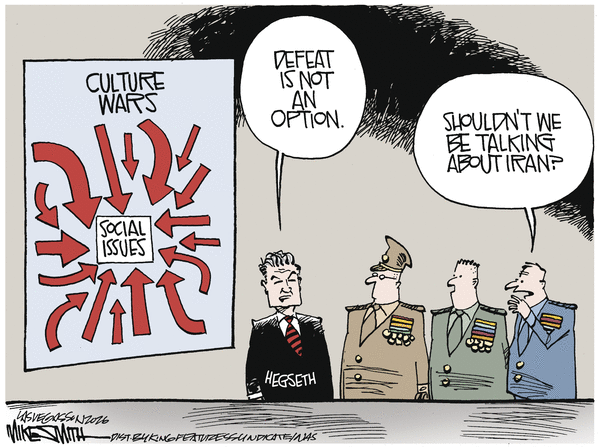
Pete Hegesth, "Obama begged Iran for a deal, we bombed Iran"Journalist, "The JCPOA (Iran deal) did that too"Hegseth, "We devastated their military"Imagine celebrating achieving the thing a previous president achieved without killing the 3,000+ Iranians dead since the US/Israel attacks
David Wise’s new experimental play, “Fight Back,” opens a portal to an earlier era of organizing and spotlights the enduring power of slow-moving consensus building.
Imagine a murder mystery dinner party, where everyone sheds their true identity at the door and assumes a role to play in the night’s events — only instead of solving a crime, they must reenact a contentious activist meeting. That’s what artist David Wise tasks participants with in his immersive theater piece “Fight Back.” He recreates the AIDS Coalition to Unleash Power, or ACT UP, meeting on March 13, 1989 in the same room where it happened nearly 40 years ago.
It’s impossible to sit in the same room in New York City’s LGBT Community Center where their meetings happened nearly 40 years ago without feeling the echoes of today’s governmental failures, and the urgent need for both resistance and mutual aid.
At the May 18 performance of “Fight Back” — which takes its title from ACT UP’s chant: “Act up! Fight Back! Fight AIDS!” — I did something we rarely have to do these days: relinquish checking and doomscrolling on my phone to spend uninterrupted time face-to-face with strangers, co-creating something from scratch. Nearly 40 of us had two and a half hours to make our way through a 26-item agenda, an education in ACT UP’s work.
ACT UP is a direct action group formed during the AIDS epidemic to fight for visibility, healthcare access and an end to the crisis. To mark the second anniversary of the group’s formation, they were in the midst of planning Target City Hall — the kind of creative, high-profile direct action for which the group had become known — to protest Mayor Ed Koch’s failure to adequately address the AIDS crisis in New York City.
By the beginning of 1989, more than 18,000 New Yorkers had been diagnosed with AIDS and over 12,500 had died. ACT UP was demanding affordable access to the highly toxic but potentially life-saving drug AZT, which had just come on the market a year earlier. They also demanded housing for people living with AIDS and changes to the Food and Drug Administration’s drug trial policy to give more patients hope. They demanded dignity for the living and the dead. In the midst of all this, members still found the time and space to plan fundraising parties and, more importantly, to flirt.
The 1980s was an era of phone trees and answering machines. We checked our cell phones at the door. The experience is an invitation to follow the advice writer Mira Jacob gave on Instagram earlier this year: “Stop scrolling. Do literally anything else … We’re going to prevail, but only if you don’t let this app scare you numb.” If you were mad in 1989 because your friends were dying at the hands of the government and you wanted to yell at someone about it, you had to show up to a meeting or participate in a phone zap or volunteer to surreptitiously print flyers at your office denouncing Mayor Koch as a closet case. (One attendee politely corrected our pronunciation of “Koch” — no relation to the present-day billionaire brothers who pronounce their last name “coke.”)
A smaller group within ACT UP gathers during David Wise’s experimental theater piece, a reminder that the organization was not a monolith. (Hong-An Tran)
The atmosphere in the room was tentative. Every question opened up a minefield that only the basic tenets of improv could answer: Say “yes, and” to help the scene unfold; make bold choices, even when you are unsure of them, and don’t “break” the illusion. Most of us had brought hastily scribbled notes about our assigned historical personas, pulled from summaries and the ACT UP oral history archive. This background helped with questions like, “What affinity groups are you in?” and “Is this your first meeting?” But they offered little to lean on when it came to more quotidian conversation starters, “Are you coming from work?” or “Are you out to your family?” Those we stumbled through, together.
I had been assigned the role of Bill Bahlman, my first part since a non-speaking role in the middle school production of “Schoolhouse Rock!” A lifelong New Yorker and a music journalist, Bill had been a part of the Gay Activists Alliance and the Gay and Lesbain Alliance Against Defamation, or GLAAD. A self-described anarchist, he sometimes found the groups to be too soft, particularly the Gay Activists Alliance’s discussions of whether to drink mixed drinks or soft drinks at their dances. He splintered off from GLAAD into the Lavender Hill Mob, a direct action group formed in 1986 and named after a British comedy film. The dozen members focused on AIDS activism and organized disruptive “zaps,” interrupting a CDC meeting, a Catholic mass and other high-profile events with leaflets and banners bearing slogans like, “Gays and lesbians will not be silenced!”
When ACT UP formed in March 1987, Bill and many other Lavender Hill Mob members joined, but their affiliation and camaraderie with one another remained. While ACT UP is often remembered as a monolith, it was in practice a true coalition under which many smaller groups coalesced, including affinity groups like Delta Queens, La Cocina or Wave 3 that demonstrated together at actions.
Bill was slated to speak late in the agenda. The items were laborious in their minutia. Should the flyers Wave 3 planned to wheat paste around the city to gather people for Target City Hall in two weeks be printed in color, or black and white? Should we send three or four people to the Lesbian and Gay Health Conference in San Francisco? We rose from our chairs for civil disobedience training, half of us playing cops and half of us playing protesters gone limp to resist arrest, but then it was butts right back in seats.
By the two-hour mark, I could no longer stifle my yawns. There may have been flirting at meetings, and even a little in our reenactment, but the agenda was a reminder that there is little instant gratification in organizing. It took much longer than an Amazon delivery or a ChatGPT response. This focus on consensus decision making has undergirded some of the most visible movements and organizations, like Occupy Wall Street, Jewish Voice for Peace and the Democratic Socialists of America. While they don’t offer an instant dopamine hit, the memorable actions and ballot wins delivered by these groups are clear evidence of their effectiveness.
There are no professional actors associated with the production. Every meeting member was a stranger assigned to play their role for one night only. That said, I recognized an actor from an old TV show who attended as a curious citizen. She had been assigned the role of our chant leader Ron Goldberg, and I expected that, given her background, she might be the one to voice the most objections. Or, I thought, they might come from the tall, brawny and bespectacled man who wore a Larry Kramer name tag, a historical figure whose outspoken anger and divisive politics had been a catalyst for ACT UP’s formation. Instead, the objections came from Karen Ramspacher, a 24-year old curatorial assistant played by a middle-aged white woman seated in the back row with a bun on top of her head. “People are dying and we can’t cobble together the money for color printing?”
The meeting’s facilitators, one of whom I assumed must be Wise himself, tried to keep us on track. I kept glancing at my watch, hoping that time would run out before it was my turn to speak. When my name was called, my hands shook. I stood at the front of the room and looked out at the gathered crowd, some in their 50s, some in their 20s, many filling out the ages in between. I held the mic and spoke about Steve Zabel, my friend who I had found murdered in his apartment at the beginning of the month. The police had done nothing. What could we do to put pressure on them? Steve was just one man, but we all knew a Steve. To my surprise, everyone had ideas. The Media Committee wanted to take it to the press. The woman with the bun wanted to agitate with the neighbors. They had Bill’s back.
When the bell rang to return us to 2026, I made my way over to the outspoken woman, who in real life looked closer to 54 than 24.
“You were great!” I said, relieved to speak as myself again. “Really channeled the anger of the time.”
“I was there,” she said.
“What?”
The woman who had interjected so many times during “Fight Back” had attended ACT UP meetings as a teenager. She had a job in the 80s in Philly calling men to let them know where they were on the wait list to see the only doctor in the city who would treat AIDS patients. Many had died before their turn came.
A little group gathered around to hear her story. One man shared that he had come to the center that night with a friend who had also been a part of ACT UP, but he had turned around at the door because she wasn’t ready to reopen the emotions of that time. Wise revealed himself to have been Iris Long from the Treatment and Data Committee, a cancer researcher determined to publicize the life-saving uses of aerosolized pentamidine. The reenactment of the meeting had, in fact, been facilitated by everyday people.
Later, the woman continued, she had worked as a social worker in New York City with young transvestites, as they called themselves then, and sex workers. At one point she was given one dose of AZT and had to choose who to give it to in her community. She didn’t realize at the time that the medication had to be taken once every 12 hours to be effective. Of course she was still angry.
After everyone else dispersed, I lingered. The woman pointed across the room at her adopted daughter, a young Black woman whose biological parents had died of AIDS in Africa. She had remained in the global AIDS fight her whole life.
“If the AIDS crisis happened in New York today, we’d all be dead already,” she told me. “You had to be out there, you had to be visible, you had to be risking arrest to make yourself heard. Today everyone is stuck at home. You know what you have to do?”
I leaned in closer.
“Host a dinner party of strangers. You don’t even have to cook. Tell everyone to bring their favorite dish. People love to show off their culinary skills. Think about the seating arrangements. You don’t even need to set an agenda. That’s where political action comes from, talking to people.”
Wise had laid the groundwork for such unexpected offline encounters. His theatrical experiment will take place again on June 15, but Wise hopes to make his impressive research on these figures widely available someday, so school groups and others can try to reenact the meeting on their own.
Art about AIDS abounds. For starters, there’s “Rent”and there’s “Angels in America,” there’s Sarah Schulman’s “People in Trouble,” Rebecca Makkai’s “The Great Believers,”and, more recently, Natalie Adler’s “Waiting on a Friend.” Those pieces invite sorrow and rage, empathy and memory in equal measure. “Fight Back” invites you to act.
Amelia Possanza is a writer and book publicist who lives in Brooklyn. Her book “Lesbian Love Story: A Memoir in Archives” was the winner of a 2023 Lambda Literary Award.
The stories of rebellion by enslaved peoples has been largely erased or occluded from history, and when these stories are told, they usually center men. In Cuba, however, two women became legends because of the leadership roles they took in rebellion. Carlota and Fermina were decisive, brave, and brutal. Both women were kidnapped from the Yoruba Nation and given the last name ‘Lucumí’, a word which refers to Afro-Cubans of Yoruba descent.
The Triunvirato sugar plantation was a fucking hellscape. By the 1840s, one third of Cuba’s population consisted of enslaved persons, almost all of whom worked in the sugar trade in some capacity. The 1840s saw Cuba utilizing steam-powered mails and railroads and engaging in massive deforestation as the economy became reliant on sugar. The Triunvirato Plantation was one of many that subjected enslaved people to a starvation diet and horrific working and living conditions.
We know very little about Carlota and Fermina. We do know, however, that on November 6, 1843, Carlota and others launched the Triunvirato Rebellion, the last in a series of uprisings across Cuba. Carlota used talking drums to communicate with other plantations, bringing the neighboring Acaná plantation, where Fermina was enslaved, as well as several others into the plan.
Carlota Leading the People (after Eugene Delacroix’s Liberty Leading the People by Lili Bernard, 2011
Fermina had recently escaped from Acaná and may have planned a June rebellion, but it didn’t happen. She was recaptured and shackled for months. Her tormentors released her from the shackles just a few days before the Triunvirato Rebellion, which she helped lead on the Acaná Plantation. In all, the enslaved people on five plantations rose up against their oppressors on or near November 6.
Here is a good overview of what we know about Carlota:
The series of rebellions that took place in 1843 (including uprisings in March and May, as well as a thwarted uprising in December) were collectively referred to as La Escalera. In response, slavers tortured and murdered so many people that 1844 became known as “The Year of the Lash”. Fermina was tortured and then killed by a firing squad. Carlota died at some point during the Trinuvirato Rebellion. Slavery in Cuba wasn’t abolished until 1886.
However, Carlota’s memory was preserved in oral legend. She became a famous symbol of resistance in Cuba. In 1975, when Cuba sent troops to support the People’s Movement for the Liberation of Angola (MPLA), they called the operation ‘Operation Carlota.’
Monument to Carlota’s Rebellion, located at Triumvirato, erected in 1991
Writing about history is a messy business. For one thing, many historical figures, especially women, and most especially women of color, have been so systematically erased that the stories we still have of them are murky. This is certainly true of Carlota and Fermina. We don’t even know their real names – only the names their slavers forced them to bear. We know for sure that they existed, and everything else is a matter of sifting various stories together and trying to figure out where they overlap.
In this column, there is also the matter of who to choose as ‘Kickass.’ Carlota and Fermina were both said to have done terrible, violent things.
CW/TW
Their story can be seen as one in which brutality begets brutality, and it can also be seen as a human being refusing to break or to become passive with despair in the face of massive crushing forces. Carlota and Fermina were clever, resourceful, determined leaders. I only wish I knew their real names.