Stacy Davis Gates, President Of A Union That Works:

All About the Badass Black Woman Standing Up Against Trump and His War on Chicago

Chicago Teachers Union leader Stacy Davis Gates defends public schools and Black families against Trump’s attacks.

By Asheea Smith Published November 12, 2025

Chicago Teachers Union President Stacy Davis Gates speaks to the City Club of Chicago at Maggiano’s Banquets on Grand Avenue on Tuesday, March 5, 2024. (Terrence Antonio James/Chicago Tribune/Tribune News Service via Getty Images)

In the heart of Chicago, one Black woman has emerged as a powerhouse in the American labor movement: Stacy Davis Gates, President of the Chicago Teachers Union (CTU) and leader of the Illinois Federation of Teachers (IFT). At a time when public education, health care, and resources feel under siege, Davis Gates has positioned herself at the intersection of activism, advocacy, and community leadership — standing up to President Donald Trump’s political attacks by defending families and public education.

A steadfast advocate for Chicagoans, the union boss has her eyes set on the prosperity of Black residents in her city by any means necessary, leading a fearless charge against militarized operations including ICE and the National Guard — deployed under Trump’s direction. And since Chicago’s been targeted by the administration, Davis Gates hasn’t flinched in the face of terror. (snip-so much MORE-go read it; it’s not long)

Detransition is key to politicians’ anti-trans agenda. But what is it really like?

Nov 12, 2025 Orion Rummler

This story was originally reported by Orion Rummler of The 19th. Meet Orion and read more of his reporting on gender, politics and policy.

For some people, gender shifts over time, often through changes in one’s sense of self. A transgender man may realize they are nonbinary and stop hormone replacement therapy. A trans woman may face so much discrimination that she represses her identity. And some trans people medically reverse their transition to live as their sex assigned at birth. 

These experiences are all part of a process known as detransitioning. Although detransitioning does not have a consistent social or academic definition, it generally applies to someone who has sought a gender transition and then stopped, shifted or reversed aspects of it. Their experiences offer a deeper look at how discrimination and gender norms impact our lives, how gender-affirming care can be improved, and how identity is perhaps more fluid than previously thought. 

As experts work to understand detransitioners, their vulnerabilities and their highly individualized needs, their identities are being co-opted as part of a national campaign against transgender rights. Health care access and research are being blocked by politicians for both trans people and detransitioners — while anti-trans rhetoric puts everyone at risk.

The Federal Trade Commission and the Justice Department are investigating gender-affirming care as medical fraud, and they are rooting this effort in detransitioners’ stories that fit the narrative the Trump administration wants to advance. The White House wants the National Institutes of Health to study “regret” and “detransition,” even as it cuts any federal funding for researchthat mentions the word “trans.” The U.S. Department of Education hosted a “Detrans Awareness Day” event last March. Meanwhile, its functions have been severely undermined by layoffs and budget cuts. 

The White House and agencies like the Justice Department claim that gender-affirming care is mutilating children, overlooking that young trans people live happily after transition and the studies showing that adolescents who regret transition are in the minority. Government officials describe trans people and detransitioners as victims of a medical conspiracy to boost profits and force gender ideology on families. Now, they are seeking evidence to prove those claims by subpoenaing hospitals for patients’ private data, including doctors’ notes, patient addresses and Social Security numbers.

Gender-affirming care has been broadly endorsed by the medical community for its effectiveness in treating gender dysphoria, a persistent distress felt when one’s body is out of sync with their identity. The 2022 U.S. Trans Survey, which polled over 92,000 trans and nonbinary people 16 and older, found that social and medical transition were profound sources of life satisfaction. Experts and advocates agree that more research and more understanding are needed to improve trans medical care. But under Trump, they also expect transgender and intersex health to keep getting worse, not better. 

The 19th spoke with two detransitioners who feel harmed and usedby the Trump administration, which has positioned itself as a protector of those who detransition. Adriana lives in New York City, where she feels safe to express herself among so many LGBTQ+ people, but has struggled to access adequate health care. Ara lives in North Carolina, a state that has several laws restricting trans rights and health care access — and where support from a mental health program and her partner has helped her navigate the challenges of detransitioning. As politicians stoke fear about gender non-conformity, their experiences offer a deeper understanding of what it means to live authentically in a politically volatile time. 

Still, more young people have been exploring their identities, expanding the boundaries of gender and adding to the cultural and social norms surrounding it. Detransitioners’ experiences are part of that social evolution. Their stories of regret and pain exist alongside stories of joy and empowerment — and these are all part of a journey of self-discovery that may have turned out to be more complicated than they initially thought. The question is, will elected officials support them on this journey or cause more harm?


‘Taking away trans health care is taking away people’s lives’

As providers of trans health care have become political targets, Ara Kareis’ own routine treatments have been disrupted.

‘I just feel like such a power source’

The joy that Adriana Del Orden feels in her body could have only come through exploring her gender. She’s tired of being told that she ruined her life.

The politics of detransition

Political rhetoric doesn’t capture the complexity of detransitioning — or what taking away health care means.

(Updated) Thank You, It’s Your Day. We Appreciate You!

And I wish to clarify. Because I push peace so much, some could understandably surmise that I “hate the US military”, which I most assuredly do not, for many reasons, not the least of which is that the US military are human beings who, for their reasons, chose the military path for at least a while.

No, I am thankful. So many did so much for so many more, and I appreciate that. I appreciate even more that the ones who survived to be with us today, are here with us today. I have respect for those who serve in that capacity; sometimes they’re put in positions of great danger and possibly having to take the life of someone else, yet they survive and come back. I am embarrassed that the US (we the people) have yet to fulfill the package veterans ought to expect for serving, and I work so that maybe one day, we will fulfill that. The US military is a special calling for those who are called, and it’s a risk for those who join feeling they have little other path when they begin. So, please accept my thanks even if you don’t feel as if you have it coming. To me, you do, because you did it and you’re here. I always hesitate to say “happy Veteran’s Day,” because it doesn’t strike me as a happy day, but more of a solemn observance day for people who did/do work that not all of us are cut out to do. That leaves thank you, and it is sincere.

Now enjoy the damn cartoon! 🙂

1st Gay Rights Organization Founded This Date In Peace & Justice History

(I don’t know what this formatting is about. This is the 3d try, so here it is as it is.)

November 10, 1924
The Society for Human Rights, the first gay rights organization in the U.S., was founded in Chicago by Henry Gerber, a German immigrant. He had been inspired by Germany’s Scientific Humanitarian Committee, formed to oppose the oppression of men and women considered “sexual intermediates.”
Henry Gerber–founder of the Society for Human Rights
More on Henry Gerber

https://www.peacebuttons.info/E-News/peacehistorynovember.htm#november10

From the link “More on Henry Gerber”:

HENRY GERBER

INDIVIDUAL | Inducted 1992 [Posthumous]

The founder of Chicago’s Society for Human Rights in 1924, the first gay rights organization in the United States, Henry Gerber was born in Bavaria as Joseph Henry Dittmar on June 29, 1892, and arrived at Ellis Island in October, 1913. With members of his family, he moved to Chicago because of its large German population. After working briefly at Montgomery Ward, he was interned as an alien during World War I. He wrote that although this was not right, he did receive three meals a day. From 1920 to 1923 he served with the U.S. Army of Occupation of Germany and during this time, he came into contact with the German homosexual emancipation movement. He subscribed to German homophile magazines and was in contact with Magnus Hirschfeld’s Scientific-Humanitarian Community in Berlin. In 1924, Gerber returned to Chicago and was hired by the post office. Gerber’s return to Chicago was amidst a backdrop of urbanization and an emerging gay subculture.

Following what Gerber had seen in Germany, he felt the need to establish an organization to protect the rights of gays and lesbians. With several friends, Gerber formed an organization which was later incorporated as The Society for Human Rights, a nonprofit corporation in the State of Illinois. The organization published a newsletter, Friendship and Freedom, which was distributed to its small membership.

In July, 1925, the society came to an abrupt end. The wife of one of the co-founders reported her husband, a reputed bisexual, to her social worker who contacted the police. Following a police raid, Gerber and several others were arrested and prosecuted for their deviancy. After three costly trials the case against Gerber was dismissed. Gerber lost his entire life savings defending himself and was fired from his job at the post office for conduct unbecoming a postal worker.

After his ordeal, Gerber moved to New York City where he reenlisted in the U.S. Army and served for 17 years. During the 1930s he managed a personal correspondence club and wrote articles in gay publications under a pseudonym. The correspondence club became a national communications network for gay men. In the 1940s, Gerber exchanged a number of letters with Manuel Boyfrank of California. Boyfrank was enthusiastic about organizing to combat homosexual oppression. Gerber offered his assistance, but refused to risk his job again. He continued his assistance through personal correspondence and numerous articles.

On December 31, 1972, Gerber died at the U.S. Soldiers’ and Airmen’s Home in Washington, D.C., at the age of 80. He lived to see the Stonewall Rebellion and the start of a new era of activist gay and lesbian liberation organizations.

© Chicago LGBT Hall of Fame. All rights reserved.

Top Democratic Officials Target Their Most Vulnerable Constituents In New Strategy Document

https://www.erininthemorning.com/p/top-democratic-officials-target-their?utm_source=post-email-title&publication_id=994764&post_id=177659051&utm_campaign=email-post-title&isFreemail=true&r=2r5nx6&triedRedirect=true&utm_medium=email

Top Democratic officials put out a new guide, entitled “Deciding to Win,” that encourages Democrats to be a little more like Republicans on “identity and cultural issues.”

Nearly Two-Thirds of Young Americans Are Thinking About Getting the Heck Out of Here

Nearly Two-Thirds of Young Americans Are Thinking About Getting the Heck Out of Here

America’s biggest export might soon be its own citizens. According to the American Psychological Association’s Stress in America 2025 survey, 63% of adults ages 18 to 34 have considered leaving the country this year because of “the state of the nation.” Among parents, more than half—53%—say the same.

These aren’t impulsive fantasies about Parisian cafés or permanent vacation visas. The study, conducted between August 4 and 24 among more than 3,000 adults, found that stress about the country’s future has hit a historic high. Seventy-five percent of Americans say they’re more worried about the direction of the nation than they used to be, and 76% call that fear a “significant source of stress.”

The anxiety isn’t limited to politics. Half of all adults reported feeling lonely, and 69% said they needed more emotional support this year than they received. “People are overwhelmed by societal division, technology, and uncertainty about what’s next,” said APA chief executive Arthur C. Evans Jr. “It’s affecting how they relate to each other and themselves.”

Almost Two-Thirds of Young Americans Are Thinking About Ditching the U.S. for Good

That division has started to show up physically. Among adults who named it a major stressor, 83% experienced physical symptoms in the past month, like headaches, fatigue, or anxiety, compared to 66% of those who didn’t. The same group was more likely to lose patience with family, cancel plans, or struggle to plan ahead.

AI is also creeping into the collective stress index. Fifty-seven percent of adults now say the rise of artificial intelligence adds to their anxiety, up from 49% last year. Among students, that number has nearly doubled to 78%. As automation expands and misinformation spreads, Americans are increasingly uneasy about how technology will reshape work, privacy, and even identity.

Still, the survey found that most people haven’t given up. Seventy-seven percent say they have some control over their personal futures, and 84% believe they can build good lives despite national instability. Family, friendships, and health remain top sources of meaning.

But optimism has its limits. Sixty-six percent of adults think they’ve sacrificed more than previous generations, and many feel the country isn’t keeping up its end of the bargain. For young Americans, especially, the American dream feels more like a relocation plan.

As stress levels rise and passports renew, the question hanging in the air isn’t whether they love their country, it’s whether they can still live in it.

A Couple Of Pieces From “Them”

A Man Got His Jaw Broken Defending a Trans Woman. The Community Paid for His Surgery

Jarod Adkison had been left with a concussion by three men.

By Abby Monteil

After the story of a cisgender man who was severely beaten over the summer while defending a trans woman went viral, strangers have helped him cover his reconstruction surgery.

33-year-old Jarod Adkison told Austin American-Statesman that he began chatting with three women while visiting Barton Springs Pool near Austin, Texas on July 26. While they were sitting by the pool, Adkison noticed three men who appeared drunk coming up and making fun of one of the women, who is trans.

“It all stemmed from the men seeing the trans lady and making a lewd gesture,” he said. (snip-MORE-click on the title to finish)

=====

Our First Lady Cole Escola to Play Gender Nonconforming Role in Netflix’s One Piece

The performer will play the role of Bon Clay.

By James Factora

Cole Escola has been cast in the third season of Netflix’s live-action adaptation of One Piece as a fan favorite character.

The news of the actor’s casting was announced on Monday. They will be playing Bon Clay, who is described as “a master of performance and precision who is as dangerous as they are dazzling, a theatrical assassin who turns combat into art.” The character in the original manga is described as an okama, a Japanese umbrella term that can refer to gender nonconforming men, trans women, and crossdressers. So basically, Escola is perfect for the role. (snip-MORE-click through on the title)

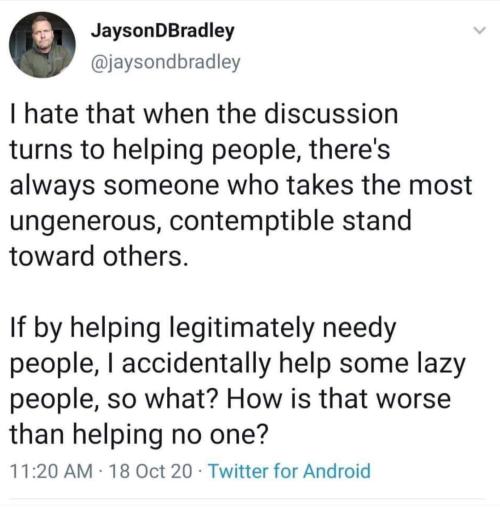
What about the bible saying, “Lazy people shouldn’t eat!”?

U.S. Labor Organizes, & Acts, On This Date In Peace & Justice History

November 8, 1892
Thirty thousand black and white, factory and dock workers staged a general strike in New Orleans, demanding union recognition, closed shops (where all co-workers join the union), and hour and wage gains. They were joined by non-industrial laborers, such as musicians, clothing workers, clerks, utility workers, streetcar drivers, and printers.
November 8, 1935
United Mine Workers president John L. Lewis and other labor leaders formed the Congress of Industrial Organizations (CIO). They had split with the existing labor union umbrella organization, the American Federation of Labor (AFL), which was not interested in organizing unskilled workers, such as those in the steel, rubber, textile and auto industries.

John L. Lewis
CIO history 

https://www.peacebuttons.info/E-News/peacehistorynovember.htm#november8

Peace Song November-

A post from Bee with a song (It’s Muse-click through and turn it up!!), then my selection beneath; leave the volume up for that one, too. Peace Out! 🕊 ☮

Leave the volume up for this one, too. Yes, it seems Christmasy, but it’s a peace song. We used to go to Wichita to see them every year. They told the story during the concert. From notes on the video:

“For anyone who wants to know the story of this song, I looked it up: The city of Sarajevo was in a war with another city, in the middle of the Bosnian War, and his city was destroyed by his own people. Desperate to do something the old man would go to the highest place he could find, and play music on his cello, things like Mozart and Beethoven. A reporter went to try and find him and ask why he did such a crazy thing. He responded because it was his only way to show that there was still a little bit of humanity in the world.”