
Tag: Justice
Hey Republicans!!
You got a problem, people. Getting Americans off their lazy-boy recliners isn’t easy. What’s this tell you?
https://bsky.app/profile/artcandee.bsky.social/post/3mi53nq5lzs26

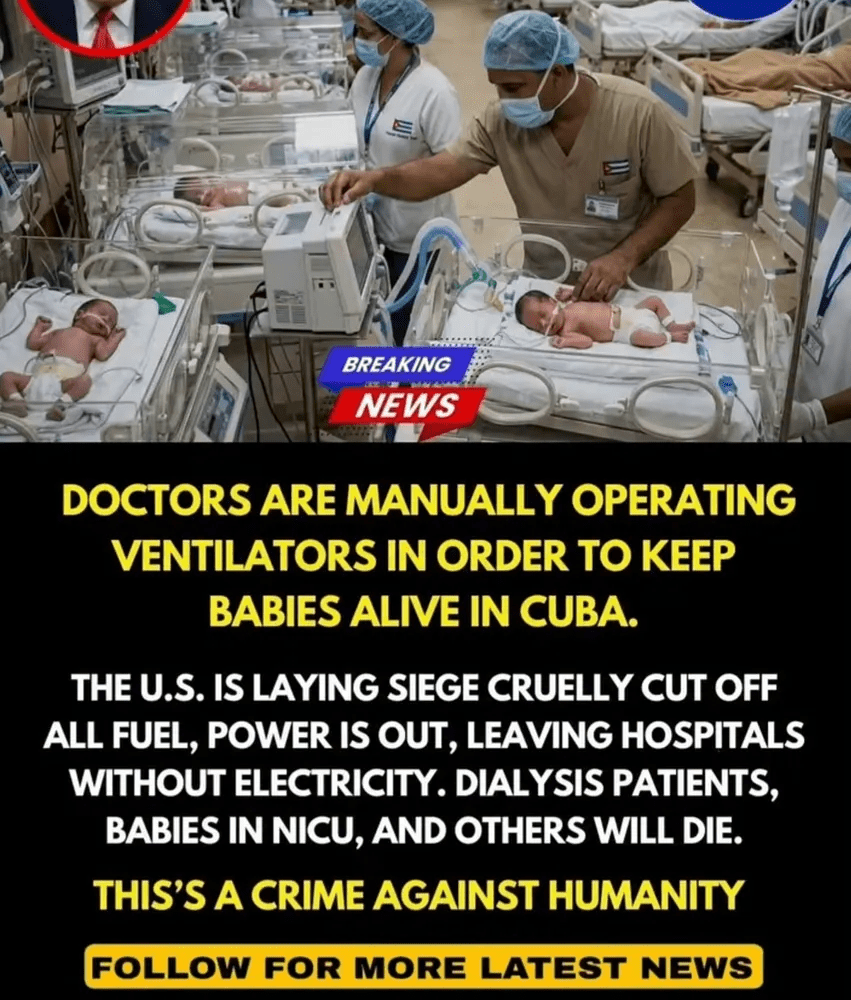
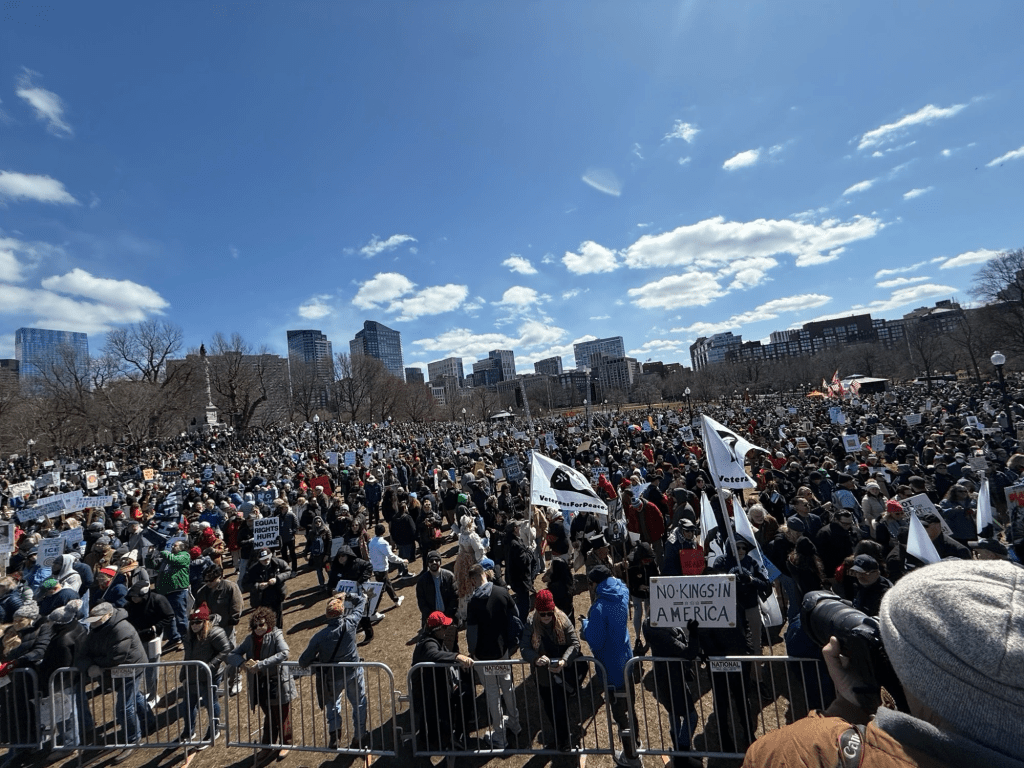
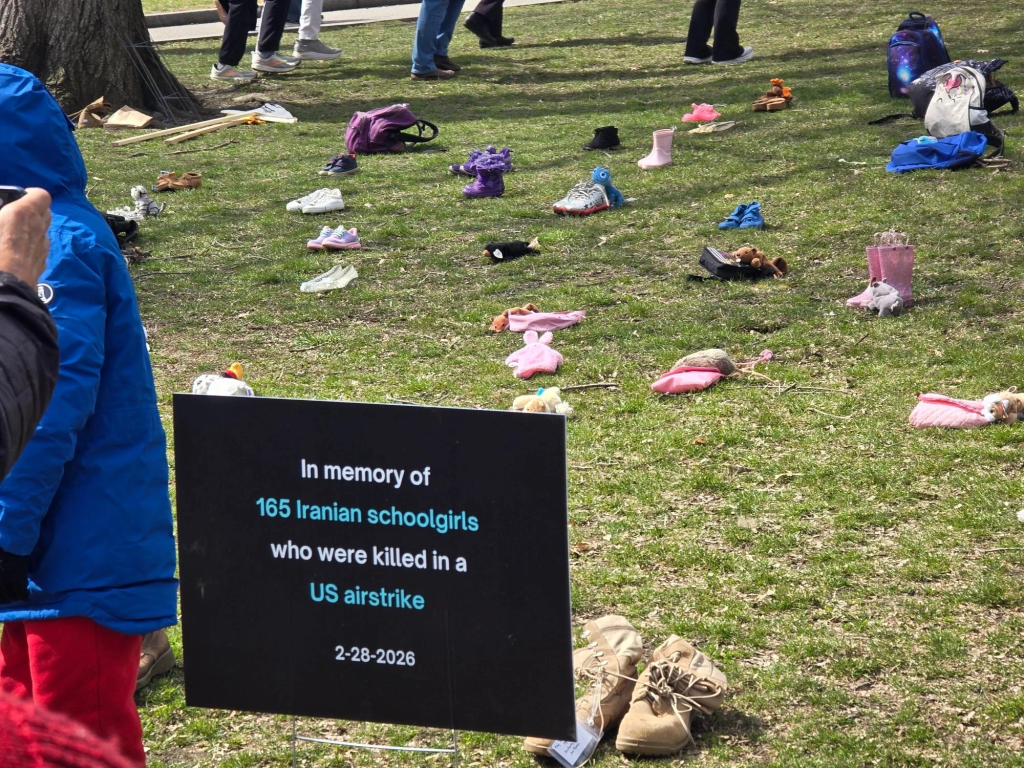
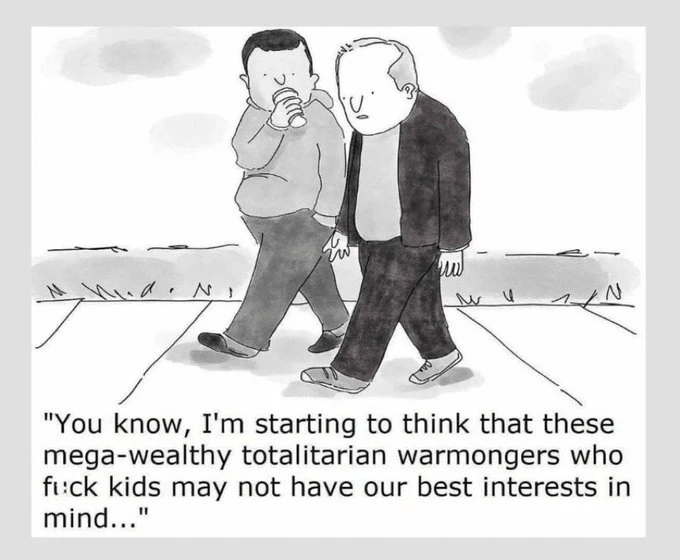

Just a question to those who support this regime: Just what the hell is it going to take before reality makes it through whatever brainwashing happened to you?
“‘Cool, sing to yourself. You’re a grown woman.’”
Taylor Tomlinson Turns Purity Culture Baggage Into Comedy
By Emma Cieslik
It has been a joy to deconstruct my religious trauma alongside 32-year-old comedian Taylor Tomlinson. Four years ago, as I was coming out as queer to my family, I found her Netflix special Taylor Tomlinson: Look at You to be a warm welcome into the community of formerly Christian queer kids and purity culture survivors. Dark humor gave all of us a silly sort of grace, a space where we could grieve and grow.
Tomlinson, who was raised in a conservative Christian household in Temecula, Calif., got her start in stand-up through the church comedy circuit. But as she grew up, she began deconstructing how her conservative Christian upbringing was hurting her mental health and sexual development, deciding instead to be a “secular” comic.
Her new Netflix special Prodigal Daughter was filmed inside Fountain Street Church in Grand Rapids, Mich., which welcomed her not despite but rather because of her comedy. On her aptly named “Save Me” tour, Tomlinson builds on a foundation of jokes about toxic Christian culture to call out not just people who weaponize religion as a tool for bigotry but also the people who make fun of those who still believe in God.
“Because if God does exist, he does not exist to make you feel better than other people. He exists to make you better for other people,” she said. “We judge each other’s coping mechanisms. Like, ‘You’re a quitter if you get on antidepressants. You’re stupid if you believe in God. B—-, I’m on mood stabilizers, you’re on Jesus. We’re all trying to get to ‘dead with Daddy.’”
In fact, Tomlinson recognizes the people in her life—her grandparents, aunt, and uncle, himself a pastor—“who are using religion correctly.”
“There are a lot of people who are using religion as a tool for community and connection and compassion and comfort,” she says, “and when I was writing this hour, I was thinking about those people.”
Cheekily, Tomlinson compares her own stand-up specials to her uncle’s Christian services. “We’re both out here on the weekends, changing lives.”
But the comedian is not here to absolve all the sins of Christianity or its effects on her.
“When you grow up in a religious environment, you spend a lot of your young adulthood untangling who you are from who they wanted you to be,” she says. For Tomlinson, this is best represented by her “late” coming out at age 30.
Tomlinson explains that she has so many queer friends who are open and free about their sexualities—the “Samanthas” of the group—but she didn’t see anyone else who, like her, was nervous entering the queer dating scene. “We need more gay prude representation,” she chuckles, making those of us coming out at an older age and experiencing a real queer second adolescence feel less alone.
A second adolescence refers to how many LGBTQ+ people didn’t have the chance to experience the joys of teenage years. Because of rampant queerphobia inside and outside religious communities, we didn’t have access to the romantic and sexual “firsts”—first crush, first kiss, first sexual encounter—that many heterosexual people did because we were told repeatedly that our love and our bodies were shameful and had to be hidden.
While she doesn’t explicitly name “second adolescence,” the significance of coming-of-age as a queer person runs throughout her special.
According to Adam James Cohen, a therapist specializing in helping LGBTQ+ patients, adolescence is critical to developing and cementing a person’s identity and sense of self. For those who missed out on that true identity formation earlier in life, second adolescence offers a mental and physical stage of healing and liberation, often involving people deconstructing their internalized anti-queerness and religious trauma. Sometimes this liberation happens through comedy, sometimes through therapy, or as Tomlinson discusses in her special, sometimes both. During this formational time, adults reckon with the grief of missing adolescence, and make up for lost time.
Second adolescence isn’t just a uniquely queer experience. Many people raised in far-right Chrisitan environments experience a new phase of psychosocial development after they leave their conservative Christian homes. For people raised in purity culture, their second adolescence can be a time of sexual exploration, experimentation, and liberation during and after deconstructing harmful theologies of the body.
For the queer Christian kids like Tomlinson, we were robbed of moments of bodily and social experimentation and generation, so experiencing our second adolescence is like coming home to our bodies, an emotional rebirth or reversion, to put it in Christian terms, of learning and loving to be a queer child and queer teenager again. For trans and nonbinary people undergoing gender affirming medical care, second adolescence can be even more physical, as hormone therapy brings about a second puberty.
And for many of us, this second adolescence is characterized by an eagerness—and joy—to accept and share the possibilities that many never questioned. As Tomlinson joked, “When I started dating women, it was the closest I’d come to feeling religious in a long time because my friend would complain about their boyfriends and husbands and I was like, ‘Have you heard the good news? You don’t have to live like this. There’s a better way.’”
Second adolescence is especially common among people who have a later-in-life realization or acceptance of their LGBTQ+ identity, often called a “queer awakening” or “second coming out,” just like Tomlinson. There is no time limit on coming out or discovering and affirming gender or sexuality, but as Tomlinson jokes in her special, “coming out as bisexual at 30 feels like saying to a waiter, ‘By the way, it’s my birthday.’ They’re like, ‘Cool, sing to yourself. You’re a grown woman.’”
Tomlinson’s special portrays this second adolescence with a humor, grace, and visibility I hadn’t encountered before but am deeply indebted to. Prodigal Daughter, and her comedy as a whole, carries special poignancy for the formerly queer Christian kids coming of age through humor and deconstruction.
No Kings, Comics, & Stuff
No Kings Day
There are no kings in America… yet

(Clay Jones writes blog entries for his toons; click through on the title above.)
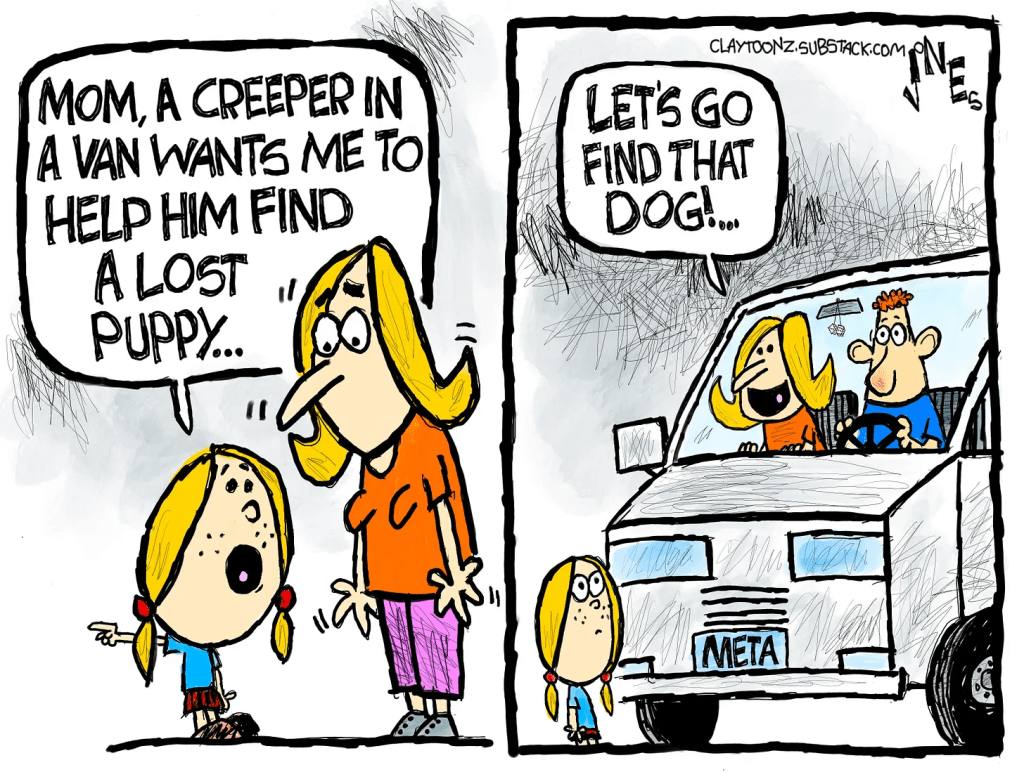
Stranger Danger Zuckerberg
Juries ruled that Meta is bad for kids

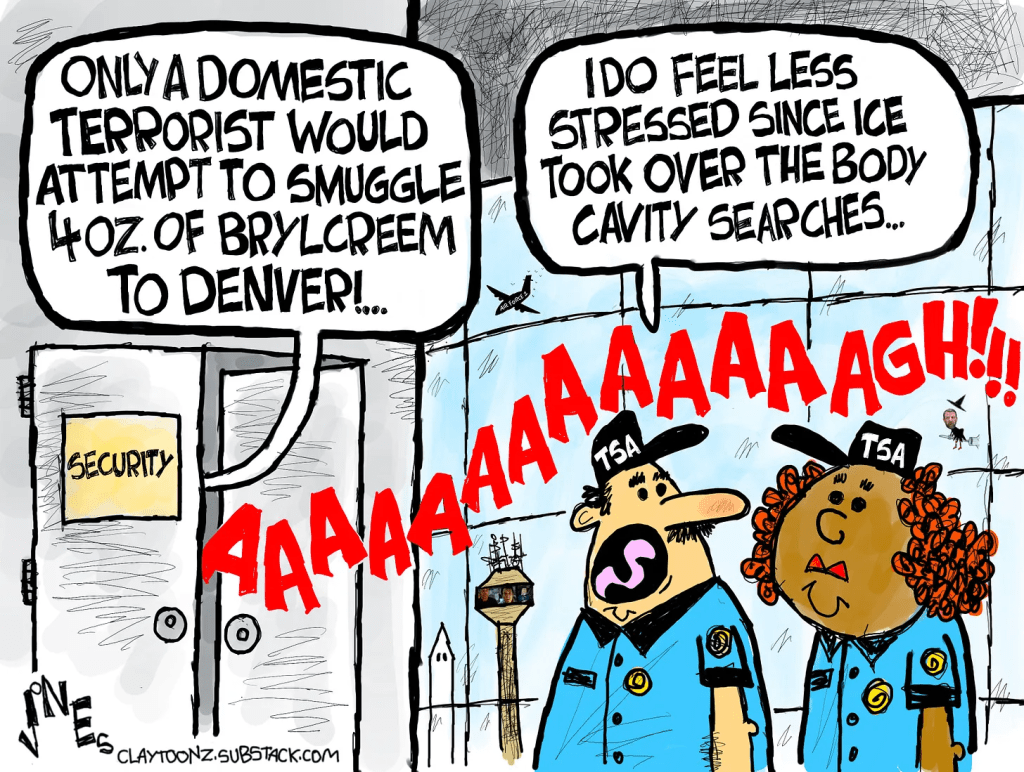
ICE Butts In
ICE ICE Butthole
From my G+ friend Brian Arbenz:
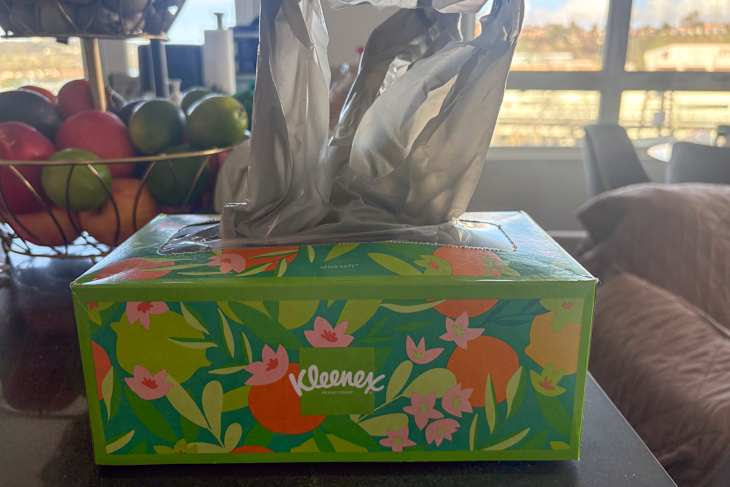
How to Turn a Tissue Box Into a Bag Organizer
Here’s how I repurposed my empty tissue box as a plastic grocery bag dispenser in a few easy steps:
- Take a plastic shopping bag and stuff it horizontally into the tissue box with the handles sticking out of the slit on top.
- Grab another plastic bag and weave it through the handles of the bag sticking out of the box, then stop once it’s about three-quarters the way through.
- Stuff both bags into the box, with the handles of the second bag sticking out again like you had before.
- Repeat the process until all of the plastic bags are in the box (I was able to fit about 12 bags in mine!)
- Gently pull a bag out of the box when you want to use it, just like a regular Kleenex box! Follow steps 1 through 4 to refill when you have more bags to store.



https://www.peacebuttons.info/
#No Kings
(and stay safe!)
Some News Bits
A few things I ran across before lunch, in one post with links. Ollie and I had a good lunch, got a few things done, then took a nice walk on a cooler day when his thick black fur coat is not too heavy for him to be on a jaunt before 7 AM; it was 2 PM.😃
Back to reality, I saw this Reuters story about Iran hacking US FBI, but it was a subscriber only story (I agree-WTF? Why should profit be made on a story like that, when some of the free articles are such dreck…) But, here is a free one:
FBI director Kash Patel’s emails, photos hacked by Iran-linked group
The vigilante group Handala Hack Team said that it had successfully gained access to Patel’s personal email account.
Then, I know many of us, if we didn’t yawn, noticed the hypocrisy in wrangling for a law that includes banning mail-in voting while on the way to the post-box. If you’re busy, just click through; the money phrase is right there at the top.
The young woman who is running for my district’s US House seat, Katy Tindell, has a website now! I’ve mentioned her, but couldn’t link because all there was was an Act Blue contribution page. But now, she has her own website.
Every one of our states has at least one candidate like this running. Please choose a campaign anywhere (But work from your home district/state first, if you can,) and sign up. Money’s tight everywhere, but give the candidate some time if you want to see them in office. There are many things that need doing, and campaigns are better off with volunteers helping.
Finally for this post, Sojo has run a piece the author, Emma Cieslik, writes about Taylor Tomlinson, and Tomlinson’s influence on the author’s own deconstruction and being out. Seriously worth the click.
A Message For Tomorrow:
(I don’t care for twangy folk music that would be country&western if it wasn’t U.S. Folk music, but. I have high regard for Woody Guthrie, really like the lyrics of this song, and Bette Midler covers it well, updating lyrics a bit while retaining its folk integrity. Thanks, Ten Bears!)
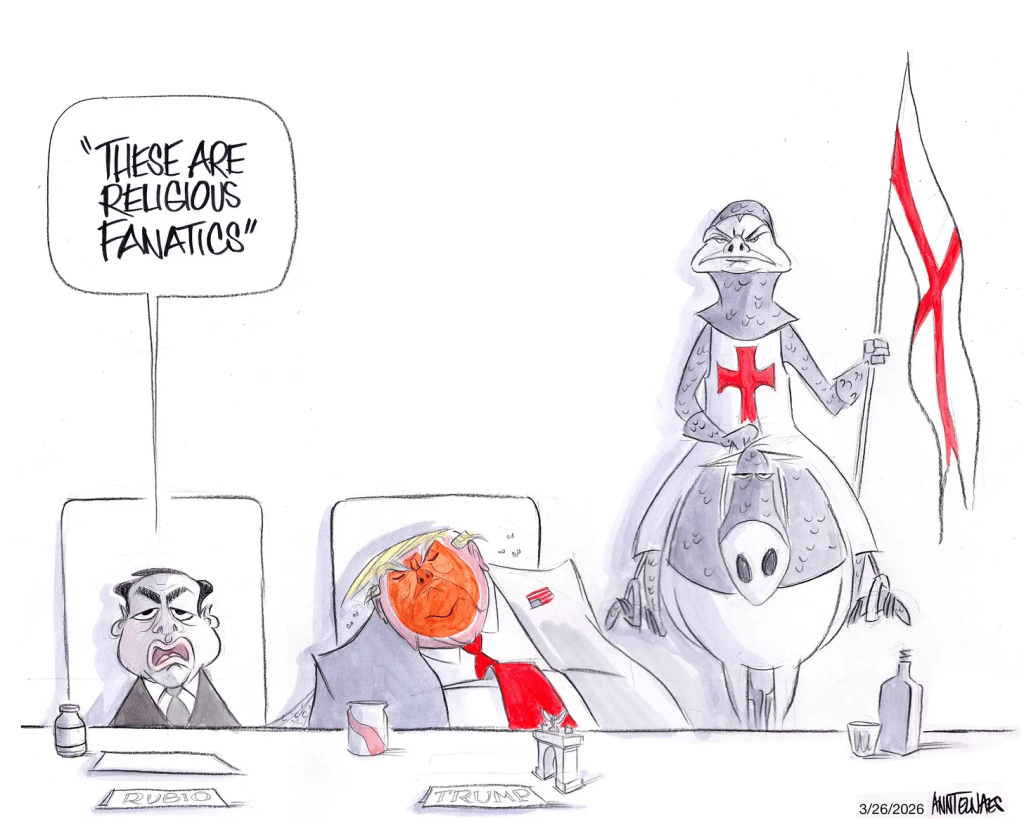
Theocracy Advances With Menace
Iran isn’t the only theocracy
Sec. of War Hegseth quotes scripture during press briefings.
Trump held a toadies meeting today.
And along those lines, check this out, and also check in on your own state legislature, because these laws are coming from a national organization. Also, dig “Independence Day”, which is not at all acknowledged in the Bible; it gets more time than even Christmas or Easter. I do not think “Christian” means what they think it means. Emphases within are mine.
Kansas Legislature’s negotiators on education bills drop sports ban tied to Christian calendar
Senate majority leader’s amendment forbid sports on Sundays, Wednesday evenings
By:Tim Carpenter
TOPEKA — The Kansas Legislature’s negotiators on education bills deleted a Senate-approved change to state law prohibiting school sports practice and competition on Sundays, Wednesday evenings and multiday periods centered on Easter, Christmas and Independence Day.
The effort to expand on Kansas State High School Activities Association rules for scheduling athletic events, currently concentrated on Dec. 25 and July 4, was led by Senate Majority Leader Chase Blasi, R-Wichita. He convinced Senate colleagues to accept his amendment to Senate Bill 515 expanding no-sports days on calendars at public and private schools statewide.
During Senate debate on Blasi’s amendment, questions were raised about his focus on Christian faith traditions. His amendment passed on an unrecorded voice vote of the Senate.
During Senate and House negotiations Monday on SB 515, Wichita Republican Rep. Susan Estes and Wichita Sen. Renee Erickson, who serve as lead negotiators on the Legislature’s education bills, agreed to cast aside Blasi’s broadened moratorium. His amendment was removed from legislation intended to enable homeschool students to join sports at private schools in the way state law permitted them to be part of public school athletics.
Blasi said he was motivated to act on concerns expressed by constituents that school-sponsored sports interrupted periods that ought to be reserved for family or church activities.
Specifically, his amendment would forbid sporting events on Sundays and on Wednesdays at 6 p.m. to midnight from Sept. 1 to April 30. In addition, he sought to apply the prohibition to a four-day window around Easter, but only from 6 p.m. to midnight. A five-day ban at Christmas and a seven-day ban encompassing Independence Day would be part of the new state law.
“This is going to assure we focus on what really keeps communities strong — that is family and faith,” Blasi said.
Sen. Marci Francisco, D-Lawrence, said she was anxious the Legislature was wading into the KSHSAA rulebook without considering family interests in other religious faiths. Blasi’s amendment didn’t address Islam’s Ramadan, Judaism’s Passover or Rosh Hashanah, Hinduism’s Maha Shivavatri or Buddhism’s Bodhi Day.
“Not any religion was considered,” Blasi said. “This was just a response to constituents.”
Francisco wasn’t convinced of the amendment’s merits.
“My constituents would like me to be as inclusive as possible,” she said.
The amendment left on the cutting room floor by the House and Senate conference committee was defended by several other members of the Senate.
Sen. Caryn Tyson, R-Parker, said she was a strong supporter of Blasi’s effort to turn back the clock in Kansas to an era more respectful of faith traditions.
“It’s a sad day that we have to legislate this,” Tyson said. “Years ago, it wasn’t even an issue. It was a standard and acceptable, but here we are.”
Sen. Brad Starnes, R-Riley, said the amendment was crafted to affirm religion as the “bedrock of our country.”
The objective of the amendment was to clear school calendars so students had more time to pursue religious interests, said Sen. Michael Murphy, R-Sylvia.
“As we move away from that, we do so at our peril,” Murphy said. “It’s time we moved back to some of those traditions that served us well.”
The House-Senate conference committee bundled the stripped down SB 515 and Senate Bill 361 into Senate Bill 382. SB 361 allows foreign exchange students to enroll in their host’s public school district. SB 382 deals with administration of state assessments to K-12 students in virtual schools. As of Tuesday, neither the House nor Senate had voted on the the three-bill deal.
Sigh. I Think We Saw This Coming, But Here It Is:
To me, this is basic misogyny; soon it will be simpler for the Olympics to ban women and girls entirely. I will note that it doesn’t seem that they’re going to check for trans men. I wonder if trans men ought to play in women’s sports, under this “logic”? Meanwhile, all the girls and women who are a little too tall, a little too strong, a little larger built in the shoulders, etc., etc. are going to be excluded along with other women who passed through male puberty before transitioning. The illogic of this makes my head explode.
I will add that there is a special place in hell for women who undermine other women; especially those who get somewhere, then yank the ladder up behind them. Lookin’ at Kirsty Coventry, pictured below, now IOC President.
Transgender women athletes banned from female Olympic events by new IOC policy
By GRAHAM DUNBARUpdated 2:25 PM CDT, March 26, 2026
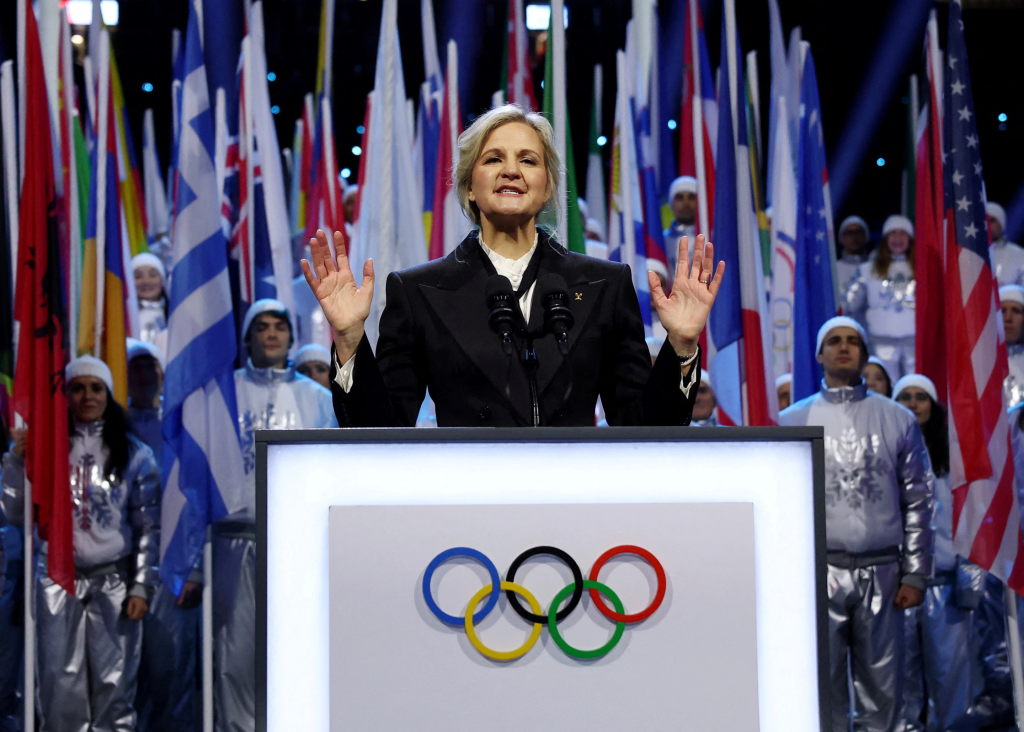
GENEVA (AP) — Transgender women athletes are now excluded from women’s events at the Olympics after the IOC agreed to a new eligibility policy on Thursday which aligns with U.S. President Donald Trump’s executive order on sports ahead of the 2028 Los Angeles Games.
“Eligibility for any female category event at the Olympic Games or any other IOC event, including individual and team sports, is now limited to biological females,” the International Olympic Committee said, to be determined by a mandatory gene test once in an athlete’s career.
It is unclear how many, if any, transgender women are competing at an Olympic level. No woman who transitioned from being born male competed at the 2024 Paris Summer Games, though weightlifter Laurel Hubbard did at the Tokyo Olympics in 2021 without winning a medal.
The eligibility policy that will apply from the L.A. Olympics in July 2028 “protects fairness, safety and integrity in the female category,” the IOC said.
“It is not retroactive and does not apply to any grassroots or recreational sports programs,” said the IOC, whose Olympic Charter states that access to play sport is a human right.
After an executive board meeting, the IOC published a 10-page policy document that also restricts female athletes such as two-time Olympic champion runner Caster Semenya with medical conditions known as differences in sex development, or DSD.
“We know that this topic is sensitive,” IOC President Kirsty Coventry said in an online news conference to explain the policy.
Coventry and the IOC have wanted a clear policy instead of continuing to advise sports’ governing bodies who previously have drafted their own rules.
“At the Olympic Games, even the smallest margins can be the difference between victory and defeat,” Coventry, a two-time Olympic gold medalist in swimming, said in a statement. “So, it is absolutely clear that it would not be fair for biological males to compete in the female category.”
She set up a review of “protecting the female category” as one of her first big decisions last June as the first woman to lead the Olympic body in its 132-year history.
Female eligibility was a strong theme in a seven-candidate IOC election last year — held after a furor around women’s boxing in Paris — when Coventry’s main rivals pledged a stronger policy to leading on the issue.
“This was a priority for me way before President Trump came into his second term,” Coventry said. “There’s not been any pressure (on) us to deliver anything from anybody outside of the Olympic Movement.”
Before the 2024 Paris Olympics, three top-tier sports — track and field, swimming and cycling — excluded transgender women who had been through male puberty. Semenya, who was assigned female at birth in South Africa and has testosterone levels higher than the typical female range, won a European Court of Human Rights judgment in her years-long legal challenge to track and field’s rules which did not overturn them. (snip-there is more, sort of pleading for understanding, but go see the rest of it if you like)
The expert group agreed the current gene test is “the most accurate and least intrusive method currently available.” The saliva, cheek swab or blood sample screens for “the SRY gene, a segment of DNA typically found on the Y chromosome that initiates male sex development in utero and indicates the presence of testes/testicles.”
Still, the mandatory gender screening — already conducted by the governing bodies of track and field, skiing and boxing — is likely to be criticized by human rights experts and activist groups.
Athlete appeal to CAS?
The IOC policy can — and likely will — be challenged at the Court of Arbitration for Sport in the Olympic body’s Swiss home city Lausanne, perhaps by an athlete acting alone.
Track athletes Dutee Chand of India and Semenya challenged previous versions of their sport’s eligibility rules at the court.
Any potential appeal would examine science underpinning IOC research which was not published Thursday. A case could occupy much of the near-28 months until the L.A. Olympics open.
“As we know in today’s world,” Coventry said, “any and all rules and regulations at any point in time could always be challenged.” (snip)
The White House welcomed the IOC’s decision, describing it as the result of the executive order.
“The IOC aligning their policy with President Trump’s executive order ahead of the 2028 LA Games is common sense and long overdue,” White House spokesman Davis Ingle said in a statement.
Banned Books
It’s a blog entry by Jenny Lawson, about one of her books. I haven’t been able to open her WP blog for a few weeks, now; I get the page that says it’s an unsafe connection. I either don’t know how, or can’t get a whole post in the WP Reader, but I did get this whole post in email, so I’ll copy & paste it here. Jenny is funny, but this is not good news about Texas and literacy.
 The Bloggess The BloggessRead on blog or Reader Today they banned my book. It was not the first. It won’t be the last. Here’s what I want you to know .  By thebloggess on March 25, 2026 By thebloggess on March 25, 2026 |
| This is not what I wanted to write. I wanted to write about how I’m about to go on book tour for my new book in a few days. Instead I am writing about the fact that I was just informed that my first book Let’s Pretend This Never Happened was banned from the high school library of a nearby town I love and visit often. Honestly, I’m not that upset about my book being banned. I’ve had so many letters from young people who felt they’d been helped by my books but it does have some profanity and so I can understand the reasoning even if I disagree with it. What I am upset about is the stories about how New Braunfels ISD has pulled more that 1,500 books from their school library shelves after the Texas’ Republican-backed book banning law (senate bill 13) passed. The bill ordered all public school libraries to review books for “profane” and “indecent” content and I guess Let’s Pretend This Never Happened was deemed too dangerous for high schoolers. Weirdly, my book was not on the original list of the 1,500 books triggered for review on March 13 but a week ago it was added to the New Braunfels ISD website as being removed for being “non-compliant”. (I’ve been called worse.) I guess 1,500 books weren’t enough. But then, it’s never enough for book banners.This is going to happen more and more. It used to be a rarer thing…almost a badge of courage to have a book banned. Now? It’s everywhere…this war against books and ideas and people. Reading is how you fall in love with people different from you, and how you develop compassion for them…because if you love them, you want to protect them. But there are some people who don’t want you to love others. They need you to fear them. Books save lives. They have saved mine. Books are safety nets for so many of us, and right now those nets are being cut.The list of banned books is incredible in length and includes so many that I adore. Equally upsetting is the fact that so many classics that shaped me have been pulled from the shelves and placed into restricted sections where they can only be accessed by students enrolled in Advanced Placement Literature, because God forbid a normal high school student would want to read the works of dangerous writers like *checks the list* Jane Austen and Emily Brontë (whose name they misspelled). Sometimes it feels like we’re living in A Brave New World (restricted) and that the book burning of Fahrenheit 451 (restricted) is closer than ever, with no Sense and Sensibility (restricted) about what this will cost. It feels like we’re going through The Crucible (restricted) and are caught in a Catch-22 (restricted) where we can’t convince people how terrible it is to ban books because they either don’t know the power of books or they absolutely know it and fear it. It’s An Absolutely Remarkable Thing (banned) how book banners go out on some kind of A Discovery of Witches (banned) and fight against Acceptance (banned) and of diversity, while we are losing All The Beauty in the World (banned). America is a Beautiful Country (banned) in so many ways, but we will lose so much of that beauty if we don’t make Changes (banned) to cherish and embrace and grow what makes us Educated (banned) and compassionate. The diversity of voices is necessary…it is a reflection of who we are and who we want to be. A plethora of ideas and voices and experiences…This Is What America Looks Like (banned). We can’t just pretend that Everything’s Fine (banned) and that this is just an overreaction of Anxious People (banned). Do you think this is what the founding fathers like Alexander Hamilton (banned) envisioned? I’m going to stop here because I’m sure you can see that this dumb paragraph is WAY TOO EASY TO WRITE because there are so many books they have issues with and you probably get the picture already but y’all….Jane Eyre? The Color Purple? The Odyssey? Crime and Punishment?? THIS IS WHAT WE’RE SAVING TEENAGERS FROM? So what can you do? You can buy books that are being targeted, especially those written by the LGBTQ+ authors or authors of color because they are being targeted the most. Supporting those authors tells publishing to keep producing those books because they are needed. Publishers will lose money if libraries become afraid to purchase books and so we need to make sure that they know the audience is there and greedy for diverse voices. Get a library card and start checking out those books and more, to prove to the government that libraries need funding and that people care about reading. Read to your children. Read in front of your children. Talk online about the books that you love so that your passion ignites others. If you’re a parent you can get involved with your school to make sure this doesn’t happen in your school and you can protest it if it happens. You can vote out the people who seem to be obsessed with freedom, but mainly when it’s their freedom to take away yours and your children’s. You can run against school board members who are book banners and show up at the meetings. You can keep updated by following organizations like PEN AMERICA, or the Texas Freedom to Read Project or Authors Against Book Bans. *deep breath* This is probably filled with typos and is not really the sort of thing that I should be writing the day before I leave to start my book tour but it’s important. When books and thoughts and people are suppressed, we all lose. Keep fighting the good fight, friends. It’s worth it. Comment |
Snips And Bits
(Just under an hour, so more than a snip or a bit, but it’s not only necessary, it’s fascinating. Or else I’m just that big a geek.)
How Angela Davis Predicted The Modern Face Of Fascism in 1971
Fifty years prior to rumors of fascism circling President Trump, activist and philosopher Angela Davis made a spooky prediction about dictatorship in the U.S.
President Donald Trump’s administration continues to stand on shaky ground amid bombshell resignations and rumors of a dictatorship brewing. But in the midst of these unprecedented times, one Black political activist’s warning could offer a shocking reality for Americans… even if the message came 55 years earlier.
Trump’s return to the White House was met with fierce criticism from leaders like former Vice President Kamala Harris and his own former chief of staff, John Kelly, who explicitly declared that Trump fits “into the general definition of fascist.” But while terms like “fascist” and “dictator” have found a comfortable place in American politics today, activists like Angela Davis were among the loudest opponents of fascism nearly six decades ago.
By the 1970s, the Cold War against the Soviet Union revamped fears of a possible fascist regime in the States– notably from many Black Panthers. While awaiting trial for murder, Davis spoke with filmmaker Peter Davis about the likelihood that America would be ruled by a dictator.
“We are closer to fascism than we’ve ever been before,” Davis said from a California prison in 1971. But while the political activist stopped short of declaring fascism had officially made its mark in the U.S. then, her scary prediction has arguably taken a new light in 2026. (SNIP-click the title to read the rest; it’s not at all long)
 Scottie's Playtime