Transgender Kansans are being informed on the eve of a new state law going into effect that their driver’s licenses will be considered invalid as of Thursday.
“Please note that the Legislature did not include a grace period for updating credentials. That means that once the law is officially enacted, your current credentials will be invalid immediately, and you may be subject to additional penalties if you are operating a vehicle without a valid credential,” read letters mailed by the Kansas Department of Revenue’s vehicles division.
“Pursuant to the new law, if the gender/sex indication on the face of your current credential does not match your sex assigned at birth, you are directed to surrender your current credential to the Kansas Division of Vehicles,” reads the letter, which The Star reviewed multiple copies of.
‘The Special Relationship only exists when the Americans want something,’ a former Downing Street aide observed after Donald Trump rejected the Chagos Islands deal. There are profound differences between London and Washington over military action against Iran while the fourth anniversary of the war in Ukraine this week has exposed further fault lines. The result is that Anglo-American relations are at their worst point since the general election.
Starmer’s team argues he should not be ousted at a time of huge international instability. But the reality of the Anglo-American relationship raises three questions. Where did things go wrong? Does the PM still have some kind of relationship with Trump? And would it matter if he were replaced by Angela Rayner, Wes Streeting or anyone else?
The PM apparently hates the way Trump calls him at random when he is with his family
During the first 18 months of his premiership, it became accepted, correctly I think, that one of the few areas where Starmer excelled was foreign affairs. He seemed particularly good at handling the often capricious President. But it is also true that the two great cleavages of recent weeks – Iran and Chagos – are intimately tied to Starmer’s personal fetish for subordinating the sovereignty of parliament to international law.
If the Prime Minister believes in anything, it is that the web of international treaties constructed to constrain rogue states after the second world war overrides domestic law. His appointment of Richard Hermer as his Attorney General was proof that this would form the backbone of his premiership.
Hermer’s numerous legal opinions flow from this belief in the primacy of international law: that Britain must not support an American attack on Tehran and must not allow America to use British air bases for the attacks. This is what prompted Trump to change his mind on the Chagos deal, by which Britain would cede control of the islands to Mauritius and then lease back British airbases which America also uses.
My understanding is that the US has not made a specific request to use the base for an Iranian operation, nor has the UK explicitly rejected the idea. However, ‘general soundings’ have made clear what the answer would be. Insiders say that Starmer and Hermer’s approach is no different from what any other PM would do. The belief in government is that allowing the US to use our bases without legal backing ‘smells like Iraq’.
This has outraged Team Trump. ‘It’s just not how they roll,’ says one insider who has dealt with the Americans. ‘Their risk spectrum is significantly different. International law, due legal process – they don’t give a shit about that.’ Privately there have been threats that the US will not be there in Britain’s hour of need. The Iran decision led directly to Trump pulling the plug on Chagos. Those who deal with the Trumpies say there is no point ‘continually making the same argument’ and the deal is now ‘in the medium-length grass’.
However, by far the bigger issue is Ukraine and that is where Starmer has deployed most of his capital with Trump. The President and his envoy Steve Witkoff began with a fundamentally misguided understanding of the conflict. ‘All of them basically come back to this belief that it’s about territory, that peace is a real estate deal,’ one insider said. On calls with British officials, Witkoff openly ridiculed the French for saying ‘root causes’ were behind Vladimir Putin’s invasion. ‘He would mock the idea that if there’s peace, the Russians will just rearm and be a threat to Europe.’
The view of Britain’s political and military leaders is quite different after four years of working closely with the Ukrainians. ‘There is a whole generation of Europeans who have made the trip to Kyiv and it feels like the most meaningful thing they’re doing in their political careers,’ a diplomat says.
The key achievement of the Starmer government, in this telling, is that ‘we have persuaded the Americans to listen to us’. A senior adviser says: ‘People are saying that Starmer’s foreign policy is a failure because of Chagos. But if you look at Ukraine, it’s been a success.’
Intercepted phone calls and messages from senior Russians ridiculing Trump have been shared by the British with the Americans. ‘We have continually shown them intelligence that shows the Russians are lying,’ a senior security source revealed. ‘The Russians are privately mocking Trump over his naivety about Putin’s intentions. Putin doesn’t want to end the war.’
‘Of course, he’s always denied any wrongdoing.’
Yvette Cooper, the new Foreign Secretary, spent an hour last week with Marco Rubio, US Secretary of State. But the four key relationships that have moved the dial are Starmer and Trump; David Lammy and Vice President J.D. Vance; the US embassy in Washington, which enjoys closer ties to the White House than any other D.C. diplomats; and, most important, Jonathan Powell, the national security adviser, and Witkoff.
Henry Kissinger is said to have asked: ‘Who do I call if I want to call Europe?’ Now a senior member of the Trump administration refers to Powell as ‘dean of the European national security advisers’. A Foreign Office source concludes that if there is regime change in London: ‘The one relationship I fear might be irreplaceable is Jonathan Powell and Witkoff.’
Opinions are divided about whether Starmer’s departure would make any difference. The PM apparently hates the way Trump calls him at random when he is with his family but he has built a ‘load-bearing relationship’ with the President. This is based, in part, on the fact that both have lost brothers. In their first meal together, Trump interrupted a conversation about tariffs to ask if Starmer’s brother had ‘a good death’, genuinely troubled by his loss.
But those who want Starmer gone will agree with the official who says: ‘Trump’s mum was British. He loves the UK and he views having a great relationship with the PM as part of his job.’
Diplomats doubt that any new leader would be given the same space by Labour MPs to develop ties with Trump. But that is another reason why foreign policy will not save Starmer. As one MP puts it: ‘If Keir thinks sucking up to Trump is the argument which saves him, he is going to be in for a rude shock.’
The SAVE Act appears to be dead, at least for now.
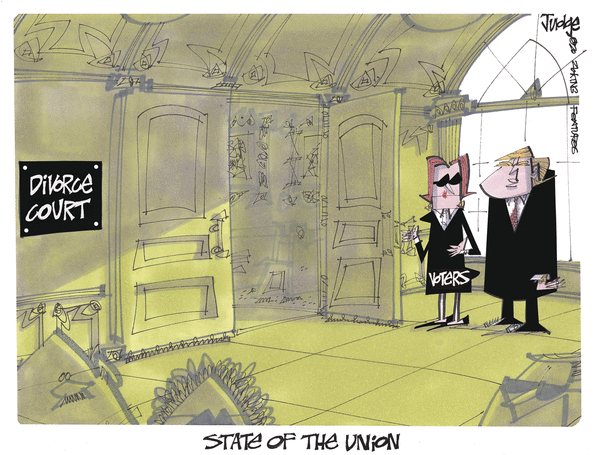
Trump wanted his party to enact the SAVE Act because it was supposed to make it more difficult for citizens he thinks are Democrats to vote: Its strict ID requirements would have impacted poor people, elderly people, students, married women, and others.
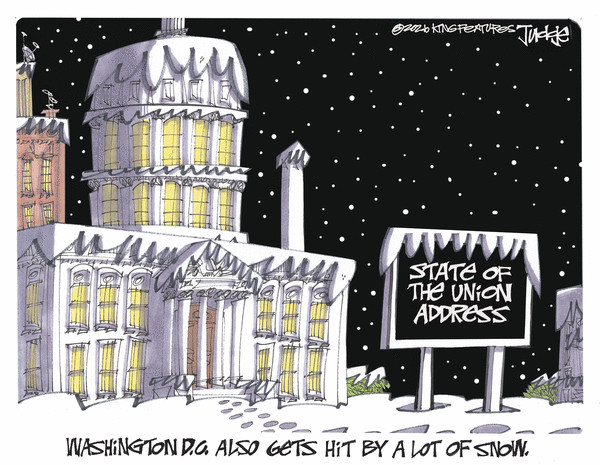
Although Trump pushed hard for its passage, most recently during the State of the Union address, enough Senate Republicans defected to make passage a possibility too remote to pursue. Republicans attempted a “talking filibuster” to get the bill across the finish line, but the procedural unity that would have required failed to materialize. Per Punchbowl News, North Carolina’s Thom Tillis, Utah’s John Curtis, Kentucky’s Mitch McConnell, Alaska Senator Lisa Murkowski, and possibly others who weren’t named broke ranks.
It’s a major loss for the president.
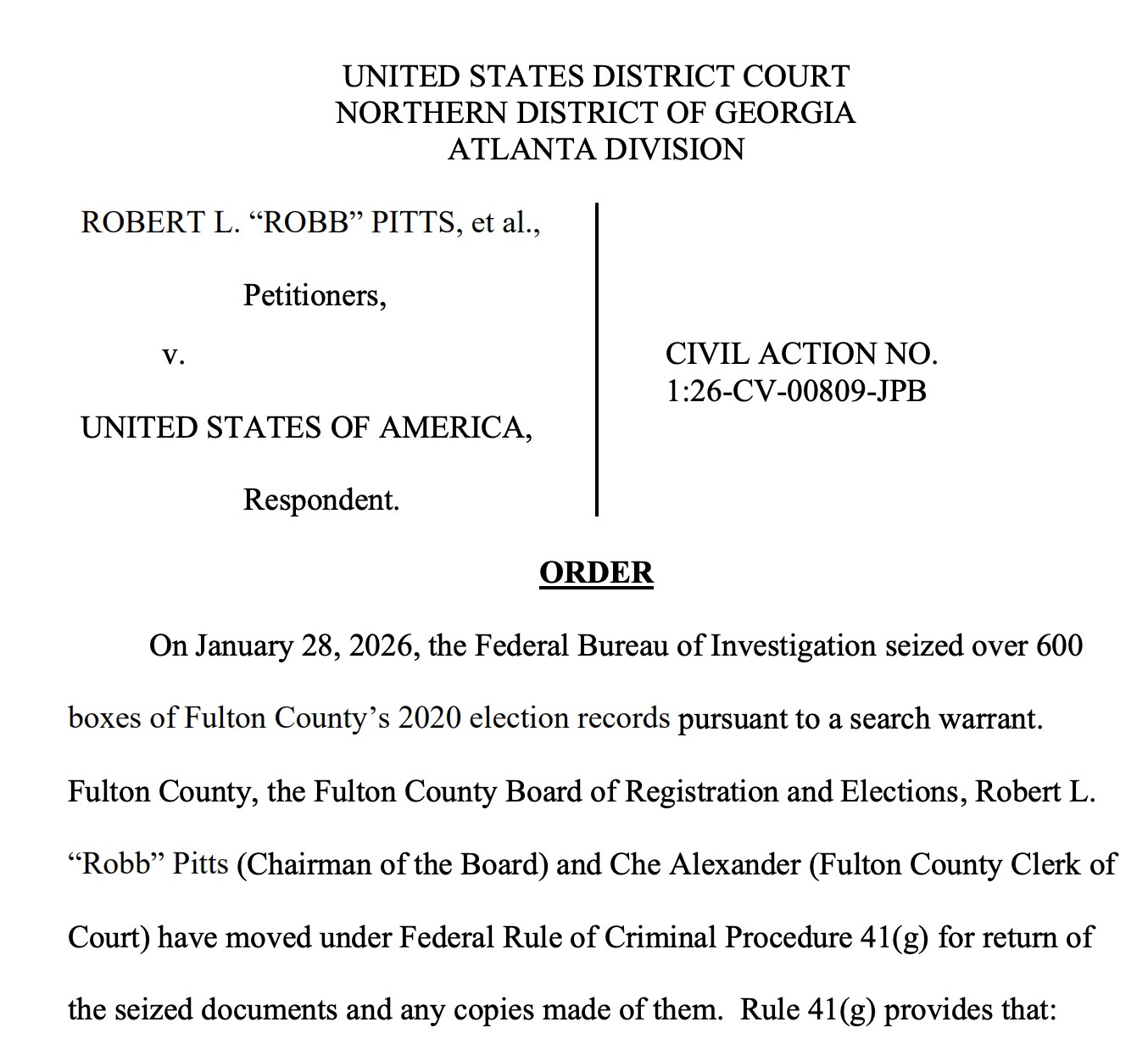
There is also good news out of Fulton County, Georgia.
Instead of the hearing we were expecting on the County officials’ request to have their 600 boxes of election records restored to them this Friday, we got an order from Judge J.P. Boulee.
The County officials asked the Judge to use Federal Rule of Criminal Procedure 41 to restore their property to them. That rule permits: “A person aggrieved by an unlawful search and seizure of property or by the deprivation of property may move for the property’s return.” Judge Boulee set forth the four requirements for establishing that the moving party is entitled to have their items returned:
(1) the government displayed a “callous disregard” for the plaintiff’s constitutional rights;
(2) the plaintiff has an individual interest in and need for the material whose return he seeks;
(3) the plaintiff would be irreparably injured by denial of the return of the property; and
(4) the plaintiff does not have an adequate remedy at law absent the Rule 41 proceeding.
The Judge pointed out that a successful Rule 41 proceeding would not deprive the government of the use of evidence for lawful purposes. If returned, the County would be required to preserve the documents for the government’s later use—a requirement that it is already subject to, because these are election records that must be maintained.
The Judge noted his obligation to hear testimony and take evidence if he was ultimately called upon to decide the dispute. That’s something that DOJ might be eager to avoid, given the apparent irregularities in their process, which saw the head of the Atlanta FBI office step aside and a U.S. Attorney from Missouri, instead of the one in Atlanta, handle the matter. He then gave the government an out: “the Court believes it is best for the parties to work toward a mutually agreeable resolution before receiving additional evidence.” He gave them until March 4 to agree on a mediator and until the 18th to report back on whether the mediation succeeds.
It’s a strong move from the Judge. He declines to rule on whether the County officials can meet the high standard for proof under Rule 41. But the fact that he hasn’t denied their request out of hand and is treating it this seriously strongly suggests to the government where this is headed if they don’t reach a deal to return the records to the County. Rule 41 proceedings don’t usually make it this far, and the government has to be concerned that’s a very bad sign for them. The risk that they will still have to return the items they seized pursuant to a court order, and that all of their maneuvering will be publicly exposed in the process, is substantial.
There’s a subtle additional benefit here. The subtext has always been that this process, designed to cast doubt on election officials in the County (even though recounts and court cases confirmed the outcome), was designed to permit Republicans who control the state legislature to take over elections. It will be much more difficult for them to proceed while this process lingers, so a delay of even a couple of weeks, with the elections drawing ever closer, isn’t a bad thing.
And finally, a caution.
The Washington Post reported this morning that “Pro-Trump activists who say they are in coordination with the White House are circulating a 17-page draft executive order that claims China interfered in the 2020 election as a basis to declare a national emergency that would unlock extraordinary presidential power over voting.”
Of course, at the time, and with Trump officials in place running cybersecurity, there was a different message. In a Joint Statement, the National Coordinator for Critical Infrastructure Security and Resilience CISA, the Election Infrastructure Government Coordinating Council (GCC), and the Election Infrastructure Sector Coordinating Council (SCC), reported that “The November 3rd election was the most secure in American history . … There is no evidence that any voting system deleted or lost votes, changed votes, or was in any way compromised … While we know there are many unfounded claims and opportunities for misinformation about the process of our elections … we have the utmost confidence in the security and integrity of our elections, and you should too.” Chris Krebs, Trump’s Director at CISA, told 60 Minutes that “[Election] Day was quiet. There was no indication or evidence that there was any evidence of hacking or compromise of election systems on, before, or after November 3 … We did a good job. I would do it one thousand times over.”
Beyond that, a 2021 intelligence review concluded that China did not engage in efforts to influence the 2020 election. There were multiple audits and recounts, court rulings, and investigations without any finding of widespread fraud. There was no evidence of coordinated foreign interference.
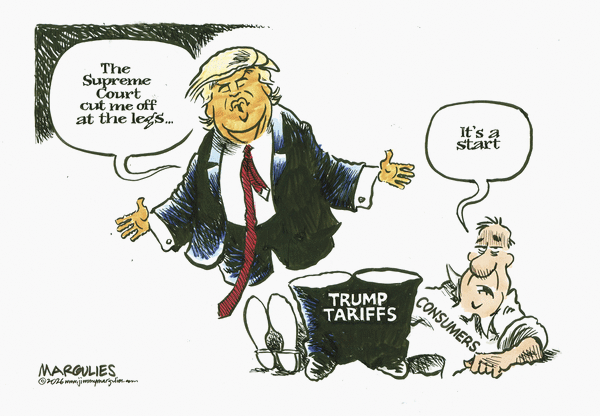
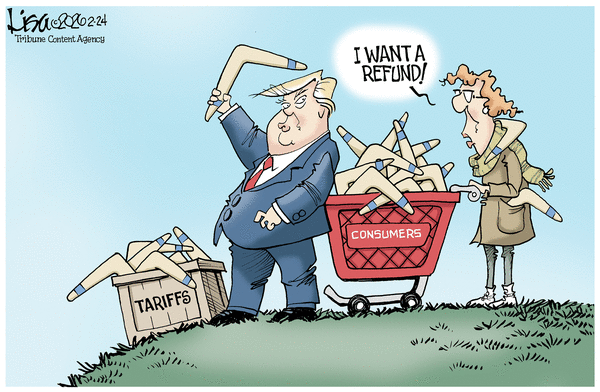
So we all get it. It’s another ginned-up emergency. There wasn’t an outbreak of irrepressible crime on American streets that necessitated the federalization and deployment of the National Guard. Trump made that up. A Venezuelan gang, Tren de Aragua, wasn’t invading the United States. Trump made that up. There wasn’t a balance of payments problem that warranted the imposition of exceptional tariffs. Trump made that up. And there’s not an emergency involving our elections that means Trump should take control of them. He’s making that up too—to the extent that there’s an emergency, he’s the cause of it.
The order Trump’s election denier buddies are pushing would use the supposed China emergency as the reason to declare yet another national emergency. The Post’s reporting suggests they will claim that permits them to “mandate voter ID, ban mail ballots, and change voting machines in November’s midterm elections.” How convenient—all the stuff they want to do, but can’t, because the law doesn’t permit it or Congress won’t pass laws authorizing it, tied up with a nice, neat bow into another one of those “uh oh—emergency, so I can claim extraordinary powers” executive orders Trump has become so fond of using.
The reality is that the president lacks constitutional authority to control elections. The Constitution gives that authority to the states. Even if Trump declared another national emergency, there is no basis for the assertion it would permit him to seize control of the elections. All this plot shows is that Trump lacks confidence in his party’s ability to win the midterm elections.
The election deniers are back in the White House and hard at work, as they were in 2020, to try and prevent American voters from determining the outcome of this year’s elections. Just like it did in 2020, the rule of law will prevail here.
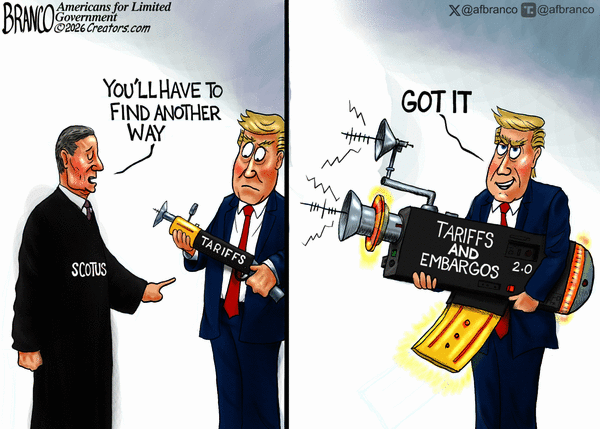
Pro-voter lawyers will go to court if Trump tries to implement this kind of desperate attempt to rig the election. And they will win. Even the Supreme Court has ruled against Trump, now in both the National Guard and in the tariffs cases, when he attempted to drum up fake emergencies to justify his assumption of exceptional powers. Nothing is certain with this Court, but district court judges who are increasingly taking this administration to task and holding it to account are likely to pave a smooth path. And working against the administration is the clear fact that the greatest threat to free and fair elections isn’t China, non-citizens, or Democrats—it’s this president and his cronies.
For years, I’ve been working to educate the public on the fact that voter fraud isn’t the problem—all of the evidence is to the contrary. The real issue is Republicans who use false or dramatically overblown claims of fraud to suppress the vote, and keep eligible citizens from voting. Let’s stay informed and make sure they don’t get away with that this year.
I feel our national security has been deeply harmed by the tRump adminsitration. I posted for tomorrow how Ukraine started making big gains against Russia’s invasion once they and foreign countries stopped sharing the war intel with the US. Seems clear everything Ukraine was sharing with the US went right to Putin. tRump’s amistration has given military secrets and tech to enemy countries just for their personal profit. And the worst of the stuff they hide. Horrific and I wonder with the military purges if the US can actually recover in the next decade. Hugs
Reddit, Meta, and Google voluntarily “complied with some of the requests” for identifying details of users critical of Immigration and Customs Enforcement (ICE) sent as part of a recent wave of administrative subpoenas the Department of Homeland Security has been distributing to Big Tech the past few months, according to an anonymously sourced New York Times report.
Those three companies, plus Discord, have received “hundreds” of such requests that have come from DHS recently. Meta, it should be noted, is the parent company of Instagram, Facebook, and WhatsApp.
Administrative subpoenas used for this purpose represent an escalation. This tool, which comes not from a judge but from DHS itself, was formerly reserved for situations like child abductions, according to the Times.
The users were targeted because their posts “criticized ICE or pointed to the locations of ICE agents,” the Times says.
A Google spokesperson replied to the Times with a statement, saying “When we receive a subpoena, our review process is designed to protect user privacy while meeting our legal obligations,” and “We inform users when their accounts have been subpoenaed, unless under legal order not to or in an exceptional circumstance. We review every legal demand and push back against those that are overbroad.”
Gizmodo requested comment from Meta, Discord, and Reddit. We will update if we hear back.
According to the Times, one or multiple of the relevant companies have stated that they notify users of these requests from DHS, and give them a 14-day window to “fight the subpoena in court” before complying.
Amazon has also been accused of at least some degree of participation with ICE’s ongoing mass deportation efforts. In October, Amazon-owned Ring announced a partnership with Flock that would loop the AI-powered network into the content coming from users’ doorbell cameras. According to a 404 Media investigation, that network feeds information to law enforcement agencies at the local and federal levels, allowing for reasonable concern that ICE has access to all that footage.
Protesters have launched an effort called “Resist and Unsubscribe” targeting ten tech companies they perceive as exceptionally supportive of ICE. That list includes Meta, Google, and Amazon, but not Reddit.
Donald Trump’s ICE is doing exactly what he wants. And now they are holding a political prisoner for nearly a year in an ICE detention camp simply because 33-year-old Leqaa Kordia dared to champion views the Trump regime opposes. This should concern all Americans especially given the recent warning from concentration camp expert Andrea Pitzer—who explained on my SiriusXM show that history tells the Trump regime building massive ICE detention camps will ultimately be used to imprison political prisoners.
That should not be a surprise to anyone who follows the history of fascist and other right wing regimes. Trump is following the fascist playbook, complete with his own secret police that has terrorized and even killed Americans who defy him. The most glaring example being the murder of Renee Good and Alex Pretti—who were then smeared by Trump officials as “domestic terrorists.”
Shockingly, we just learned that Trump’s ICE shot and killed another US citizen, 23 year old Ruben Ray Martinez, almost a year ago in March of 2025. However, Trump’s secret police covered up their involvement until recent media reports broke the story open. The details surrounding the murder of Martinez–who worked at Amazon–are simply unbelievable with ICE claiming that for some unknown reason this young man with no criminal record suddenly used his car to attack ICE officers.
Beyond that ICE has terrorized American citizens who dared film them—which they are legally entitled to—assaulted protesters and engaged in conduct consistent with an occupying army, not federal agents.
But it’s not ICE acting as a rogue agency—Trump wants them to do this. Trump—like Putin– wants to silence dissent as we’ve seen with his regime targeting all who oppose him from comedians like Jimmy Kimmel to seeking to criminally charge and imprison six Democratic members of Congress for warning members of the military to not follow illegal orders. A grand jury blocked that–at least for now.
That is why the case Leqaa Kordia demands far more attention given it’s a sneak preview of what we can expect from Trump for not just immigrants–but also U.S. citizens. Leqaa is a 33-year-old Palestinian woman with family in Gaza and the United States. Her mother is a US citizen living in Paterson, New Jersey—which is where Leqaa was staying and working as a waitress until she taken by ICE.
Leqaa Kordia
Kordia—who came to the US in 2016 on a student visa and was in the process of seeking permanent residence status via her mother –has no criminal record. The diminutive woman poses no threat to anyone. But to the Trump regime she is dangerous because she participated in peaceful protests advocating for Palestinian humanity. In the case, of Leqaa this issue is very personal in that she has lost nearly 200 relatives in Gaza.
But Leqaa’s case is not about Palestine—nor it is about Israel. Rather, it’s about freedom of speech—and the Trump’s regime targeting those who dare defy them.
How this case began was that in March of 2025, ICE informed Leqaa they wanted to speak to her. In response, she voluntarily appeared at the ICE office in Newark, New Jersey–where she was quickly arrested, thrown into an unmarked van and sent 1,500 miles away to the Prairieland Detention Facility in Texas far from her lawyer and family.
Since then, she has been detained in horrific conditions. As Leqaa detailed in a recent op-ed, the ICE facility she has been held in for nearly a year “is filthy, overcrowded and inhumane.” She slept in a plastic shell “surrounded by cockroaches and only a thin blanket.” And the food quality is so atrocious, it has caused her to vomit resulting in significant weight loss.
Worse, just a few weeks ago she experienced the first seizure of her life, collapsing to the floor. From there, ICE transported her to a hospital where her wrists and legs shackled to her bed for the three days. As she put it, “The entire time I was chained…I felt like an animal.” And simply to be cruel, ICE refused to tell her lawyers or family where she was or her medical condition.
None of this should be happening. As her lawyer Amal Thabateh explained to me, two different immigration judges ruled that Leqaa should be released on bond. But the Trump regime instead invoked a little used procedure to keep her in detention open ended.
To do that, serial liar DHS Secretary Kristi Noem smeared Leqaa as being a “terrorist” sympathizer for expressing concern for Palestinians in Gaza. They even claimed that releasing Leqaa—who again has no criminal record and was living with her US citizen mother in New Jersey–was somehow a threat to our nation. Of course, this is the same Noem who smeared with lies Renee Good and Alex Pretti as “terrorists” to justify their murders so we know she will say anything to defend the Trump regime’s crimes against humanity.
The idea Leqaa is a political prisoner is not just my view. Amnesty International lists her on their website demanding that the US government “release detained protester.” Her case is in the same section on the Amnesty website where they are calling for the release of dissidents in Russia, Belarus and other authoritarian regimes. This is where our nation is now viewed by human rights organizations.
Deeply alarming is that these ICE dentition centers are increasingly become death camps. At least 32 people died in ICE custody in 2025—the highest number in two decades. And in the past six weeks, six people have died in ICE custody including one man killed by ICE agents as they were restraining him. Will anyone be held accountable for this man’s death? That is like asking will anyone be held accountable for the death of Russian dissident Alexei Navalny killed in a Russian prison two years ago. We know that no one will be prosecuted because Russia is an authoritarian nation. As disturbing as it sounds, so is the United States under Trump.
But for those who refuse to submit to Trump and want to stand up for freedom of speech, I hope you will sign the Amnesty International petition calling for the US government to release Leqaa. Other ways to help this young woman include calling on your members of Congress to demand her release. You can also consider making a donation to her online fundraising page to help her and her family. Finally, you can follow Leqaa’s campaign for freedom on Instagram and amplify the updates.
As Andrea Pitzer repeatedly warned in our conversation on concentration camps, it does not end with people like Leqaa. It begins with people like Leqaa being held with in a camp for as long as the regime wants to keep her–in horrific conditions–simply because they want to silence her political views. They then continue until they reach people like us. But as the famous poem goes, by then it’s too late because when “they came for me…there was no one left to speak out.”
——
Below is my recent interview about Leqaa’s wrongful detention with her lawyer Amal Thabateh, who is with Creating Law Enforcement Accountability & Responsibility (CLEAR) Project and Laila El-Haddad, an award-winning Palestinian author, social activist, policy analyst and journalist.
The Dean’s Report by Dean Obeidallah is a reader-supported publication. To receive new posts and support my work, consider becoming a free or paid subscriber.
The international accompaniment movement teaches us that to sustain an emergency response to state violence, we must build durable, collective and supportive structures now.
Targeted state violence and rising fascism are being met with creative organizing by people in Minneapolis and across the country, from mass marches to neighborhood mutual aid to ICE watch foot patrols. These are all beautiful manifestations of resistance that have kept many people safe and demonstrated widespread repudiation of the Trump administration’s policies.
Yet as state-sanctioned violence becomes more coordinated, normalized and national in scope, we must continue adapting our response systems to shifting needs. Emergency response structures set up in moments of crisis can often lead to isolated, reactive decision making with responsibility falling on a few shoulders, creating the conditions for burnout, security failures, movement fragmentation and individual and organizational missteps or even collapse.
Here we can draw on some hard-earned lessons from our predecessors in the decades-long international accompaniment movement, who witness, stand with and provide security support for human rights defenders, communities and activists under attack by authoritarian regimes in Latin America.In response to sometimes devastating losses, accompaniment organizations developed a set of skills and strategies over many years for collaborative, sustainable decision making to respond to security incidents while under conditions of constant threat. We ourselves learned these skills in our many years of working with accompaniment organizations in Guatemala, Honduras and Colombia from 2008 to 2022.
We share here principles and practices from this legacy, which we hope organizations and networks, whether formal or informal, can use to develop emergency response structures that are sustainable, don’t overly burden a few individuals with the difficult decision making, actively build collective capacity and shared analysis, and support skill-building for more people in our movements.
What we present here are suggestions, and we invite you to adapt them to particular organizations and situations. They may take a bit more planning and preparation than may seem available in moments of urgency. But if we want to sustain our movements for what, unfortunately, is likely to be a long struggle, we must begin now to put durable, collective and supportive structures into practice.
1. No one person decides alone
Decision making in emergency security situations is emotionally and mentally taxing. Stress can narrow our literal and metaphorical fields of vision. And because the weight of a decision can be incredibly heavy to bear — especially if things go wrong — no one ever made a decision alone in the accompaniment organizations of which we were a part. We had clearly established protocols for which people, based on their roles in the organization, would come together for specific emergency response decisions.
For example, we established regional subcommittees based on where a security incident occurred. Each subcommittee was composed of a security lead, a representative from the advocacy team and on-the-ground volunteers, who worked together to assess, analyze and respond to emergency situations.
Applying this principle in a U.S. context, organizers of a publicly advertised protest could set a team of folks who gather at an office or a home to monitor social media and news reports for security incidents or threats, and be ready to make decisions about emergency response.
2. Prepare decision-making structures and roles beforehand
Emergency response or crisis moments are when people are most activated and are also the most likely to lead to organizational, interpersonal or movement conflict. This shouldn’t come as a surprise. After all, we are being subjected to situations of prolonged violence directed at ourselves and people we care for. We want to show up in the best way possible, yet often also feel frustration, impotence or rage.
In our accompaniment organizations, we mitigated stress and conflict (to the extent possible) by having clear processes and roles for decision making.
First, we frontloaded as many decisions as possible before an emergency, allowing us to focus on the situation at hand rather than spend time debating who would do what and delaying important support for the impacted individuals. Knowing who is going to be involved in emergency response reduces the need for conversation and shortens the response time.
The Peace Brigade International accompanies the Front of People in Defense of Land and Water in Amilcingo, Mexico. (Facebook/Peace Brigades International)
We have seen this play out in high-risk moments in our accompaniment work. For example, when we responded to nationwide protests that extended over months and saw daily murders of protesters by military and police forces, we set up a rotating decision-making group. Because roles and communication channels had already been agreed upon, colleagues didn’t have to debate who should verify information, call other allied organizations or set up our emergency response protocol. They could simply act.
Second, we made decisions in consensus. While clear decision-making structures are essential, that doesn’t necessarily mean they have to be hierarchical. We’ve found in our accompaniment work that decisions are easier to implement when everyone has a hand in shaping them. A consensus-based decision-making structure keeps any one person from carrying the whole mental load (see “No one person decides alone”) and lets us actually use the full brainpower in the room. We all come with different lived experiences, risk tolerances and ways of thinking, which means we’re bound to catch things others won’t and, luckily, vice versa.
This works best when folks talk it out together and create a clear timeline to decide. In the example above, if the group got stuck, they would start with a quick break to rest and regroup, and if that fails, go to a smaller predesignated subgroup — and, if even that doesn’t work, have a clear fallback decision-maker. Something else we’ve learned: Consensus tends to work better when we trust each other and each other’s criteria, so it helps to make the effort to get to know each other, grab a coffee or go for a walk before the emergencies happen.
3. Some participants in decision making should be offsite
It might seem logical that those directly involved in the emergency response should be onsite, able to see the situation firsthand and respond immediately. In fact, we learned in our accompaniment work that involving folks offsite as advisors or even decision makers can provide essential perspective, bring in crucial information and further spread the decision-making burden.
In one protest scenario, while tensions escalated on the ground, an off-site team a few blocks away tracked both police staging and local news sources and relayed that information back to organizers. This wider view allowed on-the-ground leadership to make informed choices without relying only on what was immediately visible.
4. Rotate the decision makers
Holding a decision-making role in an emergency situation is not easy; it means putting your body on high alert, navigating complex situations and grappling with violence directed at our communities. This, unsurprisingly, takes a toll on us over an extended period of time (more on this below).
Even if we believe we can hold this indefinitely, the reality is that, without moments to regulate our nervous systems, our bodies normalize the constant alertness, making it harder to activate when necessary and to properly analyze what is truly an emergency. We want our emergency decision makers to be well-rested, regulated and connected — for their wellbeing and ours, too.
That’s why we recommend that the decision makers in an emergency situation shift on an agreed-upon rotation. Depending on organizational structure, the best rotation might be every protest or event, or it might be a time period, like a week. This not only gives us a chance to skill up more folks in emergency response (always a benefit for our movements!), but it also gives us decision makers a chance to rest and recharge.
In the protest scenario previously mentioned, once things settled for the day, the people who had been making decisions rotated out. Some went home to sleep; others took quiet time away from phones and updates. A few days later, once they were rested enough to look at what they’d learned and what might need to change next time, they checked back in for the follow-up stage.
5. Institute Urgency Guides
Prolonged emergency situations make it harder over time to accurately recognize urgency. When everything feels critical, true emergencies can become blurred. Clear guidelines help mediate this by providing structure and clarity for decision making under sustained stress. In our accompaniment work, we used the following guidelines to categorize our responses:
On alert (prior to emergency): The situation seems to be escalating. We have seen a few signs indicating the risk level may be increasing (increased presence of armed actors, state or non-state, counter-protesters gathering, surveillance signs, suspected infiltration, etc.). Start to notify the security team (on and offsite) and start to implement increased security measures.
Immediate response (minutes to hours after): The emergency situation is active; the threat has not yet passed and there is potential for the situation to escalate or repeat. The physical and emotional well-being of impacted individuals is prioritized immediately.
Rapid (24 to 48 hours after): The specific situation has passed, but there is potential of it repeating in the near future. This could be because we will go to the same location in the next few days, or the event we are hosting will continue, or the aggressor is still nearby or indicating potential harm to our communities.
Follow-up (a few days to weeks after): The situation has passed. Here we focus on analysis and whether we need to adapt our organizational and movement strategy. This is also a great time to broaden the analysis by including allies in answering questions like: What was the aggressor’s desired impact? Have we seen this strategy used before? What are the increased security measures we may need to implement based on this situation?
We have used this for years in accompaniment spaces, allowing us to clearly mark stages in our response and who had to be involved. For example, when activists we were supporting suffered an assassination attempt, the attention moved from split-second decisions (immediate response) to checking in with impacted participants, ensuring medical attention, locating others who could be targeted next and finding safe houses, to adjusting security plans for the next day and watching for signs the situation might flare up again (rapid response). Later still, the group circled back to look at what had happened and what it meant going forward (follow up).
6. Establish ways to take care of yourself and your team before and after taking on decision-making roles.
When stepping into an emergency response decision-making role, it is essential to shore up your emotional resources before an emergency and repair your heart and mind afterward. This will look different for everyone, but all organizations and networks should dedicate time and space for everyone involved in emergency response to do this. You might employ the same tools for shoring up and for repairing: They could include a nice walk with your dog, tea with a close friend, reading a good book or taking a bath.
Whatever you need to rest and recharge, identify those activities and build them into your plans. We know this is hard, and to be clear, this level of care has not always been consistently present within accompaniment organizations; its absence often contributes to rapid turnover and diminished response capacity. Naming this matters. After more than a decade of collective work in emergency accompaniment, we have seen clearly that constant crisis response is not sustainable if people’s nervous systems are never given real opportunities to rest and regulate.
This is why we believe it is so important to speak directly about intentional, collective care practices not as an ideal, but as a necessary condition for the longevity and effectiveness of accompaniment and emergency response itself.
We don’t need to reinvent the wheel
These tools aren’t a panacea for the real risks presented by escalating state violence. They won’t stop all arrests, injuries, raids, deportations or assassinations. They won’t undo the harm already done or bring back the people we’ve lost. But the more we incorporate skillful emergency response tools into our repertoire, the more we can stay connected to one another under pressure, reduce preventable harm, and keep showing up again and again without burning out, fragmenting or turning on each other.
None of this work is new. We are drawing from the accumulated knowledge of mentors, organizers, human rights defenders, journalists, accompaniers, medics, lawyers and movement elders who have spent decades responding to fascist and authoritarian governments across regions and generations. From underground networks resisting military dictatorships, to civil rights organizers facing state-sanctioned terror, Indigenous land defenders, abolitionists, anti-colonial movements and transnational solidarity networks, people have long been building collective security, emergency response and care structures under conditions that mirror in many ways what we are facing now.
Luckily, this means we don’t have to reinvent the wheel. We just need to know how to look to the past, to other contexts and to each other for guidance and support. The more intentional we are,the better we’ll be able to keep up the struggle so that, one day soon, we will not just have survived fascism but defeated it.
It is always OK to ask to stop. Consent can be withdrawn at any time! You are not a sex toy or sex slave unless that is what turns you on. Even then you have the right to say stop. You are a person. Anyone who doesn’t stop when asked is an abuser that doesn’t deserve you. Hugs






































 Scottie's Playtime