On Tuesday, Maine Secretary of State Shenna Bellows ruled that a proposed ballot initiative banning trans students from school sports and bathrooms will not appear before voters this November. The billionaire-funded campaign initially submitted 79,692 signatures—well over the 67,682 required to qualify—and the Secretary of State’s office certified the question for the ballot in March. But indications soon emerged that the signature-gathering process was riddled with improper procedures and, in at least one documented case and potentially many others, outright forgery. After a court remand, an evidentiary hearing, and a sworn-testimony review of the petitions, 12,542 signatures were invalidated, leaving the campaign 532 short of the threshold. Barring an appeal—which is likely though its success is far from certain—transgender students in Maine can rest a little easier this election cycle.
The infractions are striking. One out-of-state circulator left his petition forms unattended at a Topsham polling place on Election Day—twice—allowing voters to sign without a witness present, in direct violation of Maine law. Another circulator did the same at a Saco polling place, leaving her table for extended periods while crowds of voters signed unwitnessed petitions. When asked under oath whether she had destroyed the unwitnessed forms as required, she said yes—but a photograph submitted into evidence showed one of those forms was in fact turned in for validation. Most troubling of all, an out-of-state signature gatherer paid per signature submitted forms that appear to contain outright forgeries: one voter listed on her petition testified under oath that she had never signed it and had never even heard of the initiative. After the Oxford town clerk flagged additional suspicious signatures, an Elections Division review compared every name on the circulator’s forms against voter registration applications—and concluded that every single one of her validated signatures should have been thrown out as signed by another person.
Based on the evidence, Bellows ruled Tuesday that the initiative had failed to qualify for the November ballot. The decision marked a reversal of her own March certification, when her office initially determined that the petition contained enough valid signatures to move forward. That earlier ruling was challenged in Cumberland County Superior Court by three Maine voters, who alleged that thousands of signatures had been collected in violation of state law. In April, Justice Deborah Cashman agreed that the original review had been incomplete and remanded the case back to the Secretary of State’s office for further factfinding, ordering a new determination of validity within thirty days. That process produced the May 12 evidentiary hearing—where witnesses, including town clerks and voters whose names appeared on petitions, testified under oath—and ultimately the decision invalidating thousands more signatures than the initial review had caught. Bellows adopted that recommendation in full.
The initiative would have done far more than what its sports-focused branding suggested. It would have defined a person’s sex for school purposes as “a person’s biological status as male or female recorded at birth on the person’s original birth certificate”—a definition that would have stripped transgender students of legal recognition in Maine schools. It would have required public schools to “maintain separate restrooms, locker rooms, shower rooms, and other private spaces for each sex,” extending the ban well beyond athletics and into every gendered space in a school building. It would have created a private right of action allowing any student to sue their school for “direct injury” suffered from a violation of the act, effectively turning every transgender student’s presence in a bathroom or on a sports team into potential litigation. And it would have specifically carved transgender students out of the Maine Human Rights Act.
The anti-trans signature drive was not a grassroots effort. It was bankrolled by Illinois billionaire Richard Uihlein, the co-founder of Uline office supplies, who donated $800,000 to fund the entire effort. Uihlein has given more than $250 million to political causes since 2016, and is a major funder of the American Principles Project, which routinely spends tens of millions on anti-trans campaign ads during election years. He is not alone: an independent analysis published by Atmos and HEATED found that 80% of 45 major anti-trans organizations in the U.S. have received funding from fossil fuel companies or billionaires. The Maine initiative was part of that broader pattern—an attempt by a small handful of extraordinarily wealthy donors to use direct democracy as a workaround in states where elected legislatures have refused to engage in anti-trans legislation.
The decision was greeted with relief by the LGBTQ+ coalition that has fought the initiative since the day it was filed. “Maine has strict rules in place to protect the integrity of our elections and our system of direct democracy. The paid, out-of-state signature gathers and the billionaire who paid to try to put this question on the ballot failed to follow the rules,” said David Farmer, campaign manager for the Campaign for Free and Fair Schools, the coalition led by EqualityMaine, GLAD Law, and the Maine Women’s Lobby. “We believe that the appeals process and the reviews by the Secretary of State are working as the law intends. They are protecting the integrity of our elections.”
The Maine ruling is not the end of fight. Similar billionaire-backed initiatives have been certified for the November ballot in Washington and Colorado, where voters will decide whether to bar transgender students from sports as well as medical care restrictions. Both efforts are also funded by conservative megadonors, and both are part of the same strategy that produced the Maine initiative: use ballot initiatives to roll back trans rights in states whose elected legislatures have refused to do so. The Maine anti-trans campaign is expected appeal Bellows’ decision to Maine Superior Court within the ten-day window the law allows.
The seahorse cousin is named for its ‘uncanny’ resemblance to the Sesame Street character
Sheena Goodyear · CBC Radio · Posted: May 21, 2026 4:01 PM CDT | Last Updated: May 21
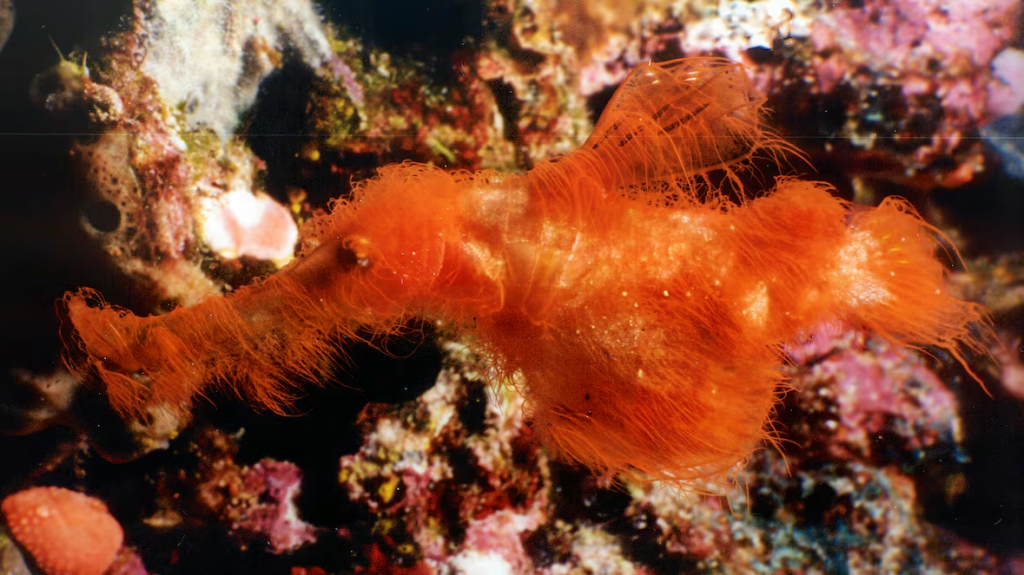
Solenostomus snuffleupagus, a newly described species of fish, is named after the beloved Sesame Street character, Mr. Snuffleupagus. (David Harasti)
Scientist David Harasti never had any doubt what he would name the tiny orange creature he first spotted on a diving expedition in Papua New Guinea in 2003.
But it would take another two decades for Harasti and his colleague Graham Short to find the elusive fish again, study it, and officially designate it a new species.
Meet Solenostomus snuffleupagus, namedafter the beloved Sesame Street character, Mr. Snuffleupagus.
“Snuffy for short,” Short, an ichthyologist at the California Academy of Sciences and the Australian Museum, told As It Happens host Nil Kӧksal. “The resemblance was quite uncanny.”
Short and Harasti have now written a new paper, published in the journal Fish Biology, describing S. snuffleupagus as a new species of ghost pipefish that makes its home along coral reefs, and disguises itself as red algae.
‘The awesome power of natural selection’
The fish has quite a few things in common with its namesake — mainly its orange-brown colouring, the long filaments that look like shaggy hair, and its elephant-like snout.
Milton Love, a marine biologist at the University of California’s Marine Science Institute in Santa Barbara, Calif., says the fish’s muppet-like appearance demonstrates “the awesome power of natural selection.”
“Clearly, all of the morphological features that we find endearing are of some value to the animal,” Love, who was not involved in the research, said in email.
“Or, and here is another hypothesis, Gaia created this fish after having one too many of those rum drinks that come with those little umbrellas.”
But its similarity to Snuffleupagus goes deeper than meets the eye.
It’s also extremely elusive, much like Mr. Snuffleupagus, who, in his early appearances on Sesame Street, was only ever seen by Big Bird, leading the other characters to mistakenly suspect he was imaginary.
Harasti and Short tried for years to spot a snuffy fish again after that first 2003 sightingto no avail.
Their luck changed in 2021 when some scuba diver buddies started seeing the little creatures on the Great Barrier Reef and got in touch. The scientists headed to Australia to see for themselves, and on their second dive, they found the fish.
“It’s an understatement to say that we screamed under water,” Short said. “We high-fived, gave each other a hug, and we were just so excited.”
An itty-bitty carnivore
In order to describe the fish and confirm it as a previously undocumented species, the scientists looked at CT scans of specimens first collected in 1993 during exhibition to far north of Queensland, Australia, in the Torres Strait.
Short says they were collected alongside several hundred other fish specimens and tucked away until he and his colleague came looking. But even back then, he says ichthyologist Helen Larson, who was part of the expedition, suspected it was a new species.
S. snuffleupagus, like other ghost pipefish, is a cousin of the seahorse.
The newly described Snuffleupagus fish is smaller than a matchstick. (Darren Rice/Matafonua Lodge)
Using iNaturalist, the citizen science platform, the scientists confirmed sightings of it in Tonga, Papua New Guinea and New Caledonia, suggesting distribution across the southwestern Pacific.
And while it may look like Big Bird’s beloved bestie, there are a few significant differences between S. snuffleupagus the fish and Snuffleupagus the muppet.
While Snuffleupagus is famously big — bigger even than Big Bird — S. snuffleupagus is roughly four to five centimetres long, about the size of an airpod.
And while Snuffleupagus would never harm a fly, S. snuffleupagus is a natural-born killer.
“They look adorable, very cute. They’re very delicate and slow moving in the water. And it’s been assumed that they only eat small crustaceans like small shrimp,” Short said.
Not so, he says. The CT scans found tiny fish skeletons in the specimens’ stomachs.
“Every fish has a role, and they are either eating or being eaten. It turns out, ghost pipe fish and in particular, snuffy … they’re just like other fish,” Short said. “They’re predators.”
Short says the widespread interest in S. snuffleupagus has been a delight, and he hopes it won’t be the last fish he brings attention to.
He and his colleague already have their eyes on another species of ghost pipe fish that is known to divers around the Pacific, but hasn’t been formally described.
If it works out, they plan to name it after another muppet, but Short wouldn’t say which one.
“Not yet, because I need approval,” he said.
Interview with Graham Short produced by Leslie Amminson
As Rhode Island Hospital begins turning over documents to a far-right judge in Texas, a number of grand jury subpoenas have been issued and DOJ settled with one hospital.
Three weeks ago, on April 29, lawyers for Rhode Island Hospital responded to an email from a Justice Department lawyer in Washington, D.C., sent the day before, asking for a conference on next steps in addressing an outstanding administrative subpoena issued by DOJ to the hospital nearly a year earlier about its provision of gender-affirming care for transgender minors.
The next day, DOJ shifted tactics without even initially telling the hospital — going to court across the country to try and get an order enforcing the subpoena.
At least seven challenges to the invasive subpoenas had previously resulted in federal court rulings quashing the subpoenas or, at least, the parts of the subpoenas seeking identifiable patient information. In the wake of those losses — and as Acting Attorney General Todd Blanche took over the Justice Department — the strategy, as Law Dork has covered, began to shift to more aggressive tactics on multiple fronts.
The change has had at least one tangible effect already with regards to Rhode Island Hospital.
Beginning Tuesday night, at least some records responsive to the administrative subpoena were sent to a far-right federal judge in Texas who on Monday ordered the hospital to provide the records to him — although, for now, not to DOJ — while the hospital appeals his earlier ruling that the records need to be turned over to DOJ.
Any action on that earlier ruling, however, would appear to conflict with a later ruling from a federal judge in Rhode Island quashing the subpoena in full and barring DOJ from receiving any such records from the hospital — although the U.S. Court of Appeals for the First Circuit late Tuesday denied a request to take further action immediately to enforce that order.
This latest dispute, which has now involved four courts across the country, as well as related discussions in court filings and before a federal judge in Rhode Island, serve as a warning for transgender people, their allies, and the parents of trans kids about how aggressively the Trump administration is acting to advance President Donald Trump’s anti-trans policies and then-Attorney General Pam Bondi’s implementation of them — and where the administration could be going next in this attack.
That April 28 DOJ email to Rhode Island Hospital’s lawyers — in which David Gunn, a DOJ lawyer, referenced having been out of office for the past few weeks before asking for a conference to discuss the subpoena production — was a DOJ response to a February 4 email from lawyers from the hospital.
The hospital’s lawyer responded simply the next day: “We are happy to connect. Would Monday of next week work?”
The conference never happened because, on April 30, DOJ went to a friendly forum for them in the Northern District of Texas seeking to enforce the administrative subpoena, which, to be clear, was issued in D.C. to a Rhode Island entity. Going there meant the case had a good chance of and was, in fact, assigned to U.S. District Judge Reed O’Connor, a far-right judge with a history of anti-LGBTQ rulings.
Within hours, and before the hospital even had a chance to file any response, O’Connor granted the request — ordering the hospital to turn over the records within two weeks.
Over the past three weeks, there have been daily developments — and often multiple developments — shining an alarming light on what is happening.
Grand jury subpoenas
In addition to the order to enforce the subpoena in the Northern District of Texas, one of the two other most significant other development was the news — acknowledged by NYU Langone Health in accordance with New York law on May 11 — that it had received a grand jury subpoena for similar records that was issued in the Northern District of Texas.
Ethan Womble is listed as the person who sought the grand jury subpoena. He is, as of last month, an Assistant U.S. Attorney in the Northern District of Texas. (He was previously listed — as recently as February — as a trial attorney in the DOJ Criminal Division’s Fraud Section, although that health care fraud work does appear to have been based out of Texas.)
Womble and Ryan Raybould, the U.S. Attorney for the Northern District of Texas, were the only two lawyers on the DOJ petition to enforce the Rhode Island Hospital subpoena. They are both former O’Connor clerks.
The grand jury subpoena — which does not require judicial approval — was received by NYU Langone on May 7 (although dated May 6), and the date for compliance is June 10.
There is also evidence that other grand jury subpoenas were issued. In addition to NYU Langone stating that it was “one of several institutions that received a grand jury subpoena,” Law Dork previously reported that DOJ’s decision to withdraw its appeal of one of its administrative subpoena losses — as to Children’s Hospital of Philadelphia (CHOP) — came the same date that the NYU Langone grand jury subpoena was issued.
In a filing later on May 6 before the district court that had heard and granted the Philadelphia hospital’s initial request, the lawyers for CHOP were direct:
Just this morning, DOJ attorneys reached out to counsel for CHOP indicating that DOJ intended to dismiss its appeal, which has been proceeding in the Third Circuit since January and in which DOJ’s brief was due today. That development, along with DOJ’s unexplained effort to compel compliance by a Rhode Island hospital in the Northern District of Texas, suggest that DOJ may seek to end-run this Court’s jurisdiction over additional issues that arise involving the Subpoena.
Unlike the administrative subpoenas, which were challenged in the locations where the hospitals were located, challenges to the grand jury subpoena(s) would generally be in the Northern District of Texas — although lawyers will be looking for other paths.
It also should be noted that it is not yet clear what, if any, action beyond the issuance of the grand jury subpoenas has actually happened in the Northern District of Texas.
The Texas Children’s Hospital settlments
The grand jury subpoenas aren’t the only new development.
On May 15, DOJ announced it had reached a “resolution” with Texas Children’s Hospital in conjunction with a long-running investigation against the hospital by the Texas Attorney General’s Office.
Although DOJ presented the development as “the first resolution secured under the Department’s ongoing national investigation into violations of federal law in connection with” provision of gender-affirming medical care for transgender minors, Texas Attorney General Paxton only mentioned DOJ in one sentence and instead stated, “After a years-long investigation by the Healthcare Program Enforcement Division, Attorney General Paxton has negotiated a historic settlement that will help protect Texans.“ DOJ does cite agreements reached by the hospital with both federal and Texas governments.
In addition to ending the provision of such care, Paxton’s news release stated that Texas Children’s Hospital has agreed to “the creation of the country’s first-ever Detransition Clinic” and “pay $10 million for billing Texas Medicaid for unallowable and illegal ‘gender-transition’ interventions, including by using false diagnosis codes.“
In the DOJ news release, which only quotes Main Justice senior officials from D.C., it noted, “These matters and the investigations into sex-rejecting procedures (sic) on minors are being led by the Justice Department’s Civil Division Enforcement and Affirmative Litigation Branch and Commercial Litigation Branch, Fraud Section.”
There was no mention of the U.S. Attorney’s Office for the Northern District of Texas — or any district in Texas, for that matter — but the fact that the news releases are about a Texas hospital, DOJ’s release referenced what appears to be the same investigation at issue in both the administrative and grand jury subpoenas, and Texas’s release referenced one of the topics raised by DOJ in defending its subpoenas as allegedly supporting its investigation (improper billing codes) should not be glossed over.
For its part, Texas Children’s Hospital, in a statement to Law Dork, sounded a significantly different note than DOJ and Paxton’s office:
Over the last three years, we have cooperated fully with the Texas Attorney General and Department of Justice, navigating an unconscionable campaign of mistruths and mischaracterizations related to gender affirming care. We produced over 5 million documents and conducted multiple internal and external investigations. These efforts have required significant staff time and financial resources to defend ourselves. All reviews and investigations continue to support the facts – we have been compliant with all laws.
Today, we made the difficult decision to settle with the Texas Attorney General and the Department of Justice, closing a chapter that has been wrought with falsehoods and distractions. To be clear – we are settling to protect our resources from endless and costly litigation. This settlement will allow us to redirect those precious resources to focus on the life-saving care and groundbreaking discoveries of our exceptional clinicians and scientists.
Nonetheless, if DOJ proceeds with a grand jury investigation in the Northern District of Texas, these settlements could quickly become very relevant to DOJ’s claims.
What happened with Rhode Island Hospital
All of which brings us back to Rhode Island Hospital.
After O’Connor issued his initial order three weeks ago Thursday, the Rhode Island Child Advocate — responsible for oversight of children under the care of Rhode Island’s youth services — sought to quash the subpoena in Rhode Island.
U.S. District Judge Mary McElroy, a Trump appointee who had initially been nominated during the Obama administration, was assigned the matter. She denied DOJ’s initial request to move the matter to O’Connor and set a quick timeline for consideration of the request.
The hospital, meanwhile, sought to stay O’Connor’s order — first before O’Connor and then at the U.S. Court of Appeals for the Fifth Circuit. (Both were denied.) The hospital also joined the Rhode Island Child Advocate’s request, intervening and filing its own motion to quash the subpoena.
On May 12, McElroy held an explosive hearing — accusing DOJ of having misled the hospital; the court in Texas; as well as, potentially, the court in Rhode Island.
Highlighting the incredibly invasive plans potentially involved in DOJ’s effort, McElroy told the relatively new DOJ lawyer before her, Brantley Mayers, counsel to the Assistant Attorney General, “[I]t is ridiculous to say that you’re going to find 14- and 15-year-olds who are undergoing gender reassignment or gender treatment and question them about what was told to them by their doctor. How invasive is that?”
An amicus brief submitted by Lambda Legal Defense and Education Fund addressed the improper ways DOJ is employing the Federal Food, Drug, and Cosmetic Act and other “healthcare offenses” to attempt to justify this investigation, but every judge has, again, found the effort to be an “improper purpose” under the laws at issue — or, at the least, the patient-specific documents requested not to have been appropriately sought.
Regarding the timing of the filing in Texas to enforce the Rhode Island Hospital administrative subpoena in conjunction with the emails earlier that week, McElroy told Mayers:
I take a very negative view to playing fast and loose by telling people one thing and filing other things with the court, and then taking the position like, oh, well, we didn’t tell you, but we did tell you afterwards. That is dirty pool, in my opinion, and the Department of Justice have willfully done that in this case.
Mayers had joined DOJ in November 2025 after three clerkships and with virtually no prior practice experience, a fact highlighted by McElroy, who repeatedly suggested that she believed the new lawyer was set up to defend the actions without having hardly any actual knowledge of the underlying investigation.
Sitting at his side, however, was Deputy Assistant Attorney General Jordan Campbell, a more senior Texas lawyer who joined DOJ in June 2025 after having co-founded a law firm that states it is “proudly seeking justice for the detransitioner community nationwide.“
Specifically as to the grand jury subpoena, which was discussed because NYU Langone’s statement had come out the day before, McElroy warned:
[T]he problem I’m having here is that it’s pretty clear to me that this was shopped to Texas, that’s fine, you have the right to investigate wherever you want, but these indictments that come out of Texas, if they ever come, because every person has signed an affidavit in this court and is going to be before me to explain it if they don’t.
Mayers insisted there were reasons for the investigation being in the Northern District of Texas — and acknowledged part of the content of a secret declaration that was filed ex parte (meaning just with the judge) in DOJ’s opposition to Rhode Island Hospital’s request that O’Connor stay his order enforcing the subpoena.
This secret declaration from Lisa Hsiao, the acting director of the Enforcement & Affirmative Litigation Branch — who has filed declarations in most if not all of DOJ’s efforts defending the administrative subpoenas and which have drawn questions previously — was later provided to McElroy as well. Of that, Mayers acknowledged:
[H]ere were many reasons why the investigation is being carried on in the Northern District of Texas. As the affidavit that you received yesterday ex parte indicates, there are potential targets, potential witnesses there.
The reference to “potential targets” of the investigation being in the Northern District of Texas appears to be a significant piece of information as that proceeds.
In any event, the next evening, on May 13, McElroy issued her ruling, quashing the administrative subpoena in full and blocking DOJ from receiving the requested documents. She also repeatedly questioned DOJ’s actions in the opinion, writing at one point that “the discrepancy between the honorable conduct expected of federal prosecutors and DOJ’s tactics in this case is unsettling.”
DOJ, however, did not let it go — appealing the order the next day and informing O’Connor of the ruling. O’Connor, on May 15, ordered an in-person hearing in Texas on May 18.
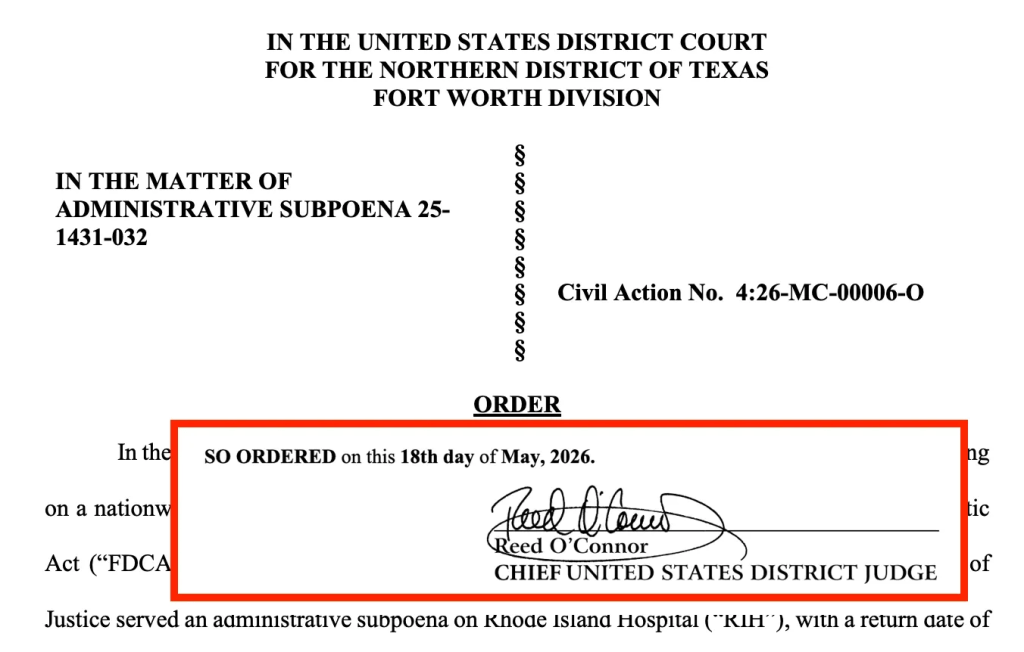
Following that hearing came the May 18 order from O’Connor, concluding that “RIH has also sought to circumvent the authority of this Court and the Fifth Circuit and attempted to collaterally attack the Enforcement Order“ and ordering the hospital to turn over to the court “all materials that it would have turned over to the Government in compliance with this Court’s Enforcement Order“ on the condition that the materials would be “secured and held in camera, inaccessible to the Government for the pendency of the appeals.“
Additionally, O’Connor — responding to his conclusion about the alleged circumvention — purported to bar Rhode Island Hospital from seeking relief from his order in any court aside from his court, the Fifth Circuit, or the U.S. Supreme Court and from “cooperat[ing] with others in seeking relief“ from his order.
The First Circuit
That led to one last effort to hold things off, with the Rhode Island Child Advocate filing a motion in the First Circuit — where DOJ had appealed McElroy’s order — on May 19 seeking an injunction ordering Rhode Island Hospital “not to produce patient-identifying information or protected health information” in response to the administrative subpoena “to any person or entity pending resolution of this appeal or until further order of this Court.”
DOJ opposed the request, and later highlighted the fact that, in Rhode Island Hospital’s notice about its production, “RIH represents that, ‘[t]o the extent that records RIH intends to produce contain any patient information, RIH will anonymize and de-identify this information.’“ DOJ stated that “RIH’s stated plan to anonymize any documents filed in the Northern District of Texas today further undercuts the Child Advocate’s claim of imminent irreparable harm.“
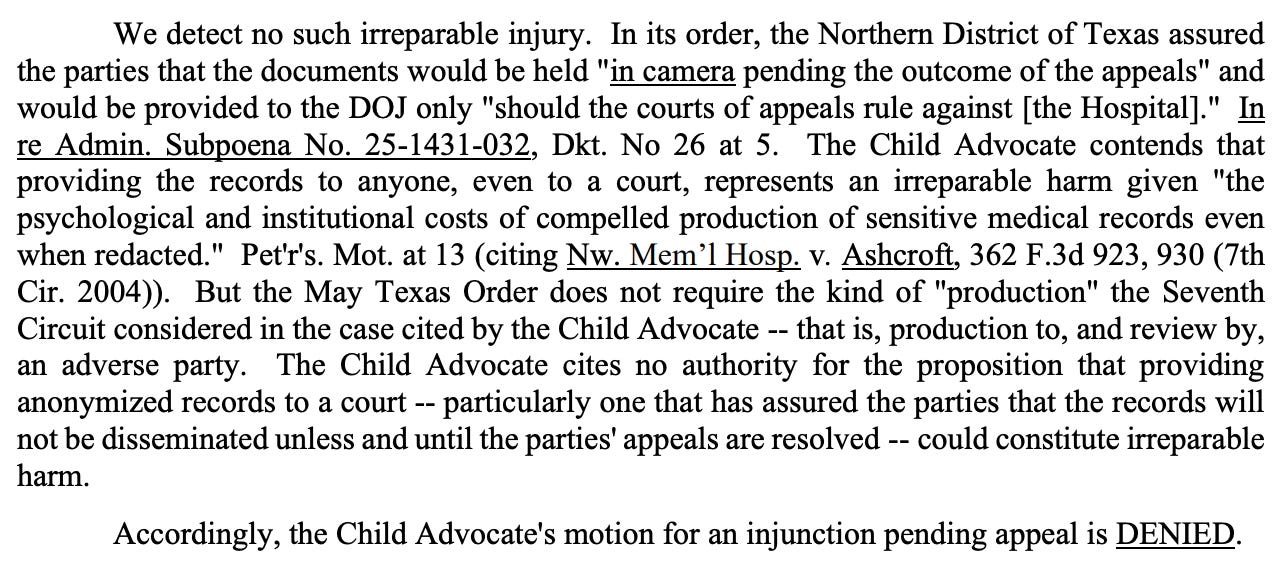
In a short order issued a few hours later, the First Circuit essentially agreed, denying Rhode Island Child Advocate’s request because, the court stated, “We detect no such irreparable injury.“
The panel consisted of Judges Gustavo Gelpí and Lara Montecalvo, both Biden appointees, and Judge Joshua Dunlap, a Trump appointee who took the bench in 2025.
Notably, Dunlap issued a concurring opinion, highlighting “additional concerns regarding the request for an injunction pending appeal“ — including, he wrote, “serious questions about the merits of the district court’s decision.” This is contrary to the seven other federal judges to have ruled on the question and was an aside, but it is nonetheless notable coming from the one Republican appointee on the First Circuit.
The bigger problem, however, with the First Circuit’s ruling is what was missing.
The paragraph highlighted above seems to run counter to and with an almost blind ignorance to all that McElroy got on the record in her May 12 hearing.
This is a situation where DOJ has questionably, and without providing public evidence, claimed that it has moved an investigation to the Northern District of Texas, justifying invoking the court’s jurisdiction there to enforce an administrative subpoena issued many months before the investigation had a connection to the district and against an entity across the nation that had been in discussion with DOJ the day before the enforcement action was filed. Then, a far-right judge there granted the request sought by his former clerks and now has ordered the hospital to provide him with the information that every other judge has decided medical providers should not need to provide.
No awareness of that reality comes through in the First Circuit’s order. Although the caveats in the order do mean that renewed requests could follow and it certainly means nothing as to the hospital or Rhode Island Child Advocate’s chances on appeal in quashing the subpoena (Dunlap’s concurrence aside), the First Circuit’s presumption of regularity is particularly ill-suited here.
As McElroy wrote specifically in her order, quoting an Oregon colleague:
The Court cannot help but share the sentiment that “[t]he presumption of regularity that has previously been extended to [DOJ] that it could be taken at its word—with little doubt about its intentions and stated purposes—no longer holds.” United States v. Oregon, No. 6:25-CV-01666-MTK, 2026 WL 318402, at *11 (D. Or. Feb. 5, 2026). It is regrettable that this is now the case.
As DOJ continues with these escalations of its attacks on trans people — and the provision of medical care specifically — courts need to keep their eyes opened to the reality as McElroy saw and detailed it, not to the image of courts as they would wish things to be.
Law Dork covers LGBTQ legal developments in depth. Consider becoming a free or paid subscriber.
One good thing about trolling comedians, they always know exactly how to respond.
New York City Pride recently announced the Grand Marshals for its annual Pride parade, scheduled for June 28.
It’s quite a roster, featuring trans actress Dominique Jackson, drag star Peppermint, trans journalist and radio personality Bernie Wagenblast, activist group Gays Against Guns and SNL alum Bowen Yang.
Of course someone was gonna have an opinion on this lineup, and one of them tried to come for Yang in the comments of the announcement on Instagram.
And Yang, ever the seasoned comedian, had the perfect response. The troll demanded to know “why bowen,” and Yang didn’t miss a beat, quipping:
“showed hole to the board.”
(snip-embedded social post)
Perfect.
It’s a strange question in the first place: Yang made history when he joined the SNL cast in 2019.
In a statement, NYC Pride wrote:
“Bowen Yang became a household name as the first Chinese-American cast member on Saturday Night Live in 2019.”
“With that platform, he helped usher in an era of authentic queer humor in mainstream media, earning an Emmy® for writing and becoming the most-nominated Asian male performer in Emmy® history in the process.”
The better question is “why not Bowen?”
(🤣 🤣 🤣 snip-MORE ; lots of embedded social media posts; enjoy!)
I love Ethel and her way of presenting facts and reality. She points out that studies in high schools indicate that the rates of trans children are 3.+ and those questioning are 2.+. Plus she points out the reason more trans people are out is the same reason more gay kids came out in the 2000s, it was the left handed issue again. When being left handed became OK to admit more people admitted and openly lived as left handed. Despite everything, trans kids feel safer coming out in the US than ever before. Hugs.
Some news about No Labels from my state; what’s happening with parties in your state? And great news regarding suicide prevention efforts aimed at LGBTQ+. I bet my state isn’t the only one!
No Labels Kansas is no more as a political party, despite bizarre bid to hijack the organization
Party didn’t fulfill plan to nominate candidates for president, vice president
TOPEKA — Demise of the No Labels Kansas political party was inevitable after it neglected to fulfill the organization’s central objective when formed in January 2024 to nominate candidates for U.S. president and vice president.
The failure of No Labels Kansas to field candidates for any type of statewide office or to win at least 1% of the total votes cast for that office in a general election meant the organization would eventually lose its standing in Kansas among the state’s five political parties. Instead of leaving Kansans to speculate when that might occur in 2026, No Labels Kansas secretary and treasurer Shane Mathis requested May 15 the termination of state recognition of the political party.
“Because No Labels Kansas declined to nominate candidates for those offices in 2024 and has no intention of doing so in the future, its central organizational purpose no longer exists,” Mathis said.
Secretary of State Scott Schwab complied Monday with the request and notified county election clerks and commissioners of state law requiring voter registration records be amended so 5,955 people registered with No Labels Kansas would be reclassified as unaffiliated.
In Kansas, the Republican Party dominates with 897,000 registered voters compared with the 575,000 unaffiliated and 495,000 Democratic Party registrants.
While founders of No Labels Kansas didn’t make a dent in Kansas elections, the existence of its organizational shell led a pair of longtime Republican operatives to attempt a hijacking of No Labels Kansas so it might be transformed into an organization with a broader mission that included nomination of candidates for state offices. (snip-MORE)
TOPEKA — A Wichita organization created an online training program for suicide prevention and mental health education to improve the care that LGBTQ+ Kansans receive when reaching out to crisis resources, including the 988 Suicide and Crisis Lifeline.
The organization, Center of Daring, focuses on inclusivity and leadership training. Its 10-part training program takes nine hours to complete and is available for free on the center’s website, according to an April 28 press release announcing the program.
“We believe this training series will fill a deep need here at a time when many LGBTQ+ Kansans don’t feel safe in our state,” said Liz Hamor, the Center of Daring founder, in the release.
Through learning activities, videos and surveys, the training covers trauma-informed intervention, intersectionality and promoting equity within a crisis response organization. The training was designed with input from LGBTQ+ residents and Kansas crisis care providers, according to the press release.
The 988 helpline is a mental health crisis resource available 24/7. It went nationwide in 2022. Kansas’ line received more than 34,000 calls, 12,000 texts and 9,000 chats in 2025, according to a state-mandated annual report.
The 988 Suicide and Crisis Lifeline is a free, confidential hotline available 24/7 for individuals in crisis or those looking to help someone else. To speak with a certified listener, call or text 988 or visit 988lifeline.org.
WASHINGTON (AP) — Barney Frank, the longtime Democratic congressman and leading liberal who brought new visibility to gay rights and crafted the most significant reforms to the financial system in a generation, has died. He was 86.
Frank died late Tuesday, according to Jim Segel, Frank’s former campaign manager and close friend.
After representing broad swaths of Boston’s suburbs in Congress for 32 years, Frank and his husband moved to Ogunquit, Maine. He entered hospice there in April with congestive heart failure and is survived by his husband, Jim Ready, and sisters, the longtime Democratic strategist Ann Lewis and Doris Breay, along with brother David Frank.
A self-described “left-handed gay Jew,” Frank was known for his acerbic wit, combative style and focus on marginalized communities. He represented the party’s left wing while keeping close with Democratic leaders who sometimes frustrated progressives.
He is best known as a pioneer for LGBT rights. After decades of grappling with his sexuality, he publicly came out as gay in 1987, the first member of Congress to do so voluntarily. With his 2012 marriage to Ready, he became the first incumbent lawmaker on Capitol Hill to marry someone of the same sex.