NEW YORK (AP) — Author Jodi Picoult has the dubious honor of being banned in two mediums this fall — her books and now a musical based on her novel “Between the Lines.”
“I’m pretty sure I’m the first author who has now had censorship occur in two different types of media,” Picoult says. “Honestly, I’m not out here to be salacious. I am writing the world as it is, and I am honestly just trying to write about difficult issues that people have a hard time talking about because that is what fiction and the arts do.”
The superintendent of Mississinewa High School in Gas City, Indiana, canceled a production last week of “Between the Lines,” saying concerns were raised over “sexual innuendo” and alcohol references in the musical. Jeremy Fewell, the superintendent, did not respond to a request for comment.
“It’s devastating for us to know that these kids who put in hundreds of hours of hard work had that torn away from them because of the objections of a single parent,” says Picoult.
“What I know, perhaps better than most people, as someone whose books have been banned, is when one parent starts deciding what is appropriate and what is inappropriate for the children of other parents, we have a big problem.”
Picoult noted that the same Indiana high school has previously produced “Grease,” where the sexual innuendo and alcohol abuse is much greater, including a pregnancy scare, sex-mad teens and the line “Did she put up a fight?”
“Between the Lines” centers on Delilah, an outsider in a new high school, who finds solace in a book and realizes she has the power to write her own story and narrate her own life. “It is a very benign message. And it’s actually a really important one for adolescents today,” says Picoult.
The original work, which features a nonbinary character, had already been edited with licensed changes to make it more palatable for a conservative audience, including removing any reference to the nonbinary character’s gender orientation.
The production was scheduled for Halloween weekend at the Gas City Performing Arts Center. The show has music and lyrics by Elyssa Samsel and Kate Anderson, and a story by Timothy Allen McDonald, based on the 2012 novel by Picoult and her daughter, Samantha van Leer. It played off-Broadway in 2022.
Picoult, the bestselling author of “My Sister’s Keeper” and “Small Great Things,” has also written about the moments leading up to a school shooting in “Nineteen Minutes,” which was banned 16 times in the 2024-2025 school year, according to PEN America, making her the nation’s fourth most-banned author.
“I had 20 books banned in one school district in Florida alone because of a single parent’s objection and she admitted she had not read any of the books,” said Picoult, a PEN America trustee. “She said that they were banned for ‘mature content and sexuality.’ There were books of mine that did not even have a single kiss in them.”
The uptick in book banning has spread to stages as well. The Dramatists Legal Defense Fund has documented recently challenged plays and musicals from states including Pennsylvania, Florida, Indiana, Kansas, Ohio and New Jersey after parents or teachers complained that the works’ social themes weren’t appropriate for minors.
The Northern Lebanon High School, in Fredericksburg, Pennsylvania, canceled a 2024 production of “The Addams Family,” citing concerns over scenes with violence, children smoking and subtle queer themes. Paula Vogel’s play “Indecent,” which explores a flashpoint in Jewish and queer theatrical history, was abruptly canceled in Florida’s Duval County in 2023 for “inappropriate” sexual dialogue.
Last year, the Educational Theatre Association asked more than 1,800 theatre educators in public and private schools across the U.S. about censorship. More than 75% of respondents reported pressure to reconsider their play and musical choices during the 2023-24 school year.
“We are not protecting kids,” said Picoult. “We are robbing them of materials that we use to deal with an increasingly complex world.”
October 20, 1947 The House Un-American Activities Committee (HUAC) opened public hearings into alleged Communist influence in Hollywood. To counter what they claimed were reckless attacks by HUAC, a group of motion picture industry luminaries, led by actor Humphrey Bogart and his wife, Lauren Bacall, John Huston, William Wyler, Gene Kelly and others, established the Committee for the First Amendment (CFA). Read more
October 20, 1962 A folk music album, “Peter, Paul and Mary,” hit No. 1 on U.S. record sales charts. The group’s music addressed real issues – war, civil rights, poverty – and became popular across the United States. The trio’s version of “If I Had A Hammer” (originally recorded by The Weavers, which included the song’s composers, Pete Seeger and Lee Hays) was not only a popular single, but was also embraced as an anthem by the civil rights movement. About Peter, Paul and Mary
October 20, 1967 The biggest demonstration to date against American involvement in the Vietnamese War took place in Oakland, California. An estimated 5,000-10,000 people poured onto the streets to demonstrate in a fifth day of massive protests against the conscription of soldiers to serve in the war. [see October 16, 1967] Read more
October 20, 1973 In what was immediately called the “Saturday Night Massacre,” President Richard Nixon’s Press Secretary, Ron Ziegler, announced that Special Watergate Prosecutor Archibald Cox had been dismissed. Cox had been investigating Nixon, his administration and re-election campaign. Nixon had demanded that he rescind his subpoena for White House recordings. Archibald Cox Richard Nixon Earlier in the day, Attorney General Elliot Richardson had resigned, and Deputy Attorney General William Ruckelshaus had been fired, both for refusing to dismiss Cox. Solicitor General Robert Bork, filling the vacuum left by the departure of his two Justice Department superiors, fired Cox at the president’s direction.
Ann Arbor (Informed Comment) – In the 1820s Greece waged a successful war of independence against an authoritarian king, the Ottoman Emperor Mahmoud II. The American public, enthralled with this saga of a quest for liberty, idolized the revolutionaries, who were led for a few years by Demetrios Ypsilantis. They took his name for the name of their town, Ypsilanti. The people here therefore have a very long history of despising tyrants, and they demonstrated it again on Saturday.
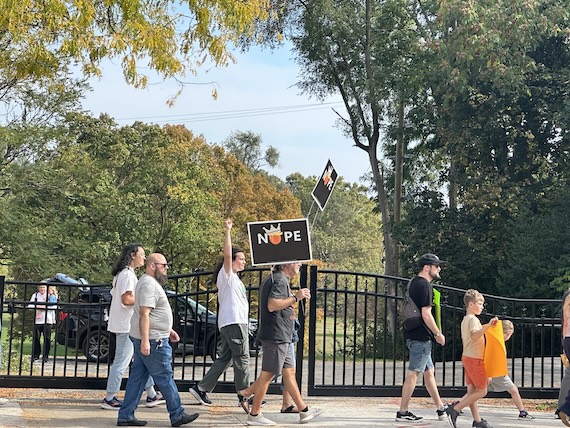
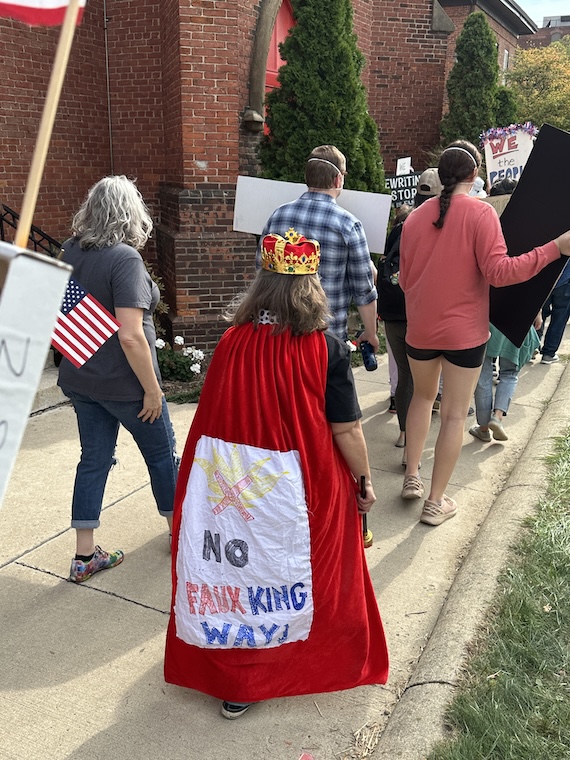
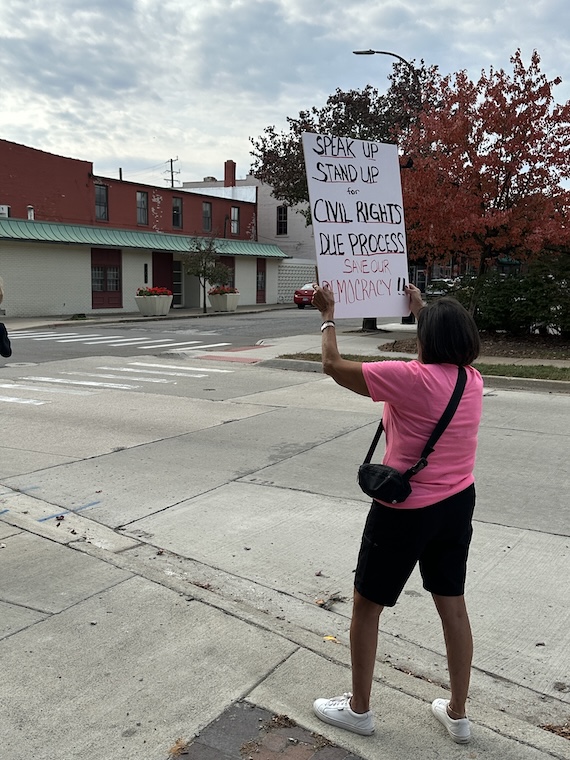
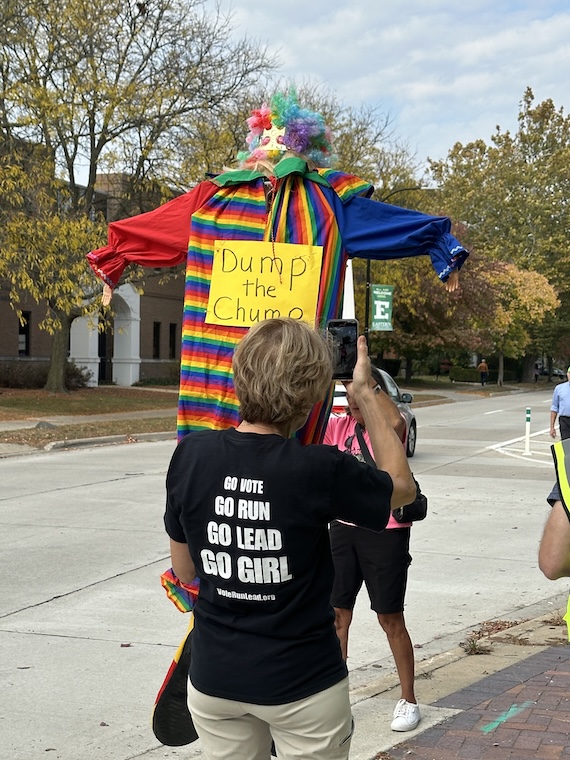
Some 3,500 demonstrators came out for a march against Trump policies on No Kings Day, October 18 in Ypsilanti, Michigan, according to Lilly Kujawski. People chanted “What does democracy look like? This is what democracy looks like!” and “Hey, hey, ho, ho, Donald Trump has got to go.”
Ypsilanti is a majority white, predominantly Democratic town of about 20,000 residents in the southeast corner of the state, with several factories (including the Rawsonville Ford plant) and Eastern Michigan University, with its WEMU NPR jazz station.
As a blue collar town, it shows that the slight swing to Trump among working class families nationally did not happen everywhere. Trump’s workers often don’t have a high school degree or are evangelicals. In 2024, he “lost majorities of blue-collar blacks, Latinos, and non-evangelical whites,” according to Brookings. The roughly one quarter of the residents in the town who are of African-American heritage suffer from the openly racist discrimination of Trump’s minions.
Trump policies favoring the rich fat cats and harming blue collar workers hurt Ypsilanti residents. His tariffs will raise the cost of the things they buy. His attack on their health care will put up their doctor and hospital costs. For those between jobs, the cuts to SNAP, medicaid and other benefits hurt.
When Demetrios Ypsilantis mounted his rebellion against the Ottoman Empire, among his goals were a rule of law and a constitutional order. The Ottoman Empire was an absolute monarchy that in the 1820s had no constitution, no legislature, and the judges in which were Muslim clerics appointed by and paid by the state, so that they had no independence of the sultan.
The French political philosopher Montesquieu (d. 1755) had laid out the problem in his Spirit of the Laws, which deeply influenced the American Founding Fathers. He wrote,
“There would be an end of everything, were the same man or the same body, whether of the nobles or of the people, to exercise those three powers, that of enacting laws, that of executing the public resolutions, and of trying the causes of individuals.
Most kingdoms in Europe enjoy a moderate government because the prince who is invested with the two first powers leaves the third to his subjects. In Turkey, where these three powers are united in the Sultan’s person, the subjects groan under the most dreadful oppression.”
Even though the school was started as a LGBTQ+ safe space they had to remove anything affirming the LGBTQ+ people. The goal of the republican right is to erase LGBTQ+ people from the public society. They don’t want us seen, they do not want us talked about. They especially don’t want kids to understand they can be themselves if they are not straight or cis. They want kids to feel they must fit the mold of straight and cis only. If you feel differently you must hide it and live miserably to make the snowflake Christian nationalist right feel comfortable. This will backfire on them. Just as the LGBTQ+ overcame the full force of the right’s bigotry once we can do it again. We have moved far too toward equality to let them push us from society again. The young people will not accept it nor tolerate the regression of freedoms to make a few bigots feel comfortable with the world around them. They also know that intolerant maga driven my the cult of tRump won’t last forever. Hugs
“We have had rainbows in our building because we are affirming to all people, and at some point our mission statement included a segment that said ‘We are affirming to LGBTQ people,’ but we have taken that out.”
Before the vote Wednesday, she said the school painted over rainbow colors and designs and replaced maps with ones that had a “Gulf of America” label. They revised the logo and reviewed textbooks and other documents.
Months after its contract was threatened over a rainbow mural and a map labeling the Gulf of Mexico, an Alabama charter school will stay open.
The state charter commission voted Wednesday to renew Magic City Acceptance Academy’s contract, allowing the school to operate for five more years. The school and its leaders came under fire this spring for allegedly violating aspects of Alabama’s new anti-DEI law, which prohibits so-called “divisive concepts” and other diversity and inclusion programming in public schools and colleges.
“I’ll say the thing that we’re all thinking,” said Karen Musgrove, the school’s CEO, after being pressed by one commissioner to address the “monster in the room.”
“We have had rainbows in our building because we are affirming to all people, and at some point our mission statement included a segment that said ‘We are affirming to LGBTQ people,’ but we have taken that out.”
“We’re affirming to all people. We’re affirming to our Black students. We’re affirming to our Hispanic students. We’re affirming to our LGBTQ students, which are in every school in the state.”
Magic City Acceptance Academy opened in 2021 in an effort to provide a supportive learning environment for LGBTQ students and other at-risk populations. Students and staff say they built a welcoming community in the Birmingham-area school, despite a firestorm of political backlash over the years.
In a plea to commissioners, one parent said “everything changed” for her son after enrolling at MCAA. He stopped skipping class, vaping and fighting, and he’s now excelling in college-level courses.
“Renewing Magic City’s charter means continuing to change lives like my son’s,” she said. “It means giving more kids the chance to discover their potential and their purpose.”
After a brief debate, the commission ultimately renewed the charter – on the condition that it agreed to maintain “strict adherence throughout its shorter term to Alabama laws, specifically including, without limitation, Alabama Code 41190,” the state’s “divisive concepts” law. If it fails to comply, Magic City could be subject to sanctions, said Lane Knight, the commission’s lawyer.
“They’ve got the financial support, they’ve got a good program, they’ve got the leadership,” said commission member Charles Knight. “And again, we all agree that we’re trying to create environments where students are educated, and obviously they’re doing a good job of that.”
Recent changes
According to emails obtained by AL.com, school officials contacted the charter commission in early 2025, just days after 1819 News ran an article claiming the school was violating the law by hosting a “radical LGBTQ+ anti-America author” and promoting diversity, equity and inclusion in its handbook.
Musgrove reached out to the commission’s director, Logan Searcy, for advice on January 24. She sent Searcy changes to the school’s mission statement a week later.
Between February and March, 1819 published a handful of articles about the school. Republican lawmakers threatened its funding and called for a state investigation.
In early February, the commission paid the school another visit.
“The goal here is to report our diligence in monitoring the school to hopefully alleviate concerns at renewal time,” the commission’s financial specialist, Douglas Riley, wrote to Principal Patton Furman on Feb. 4. “I suspect you will see much more attention from the Commission this spring with that goal in mind. Please understand the spirit in which these efforts are intended, we want to identify and fix problems before they grow into something serious.”
He wrote to school leaders again after the visit: “Y’all are making some strong moves and I hope we can put the recent press behind us and have a smooth renewal process later this year.”
That same day, the commission sent the school a letter, noting that it had received “various reports” that the school’s curricula and programming violated the new law.
Searcy visited the school, along with commission member Cynthia McCarty, on Feb. 20, according to emails.
On March 6, Musgrove issued a lengthy response to the commission’s letter, claiming that leaders had already taken steps to make changes to decor and programming, and that they had not received any negative feedback after members’ visits to the school.
Before the vote Wednesday, she said the school painted over rainbow colors and designs and replaced maps with ones that had a “Gulf of America” label. They revised the logo and reviewed textbooks and other documents.
“We don’t see ourselves as being divisive,” she said. “Because we did exactly what was asked of us.”
A new outlook
It is rare for an Alabama charter school to close down after its initial contract is granted. If the commission has any concerns about a school’s viability, they may issue a shortened two- or three-year contract.
The commission originally suggested a three-year contract for Magic City, but voted to approve a standard five-year one after some pushback.
With the greenlight from the commission, school officials plan to start work immediately on a new building, which will feature a large theater, band room and expanded mental health resources.
It plans to eventually serve up to 500 students.
“We are going to make you proud,” Musgrove told the commission. “We’re doing amazing things, and we want you to be a part of that relationship.”
The commission also approved a five-year extension for LEAD Academy in Montgomery and a three-year extension for Breakthrough Academy in Perry County.
—————————————————————————————————————–
Rebecca Griesbach
Rebecca Griesbach is a data reporter at AL.com, covering education and other issues across the state. She joined the newsroom in 2021 as a founding member of the Alabama Education Lab and a Report for America… more
I am not trans even though I have been asked because of my super strong support of trans people. I have lost friends who wouldn’t accept trans people using a public bathroom with them even though all private functions happen in enclosed little stalls. I do have distant family members who are trans and fully supported by family. More important I can clearly see the same negative vile things said about trans people are the same things pushed against gay people when I was a struggling gay teen being pushed by the same groups on the same ideas of victimhood. They were mostly driven by hyper Christian Nationalist religious groups and those who demanded that traditions along with society never change from when they were young and happy. These same groups and feelings are in play against trans people. They are simply the homosexual aids scare of the 1980s. Just as I as a young gay person needed allies and support so do trans people today. Please give as much vocal and upfront support for trans people you can. It is easier to make progress as a society if we don’t have to undo hateful laws outlawing our very existence. Hugs




 rgriesbach@al.com

