I am finding the coverage of this story an interesting example of the open bias and deliberate slanting of the story depending on who or which side is covering it. The same reports are covered with drasticly different tones, phrasing and include or exclude details depending on which group the reporter is either trying to promote or degrade. For example on This Week Martha Raddatz reported the story in the darkest most impassioned way to present Platner as an out of control phycotic abuser of women and repeatedly elaborated on his sexting of women while dating and slightly after he was married to his wife as a great moral failing making him not worth or qualified to serve in Congress. Yet she never faulted Ken Paxton or tRump the same way. During her report on this story she talked up Janet Mills praising her repeatedly while mentioning that she was the needed alternative to Platner. Her report made it sound like the entire state of Maine and all the Democrats did not want Platner but the majority of people she interviewed were supporting him. In the reporting of this by The Majority Report they take a different tact in the reporting on Platner. They report the facts in a less sensational manner and put everything in context to modern society. Below is just a clip of the transcript of the show. For those not wanting to watch this I recommend at least reading the transcript. There might be details, facts, or context not reported elsewhere. Sam askes where are the other accusers and their stories. Hugs
Um, and I’m also fascinated by the way this story has developed, like who is doing this? Uh, because the the timing of this stuff is strange. Um, and suggests that it’s not just a question of Republicans because Mhm. If the Republicans had this stuff, they would drop it uh you know in October. But why or or it could be about Republicans taking a different tact here and saying we need to get him out of the race as opposed to try and beat him because we may not be be able to beat him. The best thing is for us to get him out of the race. Yeah. And now is the most opportune time to do that. But uh regardless. So let’s put up this tweet from Lindsay Fitfield. She is the only person to suggest uh any type of physicality uh and again uh she wouldn’t have called it like abuse but any type of physicality from Platner and she also suggests that he knew uh what his tattoo
And the reason why she does that is because she wants the Times to carry the story as opposed to another outlet. And she is strategizing. The Times is are going to hit the audience. I want them to hit. If you wanted this on the uh, you know, on the right, you wouldn’t go to the Times. That’s what comms professionals do. We have this story. Where are we going to go? And she went to the Times and made a deal with them. You’ll get an exclusive when you write this.
Uh after the story went up, I began to ask them, “Wait, where are the stories from the other women? Where are their accusations of sexual assault? Why am I the focus? Why are there 11 paragraphs uh dedicated to detailing my work history?” Which is that hilarious because it was such a footnote in the story. It obscures the true nature of her collaboration with Republican operatives and her work in Republican politics. And she’s asking, “Where are their accusations of sexual assault?” Yeah, they probably just wanted to embarrass themselves by leaving those out like as if they actually existed.
Yeah. because in that instance it the whole thing sounds like a total hit job uh by these reports.Remember they’ve been working on this story for months according to her, right? I mean the dragged on and um and that’s just when they had her stuff. Keep put u why does uh it say nobody corroborate could corroborate when I offered them sources that could corroborate. They obviously went to these sources and those sources could not corroborate.
I read the article linked below. To show how badly these papers were done one paper used reports made in the Vaccine Adverse Event Reporting System (VAERS) to find what he said were “unusual patterns and safety signals highly suggestive of a causal relationship” between vaccination and Sids. VAERS is a vaccine safety monitoring program where anyone can submit a report about any suspected adverse health event that happens after a vaccination. Morgan McSweeney, a scientist who posts on social media as Dr.Noc said of the people running the CDC “They have a strong opinion about what is true. And then they go looking for whatever scrap of low-quality evidence they can find to support that opinion,” McSweeney said. “If that finding supports the story that they believe, they’re willing to overlook data points from hundreds of thousands or millions of children and go with the one that fits their story.” “This was a low-quality, very small study that was not replicated. So yeah, the CDC page now says that some studies supporting a link have been ignored by health authorities,” McSweeney said in the video, which now has more than 5m views between Instagram and TikTok. “And maybe that’s a little bit true, because the studies they’re showing here are worth less than a fart in the summer breeze.” Hugs
When approaching recent historical events, where the scope of destruction and loss can be unfathomable in scale, oral history can bring both connection and immediacy through individual stories of loss, grief, rescue, or triumph that would otherwise disappear in the grand sweep of “Great Men and their Deeds.”
[T]he method enables the documentation of certain aspects of historical experience that are often missing from other kinds of historical sources. Oral historians not only interview and engage in conversation with living sources, they also find themselves challenged in a unique way—the historian is transformed into a protagonist in the dialogue. Oral history is perhaps the only field where the sources talk back to the historian, confronting, disputing, disrupting, and sometimes resisting the historian’s understanding of the past (Frisch 1990; Shopes 2012). Oral history works with the interviewee as a partner in dialogue and the verbal form historical truth can take is always co-constructed (Cook and Goodall 2013; Goodall and Cadzow 2009; Portelli 1991).
Some of the most effective (and affecting) projects using this approach concern communities that may be far outside of the audience’s experience, whether due to time, geography, or identity. Works like Shoah by Claude Lanzmann, Hard Times by Studs Terkel, and Boots of Leather, Slippers of Gold by Elizabeth Lapovsky Kennedy document their subjects through the voices of those who lived through specific moments and events that can be overwhelming or remain unknown without a more interpersonal method.
“Many of the best works about this disease have been produced by people at various stages of HIV infection.”
The history of the HIV/AIDS epidemic has recently become the subject of numerous oral history projects, where the stories of survivors, caregivers, activists, and health care professionals have been collected and made available online, traditionally published, and edited into documentaries.
One such collection, Visual Arts and the AIDS Epidemic, was begun in 2015 by the Smithsonian Archives of American Art after receiving a grant from The Keith Haring Foundation. Haring founded the foundation in 1989, a year before his death from HIV-related illness, to maintain his artistic and philanthropic legacy. The project interviewed forty artists about their lives, their work, and how the AIDS crisis intersected and permeated both.
The interviews in the Visual Arts and the AIDS Epidemic collection cover wide ranges of personal and creative history, ranging from insider gossip and “name-dropping” to theoretical discussions of method and art history. They benefit from interviewers who bring their own experience as artists, art scholars, and historians to the conversation, with questions and insights that make this collection a rich multifaceted history of AIDS, the arts, and activism.
as if the artist were immersed in dealing with the epidemic—as so many are. Many of the best works about this disease have been produced by people at various stages of HIV infection. Perhaps they have lost a lover, nursed a dear friend, or attended a dozen funerals at a young age, and feel themselves to be, in every sense, set apart by the experience. They are implicated. Their art signifies a collective trauma—mass death in the midst of life.
Reveal Digital, an initiative “to amplify important, long-overlooked voices of the twentieth century,” has made these histories, and more, available in their developing open access collection HIV, AIDS and the Arts.
Artists in The Early Years of the Epidemic
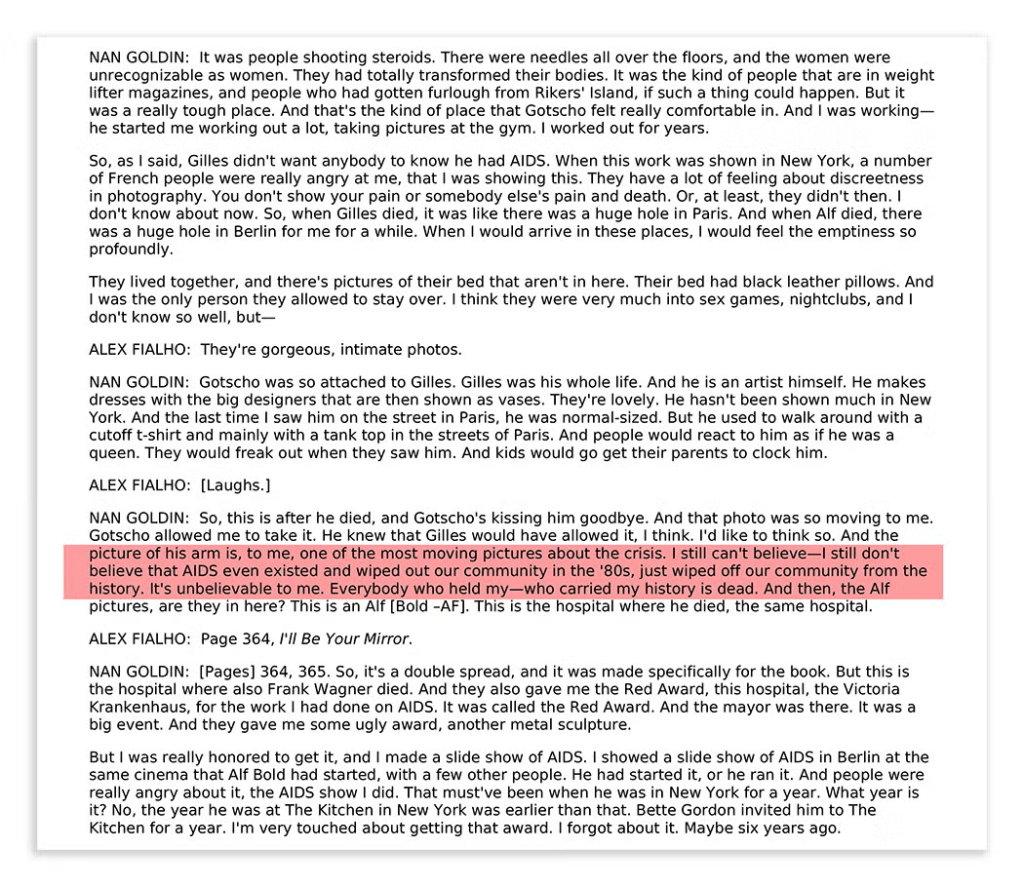
“I still can’t believe—I still don’t believe that AIDS even existed and wiped out our community in the ’80s, just wiped off our community from the history. It’s unbelievable to me. Everybody who held my—who carried my history is dead.” —Nan Goldin
One year later, William F. Buckley published a New York Times op-ed calling for HIV-positive people to be tattooed on the upper arm and buttocks to protect others (assuming that would protect both future sexual partners and intravenous drug users who might share needles). News reports about the disease largely focused on fear of contagion, the promiscuity and danger of gay men, and the threat of HIV to “normal” Americans.
In the interviews gathered in the Visual Arts and the AIDS Epidemic collection, artists describe how they first became aware of AIDS: from a loved one diagnosed after an illness; from hearing of a friend’s passing after not seeing them for a while; from a doctor telling them to stay with a partner because “there’s something going around”; or by learning of their own diagnosis. Friends were lost to the disease, and surviving family members denied the illness or sometimes actively excluded partners from funerals.
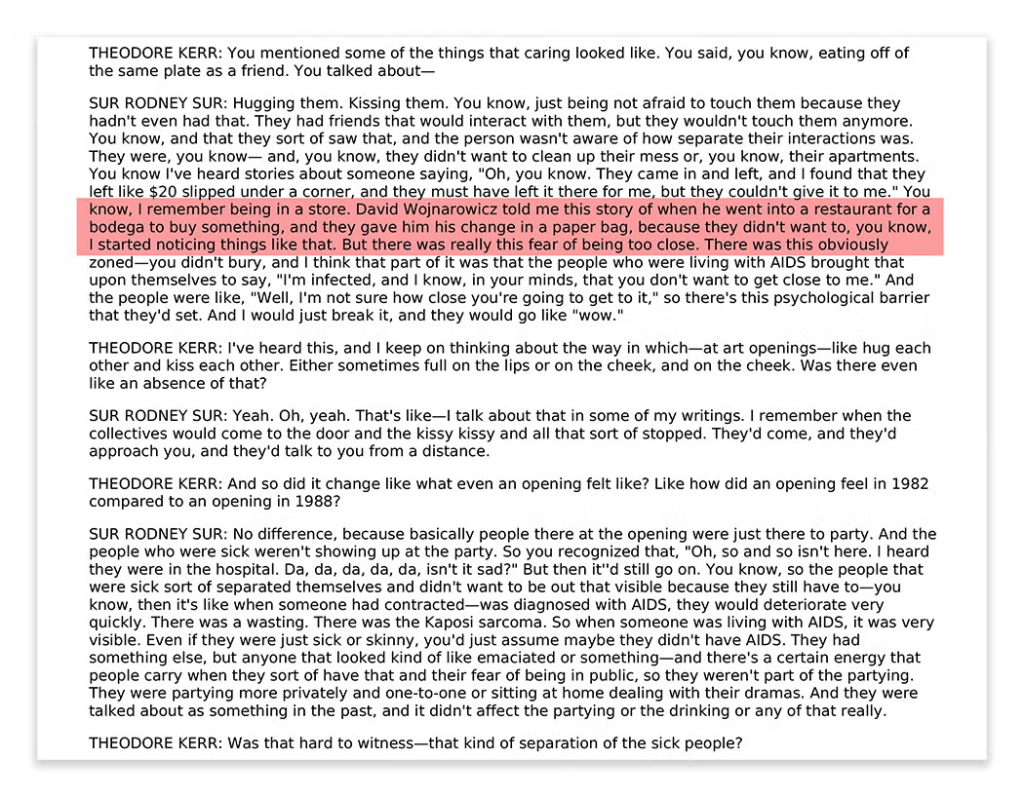
Sur Rodney (Sur), a New York City-based writer, gallery co-director, and archivist, relates that the late artist David Wojnarowicz would go to his local bodega in New York City where the clerks returned his change in a paper bag, out of fear. He describes his own anxieties when stepping in after a friend’s death to help save and archive their artworks and collections so they wouldn’t be destroyed (before there were nonprofit organizations to do so).
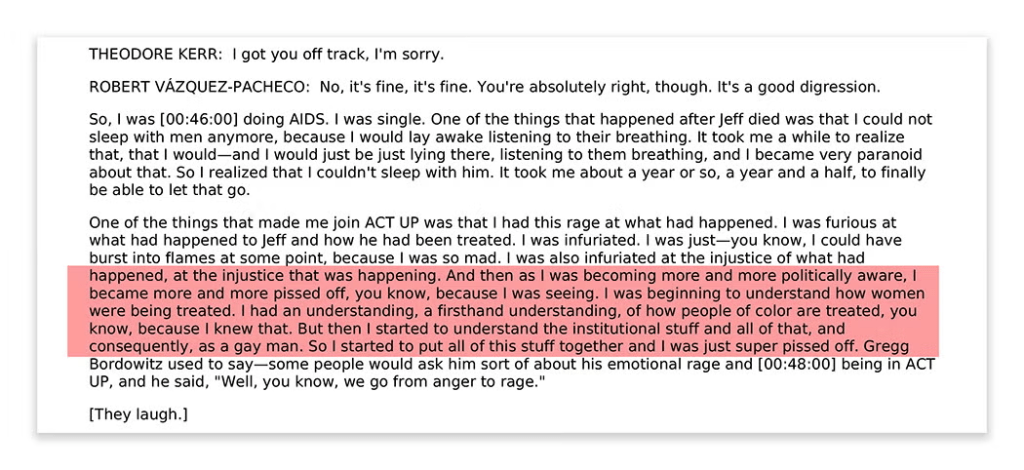
These personal experiences unfolded within the larger context of governmental indifference, active discrimination against people with the disease (or belonging to groups that were deemed “at risk”), and a growing consciousness of the political landscape of the epidemic. Robert Vasquez-Pacheco, a member of ACT UP and Gran Fury, recounts,
as I was becoming more and more politically aware, I became more and more pissed off, you know, because I was seeing. I was beginning to understand how women were being treated. I had an understanding, a firsthand understanding, of how people of color are treated, you know, because I knew that. But then I started to understand the institutional stuff and all of that, and consequently, as a gay man. So I started to put all of this stuff together and I was just super pissed off.
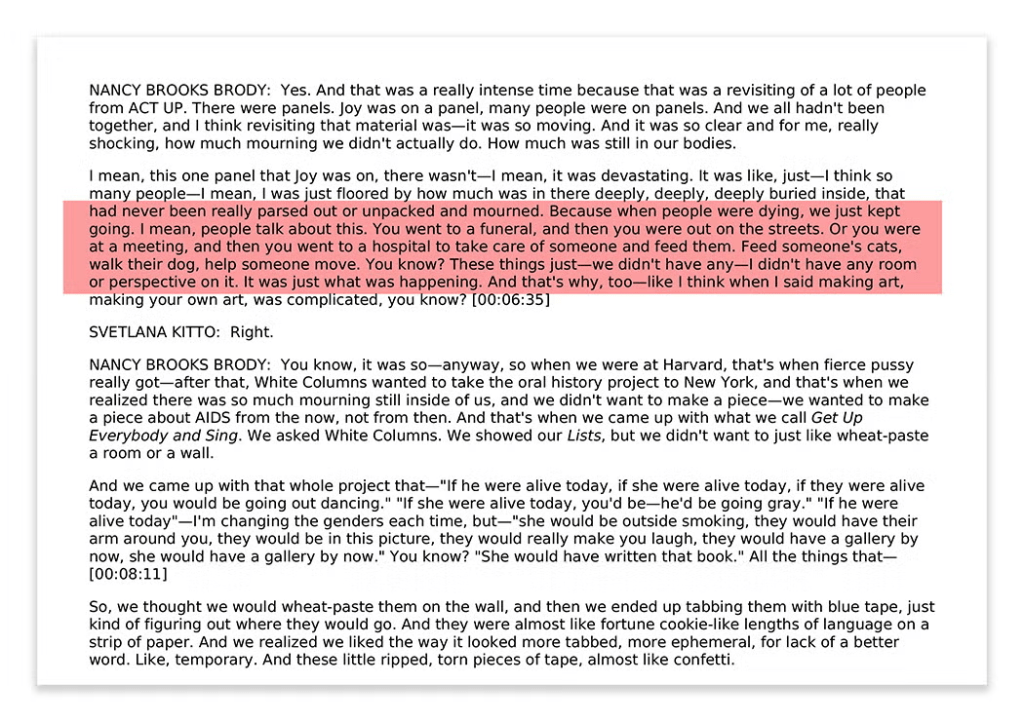
Some version of this process, repeated for many of the subjects, led people to activism, whether through art, volunteer work, protest, or sometimes all three. Nancy Brooks Brody (1962-2023), a visual artist and member of the fierce pussy collective, describes the progression in her interview.“Because when people were dying,” she explains,
we just kept going. […] You went to a funeral, and then you were out on the streets. Or you were at a meeting, and then you went to a hospital to take care of someone and feed them. Feed someone’s cats, walk their dog, help someone move. You know? These things just—we didn’t have any—I didn’t have any room or perspective on it. It was just what was happening.
The meetings she, and others, refer to were those of ACT UP New York (The AIDS Coalition to Unleash Power), which began in 1987 at a community meeting where Larry Kramer asked, “How long does it take before you get angry and fight back?” Kramer, a playwright and essayist who had been covering AIDS since the beginning through journalism, had co-founded the non-profit Gay Men’s Health Crisis in 1982. His play The Normal Heart, an impassioned call to action, spurred members of the audience to meet and subsequently take part in one of the most significant and effective activist movements of the twentieth century.
Creating Art in an Epidemic
The artistic works of those interviewed are diverse, both in media and approach: photographing people living with AIDS, using détournement to turn existing works into calls to action via graphic design, or using their body to confront audiences with the existence of the disease through performance. In some cases, their illness became an essential component of their art: John Dugdale, a former commercial photographer, began using nineteenth-century methods to capture and produce his work after HIV-related retinitis and a stroke left his sight significantly impaired. Ron Athey, one of the NEA Four, used his own HIV-positive body to create work exploring sex, trauma, and desire. The place of the artist within (or outside) a community could become a contentious issue, especially at a time when representation of people with AIDS was so fraught.
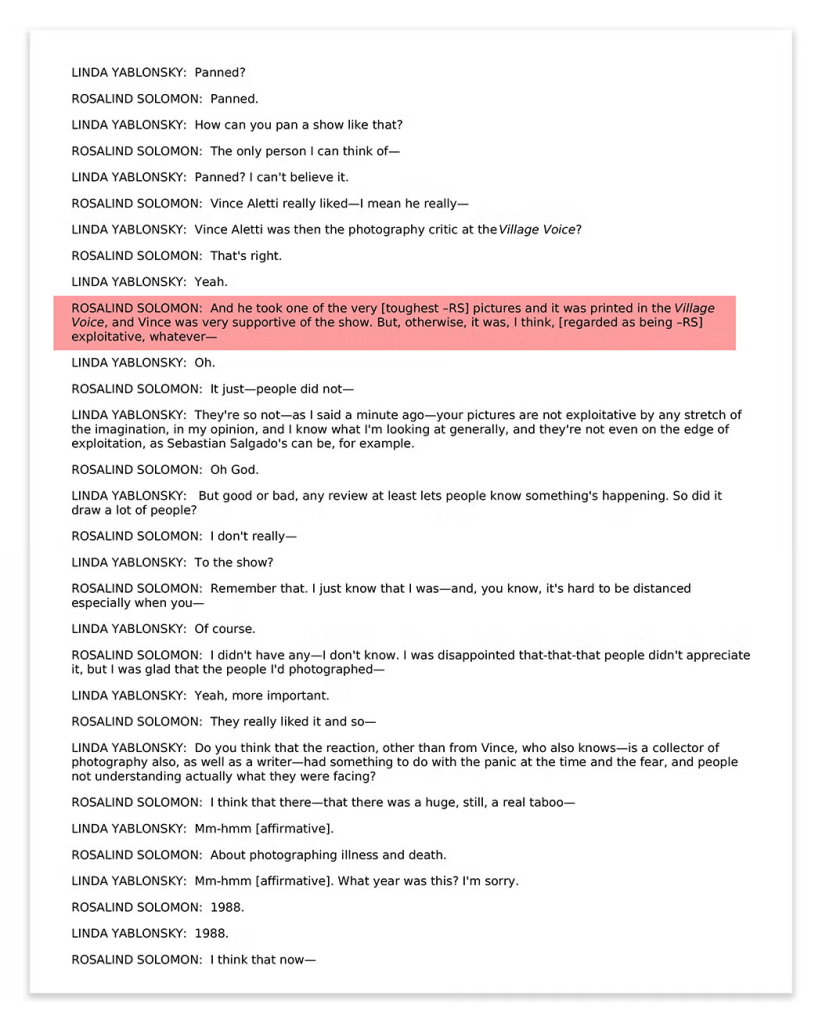
Rosalind Fox Solomon, whose 1988 show Portraits in the Time of AIDS featured photographs of the subject alone or with loved ones, some with visible lesions or in the hospital, relates that her project was critically panned and called “exploitative” at the time.
Some of the most vibrant, and now iconic, images of AIDS were created as (and for) protest: Silence = Death, the work of the Silence = Death Collective (and not ACT UP, as Avram Finkelstein relates in his interview) became the primary pictorial representation of ACT UP and a rallying slogan for the fight against the disease. Keith Haring did his own take on it for a poster, adding “Ignorance = Fear” to a “See No Evil, Hear No Evil, Speak No Evil” scene.
Collectives like Gran Fury and fierce pussy, which organized inside the ACT UP activist group, created posters for wheat-pasting that served as art, education, and calls to action around AIDS, homophobia, health care, and visibility. Whether newsprint works of text, guerrilla-installed bus station “ads,” or rolls of stickers of bloody hands announcing “One AIDS Death Every 10 Minutes,” the art of AIDS activism used any means available to communicate the urgency of the crisis.
The Visual Arts and the AIDS Epidemic collection demonstrates the power of oral history to preserve not just historical events, but what it felt like to live in the moment and survive it when so many people did not. Together with Reveal Digital’s HIV, AIDS, and the Arts archive, the collection ensures that these voices, experiences, and creative histories continue to be available to inform and educate future generations.
A group of Black Skimmers in flight resembles an aerial ballet, circling, banking, and gracefully alighting as one. Although taxonomists place this unique, long-winged waterbird in a separate genus, it’s closely related to gulls and terns.
The Black Skimmer’s most striking feature is its gaudy red-and-black bill: Both jaws are long and narrow like a knife blade, with the lower jutting out well beyond the upper. Its unique appearance lends the Black Skimmer a number of evocative folk names, including Scissor-bill, Cutwater (Cortagua or Corta-agua in South America), and Seadog (after its calls, often compared to dog barks).
This odd bill is what affords these birds their distinctive foraging style, and the name “skimmer.” A feeding skimmer flies low over the water with its beak open and lower mandible partially submerged. Where a broader bill would send a continuous spray of seawater straight down the throat of another species, the uniquely narrow mandible of the skimmer cuts through the water like a fin. When the extended lower mandible touches prey, such as a small fish, the bill’s upper mandible snaps down, securing the bird’s meal.
Another remarkable feature of the Black Skimmer is its eyes, which have large pupils that can narrow to vertical slits, like a cat’s pupils. This adaptation compensates for glare off the water’s surface and may enhance the bird’s vision as it hunts in dim light or at night.
Threats
According to the North American Breeding Bird Survey, Black Skimmers have declined in the United States by almost 90 percent since 1966. This is largely due to habitat loss and human disturbance at nesting colonies. These birds are also affected by oil spills and chemical pollution in coastal waters, and may face additional threats during the breeding season with climate change as sea levels continue to rise. (snip-MORE)
After a three-year push, Hawai’i officially has implemented a shield law to explicitly protect providers and patients of gender-affirming care for the trans community.
House Bill 1875, also known as Act 059, was signed by Governor Josh Green—himself a physician—late last week. The bill explicitly adds gender-affirming care to its existing shield law, which broadly covered reproductive health, and established safeguards from “abusive litigation” coming from outside states.
Shield laws create “legal protections for patients, health care providers, and people assisting in the provision of certain health care in states where that care is legal from the reach of states with civil, criminal, and professional consequences related to that care,” according to the Center for Reproductive Health, Law and Policy at UCLA. For example, it means Hawai’i state actors may not aid out-of-state attacks—such as, say, through the extradition of health care providers—over lawful care rendered in Hawai’i.
“The legislature finds that the people of Hawai’i have a long tradition of protecting an individual’s right to privacy and bodily autonomy independently of, and more broadly than, the United States Constitution,” the bill reads. It emphasized that the right to privacy and bodily autonomy extends to minors.
“It is the policy of this State that the rights of equality, liberty, and privacy guaranteed under […] the Hawaii State Constitution are fundamental rights and that those rights include an individual’s right to make health care decisions about one’s own body, including the right to seek and receive health care services that affirm their expressed gender.”
The signing was a resounding victory for LGBTQ activists on the islands. Hawai’i was among the last of the blue states to enact a shield law for the transgender community and their providers.
“We’ve heard from legislators that this is considered a controversial topic and that they’d rather not engage in bills that could draw attention to Hawai’i from the Trump Administration,” Abby Simmons, Chair of the Stonewall Caucus of the Democratic Party of Hawai‘i, told Erin in the Morninglast year.
Now, she’s singing a more triumphant tune. “This bill truly was a team effort,” she said in an interview this week. “Lawmakers wanted to understand the legal implications, hear from stakeholders, and make sure they were crafting legislation that would withstand challenges. While that process can sometimes feel slow, it also means that when legislation succeeds, it often has a stronger foundation.”
Simmons also said the playbook for getting the bill over the finish line was rooted in building a big tent. “I think what finally made HB1875 successful was that supporters increasingly focused on a message that resonated far beyond the LGBTQ+ community,” she continued.
“The conversation wasn’t simply about gender-affirming care. It was about protecting patients, families, and healthcare providers who are following Hawaiʻi law. It was about preventing out-of-state actors from interfering with healthcare decisions made here in Hawaiʻi. It was about provider stability at a time when Hawaiʻi already faces healthcare workforce shortages. And it was about preserving Hawaiʻi’s ability to govern itself.”
The bill arrived on the Governor’s desk amid rising federal threats from the Department of Justice against hospitals, including the use of judge and forum shopping to prosecute gender-affirming care providers in conservative jurisdictions based outside of their state. Last month, the Northern District of Texas—an infamously conservative federal court—ordered Rhode Island Hospital, which is almost 2,000 miles away, to hand over patient records from its transgender youth care program. That legal battle is ongoing.
“Gender-affirming care is lawful in Hawaiʻi, grounded in established medical standards, and essential to the well-being of transgender, nonbinary, māhū, and gender-diverse people,” Hawai’i’s LGBTQ political action committee, HOKU, wrote in submitted testimony from when the bill was being considered by the legislature.
“Failure to protect access to gender-affirming care is not only an attack on patients and providers; it is a violation of parental rights,” reads another submission from Pride at Work Hawai’i. “Parents and caregivers who affirm, support, and seek medically appropriate care for their keiki [child] are exercising their fundamental right.”
Donavan Kamakani Albano, Policy Fellow at the ACLU of Hawaiʻi, further spoke to the importance of gender diversity in Hawaiian tradition. Some right-wing officials may push the myth that transness is somehow novel or a “trend.” But Hawai’i has especially rich ties to its pre-colonial culture—including non-binary concepts of gender.
“In Kanaka Maoli culture, māhū describes someone who embodies kāne and wahine [the masculine and feminine] energies,” Albano’s testimony said. “While the visibility of māhū individuals has recently increased, ongoing barriers to gender-affirming care remain.”
This united LGBTQ advocacy with other causes. “Those principles brought together a broad coalition of supporters and helped lawmakers see the bill as a matter of healthcare access, privacy, and state sovereignty,” Simmons said.
When I was coming out of the closet, I was looking for someone—anyone—to share about their experience of coming out as a queer woman raised Catholic.
Any stories I found about reconciling queerness and Catholicism came from the perspective of gay white men. I could not find any accounts of Catholic women, nor could I find stories about deconstructing purity culture as a queer Catholic. But I knew—or rather, had faith—that I couldn’t be alone. So in 2021, I reached out to Bernie Schlager, executive director of the Center for LGBTQ & Gender Studies in Religion at the Pacific School of Religion, and asked if there were any archives, projects, or books that shared my own experience.
Schlager confirmed my suspicions: No such archives existed. But he invited me to begin the work of making an archive. I jumped at the suggestion. After all, I felt a need to find and hear other people’s stories, and I also had the skill set to conduct these interviews, having worked on oral history projects in the past. Maybe it was my calling to create an archive of queer and trans people grappling with their identity and how it related to Catholicism.
In 2022, I founded the Queer and Catholic Oral History Project. The purpose of this project is to record stories of queer and trans people who have some connection to Catholicism—whether they were born into it, converted to it, left it, or returned to it. So far, I’ve recorded over 100 interviews with LGBTQ+ clergy and laypeople who are proud to let the Catholic Church know that they exist, even if the church continues to bar them from being full members of the faith.
And as I’ve discovered, I am not alone in searching for queer Catholic stories as a way to find and affirm my place within this tradition.
As Justin Telthorst, a gay Catholic man who runs the LGBTQ+ Catholic ministry Empty Chairs, shared with me after his interview, many people reached out to him seeking stories of LGBTQ+ Catholics, but he didn’t know where to direct them until he learned about my project.
They’re not alone. Philip Calabro, a gender-fluid Catholic drag queen and employee of PFLAG, an LGBTQ+ advocacy organization, explained his own search for representation in his interview: “One thing I find myself doing pretty consistently is looking for other queer Catholics who are existing as queer Catholics because I want to know how they do it,” Calabro said. “Because I know it is possible. I can feel it.”
Like me, Calabro had faith that we were not the only ones navigating these identities. And what I will say after working on this project for five years is that learning how other people hold these two identities together only strengthens my belief in the importance of recording our histories and the transformative power of an all-inclusive gospel.
Often, anti-LGBTQ+ Christians claim that queer and trans people did not exist before the 20th century, or that modern LGBTQ+ inclusion or theology is shallow because it is rooted in cultural trends rather than the deep wells of the Christian tradition. But it’s less a matter of us not existing, or of there being no evidence that we have always been part of religious communities, than of certain terms only coming into use as society’s understanding of gender and sexuality expanded.
Sister Eva Lynn Goode, a nonbinary and Catholic Sister of Perpetual Indulgence, shared the following with me in their interview: “I come from a long line of queer people in church history, and I am blessed to continue that tradition.” They are not wrong. As I dig into contemporary queer Catholic histories, I’ve learned that there are many saints throughout church history whom people today consider queer and trans. These saints are recognized by the institutional church, but their queerness is not. Although they would not have known or claimed these terms, modern queer historians identify these saints as queer and trans ancestors who lit the way for LGBTQ+ people living today.
Perhaps the best example is queer Catholic author, teacher, and medievalist A.W. Strouse, who believes that their queerness cannot be separated from their spirituality. In fact, as they shared in their interview, being queer is a spiritual vocation.
“I don’t really see them as being distinct,” Strouse explained. “I think that being queer just saturates everything, and being a believer also saturates everything. And I know many people would find this sacrilegious, but I think that being gay for me is a spiritual vocation. I think that it’s my mission to love other queer people. And I mean, talk about loving your neighbor. If there’s anyone more destitute and in need, it is other queer people.”
LGBTQ+ Catholic lay minister and lawyer Yunuen Trujillo agreed that her visibility is an urgent testament to and a call to return to the gospel teachings of love and inclusion in her interview. “I think God made me an LGBTQ person for a reason, and I think that reason was to call the church back to its roots and to be able to show the church that we’re not supposed to be a church of power and dominance and exclusion, but we’re supposed to be a church of love and care,” she explained. “I think they fit perfectly, even though the church might not agree.”
For some people, their faith is only deepened by their identities. As they came to understand themselves more fully, they grew spiritually. In finding queer and trans spiritual ancestries, they realize and affirm the divinity and dignity in themselves—and connect more deeply with Catholicism.
In her interview, Madeline Marlett, a trans Catholic woman and board member of the LGBTQ+ Catholic organization DignityUSA, explained that she returned to the faith after stepping away from the church for a period of time. “It wasn’t until part of the way through transitioning that I felt like I wanted to reconnect with my faith,” she explained, “so that kind of brought me back into Catholic spaces, helped me find dignity.”
It’s one of the reasons many queer and trans Catholics I speak to are often very literate in church dogma and the catechism. After fighting against bigoted members of the church to live how they want and love whomever they want, they have a fuller understanding of gospel teachings and Catholic theologies of the body.
For transmasculine Catholic artist Elliott Barnhill, who creates icons of queer saints online, learning about the fields of queer theology and queer biblical studies was critical. “It’s really important for me in my coming out experience, my own acceptance of Catholicness in myself,” he said in his interview. “I have a very strong interest in the way that this fits together, that queer lives and deaths can be found in Catholic history and the way that echoes back to the present day. I believe that this history is a form of good news, and is a form of Gospel.”
It’s important to note that not all of the people I interviewed are still Catholic or align themselves with the Roman Catholic Church. The project is a testament to the diverse experiences of many queer and trans people raised in Catholic homes, communities, and cultures.
Documenting our queer religious histories and educating the Catholic church about its queer members is, on the one hand, a way to resist the homophobia in our tradition and, on the other hand, a way to honor the LGBTQ+ ancestors and contemporaries who have and are charting pathways forward inside and outside of the church. Their testimony brings attention to the harm that the church has caused, but it also brings attention to the fact that there are people committed to the church even if it rarely loves them back. For those who choose to stay, they live the gospel truth just by showing up as themselves.
Ultimately, my hope is that the Queer and Catholic Oral History Project will offer future queer Catholics what I didn’t have when I was coming out: an archive of stories to remind queer Catholics that we can change things and that we have always and will always exist.
It means we have to show up. Not only to vote, but to phone bank, write postcards, talk up the candidates every chance we get wherever we are, and anything else we can do. It’s how they did it in Hungary; people showed up, which extended the candidate’s reach. Thanks to Wonkette’s Evan Hurst for the link.
Starting early in the morning on the second Saturday of May, first hundreds and then thousands of people gathered in the square in front of Hungary’s majestic Parliament building to celebrate the start of a new political era. This was the square where tens of thousands gathered in 1956 and 1989 to demand an end to the Soviet occupation and in 2006 to protest a discredited government. It was the square on which Prime Minister Viktor Orban’s regime imposed a major redesign more than a decade ago — with traffic rerouted away, a large reflecting pool and raised beds installed, narrow pathways laid down — apparently to ensure that no such mass gathering could take place again. Today it was the square where Peter Magyar, a former Orban loyalist, would be sworn in, promising a rebirth of democracy and liberty after 16 years of autocratic control.
Squeezing into the available spaces and gradually filling up nearby cafes and streets, the crowd absorbed people of all ages: young people who didn’t remember a time before Orban and who had voted in unprecedented numbers; aging intellectuals who didn’t think they’d ever celebrate their country again; multigenerational families who had arrived by bus after seeing Magyar in their hometowns and villages. During his campaign, Magyar had traveled to an estimated 700 locations, turning many of them into “Tisza islands” — outposts of support for his party. By the end, Magyar was holding five or more rallies a day.
It had looked like an impossible quest. Orban and his cronies dominated the media, persecuted and smeared opposition politicians and changed election laws to benefit his party, Fidesz. Orban had seemed to achieve what the Hungarian sociologist and political theorist Balint Magyar (no relation) calls “autocratic breakthrough” — the point after which it’s impossible to unseat an autocrat using elections. Illiberal politicians from other countries made pilgrimages to Hungary to learn from Orban; CPAC, the gathering for American national conservatives, started staging an annual convention there; and Vice President JD Vance visited Budapest in advance of the election, in a show of support for Orban. And yet Hungarians handed Tisza not just a victory but a constitutional majority, enough power to reverse Orban’s changes to Hungarian laws and institutions. The triumph was stunning — unique in our era of democratic backsliding — and it holds clear lessons for the United States.
One obvious lesson of Peter Magyar’s success lies in the scale, reach and relentlessness of his organizing network. “They had 2,000 Tisza islands with between 30,000 and 50,000 volunteers,” Balint Magyar told me, in evident awe. “Just in their call centers, they had 3,000 to 4,000 people in the last week of the campaign.” We talked two days before the swearing-in ceremony, at his office in the spectacular but largely empty building of Central European University. In 2018, Orban’s government forced most of the university’s operations into exile amid an antisemitic scare campaign focused on the Hungarian American philanthropist George Soros, the C.E.U.’s founder and principal funder. Some of Orban’s many other scare campaigns targeted migrants, “the Brussels elites” and L.G.B.T.Q. people. During the latest election campaign, billboards and A.I.-generated social media posts warned Hungarians they were in danger of being overtaken by Ukraine and only Orban could protect them. It should have seemed absurd — it was absurd — but outlandish xenophobic and antisemitic propaganda had served Orban well for years. It didn’t work against Peter Magyar — probably because so many Hungarians got to see him in person, many of them repeatedly. This is another lesson of his success: Old-fashioned in-person politics can be a powerful antidote to media fearmongering.
In his inaugural speech to Parliament, broadcast on giant screens set up around the square, Peter Magyar said that voters had handed him a mandate “not just to change the government, but to change the system. To start over.”
Magyar enumerated the ways in which Orban had damaged Hungary: a stalled economy in which a third of the population lives in poverty, inadequate health care, low-quality schools, child welfare institutions plagued by abuse, an atmosphere of hatred and fear. Orban’s regime had “stolen from the common good of the Hungarian nation — from the pockets of the Hungarian people, and from the tables of Hungarian children and the elderly,” Magyar said, “an estimated 20 trillion Hungarian forints,” or some $65 billion, over the last decade and a half.
Previous opposition politicians had described Orban’s regime as “corrupt,” a relatively mild term suggesting some aberration from the government’s intended function. Peter Magyar made no such accommodation. Borrowing a term coined by Balint Magyar, he has called it a mafia state — a fundamentally criminal enterprise. Third lesson: Don’t mince words.
Instead of shrinking away from direct confrontation, he fortified himself against it. By getting elected to the European Parliament, in 2024, he secured immunity from prosecution in Hungary. When rumors circulated of an intimate video that would be used to blackmail him, he went on the offensive, accusing Orban of using “Russian-style kompromat” (no video was released). Knowing that he would probably be blocked from registering a new political party, he took over one that had become dormant. Even more important, instead of trying to build coalitions among other parties, he focused on conscripting as many actual people as possible, from across the political spectrum, ultimately building a giant organization capable of taking down Orban’s political monopoly.
One could say — and some have — that Magyar won at least in part because he was a former insider of Orban’s Fidesz party. But my interlocutors in Hungary emphasized that Magyar’s credibility lay in the fact that he was not a member of the old opposition, whose policies had led to the discontent that made Orban’s rise possible and whose timidity had helped perpetuate Orban’s power. That’s a lesson, too: The person best positioned to break the power of Donald Trump would not be an anti-Trump Republican but an outsider to the Democratic establishment, someone who can credibly claim that Trump didn’t happen on his watch — a Graham Platner rather than a Thomas Massie.
For all his tireless work over the last two years, Magyar did not create his political machine from scratch. Like Zohran Mamdani, Magyar excelled at converting potential supporters into campaign volunteers. An existing news distribution service provided an initial skeleton of the organizing network. A panoply of grass-roots protest movements joined, too. On the day of Magyar’s inauguration, a parallel, smaller commemoration organized by the city of Budapest celebrated those organizations. One by one, people took the microphone to give a short speech about their cause and their part in the electoral victory: teachers who had organized against a unified state-dictated curriculum; a young man who spoke up against abuses in the child care system; a high school student persecuted for reciting an anti-Orban poem; organizers of Budapest’s L.G.B.T.Q. Pride celebration. The speakers stayed onstage, gradually forming a crowd of the kind — the many kinds — of ordinary Hungarians who had ended the Orban era.
That’s a fifth lesson: Grass-roots organizations that have little or no connection to electoral politics — in the United States, that might be the networks formed by the No Kings rallies, ICE-resistance groups and so on — can matter as much as or more than those already focused on winning votes.
Another lesson lies in the issues that motivated Magyar’s voters. Hungary’s economy is a mess, but post-election polling by Median, an organization that had predicted election results with uncanny accuracy, shows that voters saw corruption as the most important issue by far. Asked why they thought Orban had lost, 49 percent cited corruption, and only 18 percent thought it was the “worsening economic situation, rising cost of living.” The next three reasons cited were “lies” (15 percent); “fearmongering, war rhetoric” (11 percent); and “people got fed up” (10 percent). In other words, Hungarians seemed to see the damage that Orbanism had done to the nation as more important than any harm they felt they had suffered as individuals. They were united by a sense of moral outrage — “value choices,” as one person close to the incoming government described it to me.
Polls have consistently shown that even Fidesz voters generally want Hungary to stay in the European Union. Some surely just want the ease of travel and residency, but others probably have in mind the loftier ideals of the E.U., such as the rule of law, human rights and the essential purpose of the E.U., which is peace.
Hungary is one of the poorer countries in the union, and in the early years of his regime, Orban was able to use E.U. membership to secure funding, and thereby power, even as he railed against the Brussels bureaucracy. But in 2022, the European Union started withholding funding, citing corruption. And in 2024, after Hungary ignored a European Court of Justice ruling that compelled it to process asylum applications, the court ordered Hungary to pay 200 million euros and imposed a daily fine of 1 million euros. (When Orban refused to pay, Brussels deducted the money from E.U. funds earmarked for Hungary.) These actions didn’t just hurt the Hungarian economy — they also allowed Magyar to draw a causal connection between Orban’s policies and the well-being of ordinary voters. One of his major campaign promises was to unlock E.U. funding.
Hungary joined the European Union in 2004. The E.U. flag — 12 gold stars on a blue background — adorned the facade of the Hungarian Parliament building alongside the nation’s red, white and green standard. But Orban’s politics, like the politics of most autocrats, was the politics of grievance. Under his regime, the E.U. flag was removed and replaced with the flag of the Szekelys, a Hungarian minority that found itself living in Romania when World War I’s victors redrew the region’s borders. Orban’s symbolic gesture helped fan resentment against the E.U. and what he claimed were a new generation of attacks on Hungarian sovereignty.
Peter Magyar scheduled his inauguration for Europe Day — the 76th anniversary of the declaration that created the road map for a united continent. Before he was sworn in, the European flag was raised again. But the Szekely flag remained, signaling that Magyar seeks to represent all Hungarian citizens, including those who supported Orban. In some U.S. coverage, Magyar has been labeled centrist or right-of-center. What his politics actually are — and this is another lesson of his victory — is pluralist. (snip-MORE)