It is 6:15 my time and I am in a lot of pain and struggling. I had my allergy shots this morning then when I got home, I started to work on the laptop Ron’s sister gave him. It is a cheap incerolron windows 11 with 6 GB of RAM. It was so frustrating to deal with. I spent nearly five hours on it before I gave up, put his old Windows 10 laptop back on his desk and hooked it to his monitor along with his USB devices. By this time my pain levels were hitting maximum.
So then I went to my office and started to make tomorrow’s cartoons / memes / news post I just wore out. I started too late and am in too much pain. So Ron made supper so I could go to bed. We had originally planned for a hamburger and salad each. But as he went to make supper I told him I just wanted the salad. After I ate I was glad I did I barely ate the entire salad he made for me.
But when I thanked him and said it was good he had not cooked the hamburgers he told me he had cooked them after I told him that as he figured I wouldn’t be able to eat a salad and a hamburger so he had always planned to eat both burgers himself, which he did. I guess good that it worked out for both of us but bad that he already knew I wouldn’t be able to eat.
By the way even though this bit of information is not needed or necessary the salad was the only thing I have eaten today. I don’t know what changed. I was making great improvement in staying up and in eating. I was up to eating two rather decent meals a day. Then suddenly I couldn’t, and I suddenly needed to go back to bed in the morning and to bed before 6 or 7 pm. Ron is again worried. I told him it probably was my pain levels as the pain clinic needed to cancel my in person visit to get my trigger point injections. But I am not sure if he is buying it. Anyway. I will try to get up by 4 or 5 to get the mentioned post out in the morning. But no guarantees on that. I can only say I enjoy doing them, I really love that people want and enjoy them, but my idea of doing them one day to post the next has not worked out since my relapse. Best wishes for all and hugs for those that want them. I am off to bed.
David Wise’s new experimental play, “Fight Back,” opens a portal to an earlier era of organizing and spotlights the enduring power of slow-moving consensus building.
Imagine a murder mystery dinner party, where everyone sheds their true identity at the door and assumes a role to play in the night’s events — only instead of solving a crime, they must reenact a contentious activist meeting. That’s what artist David Wise tasks participants with in his immersive theater piece “Fight Back.” He recreates the AIDS Coalition to Unleash Power, or ACT UP, meeting on March 13, 1989 in the same room where it happened nearly 40 years ago.
It’s impossible to sit in the same room in New York City’s LGBT Community Center where their meetings happened nearly 40 years ago without feeling the echoes of today’s governmental failures, and the urgent need for both resistance and mutual aid.
At the May 18 performance of “Fight Back” — which takes its title from ACT UP’s chant: “Act up! Fight Back! Fight AIDS!” — I did something we rarely have to do these days: relinquish checking and doomscrolling on my phone to spend uninterrupted time face-to-face with strangers, co-creating something from scratch. Nearly 40 of us had two and a half hours to make our way through a 26-item agenda, an education in ACT UP’s work.
ACT UP is a direct action group formed during the AIDS epidemic to fight for visibility, healthcare access and an end to the crisis. To mark the second anniversary of the group’s formation, they were in the midst of planning Target City Hall — the kind of creative, high-profile direct action for which the group had become known — to protest Mayor Ed Koch’s failure to adequately address the AIDS crisis in New York City.
By the beginning of 1989, more than 18,000 New Yorkers had been diagnosed with AIDS and over 12,500 had died. ACT UP was demanding affordable access to the highly toxic but potentially life-saving drug AZT, which had just come on the market a year earlier. They also demanded housing for people living with AIDS and changes to the Food and Drug Administration’s drug trial policy to give more patients hope. They demanded dignity for the living and the dead. In the midst of all this, members still found the time and space to plan fundraising parties and, more importantly, to flirt.
The 1980s was an era of phone trees and answering machines. We checked our cell phones at the door. The experience is an invitation to follow the advice writer Mira Jacob gave on Instagram earlier this year: “Stop scrolling. Do literally anything else … We’re going to prevail, but only if you don’t let this app scare you numb.” If you were mad in 1989 because your friends were dying at the hands of the government and you wanted to yell at someone about it, you had to show up to a meeting or participate in a phone zap or volunteer to surreptitiously print flyers at your office denouncing Mayor Koch as a closet case. (One attendee politely corrected our pronunciation of “Koch” — no relation to the present-day billionaire brothers who pronounce their last name “coke.”)
A smaller group within ACT UP gathers during David Wise’s experimental theater piece, a reminder that the organization was not a monolith. (Hong-An Tran)
The atmosphere in the room was tentative. Every question opened up a minefield that only the basic tenets of improv could answer: Say “yes, and” to help the scene unfold; make bold choices, even when you are unsure of them, and don’t “break” the illusion. Most of us had brought hastily scribbled notes about our assigned historical personas, pulled from summaries and the ACT UP oral history archive. This background helped with questions like, “What affinity groups are you in?” and “Is this your first meeting?” But they offered little to lean on when it came to more quotidian conversation starters, “Are you coming from work?” or “Are you out to your family?” Those we stumbled through, together.
I had been assigned the role of Bill Bahlman, my first part since a non-speaking role in the middle school production of “Schoolhouse Rock!” A lifelong New Yorker and a music journalist, Bill had been a part of the Gay Activists Alliance and the Gay and Lesbain Alliance Against Defamation, or GLAAD. A self-described anarchist, he sometimes found the groups to be too soft, particularly the Gay Activists Alliance’s discussions of whether to drink mixed drinks or soft drinks at their dances. He splintered off from GLAAD into the Lavender Hill Mob, a direct action group formed in 1986 and named after a British comedy film. The dozen members focused on AIDS activism and organized disruptive “zaps,” interrupting a CDC meeting, a Catholic mass and other high-profile events with leaflets and banners bearing slogans like, “Gays and lesbians will not be silenced!”
When ACT UP formed in March 1987, Bill and many other Lavender Hill Mob members joined, but their affiliation and camaraderie with one another remained. While ACT UP is often remembered as a monolith, it was in practice a true coalition under which many smaller groups coalesced, including affinity groups like Delta Queens, La Cocina or Wave 3 that demonstrated together at actions.
Bill was slated to speak late in the agenda. The items were laborious in their minutia. Should the flyers Wave 3 planned to wheat paste around the city to gather people for Target City Hall in two weeks be printed in color, or black and white? Should we send three or four people to the Lesbian and Gay Health Conference in San Francisco? We rose from our chairs for civil disobedience training, half of us playing cops and half of us playing protesters gone limp to resist arrest, but then it was butts right back in seats.
By the two-hour mark, I could no longer stifle my yawns. There may have been flirting at meetings, and even a little in our reenactment, but the agenda was a reminder that there is little instant gratification in organizing. It took much longer than an Amazon delivery or a ChatGPT response. This focus on consensus decision making has undergirded some of the most visible movements and organizations, like Occupy Wall Street, Jewish Voice for Peace and the Democratic Socialists of America. While they don’t offer an instant dopamine hit, the memorable actions and ballot wins delivered by these groups are clear evidence of their effectiveness.
There are no professional actors associated with the production. Every meeting member was a stranger assigned to play their role for one night only. That said, I recognized an actor from an old TV show who attended as a curious citizen. She had been assigned the role of our chant leader Ron Goldberg, and I expected that, given her background, she might be the one to voice the most objections. Or, I thought, they might come from the tall, brawny and bespectacled man who wore a Larry Kramer name tag, a historical figure whose outspoken anger and divisive politics had been a catalyst for ACT UP’s formation. Instead, the objections came from Karen Ramspacher, a 24-year old curatorial assistant played by a middle-aged white woman seated in the back row with a bun on top of her head. “People are dying and we can’t cobble together the money for color printing?”
The meeting’s facilitators, one of whom I assumed must be Wise himself, tried to keep us on track. I kept glancing at my watch, hoping that time would run out before it was my turn to speak. When my name was called, my hands shook. I stood at the front of the room and looked out at the gathered crowd, some in their 50s, some in their 20s, many filling out the ages in between. I held the mic and spoke about Steve Zabel, my friend who I had found murdered in his apartment at the beginning of the month. The police had done nothing. What could we do to put pressure on them? Steve was just one man, but we all knew a Steve. To my surprise, everyone had ideas. The Media Committee wanted to take it to the press. The woman with the bun wanted to agitate with the neighbors. They had Bill’s back.
When the bell rang to return us to 2026, I made my way over to the outspoken woman, who in real life looked closer to 54 than 24.
“You were great!” I said, relieved to speak as myself again. “Really channeled the anger of the time.”
“I was there,” she said.
“What?”
The woman who had interjected so many times during “Fight Back” had attended ACT UP meetings as a teenager. She had a job in the 80s in Philly calling men to let them know where they were on the wait list to see the only doctor in the city who would treat AIDS patients. Many had died before their turn came.
A little group gathered around to hear her story. One man shared that he had come to the center that night with a friend who had also been a part of ACT UP, but he had turned around at the door because she wasn’t ready to reopen the emotions of that time. Wise revealed himself to have been Iris Long from the Treatment and Data Committee, a cancer researcher determined to publicize the life-saving uses of aerosolized pentamidine. The reenactment of the meeting had, in fact, been facilitated by everyday people.
Later, the woman continued, she had worked as a social worker in New York City with young transvestites, as they called themselves then, and sex workers. At one point she was given one dose of AZT and had to choose who to give it to in her community. She didn’t realize at the time that the medication had to be taken once every 12 hours to be effective. Of course she was still angry.
After everyone else dispersed, I lingered. The woman pointed across the room at her adopted daughter, a young Black woman whose biological parents had died of AIDS in Africa. She had remained in the global AIDS fight her whole life.
“If the AIDS crisis happened in New York today, we’d all be dead already,” she told me. “You had to be out there, you had to be visible, you had to be risking arrest to make yourself heard. Today everyone is stuck at home. You know what you have to do?”
I leaned in closer.
“Host a dinner party of strangers. You don’t even have to cook. Tell everyone to bring their favorite dish. People love to show off their culinary skills. Think about the seating arrangements. You don’t even need to set an agenda. That’s where political action comes from, talking to people.”
Wise had laid the groundwork for such unexpected offline encounters. His theatrical experiment will take place again on June 15, but Wise hopes to make his impressive research on these figures widely available someday, so school groups and others can try to reenact the meeting on their own.
Art about AIDS abounds. For starters, there’s “Rent”and there’s “Angels in America,” there’s Sarah Schulman’s “People in Trouble,” Rebecca Makkai’s “The Great Believers,”and, more recently, Natalie Adler’s “Waiting on a Friend.” Those pieces invite sorrow and rage, empathy and memory in equal measure. “Fight Back” invites you to act.
Amelia Possanza is a writer and book publicist who lives in Brooklyn. Her book “Lesbian Love Story: A Memoir in Archives” was the winner of a 2023 Lambda Literary Award.
I was to have an appointment this morning with my pain clinic provider. My pain medication and steroid shot provider. But first thing this morning I called into the clinic and got a less than understanding person who would only tell me her screen was different from mine and was rude, belligerent, and not really on the same brain level as I was. The result was I had no appointment today that would give me relief and let me walk.
This was important to me because my ability to walk or even function is getting less and less, but the clinic has been in the process of moving and has been the target of anger from the largest profitable medical providing system in our county. Ron and I worked for that system. They don’t like any company that provides services they have in house or contracted doctors to do so they try to either take them over, have cooperative agreements with them (meaning they get a cut of the cash) or destroy the competition. Thier responce is to try to either ruin any competition or to fold it into their company. So my pain providers who once worked in partnership with that hospital system but then refused to submit to them agreeing to be folded into the hospital system the hospital system is endeavoring to destroy. Sadly for the hospital system the patients like me were loyal and stayed with the providers we had instead of abandoning them.
The pain group grew and merged with some other groups because they needed protection from the hospital system that runs the majority of medical services in our area and provides the only hospitals for doctors that business requires access to hospital type services. Blackmail on display for the for profit healthcare system in the US.
The building they had was far too small, so they are moving. I had my last visit on the first of June as a telehealth because they couldn’t get the city inspection certificate to allow them to use the new building. My pain doctor listened to me and said I needed the next in person visit to get muscle injections and then an appointment with my pain surgeon for spine shots.
That has led to this where I get multiple emails and texts of appointments that then never appear on my patient portal. So today I got showered and dressed and Ron put my walker in the car. But then the appointment disappeared from my patient portal list and several new appointments were listed.
Which leads me to the point of this post. I was emotionally rocked at 7:45 this morning after finding out I did not have an appointment for the relief I needed and was depending on. I went to work doing the cartoons / memes / news post for today. But by 10 I was in serious pain. I took my noon medications early. It did not help and by noon I couldn’t walk. At 1 pm I took an additional 15 miligarm extended relief morphine and another 15 miligarm instant relief.
At this point Ron had done everything all day in the house and seeing how much pain I was in wouldn’t even let me do the easiest things. Ron had been doing that for weeks now trying to make sure I did not do anything that might cause me pain even to the point of getting into arguments if I should do the dishes even though for the washing part I could use my grand rolling stool.
That did not help so at 3 pm I took another 30 miligarm exstened relief morphine and another 20 miligram backlofen muscle relaxer. That did the trick. It was slow in helping but by 4 pm I could feel the relief and the frantic desperate need for the pain to stop was dissipating. By 5 pm I felt almost pain free, as pain free as I can ever be.
So why this post you might be wondering. Several reasons. I still have to finish tomorrow’s cartoons / memes / and news posts and want everyone to understand why it might be late. But most important are the draconian laws about pain medications that have swept the country mostly driven by republicans but also some democrats that want to look tough on drug abuse since they got caught doing nothing over the OxyContin scandal. So if one company convinced doctors on lies to overprescribe medication leading to massive addiction issues when those pain drugs were withdrawn politicans with no medical backgrounds or information just started setting abartary rules which made no medical sence.
So state legislators who had no expertise started to push laws that limited the amount of medications that doctors could prescribe. I want you to understand how that affected me. I was receiving a combination of medication that made it so with all my dying bones, all my bones growing in very painful ways, my immune system attacking my own body that let me live a normal life. I could walk, I could garden, I could grocery shop.
But then those drugs were taken away or reduced by nonmedical people in the Florida legislature who wanted to look tough on illegal drugs. Remember my legal drugs were prescribed by doctors that had years of experience in pain medication. So for a politician to run for reelection on being tough on illegal drug use I had my medications reduced and restricted. That was the start. Over the years legislators who were realtors or other wealthy people with no medication criteria or education background created more laws in Florida resticted my pain medication amounts that could be prescribed to me.
Which leads me to this year. I was down to the barest amount of pain medication daily along with having to have trigger point muscle injections every two months and every 6 to 8 months having spine epidurals. That of course increased the cost of each visit to my pain doctors. Grand how the government is looking after the lower incomes. But I no longer could do any yard work, couldn’t do any real house work other than folding clothing or doing a small amount of dishes. I had been basicly reduced to sitting in my chair at my desk. Then came the new fuck you from the tRump people.
RFK Jr. decided that people like me were getting too much pain relief and all we needed to do was live like he did. So he sent out a directive to all doctors that they had to get all their patients to 100 morphine equivalent levels with the goal of taking them to less than 50 morphine equivalent levels or those that did not comply would be fined and possibly lose their license.
I was well above that limit set by a toilet seat snorting cocaine addict that made his millions refuting real medical science while playing off his family name. So I got taken down another 15 milligrams of instant release with the pain doctors having to keep every visit to justify my being over that and risking their license and practice. To day I had to dip into my saved medication to function. What am I to do when they are gone?
My primary pain doctor along with my pain surgeon has recommended and sent a referral to a neurosurgeon to have some of the vertebrae/nerves repaired. But I have to have eye surgery, Ron needs eye surgery, and all of this is not covered completely by medicare. So we are on the hook for the costs. We recently paid $2,800 for Ron’s heart catheterization, which thankfully turned out he did not have any real blockages. Was that collusion between the people who did the scan and those that did the heart catheterization?
But his eye surgery will be at least $ 1,000 and mine for my eyes will be at least twice that. So my back surgery is not going to happen anytime soon. As I let everyone know my eye doctor would not even give me a prescription for glasses as she said my vision is far too compromised. Yes I will address that issue, I promised Randy after he chewed my ass off for a long time over the issue. My point is that we have a lot of medical issues and it will take time.
That flows to my last point. Tomorrows cartoons / memes / news post. It is not done yet but I am working on it. Now that I am not in excruciating pain with every breath I will try to finish up and get it scheduled. However, and I am going to regret mentioning this. Due to the medication and pain I did eat anything but a small breakfast. I simply can not stomach food now. I know the wonderful people here will tell me to use MDavis’s grand advice to use a nutritional shake and I will do so. But I wanted to be honest as I am always here even when it is painful for me, I just can’t stomach food now. Best wishes for everyone and hugs for those that want them.
I barely got the cartoons / memes /news post out for the morning of the 13th on time. I have been struggling the last four days. I set my alarm and pulled my old ass out of bed this morning even though Ron protested I need far more sleep and I managed to get today’s cartoons / memes / news post out around noon my time. It takes 6 or more hours to put it together as I have to sort them as I put them in the post page. And if something comes up that needs to be inserted before hitting the post I have to work that in. I am not complaining. I love doing them and it seems many love seeing them. There are over 60 separate web pages with each having many things on each one.
Yesterday I went back through the comments and opened a new tab for everyone I could see addressed to me and a few to Ali that caught my attention. I really do love the comments. I will be honest if I could have a blog of just comments I would do that and not post. I love the interaction with people, and yes even with people I disagree with.
So today dealing with everything else I got the first one out. I listened to the mostly biased bulls**t corporate broadcast media and grew ever more upset over the lies and misinformation.
Then I started on the cartoons / memes / and news post for tomorrow. At some point Ron told me we had to do supper and we had agreed on ribs, ear corn, and small new potatoes chunked. As time for supper came near Ron had me take my blood sugar and because I am eating so little / infrequently it was 72, below what my endrochonoligest wants for me because of my pain levels. He again explained to me that the kind of pain I have causes my body to produce blood sugar to protect itself.
We started to eat. I ate two ribs, about four potato chunks and started on an ear of corn when I got so sleepy and tired. I couldn’t finish. Ron came to the door of my office and saw me sort of dozing over my plate and demanded I go to bed. I pointed to the nearly eaten ear of corn and the rest while pretending I had not fallen asleep. He asked me to eat the small amount of corn left on the ear as he knows how much I like that and then reached in front of me and took the plate with the other stuff away.
He has already set the bed up for the pile of cat towels that rest close to me on the king size bed because Ron’s cat Tupac clings to and cuddles me at night. But the multiple layers are needed because he is incontenate and when he wakes up noticing he is lying in his own pee soaked towels he will nudge me to remove them so he has fresh clean towels to then lie back down on. Why me and not Ron?
Tomorrow morning I have a pain doctor appointment where I hope they will be able to give me enough trigger point steroid injections that I will be able to walk again. After that I will try to finish the post I started today, but it will have to be after noon my time as my appointment is for 10 am. Plus I have new information on Ron’s eye surgery as well as mine.
I apologize to everyone for being so weak that I cannot get these posts out on time. My health has gotten so much better and I am starting to grow hair and fingernails again. I have more energy than even a month ago, but I still get so very tired that I need to go to bed at weird times. For example I was working on posting something a few days ago and suddenly I had to go laydown for an hour / half before I could get back up to finish it.
Thank you for understanding, especially about the comments. Please keep sending them in on posts even if you feel I have not responded. I try to go back through the WordPress dashboard to open those I missed in new tabs. I do miss some and if you think I missed your comment you want me to address please send it to me again. I am not ghosting you; I am just very tired.
Best wishes to everyone and hugs / love to all who want them. I really care about people and the people here seem like grand people to care about. Scottie
(You may listen to this, on the page linked above)
Sparky the Baltimore Oriole. Photo by Melissa Groo.
One early May, I watched a pair of Baltimore Orioles courting in my backyard. Before long, the female was weaving an intricate nest in the sugar maple outside my bedroom window. Three weeks later, the begging calls of chicks emanated from within.
As a self-professed “wildlife biographer,” I sought to photograph every stage of their story. I learned each oriole’s unique traits: the father’s dulcet chirrups as he patrolled his territory and the specific flight paths he took to the nest, the mother’s burnt-orange plumage as she moved surreptitiously through the trees, and her cryptic, leaf-like flutter down to the jelly feeder. I marveled at their tireless vigilance against marauding Blue Jays and squirrels and the dozens of daily forays they made to find insects for their nestlings.
One day, hearing a great ruckus, I rushed outside to find the parents flitting about a chick on the ground. She was injured and squawking piteously, likely captured by a predator and then released in the ensuing fray.
I scooped her up, pleading uselessly with the parents for forgiveness, and raced her to Cornell University’s wildlife hospital, not far from my home. She’d suffered puncture wounds and a ruptured air sac. After a stint in the hospital and then with a rehabilitator, she was transferred to me (a subpermittee under a wildlife rehabilitator’s license) in hopes of a release. But first, we needed to prove she could fly.
I named this tiny, spunky bird Sparky. (snip-MORE)
The Pigeon Guillemot is an attractive member of the auk family, a group of marine birds that also includes the puffins, murres, and auklets. The auks are largely known to forage on the open ocean, with some species diving to extraordinary depths for their food. The Pigeon Guillemot, however, forages in shallow waters near the shore and doesn’t usually dive deeper than about 100 feet. Nonetheless, they are graceful divers, “flying” underwater, their partially opened wings helping them maneuver and propelling them along. Like other auks, they use their feet as rudders.
Pigeon Guillemots are particularly fond of small fish and crustaceans, which they chase out from under rocks on the sea floor. But foraging among the nooks and crannies is not without its risks — the Pigeon Guillemot itself is food for other marine life, including the giant Pacific octopus!
Nesting colonies can be quite large, especially on small offshore islands with few predators. And Pigeon Guillemots dress quite elegantly for the occasion: During the breeding season, males and females sport velvety black plumage with a broad, white, vaguely V-shaped wing patch, all set off by their flashy, bright red feet. After the breeding season concludes, however, these birds molt to a mostly white and ashy black-and-gray plumage. (snip-MORE)
Yesterday I had a relapse after nearly a week of feeling very energetic compared to lately. Last night I went to bed early. I had started an email to MDavis who sent me a beautiful, encouraging email and it has been three weeks but I was just feeling up to replying to them. But today I had my yearly eye appointment with the same eye doctor who referred me to the eye surgery center for needed cataract surgery. If anyone needs reminding that was a year ago when I was on the gurney with IVs in and eyes medicated but as they were about to take me into surgery the anesthesiologist stopped everyone to ask me questions. She went over my medical list with me and then sadly said I take more heavy pain medications daily than she could give me during the operation. That would mean that I would have to have eye surgery without any sedation. When I told her I was sensitive to anything near my eyes she told everyone to pause and she went to talk to the surgeon. They agreed that I would need to go to a much larger surgery center that could put me under enough anesthesia that would knock me totally out.
So today I saw the same eye doctor at a much bigger facility they had joined. Long story short after the exam the doctor told me the bad news. My current vision is far beyond what glasses could help with. She was emphatic in saying I must get my cataract surgery done as soon as possible. She went over everything with me and detailed why she couldn’t give me a prescription for glasses that would make it so I could see the computer, the phones, the Ipad, and see well enough to drive better. At this point my vision is so bad they couldn’t even make the letters smaller than the largest ones they wanted me to read clear.
She wanted to know why I had not followed up with their surgery center’s referral to the larger university run on in Naples as I was referred to. I explained to her the horrifically emotional and financially draining year we had had. She listened and when I explained Ron and I had decided his eyes needed to be done before mine as he has a torn lens and eye inflammation issues, she understood and agreed to take him on as a patient. But she kept pushing for me to get my eyes done in the next 6 months. She said she would send the referral, which was good for 6 months and it normally took that long to get set up with the facility and have the necessary visits. She added that if in the 6th months I was not financially ready to do it the surgery center in Naples would extend my time to have it done. But she again pushed that I did not have a lot of time to wait with my diminished vision. She asked how I did my daily stuff and I explained to her I have my large desktop monitors set to 250 and that my browser is set to 110% which I take up to 130 some days. I also showed her my two over the counter readers I have which one is 150 and the other is 175, which I use for my phone, tablet, and the computer monitors.
I explained all this to Ron as we drove home. He agreed to get an appointment with her to start his eye surgery but the closest appointment he could get was in August. At which point he got upset with me and said we would have to move forward with my eye surgery even before his. He went on at length about how he had noticed how I was struggling on the computers and with things I was trying to do. He mentioned the lighted magnifying glasses I keep around to help me read stuff. He mentioned how now I was having to have him read everything that came in mail and instructions to me. He reminded me that when he asked me to help him set up his sister’s new electronic entry system on the house she just bought I had to have him do the actions as I explained it to him as I couldn’t see the key pad clearly enough even with a bright light on them. Then he dropped the mother of all bomb shells on me which made me give in. He wondered with my vision so bad how I well I was seeing to drive. He was getting more and more upset. As I don’t think he is a good driver and I think I am a far better driver I gave in. So …
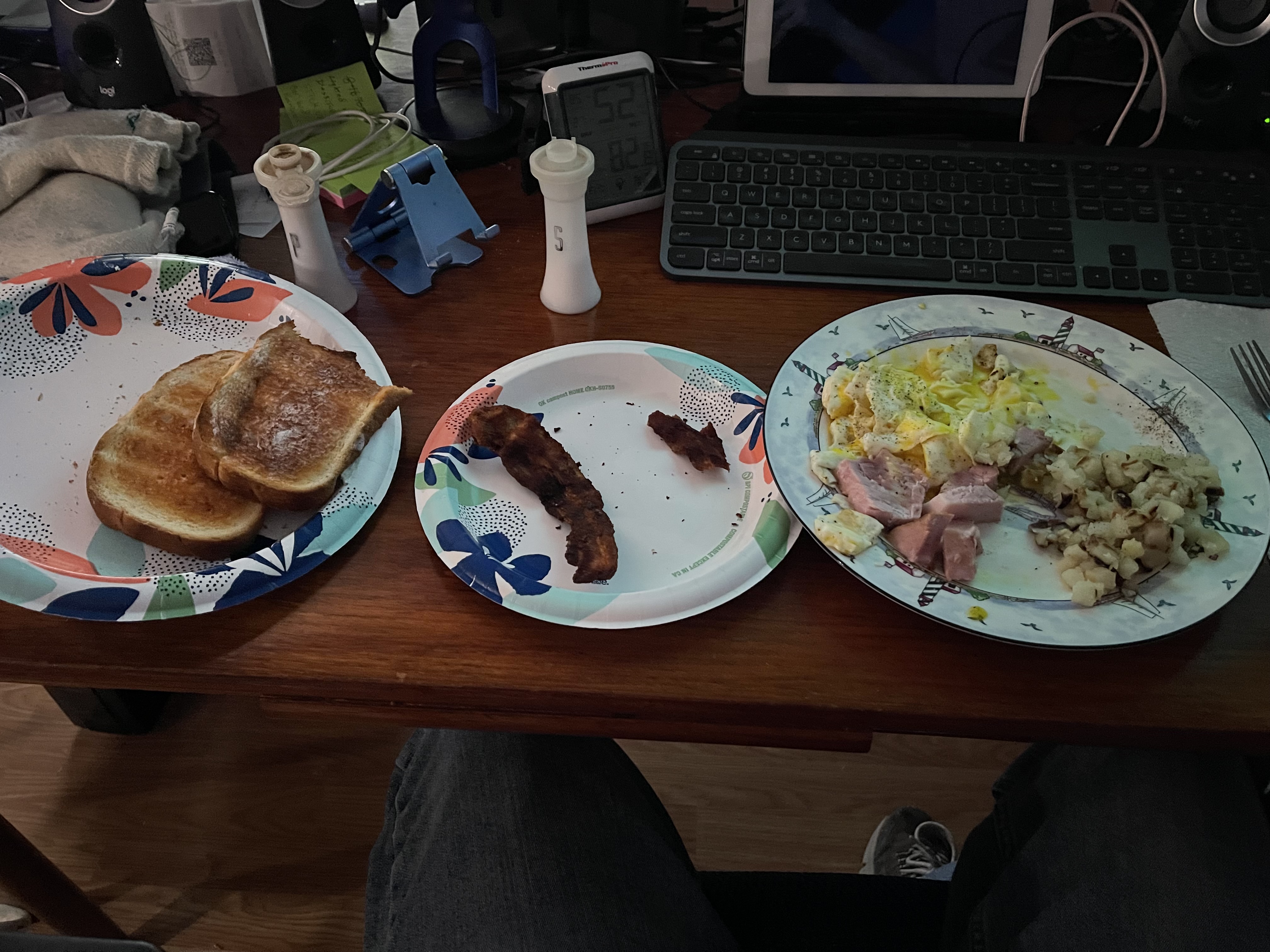
I said I would make supper. I got my very tall adjustable stool out and offered to make fried eggs, fried potatoes, fried bacon, and fresh ham steak I cooked in a large frying pan of water. All with a side of two slices of toast. Ron loved the idea which stopped him from harassing me about my eyes. I do love to cook and it was emotionally satisfying for me. I was unable to eat much of mine but I did eat the potatoes along with all the ham I took, a strip of bacon and half a piece of toast. But Ron ate most of what I couldn’t which is why he blames me for his current weight. Picture below. Hugs
A pair of hearings on Tuesday highlighted the extreme nature of DOJ’s requests — and the speed with which DOJ has moved to try and get the invasive patient data in recent weeks.
The Trump administration’s actions aimed at making it more difficult for transgender minors to receive gender-affirming medical care regardless of state policies allowing or even protecting such care are facing strong pushback. And while the Justice Department has described a “nationwide” investigation into the care, it was those challenging DOJ who prompted hearings on both coasts on Tuesday.
The Justice Department’s efforts to obtain information about patients who received gender-affirming medical care by way of administrative subpoenas and, more recently, grand jury subpoenas are extreme — and lawyers say, unprecedented.
The pair of hearings Tuesday highlighted the extreme nature of DOJ’s requests — and the speed with which DOJ has moved to try and get the invasive patient data in recent weeks after nearly a year since the first requests went out in July 2025.
The administrative subpoenas have been blocked when challenged, leading a set of patients to seek a class-action order quashing the patient-specific requests in all of the administrative subpoenas.
At 10:00 a.m. ET Tuesday, U.S. District Judge Julie Rubin held a hearing related to that request at the Edward A. Garmatz U.S. District Courthouse in Baltimore.
Rubin, a Biden appointee, was one of the judges who had previously quashed the patient-specific requests, as to those who moved to quash the administrative subpoena issued to Children’s National Hospital (headquartered in D.C. but with locations in Maryland as well), finding that the “Subpoena lacks a legitimate purpose.“
The bulk of Rubin’s questions to Rachel Berg from the National Center for LGBTQ Rights on Tuesday related to whether Rubin could certify a class in a motion to quash an administrative subpoena and, if not, how far relief could go.
Ultimately, Berg acknowledged that, if Rubin did not certify a class, relief could only reach those with a connection to Maryland. In their filing, they had noted that “[a]t least two Movants currently reside in Maryland and four families received services from Children’s National Hospital in Maryland.“
That would, however, not accomplish what the litigation is seeking to do — stop DOJ from getting any of the patient-specific information in response to any of the administrative subpoenas. As such, if Rubin denies this request, there likely would be a further effort to accomplish that goal.
At the same time, Rubin pushed DOJ’s Scott Dahlquist on the opposite side nearly as strongly as she’d pushed Berg. When he insisted that the patients were seeking “sweeping, nationwide” relief, Rubin asked how that’s different from any class-action litigation. Dahlqust’s response was, essentially, that you can’t get class relief for an administrative subpoena.
On rebuttal, though, Berg responded that, though the patients’ request to the court might be without a perfect match from past litigation, the reason that is so is because there is no precedent for the Justice Department’s actions here.
Although it is not clear how Rubin will rule, the relevance of the administrative subpoena fight could be taking on less importance in short order. As Law Dork has covered in depth, DOJ’s apparent move to grand jury subpoenas issued in the Northern District of Texas in May is reaching a head — with at least two grand jury subpoenas having initially had a return date of Wednesday, June 10.
Over the past week, patients ofLucile Salter Packard Children’s Hospital at Stanford have made efforts to block the grand jury subpoena issued to Packard. After a first attempt to block Packard from turning over the information — in a lawsuit filed only against Packard — was rejected over the weekend, the patients filed an expanded lawsuit on Monday. In that, they added the Justice Department and Acting Attorney General Todd Blanche as defendants and asking for class-action relief for all who received gender-affirming medical care as minors in California and, specifically, Packard patients (similar to litigation in New York City). They also filed a request for a temporary restraining order barring DOJ from receiving patient-specific information, given the forthcoming return-date deadline.
At 10:00 a.m. PT Tuesday, U.S. District Judge Casey Pitts held a conference related to that request. Pitts was presiding over the remote hearing from his courtroom at the Robert F. Peckham Federal Building and U.S. Courthouse in San Jose.
The hearing before Pitts, another Biden appointee, ultimately, was less adversarial — for now — than the Baltimore hearing.
Late Monday, Pitts had issued a temporary order blocking Packard from turning over any more documents to the government and blocking DOJ from taking any further action to enforce any grand jury subpoenas that would affect the would-be class here while he considered the matter.
Everyone, more or less, was OK with keeping that status while taking up the TRO request on a slightly less rushed timeline.
Although it took a few minutes at the status conference for everyone to agree that everyone was on the same page, ultimately John Wollman, the assistant U.S. attorney from the Northern District of California representing the government at the hearing, while not acknowledging any grand jury subpoena, agreed to push back any Packard subpoena response date to June 25 to allow time for briefing and arguments on the patients’ request.
Although the parties need to submit a briefing schedule to Pitts for how to proceed, the outcome is similar to that reached temporarily as to the grand jury subpoena challenge in New York City, where the next hearing is set for June 22.
In short, the grand jury subpoenas that are known to have been challenged are on hold for now by agreement of the government while the litigation is considered.
Despite that, though, the return date was June 10 on both published grand jury subpoenas, so it is possible that others are out there that have not been challenged and will lead to productions on Wednesday. (Of course, it is also possible there are other challenges that have just flown under the radar.)
Regardless, and as NCLR’s Berg detailed Tuesday in Baltimore, this is an unprecedented, multi-pronged attack on a small handful of children. What’s more, given the way DOJ is going about this, they and their families might not even know that their records might be turned over to the government — or if their provider has even been subpoenaed.
Law Dork will continue to cover this story. If you know about any previously unreported subpoenas, other related DOJ efforts, or other challenges to those efforts, please reach out. Chris Geidner is available on Signal at crg.32 for more secure communications.
Tucked in New York City Mayor Zohran Mamdani’s sprawling universal childcare plan is a little-talked-about milestone: In September, the city will open what appears to be the first free daycare for municipal workers in the country.
The center, called The Little Apple, is a pilot program that could prove to be a model for cities across the country that are childcare curious, but not ready to take the big universal swing.
Housed in a renovated space on the first floor of the David N. Dinkins Municipal Building in Manhattan, home base for more than 2,000 city workers, the Little Apple will offer free care to the kids of full-time staff. All workers in the Department of Citywide Administrative Services (DCAS), a city government support agency, can also take advantage of it regardless of their work location.
The center will be small — just 40 seats for children ages six weeks to 3 years old. To pay for it, the city budgeted about $1.5 million, or $35,000 per child.
“This is what Wall Street could call a good investment,” Mamdani said in a press conference announcing the new center. “We know that after housing, the cost of childcare is what is pushing working families out of this city.”
DCAS Commissioner Yume Kitasei told The 19th said the solution came about as a retention strategy, responding to the needs workers shared. In surveys, workers enthusiastically embraced the idea. One worker described access to free childcare as “life-changing.”
That’s probably not hyperbole. Childcare affordability is a national problem that has only grown more acute. Childcare costs an average of more than $13,000 annually nationwide; in New York for an infant at a center it’s closer to $21,000 on average. Paying for a daycare now vies with housing costs as the top constraint on family budgets, so much so that some parents have had to move or drop out of the workforce.
Cities, meanwhile, have been struggling to retain their workers since the pandemic. Benefits like childcare, which some cities and private companies have dabbled with, can help address the quality-of-life issues that are pushing workers out of jobs.
“This is a great time for us to sort of be thinking about: How can we make our jobs even more attractive to people and also retain the city workers that we have?” Kitasei said. “This is one piece of that puzzle.”
Kitasei added that a “healthy” number of staffers applied for The Little Apple and the department expects to fill its 40 childcare seats. Anyone who doesn’t get a spot will be put on a waitlist.
There is an appetite across the country for childcare solutions that could help bring down costs for certain workers, and cities are already taking on creative fixes.
In the private sector, Google, General Mills and Siemens closed longstanding childcare centers they operated on their campuses in recent years, but efforts continue elsewhere. Patagonia has operated a childcare center at its California headquarters since the 1980s, a move it argues has lowered turnover from employees who use the site by 25 percent. Overstock.com also has an onsite childcare center at its Utah headquarters. Both are subsidized, not free.
“As cities in every region of the country compete with the private sector and other municipalities to attract and retain workers and elected officials, ensuring access to childcare offers an opportunity for local governments to build a representative workforce and invest in the future of their communities,” said Quincy Midthun, an outreach specialist with the Mayors Innovation Project at the High Road Strategy Center, a think tank focused on solutions to social problems.
The Little Apple, and New York City broadly, reflect a changing political tide when it comes to childcare.
Mamdani and New York City children cut through “red tape” at a formerly vacant early childhood education center in Brooklyn, marking its official opening ahead of the fall term in 2026. (Michael Appleton/Mayoral Photography Office)
The announcements of universal childcare in New York City and in New Mexico in the last year received an enormous amount of attention across the country. Both places took an idea that for many years was floated as a pipe dream — treating childcare similarly to public education — and turned it into reality. In New York, it’s one of the few issues that Mamdani, a Democratic socialist, and Gov. Kathy Hochul, a centrist Democrat, can agree on.
Voters are also hungry for more solutions: In poll after poll, they assert that spending money on childcare is a goodinvestment.
Emmy Liss, who heads Mamdani’s childcare office, said childcare is at a “political tipping point.”
“We’re in this moment where folks across all political, socioeconomic, demographic spectrums recognize that childcare is essential, that childcare is something families are struggling to access, and know that the market economics of childcare don’t work without public investment,” Liss said. “We see recognition of that.”
With Little Apple, New York is testing what it looks like to commit to its promises of free care for all, but doing it first for its own employees.
“If we are asking folks to report to work in person in parts of the city where childcare is expensive, as it is all over the city, I think that we have to recognize that childcare is an important part of how we keep people in the workforce,” Liss said.
Mamdani and Hochul have been working to make childcare universally available to children in the city through a phased rollout set to conclude in four years. For 2-year olds, the mayor announced that 2,000 free seats will be available in the fall in four largely low-income areas of the city. Another 12,000 are planned for 2027. For 3-year-olds, about 2,000 new seats will be added in the fall, as well. The city has an existing universal childcare program for 4-year-olds.
Universal childcare as Mamdani envisions it will cover kids ages 6 weeks to 5 years with a price tag of about $6 billion annually, making it the most expensive pillar of his affordability agenda. Mamdani is expected to push to fund the program with a tax increase on the wealthy, a strategy Hochul has not been on board for, though the state is chipping in $4.5 billion. Mamdani has not yet unveiled what his universal childcare program would look like for infants and young toddlers.
How New York City’s program rolls out and its sustainability are being closely watched by proponents of universal care, who argue it’s also an anti-poverty measure.
“We know that other places are watching as we try different things out, including the work at the Little Apple,” Liss said.
In New York City, 21 percent of working parents experienced some kind of childcare hardship in 2024 that forced them to forgo care or use inadequate care, particularly families living in poverty, single mothers and Black parents, according to a recent report from Robin Hood, an anti-poverty organization, and Columbia University’s Center on Poverty and Social Policy.
An average of 3,400 2- and 3-year-olds were pushed into poverty between 2022 and 2024 specifically due to the cost of childcare, a separate report from the same organizations found. An estimated 4,100 2- and 3-year-olds would be lifted out of poverty each year if they had access to universal 2-K and 3-K education. That would reduce poverty for this age group by 9 percent.
Rebecca Bailin, the executive director of the parent organizing group New Yorkers United for Child Care, said the problem has reached such a fever pitch that thousands of parents started to organize around the issue in 2023 and helped push the agenda that was central to Mamdani’s election.
Bailin, who has a 1-year-old, said she can now depend on a 3-K program when her child turns 3 and likely a 2-K program, as well — a savings of about $100,000. The 2-K program Mamdani is rolling out will also be full-day care rather than partial-day care that wraps up around 2 p.m. like the existing 3-K program, addressing a top ask from parents.
“People are stoked,” Bailin said. “People feel like they can stay in the city.”
The Little Apple is a small part of the larger effort, but, “if we want to retain people, we have to do this,” Bailin said.
“This is something we want to see scaled. If city workers can’t afford to live here, that’s a real problem,” she continued. “This is really critical and we need this for everybody.”
This clip was with a reporter detailing the abuses in ICE detention facilities and the illegal actions of ICE agents and for profit prison staff. Profit over people as these ICE and prison staff do not see the detainees as humans like themselves. What is concerning is ICE is learning how to use existing laws to make the local law enforcement work against the will of the people. This young man wont admit he was attacked by ICE agents instead saying he thinks he hit a tree limb in the confusion but I showed Ron the video and he said the guy looks to him like he was hit repeatedly and hard in the head and possibly the body as well. When will we as a people see that these abuses are so very similar to the abuses suffered by the minorities in 1930s Geermany. Hugs