Sam and crew go over Graham Platner’s win and his interview with Mika Brzezinski Scarborough on Morning Joe. Amoung the jokes about her interview they go over his acceptance speech. I am personally satisfied he has answered all the questions. I love his line “… if you give me the chance I will be a senator for the people who cannot afford to buy a senator”. I am a progressive and a believer in DSA policies. Graham Platner is not the perfect person who is flawless and unlike many his flaws are out in the open, not hidden behind a facade of fake religious politeness. He is a populist. I am not looking for religious leaders in our lawmakers, I am not expecting someone who walked blamelessly through life, that they way only one person did and his name was Jesus. I am looking for someone whose policies help the lower incomes and the public at large, not the privileged few. I am looking for a congress and White House filled with people who do not think elected office is their golden ticket to personal wealth and authority over others. Real people screw up and those that ask and work for a second chance should be given a chance to show they deserve it. In my opinion Platner has and does shown he deserves his forgiveness. Plus people look at Graham’s past are not looking at Collin’s past or even Mika who started dating Joe when he was still married. To me a lot of these people going on about Platner’s past seem to hold him to a different standard than they themselves are held or republican canidates are held. Hugs.
At a D-Day celebration, Secretary of Defense Pete Kegseth claimed that today a different dangerous ideology is storming the beaches of European countries, and he listed them. Kegseth is a die hard white supremacist Christian nationalist who is trying to enforce a Christianity only policy in the US military to the point military members can no longer have atheists on their dog tags. So aside from Kegseth implying the Allies had a dangerous ideology which I guess the Nazis would have agreed with as Sam and crew discuss, the dangerous ideology he is demanding Europe stop and repel is Islam and the dangerous men are Muslims. Hugs
Another sitting congress person who is bought and owned by Israel to the point where he is adamant that Israel was not breaking the Leahy law on the use of military weapons. How did we the people let so many of our congress people be owned by foreign governments? Oh yes it was citizens united. That was one of the SCOTUS rulings that made bribery legal because the majority of right wing justices on the courts were taking bribes from wealthy people. Hugs
I first read about Bayard Rustin in “The Nation” in the late 1990s. His story was both sad and inspirational. Here is some background on an unrecognized star (not that article I read years ago, I’m sorry. I have no access.)
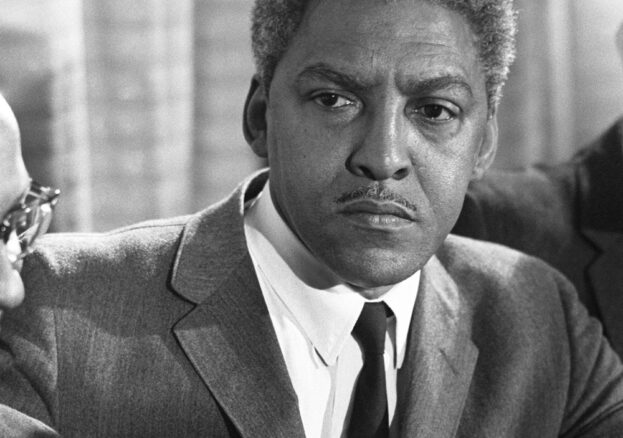
Bayard Rustin (1912–1987) was a human rights activist known for his work during the Civil Rights Movement
Rustin was a key organizer of the 1963 March on Washington for Jobs and Freedom and was one of Martin Luther King Jr.’s closest advisors, especially on techniques of nonviolent resistance. Rustin was extremely active in the Congress of Racial Equality (CORE) and helped to create the Southern Christian Leadership Conference (SCLC).
Early in his career, he was arrested for “moral cause” which led to his outing to the public. However, once outed, Rustin was completely open about his sexuality and was never ashamed. Criticism and discrimination over his sexuality led Rustin to have a more background role in the Civil Rights Movement. He never wanted his sexuality to have a negative effect on the Movement, which is often the reason that Rustin’s efforts are not widely known. (snip-MORE)
Bayard Rustin was an American leader in social movements for civil rights, socialism, pacifism and non-violence, and gay rights.
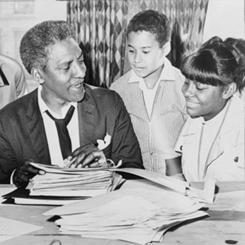
2HKJNR6 Bayard Rustin (1912-1987), American civil rights activist, attending Walter Reuther Press Conference, Warren K. Leffler, US News & World Report Magazine Collection, March 17, 1965
Bayard Rustin was an unsung hero whose indomitable spirit and relentless dedication carved a pivotal path in the American civil rights movement. Despite the shadows cast by prejudice and political adversity, Rustin’s life radiated with a fervent commitment to justice, equality, and nonviolence. His story is one of courage, resilience, and unwavering passion for the principles he held dear.
A Foundation of Activism
Born on March 17, 1912, in West Chester, Pennsylvania, Rustin was nurtured in a household steeped in activism and moral conviction. Raised by his Quaker grandparents, particularly his grandmother, Julia Rustin, a dedicated member of the NAACP, he absorbed the values of equality and social justice from an early age. This upbringing ignited a spark within him that would blaze throughout his lifetime.
Rustin’s early education at Wilberforce University and Cheyney State Teachers College further fueled his activist spirit. Though he did not complete his degree, these institutions were fertile ground for his burgeoning political consciousness. His move to Harlem in 1936 immersed him in the heart of African-American culture and political activism, setting the stage for his life’s work.
The Power of Nonviolence
Rustin’s commitment to nonviolence was both a strategic choice and a deeply held belief. His association with the Fellowship of Reconciliation (FOR), a pacifist organisation, was pivotal. Under the mentorship of A. J. Muste, Rustin honed his skills in civil disobedience and nonviolent resistance, becoming a leading voice in the fight against racial injustice.
In 1947, Rustin co-organised the Journey of Reconciliation, a courageous precursor to the Freedom Rides of the 1960s. This daring initiative aimed to dismantle segregation on interstate buses through direct action. Facing arrests and brutality, Rustin’s unwavering resolve demonstrated the transformative power of nonviolent protest and set a powerful precedent for future civil rights campaigns.
A Strategic Visionary
Rustin’s encounter with Martin Luther King Jr. during the Montgomery Bus Boycott marked a turning point in the civil rights movement. Recognising King’s potential, Rustin became a crucial advisor, infusing the movement with his vast experience and strategic acumen. His efforts were instrumental in the formation of the Southern Christian Leadership Conference (SCLC) in 1957, strengthening the infrastructure of the civil rights struggle.
Rustin’s strategic brilliance shone through his emphasis on Gandhian principles of nonviolence. He played a key role in guiding King towards these philosophies, ensuring that nonviolent resistance remained at the heart of the movement. Rustin’s behind-the-scenes influence was a driving force that propelled the civil rights movement forward, even amidst escalating tensions and opposition.
Bayard Rustin was a black Civil Rights activist, a close associate of Martin Luther King, and an advocate of gay and lesbian rights, and a Quaker.
Rustin was born in West Chester, Pennsylvania and was brought up by his grandmother, who had been raised as a Quaker. He himself became a Quaker in 1936, shortly before moving to New York where he lived most of his adult life. He was a pacifist and a primary influence in bringing non-violent resistance into the American Civil Rights Movement, much inspired by Gandhi’s approach in India.
In 1941, he joined the pacifist Fellowship of Reconciliation. He protested against segregation within the armed forces, and worked with the American Friends Service Committee to protect the property of interned Japanese Americans.
Despite his membership of the Society of Friends (one of the so-called ‘Historic Peace Churches’), Rustin was jailed in 1944 for his conscientious objection to cooperating with the draft. While in jail, he organised protests against segregated seating in the dining hall. In a letter to the prison warden, he wrote:
Both morally and practically, segregation is to me a basic injustice. Since I believe it to be so, I must attempt to remove it. There are three ways in which one can deal with an injustice. (a) One can accept it without protest. (b) On can seek to avoid it. (c) One can resist the injustice non-violently. To accept it is to perpetuate it.
After the War, he took part in the Journey of Reconciliation across four southern States, to protest against illegal segregation in inter-state travel. He was arrested, along with his fellow protestors, several times in the course of the journey and in North Carolina was sentenced to thirty days on a chain gang. The protest became a model for future ‘Freedom Rides’.
In 1956, he was asked to advise Martin Luther King on the application of non-violent resistance to the boycott of public transport in Montgomery, Alabama. In August 1963, Rustin had the mammoth task of organising the March on Washington for Jobs and Freedom – a rally attended by twenty thousand people that culminated in King’s ‘I have a dream’ speech. In 1968, shortly before King’s assassination, he drafted the ‘Economic Bill of Rights’ which called for – among other things – a meaningful job and a living wage for people of all colours.
Rustin’s concern for Human Rights was never confined to black Americans. In the 1940s and 50s, He supported independence movements in India, Ghana and Nigeria. In the 1970s and 1980s, Rustin became an election and human rights observer in countries like Chile, El Salvador, Grenada, Haiti, Poland, and Zimbabwe. As Vice Chairman of the International Rescue Committee he participated in the international March for Survival on the Thai-Cambodian border and helped raise awareness of the plight of the Vietnamese boat people. He was Co-Chairman of the Citizens Commission on Indochinese Refugees and helped found the National Emergency Coalition for Haitian Refugees.
Rustin was an openly gay man who had once been arrested for public indecency at a time when homosexuality was illegal in all US states. This fact was used against him more than once and contributed to his relatively low profile in the Civil Rights movement. However, in the 1970s and 80s he wrote a number of essays which drew parallels between the black civil rights movement and the gay liberation movement. In 1986, Rustin wrote:
Today, blacks are no longer the litmus paper or the barometer of social change. Blacks are in every segment of society and there are laws that help to protect them from racial discrimination… It is in this sense that gay people are the new barometer for social change… The question of social change should be framed with the most vulnerable group in mind: gay people.
Rustin fell ill during a human rights expedition to Haiti in 1987 and died shortly after from a perforated appendix.
His life was documented in the film Brother Outsider.
His collected writings were published in A Time On Two Crosses.
Dan McClellan explains why saying the bible is against homosexuality is wrong. The status of the male as the top of the hierarchy was of primary concern. Women were of a lower status than men. For a man to penetrate caused his status to fall to that of a woman. That was the sin of same sex acts in their society. So men were told not to penetrate other men as that lowered them to the position of women in their society. He points out that they felt that a man who wanted to be penetrated was thought to have a mental illness. He points out how the people of that time were not worried about female same sex acts because they did not lower anyone status because no penis was involved and no male was emasculated. McClellan points out that the bible really was only concerned with one side of the same gender act so it was not homosexuality that it condemned but the lowering of a male’s top position in society that was the issue. I have watched and posted a lot of his videos on sexuality in the bible and those who use the bible as a club to bash LGBTQ+ people with. He is a scholar so he gets into the weeds of the real meanings of the words that make up the text. He can be difficult to follow sometimes because of that. He also used the example of slavery in the bible and how it was used to justify owning another person as property. It is an interesting video that gets easier to understand towards the end as he wraps it all together and warns those who use the bible in this manner that they are causing a lot of harm to those who do not believe or think as they do on same sex acts. Hugs
When approaching recent historical events, where the scope of destruction and loss can be unfathomable in scale, oral history can bring both connection and immediacy through individual stories of loss, grief, rescue, or triumph that would otherwise disappear in the grand sweep of “Great Men and their Deeds.”
[T]he method enables the documentation of certain aspects of historical experience that are often missing from other kinds of historical sources. Oral historians not only interview and engage in conversation with living sources, they also find themselves challenged in a unique way—the historian is transformed into a protagonist in the dialogue. Oral history is perhaps the only field where the sources talk back to the historian, confronting, disputing, disrupting, and sometimes resisting the historian’s understanding of the past (Frisch 1990; Shopes 2012). Oral history works with the interviewee as a partner in dialogue and the verbal form historical truth can take is always co-constructed (Cook and Goodall 2013; Goodall and Cadzow 2009; Portelli 1991).
Some of the most effective (and affecting) projects using this approach concern communities that may be far outside of the audience’s experience, whether due to time, geography, or identity. Works like Shoah by Claude Lanzmann, Hard Times by Studs Terkel, and Boots of Leather, Slippers of Gold by Elizabeth Lapovsky Kennedy document their subjects through the voices of those who lived through specific moments and events that can be overwhelming or remain unknown without a more interpersonal method.
“Many of the best works about this disease have been produced by people at various stages of HIV infection.”
The history of the HIV/AIDS epidemic has recently become the subject of numerous oral history projects, where the stories of survivors, caregivers, activists, and health care professionals have been collected and made available online, traditionally published, and edited into documentaries.
One such collection, Visual Arts and the AIDS Epidemic, was begun in 2015 by the Smithsonian Archives of American Art after receiving a grant from The Keith Haring Foundation. Haring founded the foundation in 1989, a year before his death from HIV-related illness, to maintain his artistic and philanthropic legacy. The project interviewed forty artists about their lives, their work, and how the AIDS crisis intersected and permeated both.
The interviews in the Visual Arts and the AIDS Epidemic collection cover wide ranges of personal and creative history, ranging from insider gossip and “name-dropping” to theoretical discussions of method and art history. They benefit from interviewers who bring their own experience as artists, art scholars, and historians to the conversation, with questions and insights that make this collection a rich multifaceted history of AIDS, the arts, and activism.
as if the artist were immersed in dealing with the epidemic—as so many are. Many of the best works about this disease have been produced by people at various stages of HIV infection. Perhaps they have lost a lover, nursed a dear friend, or attended a dozen funerals at a young age, and feel themselves to be, in every sense, set apart by the experience. They are implicated. Their art signifies a collective trauma—mass death in the midst of life.
Reveal Digital, an initiative “to amplify important, long-overlooked voices of the twentieth century,” has made these histories, and more, available in their developing open access collection HIV, AIDS and the Arts.
Artists in The Early Years of the Epidemic
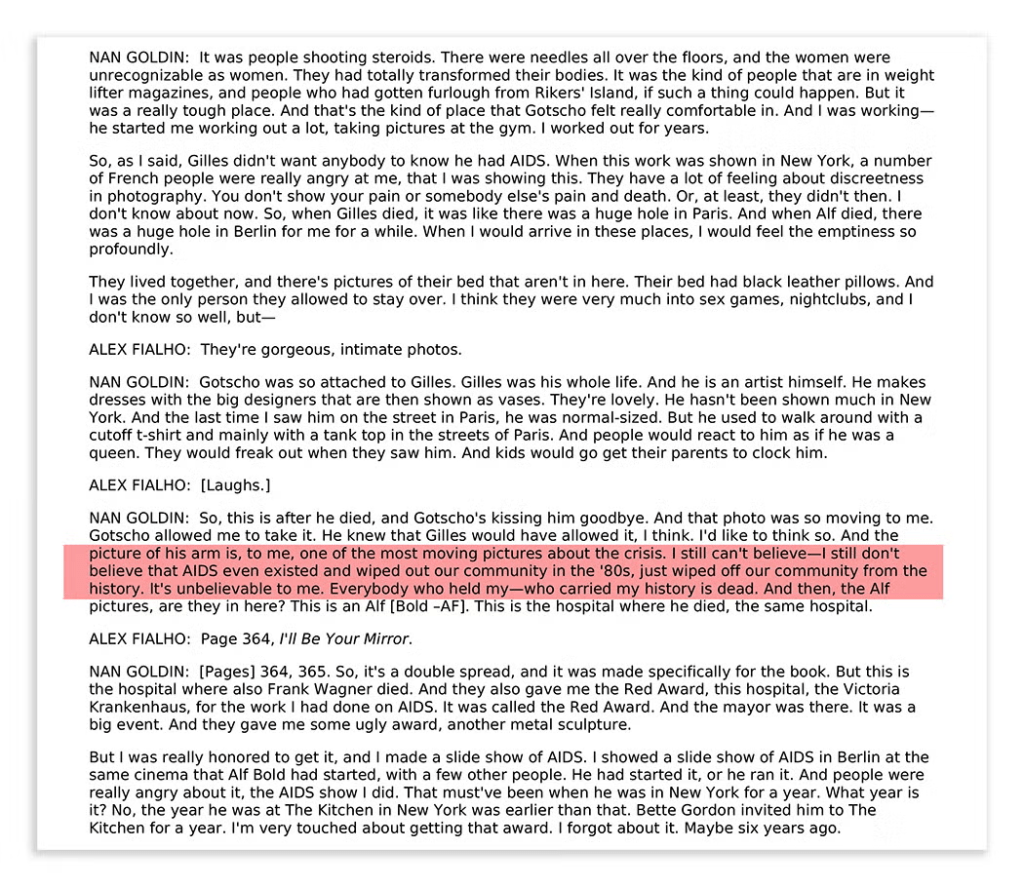
“I still can’t believe—I still don’t believe that AIDS even existed and wiped out our community in the ’80s, just wiped off our community from the history. It’s unbelievable to me. Everybody who held my—who carried my history is dead.” —Nan Goldin
One year later, William F. Buckley published a New York Times op-ed calling for HIV-positive people to be tattooed on the upper arm and buttocks to protect others (assuming that would protect both future sexual partners and intravenous drug users who might share needles). News reports about the disease largely focused on fear of contagion, the promiscuity and danger of gay men, and the threat of HIV to “normal” Americans.
In the interviews gathered in the Visual Arts and the AIDS Epidemic collection, artists describe how they first became aware of AIDS: from a loved one diagnosed after an illness; from hearing of a friend’s passing after not seeing them for a while; from a doctor telling them to stay with a partner because “there’s something going around”; or by learning of their own diagnosis. Friends were lost to the disease, and surviving family members denied the illness or sometimes actively excluded partners from funerals.
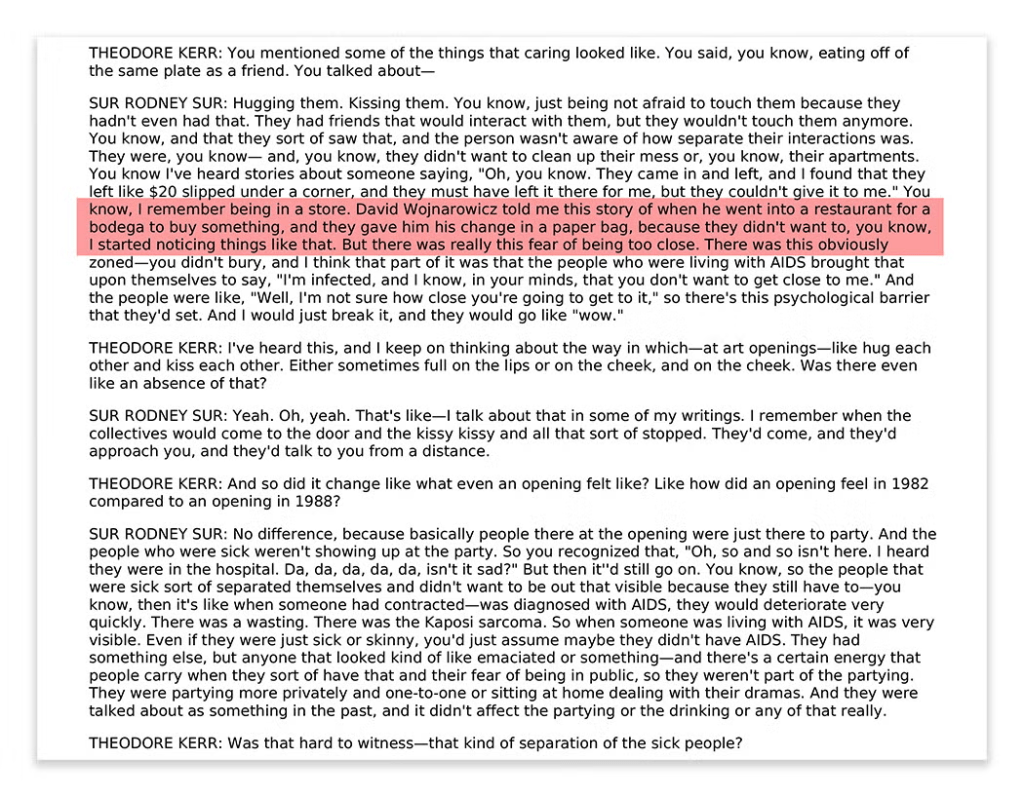
Sur Rodney (Sur), a New York City-based writer, gallery co-director, and archivist, relates that the late artist David Wojnarowicz would go to his local bodega in New York City where the clerks returned his change in a paper bag, out of fear. He describes his own anxieties when stepping in after a friend’s death to help save and archive their artworks and collections so they wouldn’t be destroyed (before there were nonprofit organizations to do so).
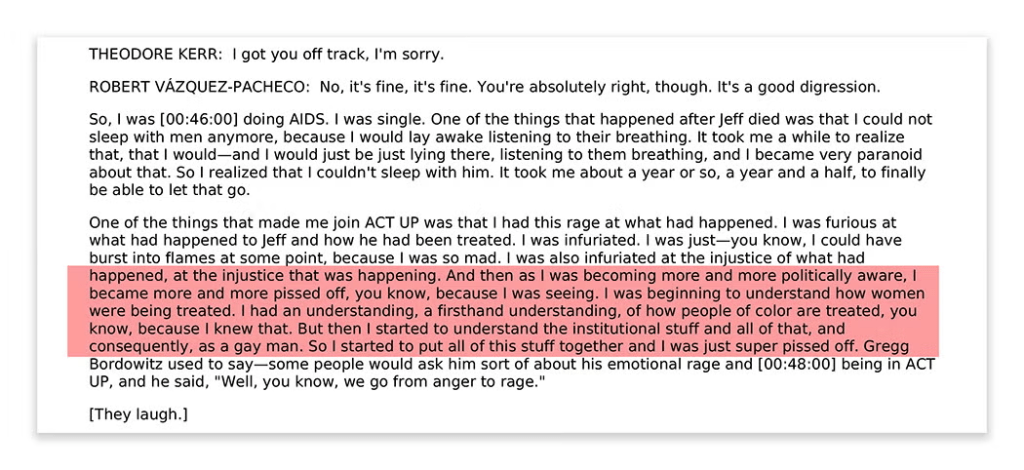
These personal experiences unfolded within the larger context of governmental indifference, active discrimination against people with the disease (or belonging to groups that were deemed “at risk”), and a growing consciousness of the political landscape of the epidemic. Robert Vasquez-Pacheco, a member of ACT UP and Gran Fury, recounts,
as I was becoming more and more politically aware, I became more and more pissed off, you know, because I was seeing. I was beginning to understand how women were being treated. I had an understanding, a firsthand understanding, of how people of color are treated, you know, because I knew that. But then I started to understand the institutional stuff and all of that, and consequently, as a gay man. So I started to put all of this stuff together and I was just super pissed off.
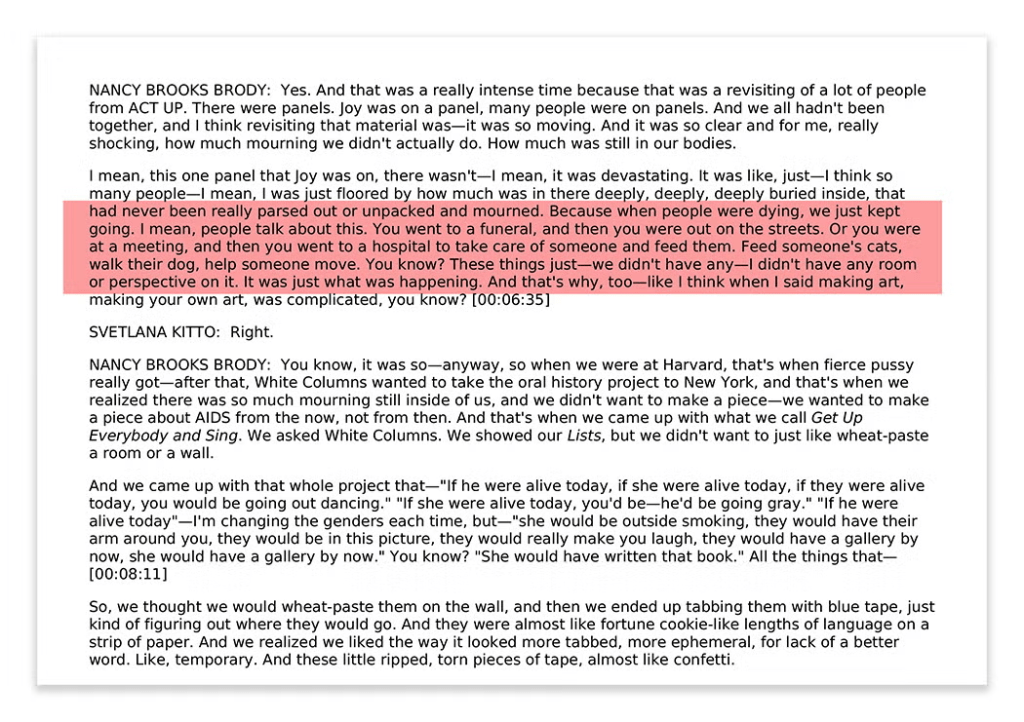
Some version of this process, repeated for many of the subjects, led people to activism, whether through art, volunteer work, protest, or sometimes all three. Nancy Brooks Brody (1962-2023), a visual artist and member of the fierce pussy collective, describes the progression in her interview.“Because when people were dying,” she explains,
we just kept going. […] You went to a funeral, and then you were out on the streets. Or you were at a meeting, and then you went to a hospital to take care of someone and feed them. Feed someone’s cats, walk their dog, help someone move. You know? These things just—we didn’t have any—I didn’t have any room or perspective on it. It was just what was happening.
The meetings she, and others, refer to were those of ACT UP New York (The AIDS Coalition to Unleash Power), which began in 1987 at a community meeting where Larry Kramer asked, “How long does it take before you get angry and fight back?” Kramer, a playwright and essayist who had been covering AIDS since the beginning through journalism, had co-founded the non-profit Gay Men’s Health Crisis in 1982. His play The Normal Heart, an impassioned call to action, spurred members of the audience to meet and subsequently take part in one of the most significant and effective activist movements of the twentieth century.
Creating Art in an Epidemic
The artistic works of those interviewed are diverse, both in media and approach: photographing people living with AIDS, using détournement to turn existing works into calls to action via graphic design, or using their body to confront audiences with the existence of the disease through performance. In some cases, their illness became an essential component of their art: John Dugdale, a former commercial photographer, began using nineteenth-century methods to capture and produce his work after HIV-related retinitis and a stroke left his sight significantly impaired. Ron Athey, one of the NEA Four, used his own HIV-positive body to create work exploring sex, trauma, and desire. The place of the artist within (or outside) a community could become a contentious issue, especially at a time when representation of people with AIDS was so fraught.
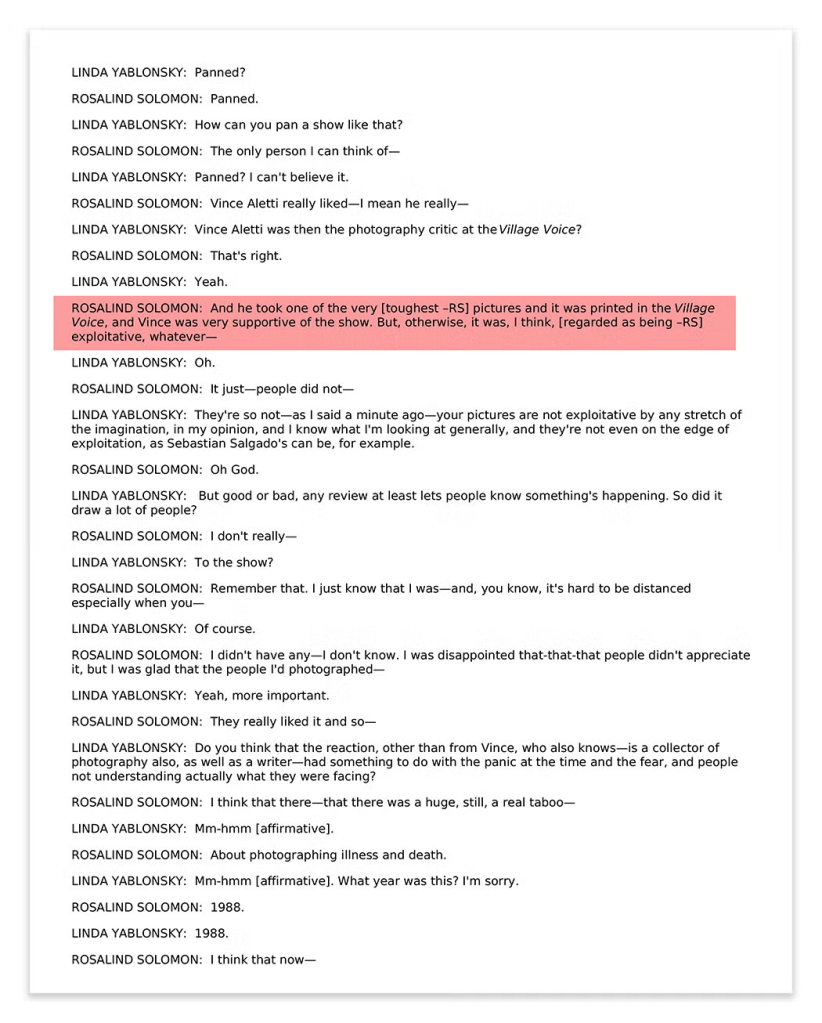
Rosalind Fox Solomon, whose 1988 show Portraits in the Time of AIDS featured photographs of the subject alone or with loved ones, some with visible lesions or in the hospital, relates that her project was critically panned and called “exploitative” at the time.
Some of the most vibrant, and now iconic, images of AIDS were created as (and for) protest: Silence = Death, the work of the Silence = Death Collective (and not ACT UP, as Avram Finkelstein relates in his interview) became the primary pictorial representation of ACT UP and a rallying slogan for the fight against the disease. Keith Haring did his own take on it for a poster, adding “Ignorance = Fear” to a “See No Evil, Hear No Evil, Speak No Evil” scene.
Collectives like Gran Fury and fierce pussy, which organized inside the ACT UP activist group, created posters for wheat-pasting that served as art, education, and calls to action around AIDS, homophobia, health care, and visibility. Whether newsprint works of text, guerrilla-installed bus station “ads,” or rolls of stickers of bloody hands announcing “One AIDS Death Every 10 Minutes,” the art of AIDS activism used any means available to communicate the urgency of the crisis.
The Visual Arts and the AIDS Epidemic collection demonstrates the power of oral history to preserve not just historical events, but what it felt like to live in the moment and survive it when so many people did not. Together with Reveal Digital’s HIV, AIDS, and the Arts archive, the collection ensures that these voices, experiences, and creative histories continue to be available to inform and educate future generations.
I really enjoy how well someone who knows the bible and the meaning of the words of Jesus can turn the bible bashers arguments around on them to show support for the oppressed minorities. Hugs
This is pure racism and entitlement. The boy put the bottles of water back. But even if he had not does stealing bottles of water rate or equate to a death penalty performed by a civilian? This is clearly an extra juditiacal killing. No judge or jury just a store owner and his son angry thinking a kid stole from them deciding to end his life. This automatic killing of Black people with no evidence has to stop. Black Lives Matter. Hugs
Gas station owner charged in shooting death of 14-year-oldRick Chow, 58, has been charged with murder after allegedly killing Cyrus Carmack-Belton in Columbia, South Carolina, on Sunday, police said.
The family of Cyrus Carmack-Belton expressed their indignation towards a South Carolina jury’s decision on Tuesday to acquit Chikei Rick Chow in the 2023 fatal shooting of the Black 14-year-old.
“Yesterday a jury watched our 14-year-old boy run away from two grown men on video. They knew one of them shot him in the back and they still said no one is to blame,” the family said in a statement first released to ABC News. “We are heartbroken. We do not accept it. Cyrus stole nothing. He was a child, and he was running for his life. Our son mattered.”
Chow, a 61-year-old store owner, shot the 14-year-old in the back outside of his Columbia, South Carolina, store in May 2023. He and his son were seen chasing Carmack-Belton outside of the store in video leading to the incident. Chow was charged with murder and denied bond multiple times before his acquittal.
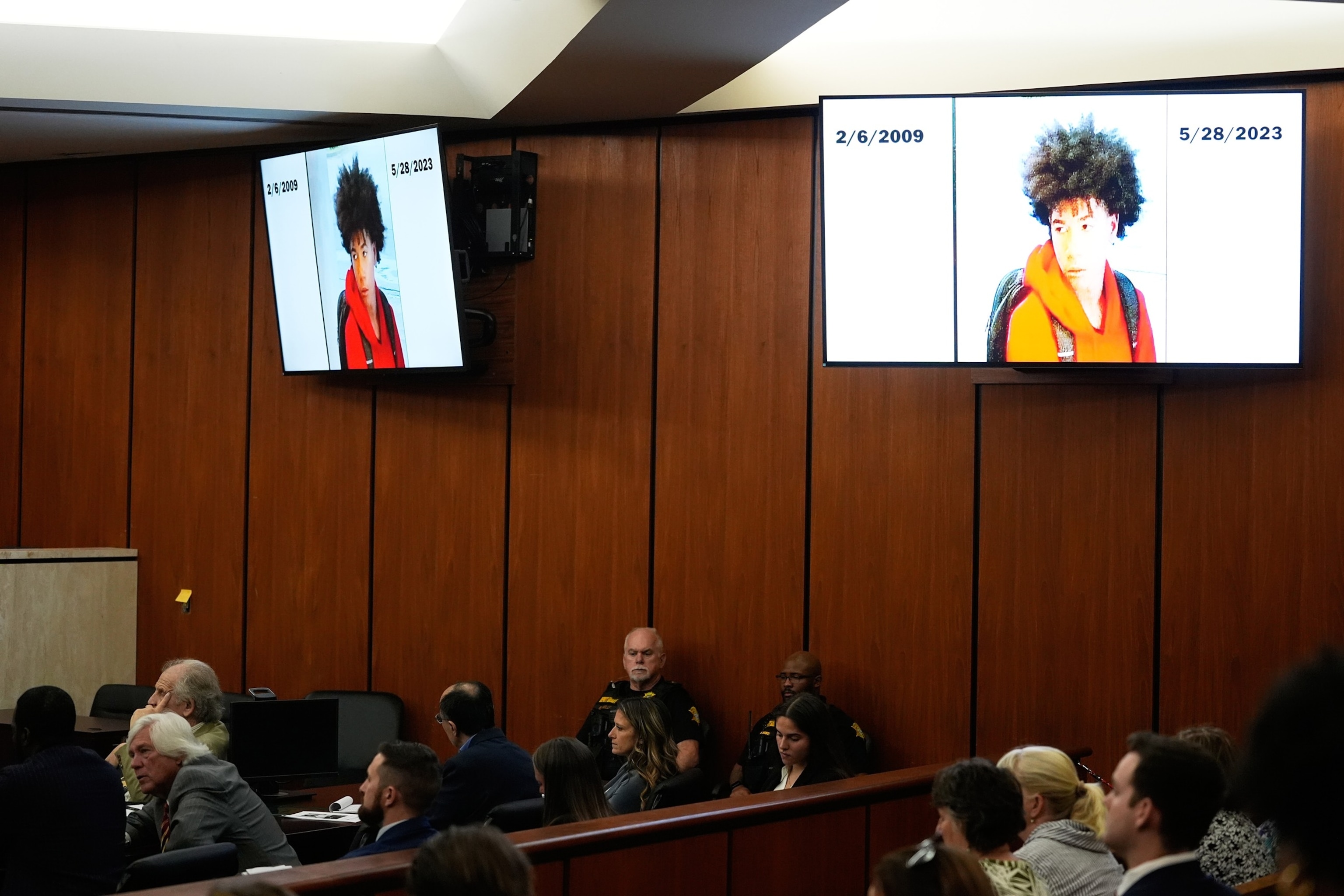
An image of Cyrus Carmack-Belton is displayed in court during closing arguments in the murder trial against his shooter, Chikei Rick Chow, a convenience store owner accused in the 2023 fatal shooting of the 14-year-old, on June 1, 2026, in Columbia, S.C.
Erik Verduzco/AP Photo
Prosecutors alleged that Chow acted out of a false belief that Carmack-Belton had shoplifted four bottles of water from his store. The defense claimed that Chow acted to protect his son, after allegedly seeing Carmack-Belton point a gun at him.
“On behalf of the Chows, we’re very pleased at the jury’s deliberations and their verdict,” attorney Jack Swerling said in a statement to ABC News. “We think it was the appropriate verdict in this case, although it was a difficult decision to come to, because you have two different stories, two extreme differences.”
Video obtained by ABC News shows that Carmack-Belton returned the bottles of water in question and did not steal anything from the store. A 9mm pistol was found next to Carmack-Belton, with prosecutors saying it was in his possession during the chase, and it had fallen to the ground at some point.
In this June 1, 2023, file photo, mourners stop by a memorial to Cyrus Carmack-Belton, in Columbia, S.C.
Jeffrey Collins/AP, FILE
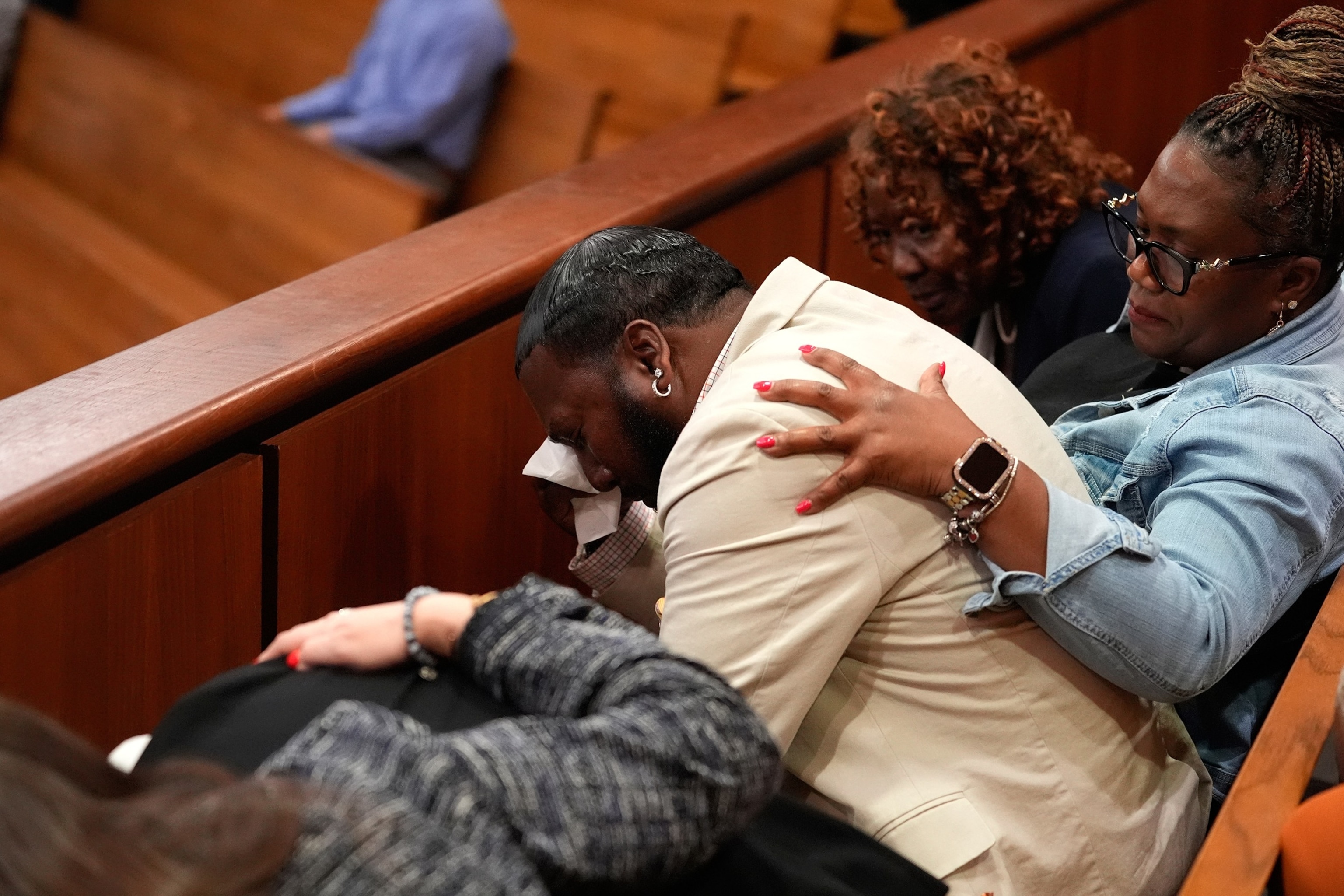
As the verdict was read in the courtroom, members of the Carmack-Belton family and the audience were seen breaking into sobs.
In their statement Tuesday, Carmack-Belton’s family drew a connection between their case and a larger history of violence against the Black community. “Black families have stood right here too many times — burying our children and then being told the law sees nothing. We feel every bit of that today,” the family said.
Troy Belton, center, father of Cyrus Carmack-Belton, reacts after a not guilty verdict against Chikei Rick Chow, a convenience store owner accused in the 2023 fatal shooting of his 14-year-old son, during a murder trial, on June 1, 2026, in Columbia, S.C.
Erik Verduzco/AP Photo
“To everyone hurting with us: honor Cyrus in peace. We will not stop. We’re taking this fight to civil court, and we will not rest until our son’s life is given the dignity this verdict denied him,” the family added.
According to family attorney Todd Rutherford, the family filed a civil lawsuit against Rick Chow in Richland County, which was put on hold until the conclusion of the criminal case.