
On the last post I made about this I was going to write a long intro. However when I read the comments every point I would have made is made in the comments in far fewer words than I would have done. So if you wish to see opinions on what the government is doing to follow Russia and wipe the LGBTQ+ from society in the name of protecting children / straight people / cis people / and religious privilege to discriminate then please read the comments. Hugs
Category: History
John Fugelsang: Reclaiming Jesus’ Teachings
I love this video. John Fugelsang is a wonderful person to elaborate on the bible and he does so as a follower of Jesus, not Paul or the Old Testament. His mother was a nun and his father was a monk and the way he describes his father wearing his robes is as the Christian jedi of Flatbush. He explains how those using the bible to attack or bash others including the LGBTQ+ are not following Jesus that they are following Paul. He explains clearly how Jesus brought a new covenant for the people doing away with the old one in Leviticus. He explained how those using the bible to bash others and not feed & clothe the stranger/ immigrant are totally against what Jesus preached. He also mentioned how those trying to force the Old Testament of the bible in schools never want the words of Jesus hung in classrooms in public schools, they never want the sermon on the mount posted on the walls. Those kind of people only want authoritarian laws or do and dont do pushed on kids. Enjoy the video, I listen to him on The Daily Beans (news with swearing) friday newscast and his Sirius talk show. Hugs
A Murder, Indeed!
As The Crow Poops
SCOTUS answers the caw of racism
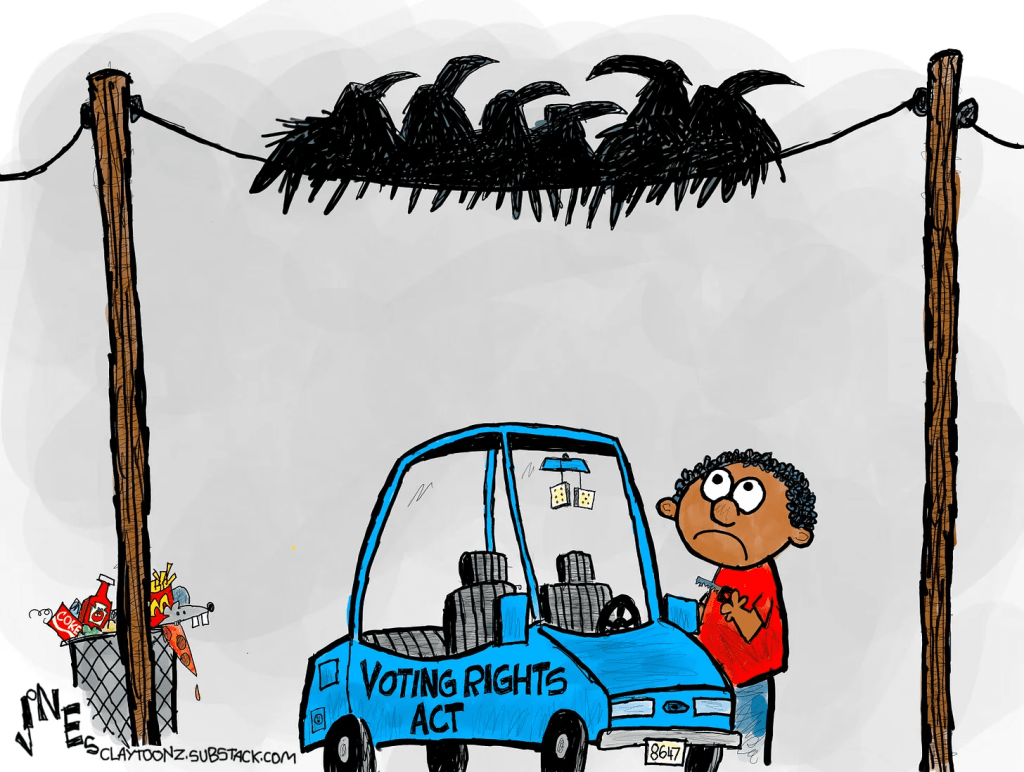
In a 6-3 decision on Wednesday, the Supreme Court struck down Louisiana’s second majority-Black congressional district, ruling it an unconstitutional gerrymander. Immediately, Louisiana conservatives started redrawing the state’s congressional districts, without any of them being majority Black. Now, election maps from local school districts to state legislatures to Congress will be redrawn to undermine minority representation.
Louisiana is now planning to postpone the state’s May 16 primary, in which many people have already voted, so it can redraw the congressional maps. And just announced early this evening, Alabama and Tennessee will also be redrawing their congressional maps before the midterms. They won’t be the last.
Don’t be surprised if Republicans don’t create a red sweep of congressional districts across the South on Election Day.
The Voting Rights Act was created to prohibit discrimination in American voting and was signed into law by Lyndon B. Johnson in 1965. The act ended things like literacy tests for minorities before they could be allowed to vote. It increased voter turnout among black Americans. According to the National Archives, around 250,000 new Black voters registered to vote by the end of 1965. Nine out of 13 Southern states had more than 50 percent of African Americans registered to vote by the end of 1966. What the Supreme Court did on Wednesday was to encourage discrimination in American voting.
The conservative Supreme Court has been chipping away at the Voting Rights Act for years. The court issued a ruling in 2013 that killed federal oversight of voting rules in nine states, and led to over 1,000 closings of voting precincts, mostly in Black districts. Studies years later show that it increased the racial turnout gap, translating to hundreds of thousands of uncast ballots by voters of color in the 2022 election. Remember the 2013 ruling the next time you hear a MAGAt brag about Trump sweeping all of the swing states in 2024.
In 2021, the court ruled that fears of election fraud could justify new election rules without evidence that any fraud had occurred in the past, or that new rules created by Republicans in the aftermath of Donald Trump losing the 2020 election would make elections safer.
Now the court has ruled that the majority-minority congressional districts created with the intent of ensuring minority voters could elect candidates of their choice were unconstitutional. This will lead to states like Louisiana, Arkansas, Mississippi, and South Carolina, etc, having congressional delegations without any Black members.
Samuel Alito wrote the conservative court’s majority decision and said that the gerrymandered district that gave the state its second Black congressional representative was unconstitutional. The six conservatives say that this congressional district was discriminating.
The Civil Rights Act required Southern states with a history of voter discrimination to obtain federal approval before making changes to their voting laws. Now, that’s gone. Yeehaw states will now be free to discriminate in their elections without the burden of the federal government stopping them.
Section 2 of the Voting Rights Act outlaws any voting practice that creates hurdles to voters “on account of race or color.” Technically, that provision has not been eliminated, but as Justice Elena Kagan wrote in her dissent, it leaves the provision “all but a dead letter.” She said the bar to show intentional discrimination is “an almost insurmountable barrier for challenges to any voting rights issues to prove discrimination.”
The Rev. Al Sharpton called the high court’s decision a “bullet in the heart of the voting rights movement, and said in a statement, “The Supreme Court has not just weakened a law, it has humiliated and dismantled the life’s work of Dr. Martin Luther King Jr., John Lewis, and every man and woman who marched, bled, and died for Black Americans to have an equal voice at the ballot box.” It’s like the Roberts Court has just burned down the Edmund Pettus Bridge.
Cliff Albright, a co-founder of the group Black Voters Matter, said Wednesday’s ruling “means that you have entire communities that can go without having representation. It is literally throwing us back to the Jim Crow era unapologetically, and that’s not exaggeration.”
Kareem Crayton, vice president of the Brennan Center for Justice’s Washington office, said the court’s steady work to erode the Voting Rights Act, culminating in Wednesday’s decision, amounted to “burying it without the funeral.”
Maria Teresa Kumar, president of Voto Latino, said the decision will allow more aggressive “cracking and packing” of populations to dilute their votes, “not just in congressional districts but also in state legislatures, county commissions, school boards, and city councils.”
Marc Morial, National Urban League president and CEO, said, “This decision is a continuation of a frontal assault on the gains of the Civil Rights Movement that began in 1954 with the Brown versus Board of Education decision.
Sophia Lin Lakin, deputy director of the American Civil Liberties Union’s Voting Rights Project pointedout that a loss of representation, especially in state legislatures and Congress, will translate into minority communities losing a voice on issues that matter to them, such as healthcare, education and needed public works upgrades, and said, “States can now point to partisan objectives to justify maps that strip voters of color of representation, and federal courts will have little basis to intervene.”
Shalela Dowdy, an Alabama resident who was a plaintiff in a lawsuit that resulted in the creation of a new Alabama district in 2023, said, “Putting it in the hands of the states on this level is dangerous. There’s just been a history of the states not doing the right thing based off their state population.”
Stupid and racist, conservatives, like Gary McCoy and Margolis & Cox, love to claim that rules and laws that create black congressional districts, and the Civil Rights Act itself, are racist. But what they are doing is eliminating black representation while creating more for whites.
The Supreme Court has once again taken our nation backward. And again, this is the fault of Donald Trump and Mitch McConnell, who broke every rule and norm they could to pack the court with their troglodytes, even by stealing appointments from Democratic presidents. This court has actually taken away rights from Americans, like the guarantee of a woman’s right to choose.
And again, the court is doing everything it can to make it much more difficult to defeat Republicans.
Republicans love to claim that they’re the party that passed the Voting Rights Act. While not technically true, it could not have passed without Republican support. But now, the Republican Party is the one to kill the Voting Rights Act.
Donald Trump’s legacy will not be ballrooms, arches, his face on coins, passports, and his name on federal structures; it will be creating the court that killed democracy.
Crows: My Neighbourhood is full of crows. While you do find them in cornfields, they are also an urban bird. They also have the ability to mimic, like a parrot or a mynah. They are extremely intelligent. I like them. My friend and cartooning colleague Chris Britt creates paintings of crows. I texted him once to tell him that I just saw a murder outside my house. On some days, I have very large and loud murders. (snip-MORE)
Some Stuff To Read & Look At
Some entertaining; some, things about which to think. The first bit is somber; exceedingly somber. It is easy to just click through on the title to read the entire post; I subscribe for free, so I don’t want to just take the whole thing. Beneath, more stuff! Enjoy your May Day. 🌺
We Lost.
When the Supreme Court dealt the final blow to the Voting Rights Act, it completed its mission to erase the tangible results of the Civil Rights Movement.
Michael Harriot Apr 30, 2026
The dictum,”once a free man, always a free man,” though founded about as deeply in law, history and reason as, that “all men are born free and equal,” … [is] unimportant and ineffectual to protect the rights of citizens of slave States.
— Judge Hamilton Gamble
On March 22, 1852, America made a slave.
America’s race-based, constitutionally enforced system that legally extracted labor and intellectual property through violence or the threat of violence existed long before the 13 English colonies staged an insurrection against their British master. Colonial law made the condition intergenerational and perpetual. The founders wrote the fugitive slave clause to ensure that people who had already been reduced to human chattel couldn’t free themselves. But the Constitution didn’t make someone a slave. (snip-MORE, and so worth the click!)
And an antidote to that–click and fall in love!
May Day Is Tomorrow!
Here is some information. There is something everyone can do.
May 1 3:30 – 5:30 PM ET Community Hosted
May Day! Workers over Billionaires: A Nationwide Day of Action
(Click the headline right up there for more info, or scroll down for yet more links and info)

The next National Day of Action is right around the corner, May Day, Friday, May 1st.
The national call is for no business as usual. This will look different in different places. In some locations, it will mean no work, no school, and no shopping. (snip)
May Day Actions
This May Day, we’re flexing our economic power as workers, students, and everyday people to send a clear message to the Trump regime: we will not do business as usual while they trample our rights, terrorize our communities, and drag us into a senseless war in Iran.
So on May 1st we are taking action by:
- Hosting or joining a local May Day event
- Participating in No Work, No School*, No Shopping
The first step: pledge to build power and take collective action with us on May Day.
Note: A core principle behind all May Day events is a commitment to nonviolent action. We expect all participants to seek to de-escalate any potential confrontation with those who disagree with our values and to act lawfully at these events. No weapons are permitted under any circumstances. (snip)
Mayday Protest – National Day of Action
It’s time for the conditions and standard of living that the working class deserves. We’re beginning a year of action on May 1st with a series of protests, strikes, and other direct action opportunities.
MAY 1 NATIONAL DAY OF ACTIONS:
THRIVING WAGES
The working class people have been taken advantage of for far too long! Join us as we mobilize to create worldwide plans of action for THRIVING WAGES. We are demanding at least $20/hr as well as better union laws, the ease of information for organizing co-ops, and better working conditions. But wait, there’s more! We are also demanding mandatory PTO, paternal leave, and good benefits.
Why do we want these demands?
Inflation over the last year has risen over 7% and continues to climb.
Rents and housing costs have skyrocketed.
The costs of consumer goods as greatly increased.
Yet corporations and billionaires have doubled their wealth in 2 years as the working class has struggled during a pandemic that has killed over 850,000 Americans and counting. (snip-MORE)
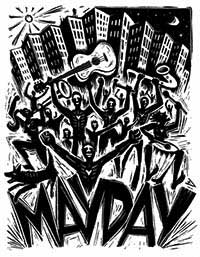


So, some of us don’t get around much anymore. Some of us may be somehow constrained to go to work. Some of us have waited all week to buy a few needed groceries. Maybe we wanted to participate, but just forgot and now it’s tomorrow, and there doesn’t seem to be a way to do it. How can we participate? Well, click onto any or all of these links to find out. There is no fault or fail in not being able to do the primary actions, but there are other ways to participate, and even if we don’t find a way, we can certainly work toward being able to observe a personal May Day now and then on our own. We can simplify, and always work to keep our spending where it will be most useful to community. And maybe we can watch someone else’s kids or pets while they go and do. Benefitting our communities while not feeding the already-wealthy with our commerce, labor, and dollars will benefit people, and is the objective. Above this graf are resources. May Day is tomorrow. Let’s do all we can!
Looking At This Week With Joyce Vance
The Week Ahead
April 26, 2026
Stay with me tonight. This one runs a little long, but it’s all information you’ll need.
It’s likely that much of this week will be overshadowed by investigation into what happened Saturday night at the White House Correspondents’ Dinner, where Cole Thomas Allen, a 31-year-old California man with a master’s degree from Cal Tech, approached the ballroom at the Washington Hilton armed with a shotgun, a handgun and knives, and attempted to sprint through the magnetometer security checkpoint. He was stopped there. A Secret Service agent was shot, but was fortunately protected by a bulletproof vest. It’s not clear who shot him.
The White House Press Corps, still dressed in tuxedos and ball gowns, trooped into the press briefing room at the White House to hear from the President, who appeared, flanked by acting Attorney General Todd Blanche, FBI Director Kash Patel, and others. They, too, were still in tuxedos from the event.
It’s not clear who the “designated survivor” for the event was. CBS’ Margaret Brennan pointed out Sunday morning that “Five of the top six officials in the presidential line of succession were in attendance: Vice President JD Vance, House Speaker Mike Johnson, Secretary of State Marco Rubio, Treasury Secretary Scott Bessent, and Defense Secretary Pete Hegseth.”
Trump was in good spirits as he spoke, complimenting the press and laughing about the speech he had hoped to give after dinner. It was a much more affable Trump than we’ve seen in the course of the last year as he interacted with members of the media he has often been sharply critical, or dismissive of, during his first year in office. Trump went on the attack against the press even before his January 2025 inauguration, as we discussed at the time.
This was a different Trump who spoke in a very measured fashion, far more measured than usual, almost as if he saw this incident as providing the opportunity for a reset. He respectfully took questions from reporters like CNN’s Kaitlin Collins and NBC’s Garrett Haake. He was kindly toward the press; that’s the only way to characterize it. Whether that was a momentary blip or it suggests he will try to convince the media to rebuild its relationship with him remains to be seen. He did say that the Correspondents’ Dinner would be rescheduled within a month, without seeming to understand that the Correspondents’ Association puts on the dinner and controls the event.
At the press conference, Trump was asked why this keeps happening to him—this was the third attempt on his life since he announced his run for the presidency ahead of the 2024 election. He responded that he “has studied assassinations” and that it’s the “people who do the most” that assailants go after, using Abraham Lincoln as an example. Trump said that it “only happens to impactful people” and that he didn’t want to say he “was honored” by the repeated attempts on his life, but he let the implication hang in the room.
But he did not abandon politics. As he began his comments, Trump said the incident demonstrated why the ballroom he is building at the White House is needed.
Trump reiterated his comments in a Sunday morning post on Truth Social, claiming presidents have been demanding a ballroom like the one he’s building for 150 years.
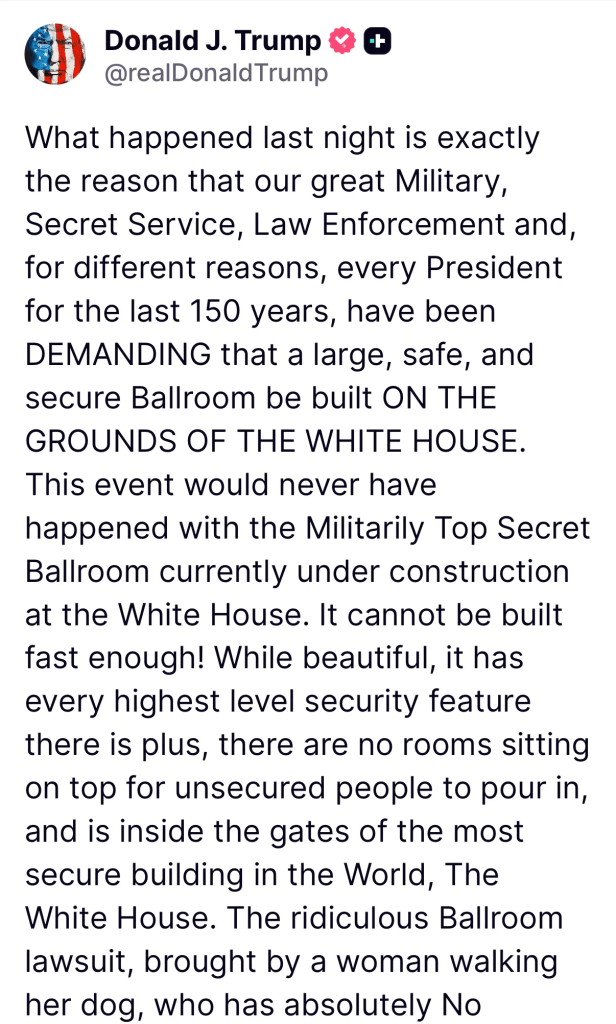
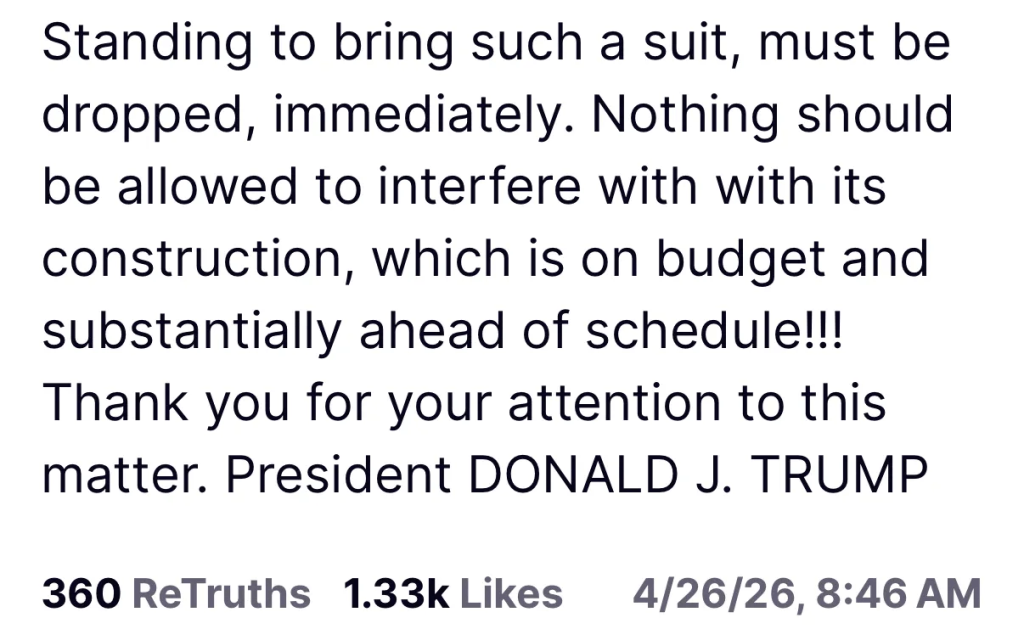
His amen corner all took up the chant on Twitter, on cue.
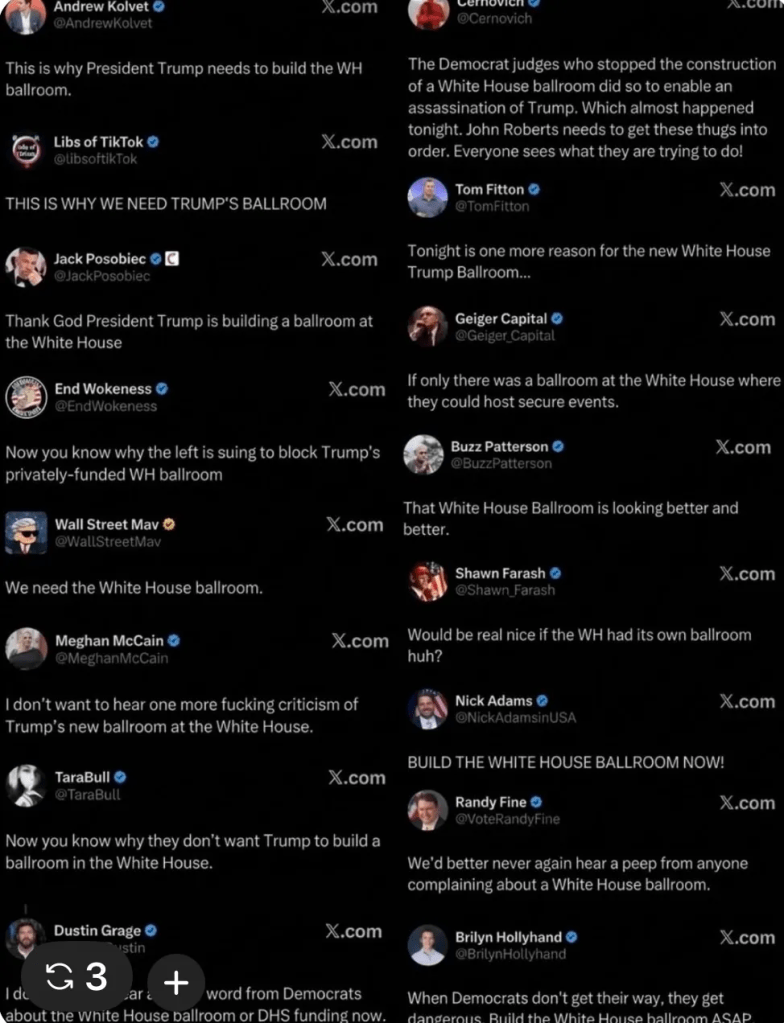
But, as we noted above, the dinner is run by the Correspondents’ Association, not the White House. There is no reason to believe they would use a White House ballroom for a dinner designed to celebrate freedom of the press and its independence from government. Trump can make the argument he needs a safe space to entertain, but it’s a disconnect from the event last night.
Miles Taylor commented on Threads that “The WHCD shooter will be used to justify things that have nothing to do with the WHCD shooter. Mark this moment.” That seems likely.
The immediate investigation will focus on whether the shooter was a lone wolf, as it appears, or whether there is an ongoing threat. There is reporting today that Allen was a member of a group called The Wide Awakes, who appear, based on their web presence, to be committed to “radically” reimagining the future, but look to be a group of creative, peaceful people. Law enforcement will want to determine whether someone or something radicalized Allen and directed him toward violence.
There are sure to be, and there should be, questions about the Secret Service and how this happened. Asked about that during the press conference, Trump responded that he was “very impressed by the Secret Service.” But this is the third time a would-be assassin has gotten close to Trump, and one would have expected them to tighten ranks after the first attempt. Trump, however, does not seem to have viewed any of it as a failure by the Service and he was complimentary of the D.C. police, as well, in a phoner on Fox News.
It’s important to note that the Secret Service stopped Allen at the perimeter they had established. They succeeded in that sense. The real question will be whether the perimeter should have been set further back. I’ve attended the dinner multiple times and one observes layers of security that require guests to walk up the hill to the circular drive in front of the Washington Hilton before entering the hotel, but there are parties and receptions occurring in advance of the perimeter before entering the ballroom area, and, as we now know, Allen avoided scrutiny as a guest who checked into the hotel the day before the dinner. There are real questions that will have to be confronted here to ensure protection for future dinners, to say nothing of the scads of parties that happen in connection with this dinner, and other national events that are held at the Hilton.
Late Saturday evening, D.C. U.S. Attorney Jeanine Pirro announced that Allen would be arraigned on Monday. She said he will be charged with one count of assault on a federal officer using a dangerous weapon and two counts of using a firearm during a crime of violence. That could be fluid as officials learn new information. But the charges she identifies are found at 18 USC 111, which carries a 20-year maximum penalty, and 18 USC 924(c), which carries a 7-year penalty if a firearm is brandished and a 10-year penalty if it’s fired.
The motive seemed to be coming into focus throughout the day as some of Allen’s anti-administration writings were released. On Meet the Press, acting Attorney General Todd Blanche said authorities believed the suspect may have been targeting Trump administration officials, including Trump himself. The basis for that belief appears to have been examination of electronic devices and some writings. But Blanche told CNN’s Dana Bash they were still looking at the motive.
As I heard seasoned journalists, many of them friends, discuss how frightening the shooting was on air Saturday night and Sunday morning, I couldn’t help but reflect on how much worse it is for America’s children. How many of them still suffer a lingering sense of trauma from the moment a shooter crashed into their classroom or their place of worship? If there’s ever been a time to pass sensible gun control laws, it’s now. If we’re going to play politics, as Trump did with immediately pivoting to justifying his ballroom, let’s play that kind and make some good trouble.
There will be in court developments in other matters to track, as well, this week:
This Wednesday will be the last regularly scheduled day for the Supreme Court to hear oral argument this term. The Court will take up two consolidated cases, Mullin v. Doe and Trump v. Miot, and consider whether the Trump administration acted properly when it revoked protected status for Syrians and Haitians living in this country. The cases involve decisions from New York and Washington, D.C., barring the administration from stripping more than 350,000 Haitians and 6,000 Syrians of protected legal status that protects them from deportation.
The cases hit the court just last month, on March 16. The Court allowed the lower courts’ decisions to remain in place, preventing deportations, determining that it would hear the case promptly, allotting an hour for oral argument. This has all happened very quickly, with the final brief being filed just last week on Monday.
There is also news on the voting front. Friday evening, Mississippi Governor Tate Reeves announced that he was calling a special session of the legislature so that new maps could be drawn.
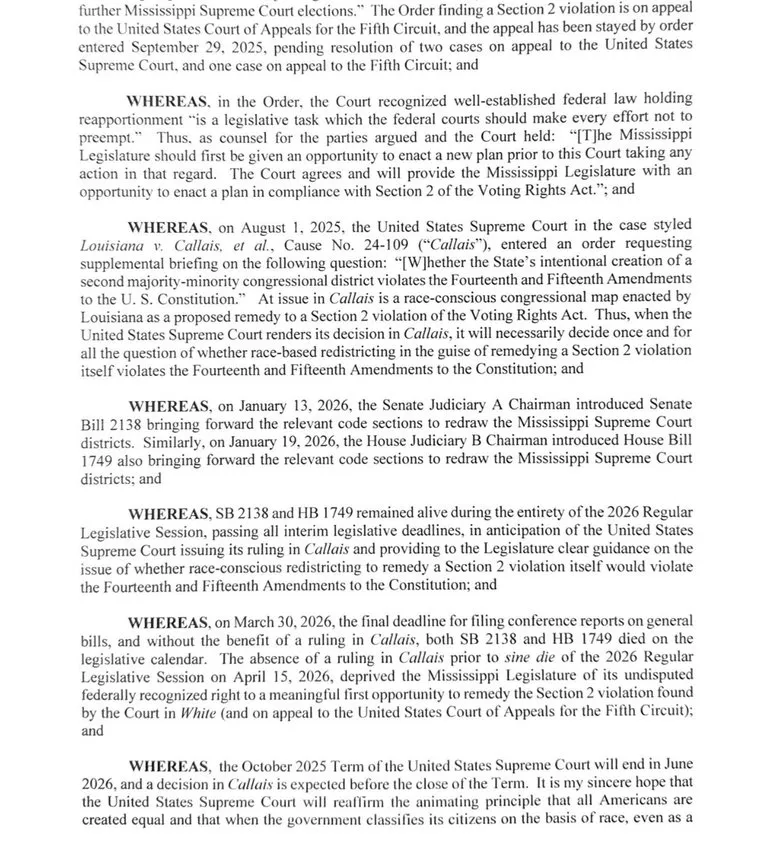
This redraw would be limited to state Supreme Court districts. A federal court found Mississippi’s state Supreme Court districts violated Section 2 of the Voting Rights Act and required the legislature to pass a remedial map. But it failed to do so during the regular session. A court hearing was scheduled for this week, and the court would have likely adopted its own map. So the Governor is calling this special session in hopes the court will hold off until the legislature has time to act.
In the election last November, voters ended the Republican supermajority in the legislature, but Republicans still hold a majority of the seats in both chambers and should be able to pass a map of their own devising. So the governor likely believes a map that comes out of the legislature will be superior to one created by the court.
And finally, the SAVE Act isn’t quite dead yet. We need to stay alert to any resurgence and be prepared to call our members of Congress to demand they resist its resuscitation. Trump is again demanding that his party end the filibuster and pass the Act, saying that not doing so will “lead to the worst results for a political party in the HISTORY of the United States Senate.” It reads as an acknowledgment that only voter suppression can save the Republican Party in the midterm elections.
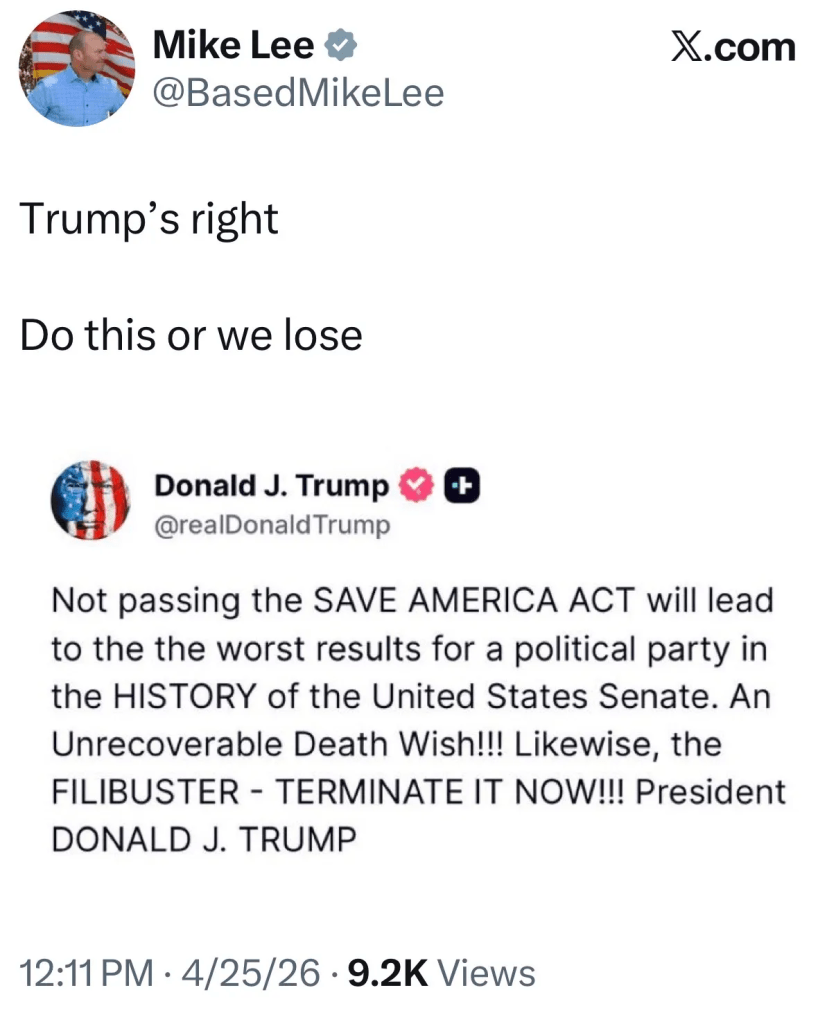
Utah Senator Mike Lee followed up on Trump’s command with this tweet. Lee is not up for reelection until 2028. But he, too, seems to sense that this will be a dangerous election for Republicans. The SAVE Act is one of the last-ditch efforts Republicans have to suppress the vote and hold onto power this year and again in 2028. There is no mention of crafting policies designed to win the hearts and minds of American voters. It’s just about keeping eligible American citizens from voting. We must do everything we can to resist that.
If you’ve found this useful, it’s exactly the work I do every week—reading the filings, tracking the arguments, and explaining what it means before it becomes obvious. The headlines will keep coming, but understanding them takes more than a glance. That’s what this space is for. My goal is to give you clear, careful analysis you can rely on. If that’s the kind of work you value, I hope you’ll choose to subscribe.
We’re in this together,
Joyce
Let’s talk about the new Trump-GOP DC gerrymander plan….
On bad apologetics about homosexuality & the Bible
This is a very well researched and scholarly man. He knows far more than the dogma of the bible he knows how to read the Hebrew and the nuances of the time. Hugs
Today Is Arbor Day, 2026!
I was just telling Jill over on Filosofa’s that I’d totally missed that today is Arbor Day. I’m so sorry and a bit ashamed; DH was a tree planter, and we always did some sort of observation. This year it almost slipped by! Anyway, we can start with a couple of quotes; here are two of my favorites:
Trees are as close to immortality as the rest of us ever come.”
― Karen Joy Fowler
“You know me, I think there ought to be a big old tree right there. And let’s give him a friend. Everybody needs a friend.”
― Bob Ross
https://onetreeplanted.org/blogs/stories/inspirational-quotes-about-trees
Here at the Redford manse, we have two fine green ash trees, not young but not at all old. The Arbor Day Foundation sends (or used to) send little saplings out to elementary schools, and we took one two years in a row, then contributed the rest to the city. Anyway, those are some really nice trees! Here’s some info from the Foundation. In case Arbor Day about slipped past you, too, there could be a reason; some states observe on other days. On the page linked below, you can see that, along with when and how the rest of the world observes. Surf around the site, too; there are many resources to help us make good history with trees!
Arbor Day Dates Across America
National Arbor Day is always celebrated on the last Friday in April, but many states observe Arbor Day on different dates throughout the year based on best tree planting times in their area. (snip-see the chart on the page)
From The Farmers Almanac (a good source for so very much in life!)
Home » Holidays & Events » Minor Holidays Arbor Day 2026: What and When is Arbor Day?
Arbor Day 2026: What and When is Arbor Day?

What Is Arbor Day?
Arbor Day is a national holiday that recognizes the importance of trees. The most common way people celebrate Arbor Day is to get together in groups to plant trees. (snip)
How Did Arbor Day Start?
The day was the brainchild of Julius Sterling Morton, a Nebraskan journalist who later became the U.S. Agriculture Secretary under President Grover Cleveland. Morton was an enthusiastic promoter of tree planting, had long championed the idea of a day dedicated to planting trees.
When Was The First Arbor Day?
Arbor Day was first celebrated in Nebraska on April 10, 1874, following a proclamation by Gov. Robert W. Furnas. In less than a decade, the idea for the holiday caught on in other sates until, by 1882, its observance had become a national event. Nebraska made Arbor Day a legal holiday in 1885, moving it to April 22, Morton’s birthday. An estimated one million trees were planted during the first Arbor Day.
Many other countries around the world set aside one day each year to celebrate trees, though not all of them take place on the same day as Arbor Day. One of the oldest is Tu Bishvat, a minor Jewish holiday that usually falls in late January or early February. In ancient times, the people of Israel used this day to plant trees and celebrate their gifts by eating dried fruit and nuts, including figs, dates, raisins, carob, and almonds. (snip)
There is much more information on all of these pages. But most importantly, try to get out and hug a tree, and maybe facilitate the planting of another tree! Or draw a tree, or dream of trees…
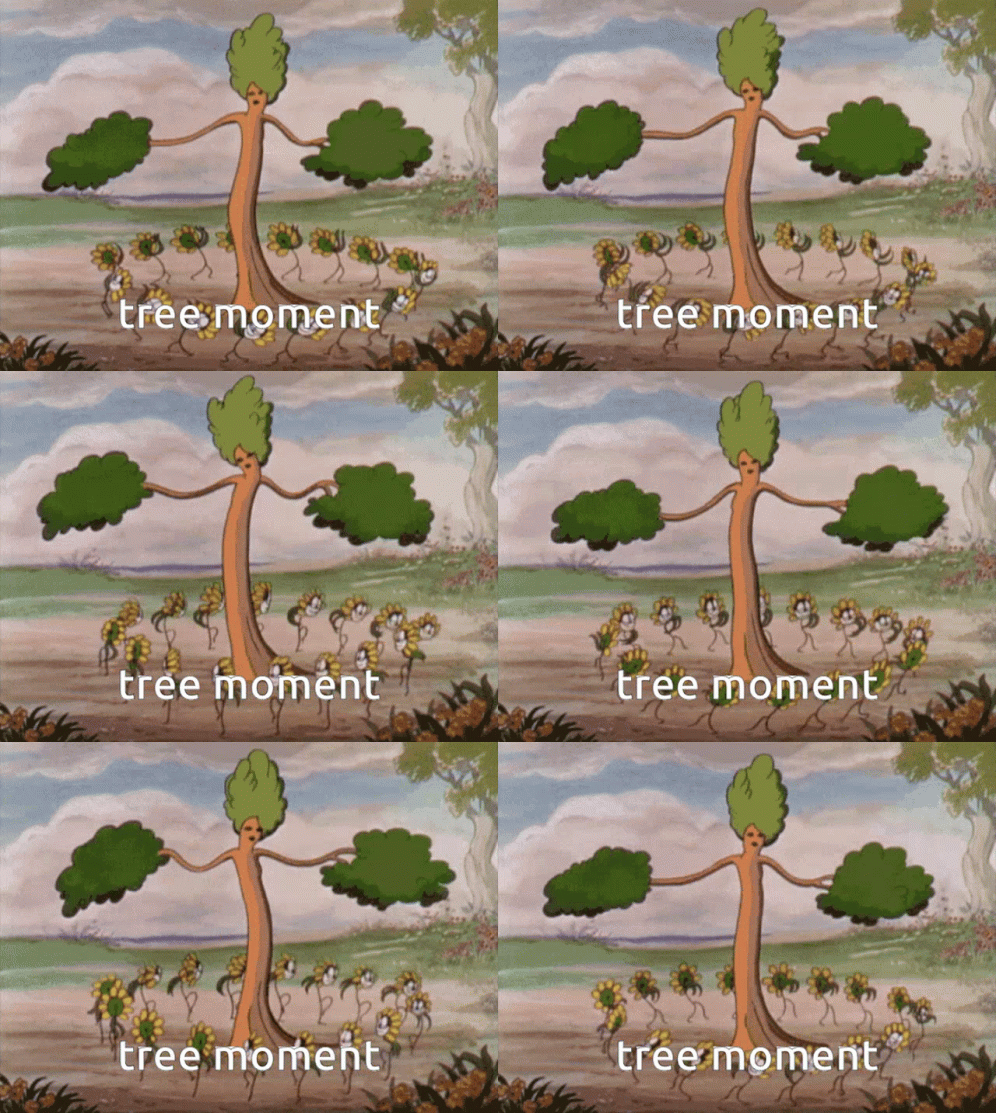
I hope this is a fine day for all who read here!
A Couple Of Current Events Short Videos
(I know; sneaking in another funny one, but it’s also political.)

