Definite beverage alert, though it may be choking rather than laughing.
We all knew it was inevitable: the MAGA conspiracy set is knee-deep in transvestigating Charlie Kirk and his widow, Erika Kirk.
For the blissfully offline (oh, how we envy you), “transvestigation” is a transphobic conspiracy theory advanced over the past eight years, adherents to which believe countless celebrities, politicians, and other public figures are secretly transgender. The conspiracy usually involves armchair phrenology, as believers overlay diagrams of skeletons and skulls over photographs to highlight alleged “discrepancies,” and pseudoscientific analyses of body language and posture. It’s abject nonsense that conveniently ties in with QAnon, “Pizzagate,” and other right-wing conspiracies — and nobody, not even far-right figureheads themselves, are safe from suspicion.
Transvestigators on social media started training their eyes on Erika Kirk roughly two months ago in mid-September, shortly after her husband, Turning Point USA cofounder Charlie Kirk, was shot and killed in Utah. (snip)
Comments on the post were somewhat divided, though many took Starbucs’ side. “Of course almost all models, especially agent models and Victoria secret models are mostly [trans women],” one wrote. Another simply called her a “filthy Luciferian.” Others cited a video Erika Kirk filmed over a decade ago, in which she described herself in childhood as a tomboy, as evidence that she was actually assigned male at birth. Some even took the opportunity to posthumously transvestigate Charlie Kirk as well; “that’s why Charlie Kirk seemed so feminine and emasculated because she was a transgender handler. That’s why he was so pretty,” one person wrote. (emphasis mine-A.) (snip-MORE-it’s not long)
Here’s what you need to know about Trump’s trans passport ban. By Quispe López
On November 6, the Supreme Court granted the State Department temporary permission to enforce the Trump administration’s passport ban, giving it authority to bar transgender, nonbinary, and intersex people from obtaining passports with gender markers that reflect their identity.
The decision reversed two previous injunctions ordered by lower courts, filed by the American Civil Liberties Union (ACLU) as a class action lawsuit against the State Department, Orr v. Trump, which temporarily prevented the Trump administration from enforcing its trans passport ban. The ban stems from an anti-trans executive order in which the Trump administration attempted to codify the legal definition of gender as biological sex determined “at conception.”
While the lawsuit was pending, the injunctions temporarily allowed trans, nonbinary, and intersex people to obtain passports, new or renewed, with the gender marker corresponding to their identity. Following the Supreme Court’s decision, which allows the State Department to enact the executive order while Orr v. Trump is debated, people who apply for a new or renewed passport will only be able to receive one with their sex assigned at birth. According to the ACLU, there is no guidance on what intersex people who might not have any documents with an F or M marker from around the time they were born should expect for their passports. (snip-MORE-also, not long)
November 15, 1917 About 20 women peacefully picketing for universal suffrage (right to vote), who had been arrested in front of the White House a few days earlier, were subjected to beatings and torture at Occoquan workhouse in Virginia. The National Women’s Party and other organizations had been picketing the White House and President WoodrowWilson as he traveled around the country ever since the inauguration of his second term. Mary Winsor The incident became known as the “night of terror.” Wilson had led the country into the European war (later called World War I), by characterizing the U.S. mission as “making the world safe for democracy.” The women demonstrating outside in Lafayette Square called attention to the need for complete democracy at home, where half of its citizens lacked complete voting rights. Many women, including Lucy Burns and Alice Paul, had been arrested several times, usually for obstructing the sidewalk, and imprisoned before. When a judge learned of the abuse he freed the women. Public outrage over their treatment increased sympathy for the suffrage movement. . left: Lucy Burns in Occoquan Workhouse, Washington, DC right: Alice Paul, New Jersey, National Chairman, Congressional Union for Woman Suffrage; Member, Ex-Officio, National Executive Committee, Woman’s Party, ca 1915 Amazing resources from the Library of Congress on women’s suffrage (It’s still all there-go see!)
November 15, 1940 75,000 men were called to Armed Forces duty under the first peacetime conscription. Draft inductees leaving Wilmington, Delaware in November, 1941
November 15, 1943 Heinrich Himmler, Adolf Hitler’s head of the SS (Schutzstaffel or protective rank), Gestapo, the Waffen SS and the Death’s Head units that ran the concentration camps, made public an order that “Gypsies”-more properly, the Roma-and those of mixed Roma blood were to be put on “the same level as Jews and placed in concentration camps.” “Gypsy” prisoners arriving at a Concentration Camp Himmler was determined to prosecute Nazi racial policies, which dictated the elimination from Germany and German-controlled territories of all races deemed “inferior,” as well as “asocial” types, such as hardcore criminals. “Gypsies” fell into both categories according to the thinking of Nazi ideologues and had been executed in droves both in Poland and the Soviet Union. The order of November 15 was merely a more comprehensive program, as it included the deportation to the Auschwitz death camp of “Gypsies” already in labor camps. The Gypsies in Germany Gypsies: Forgotten Victims of the Holocaust
November 15, 1957 U.S. Committee for a Sane Nuclear Policy (SANE) was founded. Thirty years later on November 20, SANE merged with the Nuclear Freeze organization (dedicated to freezing all nuclear weapons testing worldwide) at a joint convention in Cleveland to form SANE/FREEZE. Its successor is known as Peace Action, the largest U.S. peace organization. Sane Nuclear Policy poster, 1960 SANE history-Peace Action
November 15, 1969 Following a symbolic three-day “March Against Death,” the second national “moratorium” against the Vietnam War opened with massive and peaceful demonstrations in San Francisco and Washington, D.C. Organized by the New Mobilization Committee to End the War in Vietnam (“New Mobe”), an estimated 500,000 demonstrators participated as part of the largest such gathering to date. It began with a march down Pennsylvania Avenue in front of the White House (while Pres. Nixon watched the Purdue-Ohio State football game on TV) to the Washington Monument, where a mass rally with speeches was held. Pete Seeger, Arlo Guthrie, Peter, Paul and Mary, and four different touring casts of the musical “Hair” entertained the demonstrators. The rally concluded with nearly 40 hours of continuous reading of known U.S. deaths (to that date) in the Vietnam War.
November 15, 1986 A government tribunal in Nicaragua convicted American Eugene Hasenfus, a CIA operative, of delivering arms to Contra rebels and sentenced him to 30 years in prison. He had been arrested when his plane was shot down by Sandanista troops. He was pardoned a month after his conviction (his last name means “rabbit’s foot” in German). Hasenfus under arrest
American Bird Conservancy has changed its page. It seems even easier to use. Here are some bits about this week’s bird.
About
Most woodpecker species in the United States and Canada display a mix of black, white, and red plumage, but don’t tell the Lewis’s Woodpecker. Its unusual mix of colors includes a red face, pink belly, glossy green back, crown, and nape, and silver-gray collar. The bird is simply stunning.
Lewis’s Woodpecker also differs from other members of its family in many of its foraging styles and food choices. In the summer, the bird eats mostly insects, catching them in flight by swooping out from a perch like a flycatcher or by foraging in flight like a swallow. Wide, rounded wings give the bird a buoyant, straight-line flight, more like a jay or crow than a woodpecker. The bird seldom excavates for wood-boring insects; unlike other woodpeckers, this species lacks the strong head and neck muscles needed to drill into hard wood.
In the fall, Lewis’s Woodpeckers switch to eating nuts and fruit, chopping up acorns and other nuts and caching them in bark crevices for later consumption. During the winter, they aggressively guard these storage areas against intruders, including other woodpecker species.
Ornithologist Alexander Wilson described the species in 1811 and named it for Meriwether Lewis, who observed the bird in 1805 during the Lewis and Clark expedition.
Threats
Birds around the world are declining, and many of them, like Lewis’s Woodpecker, are facing urgent, acute threats. Moreover, all birds, from the rarest species to familiar backyard birds, are made more vulnerable by the cumulative impacts of threats like habitat loss and invasive species.
Habitat Loss
Surveys indicate that Lewis’s Woodpecker populations may have declined by about 60 percent since the 1960s, and much of the reduction is likely due to loss or alteration of suitable nesting habitat. Like all other woodpeckers, the Lewis’s Woodpecker requires cavities in snags (standing, dead, or partly dead trees) for nesting. Logging, the suppression of wildfires, and grazing have altered many of the western forests where the species is found. The changes to the landscape often result in large areas dominated by trees that are the same age, leaving few dead or decaying trees available for the birds’ nests.
Pesticides take a heavy toll on birds in a variety of ways. Birds can be harmed by direct poisoning from pesticides, lose insect prey to pesticides sprayed on crops and lawns, or be slowly poisoned by ingesting small mammal prey that have themselves ingested rodenticides. Lewis’s Woodpeckers are likely exposed to pesticides in orchards and other agricultural settings.
Off Trøndelag’s coast, long lines of kelp now do double duty. They grow fast. They also lock away carbon. A new pilot farm near Frøya aims to turn that promise into measurable removal of CO₂ from the air, according to DNV.
The site spans 20 hectares and carries up to 55,000 meters of kelp lines. First seedlings went in last November. The goal is proof of concept, then scale.
How the Pilot Works
The three-year Joint Industry Project, JIP Seaweed Carbon Solutions, brings SINTEF together with DNV, Equinor, Aker BP, Wintershall Dea, and Ocean Rainforest, with a total budget of NOK 50 million, Safety4Sea reports.
Researchers expect an initial harvest of about 150 tons of kelp after 8–10 months at sea. Early estimates suggest that biomass could represent roughly 15 tons of captured CO₂. This is a test bed for methods that can be replicated and expanded, DNV explains.
There’s a second step, as kelp becomes biochar. That process stabilizes carbon for the long term and can improve soils on land, SINTEF’s team told Safety4Sea. The project is designed to test both the removal and the storage.
A Long History, A New Mission
Seaweed isn’t new here. Norwegians have cultivated kelp since the 18th and 19th centuries for fertilizer and feed. Scientists advanced modern methods in the 1930s, laying the groundwork for today’s farms, according to SeaweedFarming.com. Cold, nutrient-rich waters support species like Laminaria and Saccharina. They grow quickly and draw down dissolved carbon and nitrogen.
The country’s aquaculture backbone also helps. Norway already runs one of the world’s most advanced seafood sectors. That expertise now extends to macroalgae.
Policy, Permits, and Ecosystems
Commercial cultivation began receiving specific permits in 2014, and activity has expanded across several coastal counties, according to a study in Aquaculture International. Researchers detailed the risks that accompany scale: genetic interaction with wild kelp, habitat impacts, disease, and space conflicts. Integrated Multi-Trophic Aquaculture, where seaweed grows alongside finfish, can recycle nutrients from farms and reduce eutrophication pressures.
Engineering for Open Water
Getting beyond sheltered bays is crucial. One path is the “Seaweed Carrier,” a sheet-like offshore system that lets kelp move with waves in deeper, more exposed water. It supports mechanical harvesting and industrial output without using land, Business Norway explains. The same approach can enhance water quality by absorbing CO₂ and “lost” nutrients.
The Frøya project is small in tonnage but big in intent. It links Norway’s long kelp lineage with new climate tech: fast-growing macroalgae, verified carbon accounting, and durable storage as biochar. If these methods prove reliable at sea and on shore, Norway will have more than a farm. It will have a blueprint for ocean-based carbon removal that others can copy.
November 14, 1910 Eugene Ely performed the first airplane takeoff from a ship. His Curtiss pusher flew from the deck of the U.S.S. Birmingham in Hampton Roads, Virginia.By January he would execute the first (takeoff and) landing on a warship, the U.S.S. Pennsylvania. Captain Washington I. Chambers of the Navy Department had been interested in the military uses for the seven-year-old invention. Naval flight training started shortly thereafter. More of the whole story.
November 14, 1954 “Ten Million Americans Mobilized for Justice” began a campaign to collect 10 million signatures on a petition urging the Senate not to censure Senator Joseph McCarthy (R-Wisconsin). The motion of censure against Senator McCarthy was for obstructing a Senate committee and for acting inexcusably and reprehensibly toward a U.S. soldier appearing before his own committee. McCarthy had used his Senate Permanent Investigations Subcommittee to publicly denounce thousands as subversive, especially within the federal government, many without any justification. The political views of most were painted as treasonable and conspiratorial, rather than differing political views. The petition effort fell about nine million signatures short. More on Joe McCarthy
November 14, 2000 Florida Secretary of State Katherine Harris, simultaneously co-chair of George W. Bush’s Florida presidential campaign organization and the public official responsible for the conduct of the election itself, certified Governor Bush’s fragile 300-vote lead over Vice President Al Gore in the 2000 presidential election. Katherine Harris Florida Judge Terry Lewis gave Harris the authority to accept or reject a follow-up manual recount from some counties where the count was open to question. Harris rejected the manual recounts.
Leading up to the 2024 presidential election, U.S. Army veteran Sae Joon Park kept in mind a warning from an immigration officer: If Donald Trump were elected, Park would likely be at risk for deportation.
Park was 7 when he came to the U.S. from Seoul, South Korea. He joined the Army at 19 and received a Purple Heart after being shot in Panama. After leaving the military, he lived with PTSD, leading to addiction issues.
After a 2009 arrest on a drug charge, Park was eventually ordered deported. But because he was a veteran, he was granted deferred action, allowing him to remain in the U.S. while he checked in with immigration officials annually.
For 14 years he did just that, while raising children and building a new life in Honolulu. Then in June, when Park went in for his appointment, he learned he had a removal order against him. Instead of facing extended time in detention, he chose to self-deport.
“They allowed me to join, serve the country — front line, taking bullets for this country. That should mean something,” he said.
Instead, “This is how veterans are being treated.”
During his first term in office, Trump enacted immigration policies aimed at a group normally safe from scrutiny: noncitizens who serve in the U.S. military. His administration sought to restrict avenues for immigrant service members to obtain citizenship and make it harder for green card holders to enlist — actions that were unsuccessful.
Now, military experts and veterans say service members are once again targets of the president’s immigration policies.
“President Trump campaigned on a promise of mass deportations, and he didn’t exempt military members, veterans and their families,” said retired Lt. Col. Margaret Stock, a lawyer who helps veterans facing deportation. “It harms military recruiting, military readiness and the national security of our country.”
Both policies barred enforcement actions against active-duty service members, absent aggravating factors. Under the new policy, noncitizen relatives of service members are not addressed.
Some service members, like Park, are choosing to self-deport. In other instances, immigrant family members of soldiers or veterans have been detained — including Narciso Barranco, a father of three U.S. Marines who was detained earlier this year in Santa Ana, California.
“The people being ripped from our communities are hardworking, honest, patriotic people who are raising America’s teachers, nurses and Marines,” Barranco’s son, veteran Alejandro Barranco, testified in July to a U.S. Senate subcommittee. “Deporting them doesn’t just hurt my family. It hurts all of us.”
This image provided by News21 shows Michael Evans, a veteran who has been deported, hugging Diane Vega, a veteran and volunteer, at the Deported Veterans Support House on Saturday, June 28, 2025, in Ciudad Juárez, Mexico. (Sydney Lovan/News21 via AP)
There is no publicly available data on how many veterans are being affected, though ICE is supposed to track service member removals and the Department of Homeland Security is typically required to share that information with Congress.
A 2019 federal report found 250 veterans had been placed in removal proceedings between 2013 and 2018. News21 could find only two DHS reports tracking removals of veterans. One, covering the first half of 2022, said five veterans had been deported; another, for calendar year 2019, said three veterans had been deported.
In June, U.S. Rep. Yassamin Ansari, an Arizona Democrat, and nine members of Congress wrote to federal officials seeking the number of veterans currently facing deportation — noting “some estimates” put the overall number of deported veterans at 10,000.
Her office did not return messages. DHS and ICE also did not respond to questions.
Federal lawmakers have proposed several bills to protect immigrant service members and their relatives. One measure, introduced in May, would give green cards to parents of service members and allow those already deported to apply for a visa.
U.S. Sen. Tammy Duckworth, an Illinois Democrat and Army veteran, has sponsored some of that legislation. She told News21: “This is about the men and women who wore the uniform of our great nation, many of whom were promised a chance at citizenship by our government in exchange for their service. It’s about doing the right thing.”
As of February 2024, more than 40,000 foreign nationals were serving in active and reserve components of the Armed Forces, according to the Congressional Research Service. Another 115,000 were veterans living in the U.S.
Serving in the military has long been a pathway to citizenship, with provisions providing expedited naturalization dating back to the Civil War.
During designated periods of hostility, noncitizens who serve honorably for even one day are eligible to apply for naturalization if they meet all criteria. The U.S. has been in a period of hostility since 2001.
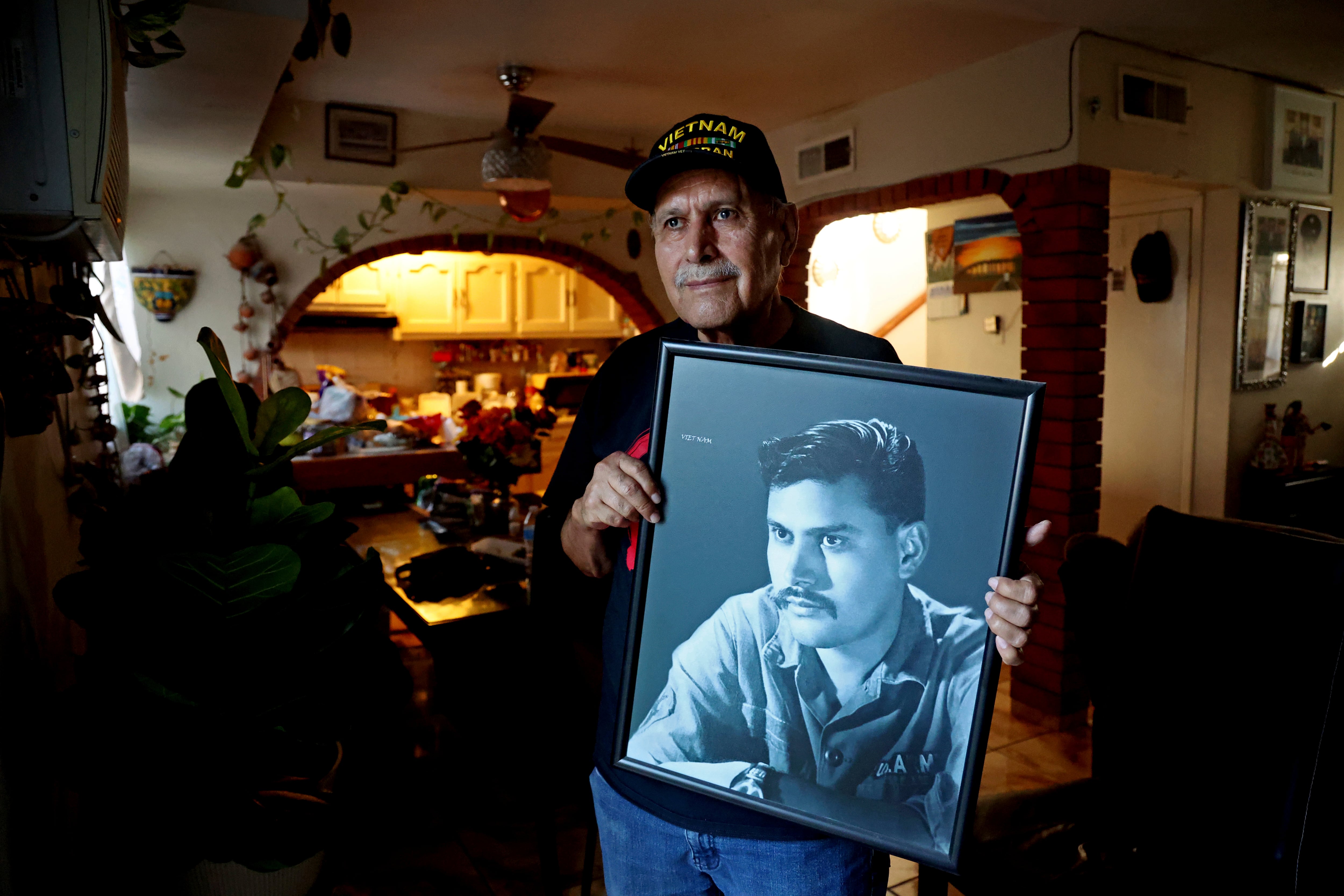
This image provided by News21 shows Army veteran Jose Francisco Lopez holding a portrait from his time in service on June 28, 2025, at the Deported Veterans Support House in Ciudad Juárez, Mexico. (Sydney Lovan/News21 via AP)
Despite that longstanding policy, the Department of Defense, during Trump’s first term, required service members to complete six months before obtaining military documents required to apply for citizenship.
The American Civil Liberties Union sued, and in 2020, a federal judge struck down the change. The Biden administration wound up rescinding the six-month policy.
Nevertheless, ACLU attorney Scarlet Kim said: “If you don’t get your citizenship while you’re serving and then you’re discharged … you can potentially become vulnerable to deportation.”
That’s the situation facing Army veteran Marlon Parris.
Parris, born in Trinidad, has been in the U.S. with a green card since the 1990s. He served in the Army for six years and received the Army Commendation Medal three times, according to court records.
Before his discharge in 2007, he was diagnosed with PTSD — which was cited when Parris pleaded guilty in 2011 to conspiracy to distribute cocaine and sentenced to federal prison.
Upon his release in 2016, the government assured him he would not be deported, according to the group Black Deported Veterans of America. But on Jan. 22, agents detained Parris near his home in Laveen, Arizona. In May, a judge ruled he was eligible for deportation.
His wife, Tanisha Hartwell-Parris, told News21 the couple plan to self-deport and bring along some of the seven children, ranging in age from 8 to 26, who are part of their blended family.
“I’m not going to put my husband in a situation to where he’s going to be a constant target, especially in the country that he fought for,” she said.
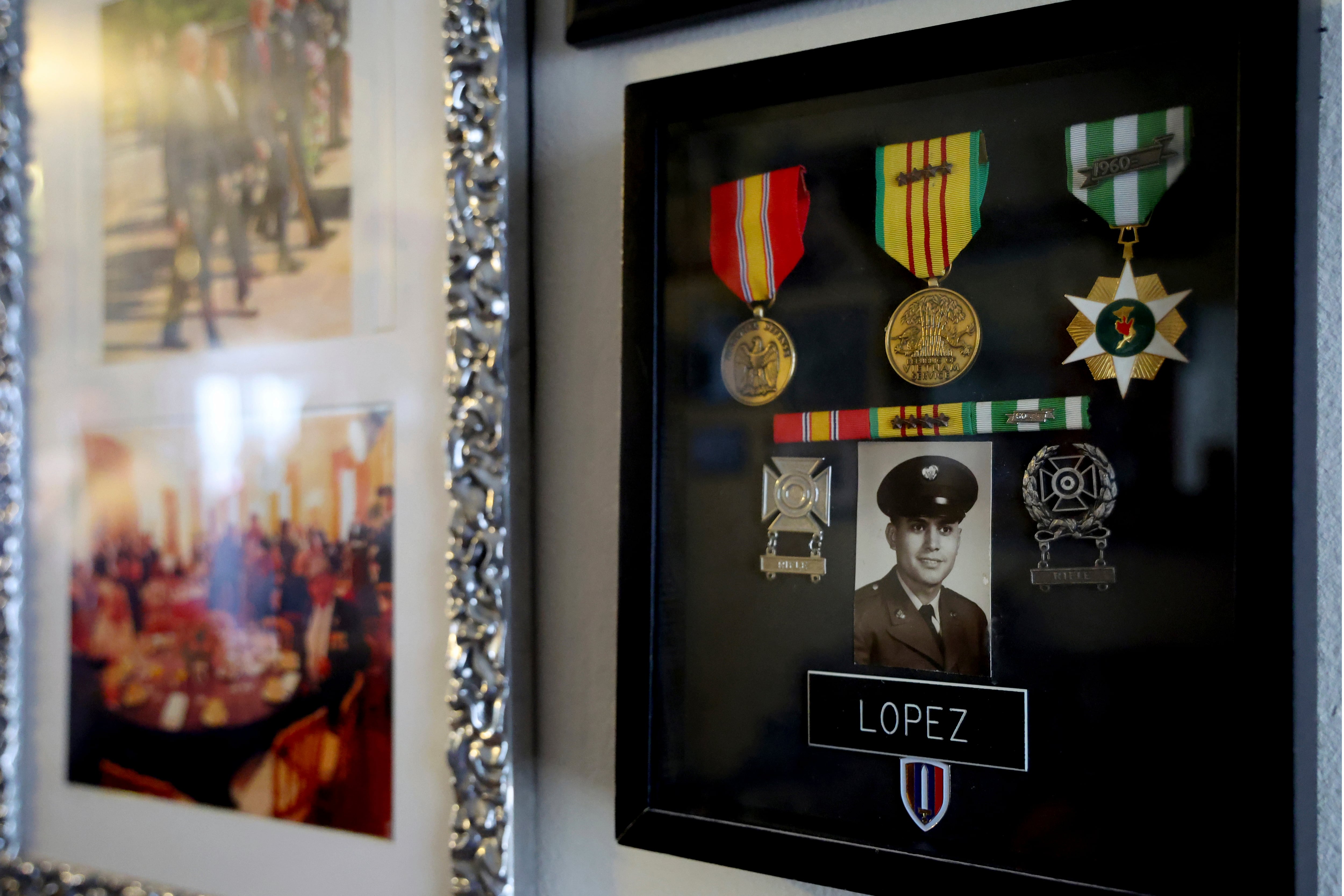
This image provided by News21 shows memorabilia from Jose Francisco Lopez’s service during the Vietnam War displayed inside the Deported Veterans Support House on Saturday, June 28, 2025, in Ciudad Juárez, Mexico. (Sydney Lovan/News21 via AP)
A report published last year by the Veterans Law Practicum at the University of California, Berkeley, School of Law noted that more than 20% of veterans with PTSD also have a substance use disorder, and that can result in more exposure to the criminal justice system.
That situation is “the most common scenario in terms of how deportation is triggered,” said Rose Carmen Goldberg, who oversaw completion of the report and now teaches in the Veterans Legal Services Clinic at Yale Law School.
The report stressed that even though deportation does not disqualify veterans from benefits earned through service, “Geographic and bureaucratic barriers may … stand in the way.”
In 2021, the Biden administration launched the Immigrant Military Members and Veterans Initiative (IMMVI) to ensure deported veterans could access Veterans Affairs benefits. The program offered parole to those needing to return to the U.S. for legal services or health care.
Jennie Pasquarella, a lawyer with the Seattle Clemency Project, said the biggest flaw of the program is that parole into the U.S. is temporary — a “dead end” if a veteran doesn’t have a legal claim to restore legal residency or to naturalize.
“We had asked the Biden administration to do more to ensure that there was a further path towards restoring people’s lawful status beyond parole,” she said. “Basically, we didn’t succeed.”
In the absence of aid in the U.S., more veterans are turning to help elsewhere.
José Francisco Lopez, a native of Torreón, Mexico, and Vietnam War veteran, experienced PTSD and addiction. He eventually went to prison for a drug-related crime and in 2003 was deported.
“I almost gave my life in Vietnam, and now they just throw me away like garbage,” he said.
For years, Lopez thought he was the only deported veteran in Mexico — until he met Hector Barajas, a deported Army veteran who in 2013 founded the Deported Veterans Support House in Tijuana.
Inspired, Lopez opened his own Support House in Ciudad Juárez.
Lopez, 80, is now a legal resident of the U.S. but splits his time between El Paso and Juárez, providing deported veterans housing, food and advice about how to apply for benefits. Since opening the support house in 2017, he’s helped about 20 people.
Back in Seoul, Park, 56, is adjusting to life in a country he hadn’t visited in 30 years. When he first arrived, he cried every morning for hours.
“It’s a whole new world,” he said. “I’m trying to really relearn everything.”
Park’s attorney started a petition to urge prosecutors to dismiss his criminal convictions, to help cancel his deportation order. More than 10,000 people have signed.
Park said he’s grateful for the support but has little faith he will ever be allowed to return to the U.S. He said: “This is not the country that I volunteered and fought for.”
News21 reporters Tristan E.M. Leach, Sydney Lovan and Gracyn Thatcher contributed to this story. This report is part of “Upheaval Across America,” an examination of immigration enforcement under the second Trump administration produced by Carnegie-Knight News21.
from the end of the shutdown,-and I have huge hope that we the people will continue to stand together to help each other through the days!-we do get the Astronomy Photo of the Day again!
Explanation: Few cosmic vistas can excite the imagination like The Great Nebula in Orion. Visible as a faint, bland celestial smudge to the naked-eye, the nearest large star-forming region sprawls across this sharp colorful telescopic image. Designated M42 in the Messier Catalog, the Orion Nebula’s glowing gas and dust surrounds hot, young stars. About 40 light-years across, M42 is at the edge of an immense interstellar molecular cloud only 1,500 light-years away that lies within the same spiral arm of our Milky Way galaxy as the Sun. Including dusty bluish reflection nebula NGC 1977, also known as the Running Man nebula at left in the frame, the natal nebulae represent only a small fraction of our galactic neighborhood’s wealth of star-forming material. Within the well-studied stellar nursery, astronomers have also identified what appear to be numerous infant solar systems.
Abby Martin joins the program to discuss her new film, Earth’s Greatest Enemy which exposes the U.S. military as the world’s largest polluter. Live-streamed on November 6, 2025.