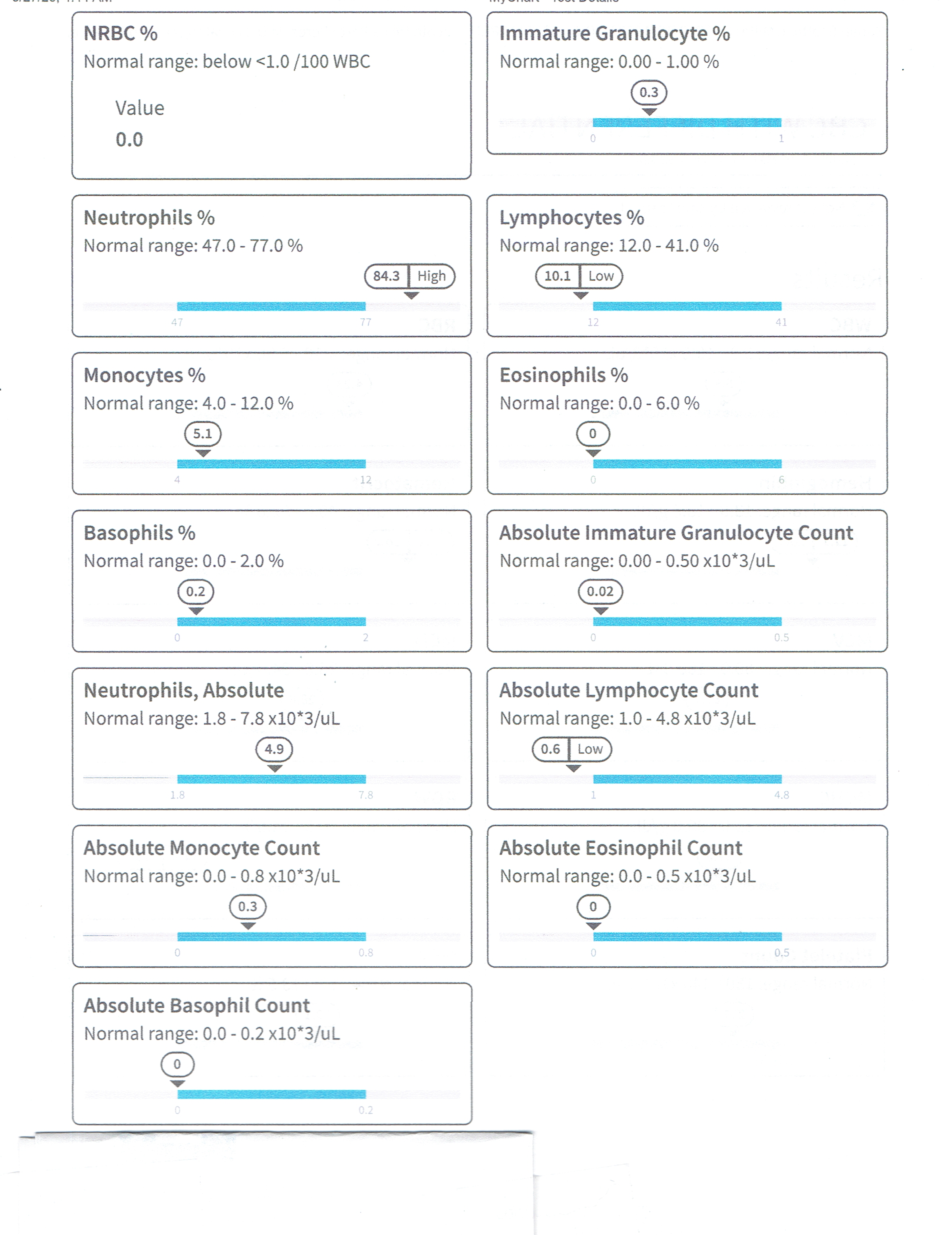
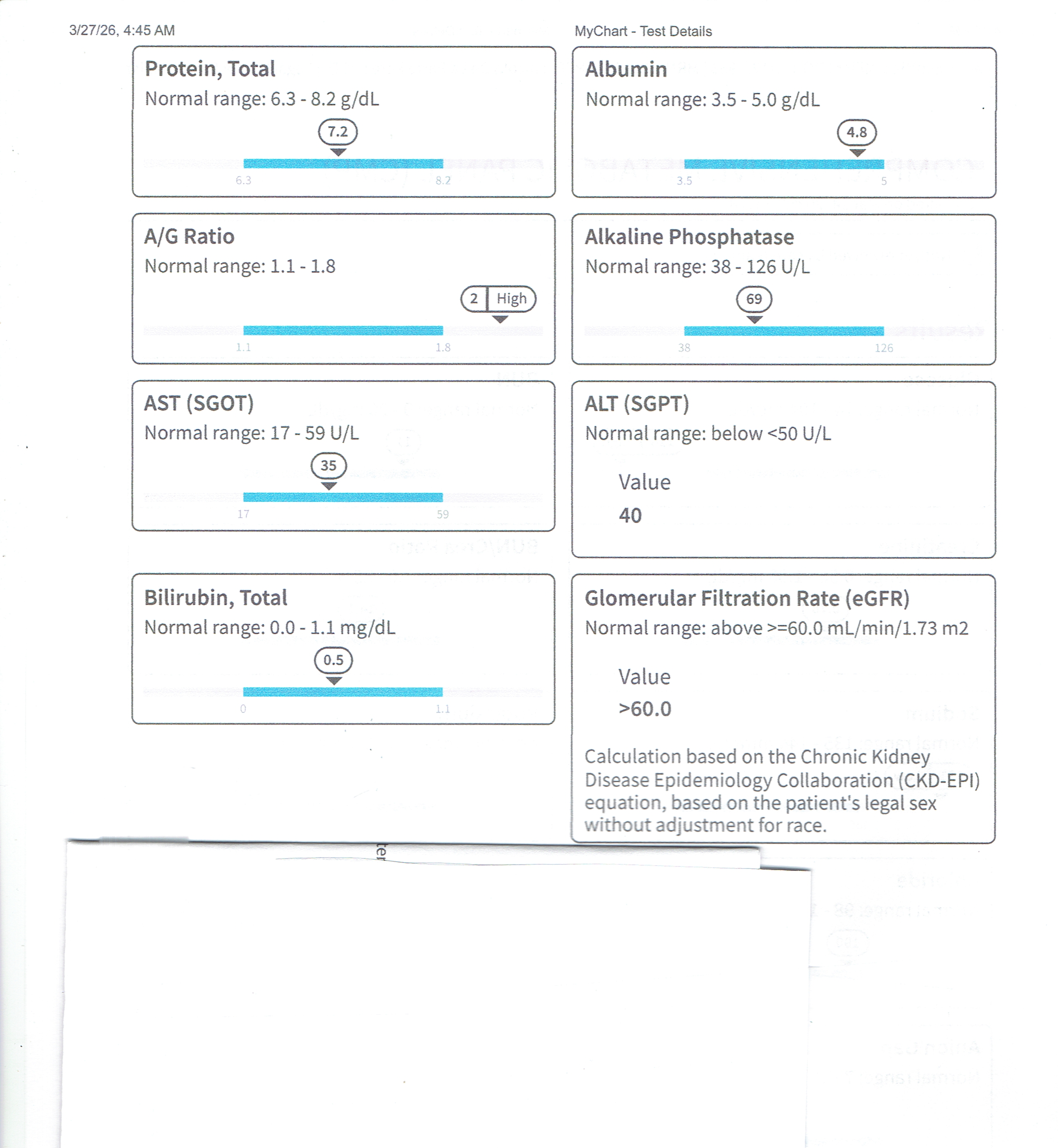
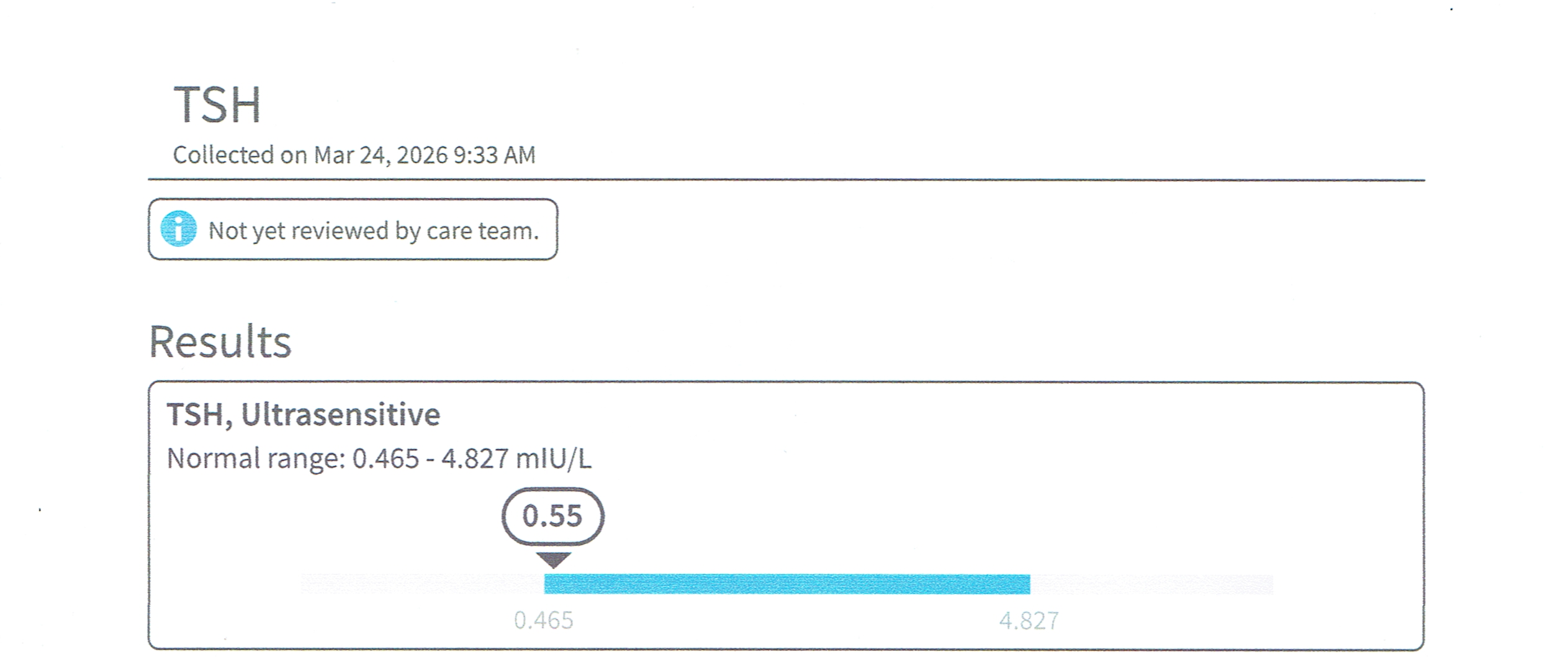
On Monday March 23 I had an epidural in my back. On Tuesday I had to have my blood work done for some upcoming doctor’s appointments. Ron and I went over the results and they don’t look good. They look worse on the computer screen than what came out in print because the print did not have all the colors and marks. But I looked up some of the results. One said it could be an indicator of anemia, which I have had in the past bad enough to put me in the hospital. The other suggestion from looking up the fact that all this dealt with my red and white blood cells was leukemia or kidney disease, and more likely autoimmune issues. I have all the symptoms of lupus, and my immune system has long been compromised. So that is a possiblity. My PSA is elevated and my TSH keeps dipping low. That is my thyroid which means is it going hyperactive. My first endocrinologist said that the thyroid reacts to things happening in the body so it could be dropping due to my other results. Medicare kicked back three tests because of changed codes / incorrct codes / or too early. The tests were PSA, A1C, and lipid panel. The lab wanted over $400 for the tests. I declined to pay for it. Here are the printed labs from the website and then scanned so I could include them. I deleted / covered the sensitive identifying information. Got to go get shots from the allergy clinic, they had to put me back on weekly for 5 weeks. Oh and I am salt wasting. No change it is actually the same from the last test and up from the low of 117. My kidneys don’t get the signal from my brain to stop taking salt out of my blood. At 115 you can start to have seizures. I am one of the few people told to eat as much salt as I can. Hugs
OK so we had the appointment with his new heart doctor. I liked him he smiled a lot and was a genuinely happy man even though it was clear he had a bent spine and so was hunched over. When Ron told him I was his spouse the doctor totally seemed OK. I was wearing my white pride hat as usual. He remembered Ron from the ICUs and asked if I was medical as well. I replied no Ron was the doctor in our family which got a smile and chuckle from him as Ron tried to protest that which made the doctor smile more. He said he would talk to both of us on my level, even if it was basic for Ron because he wanted me included. When I had a question he would answer it and totally include me in all the discussion. Ron has one blockage they think is 80% and and at least two that are 70% and one that is just starting.
The plan is to do a heart catheterization. They will go in through the wrist and prep the groin in case. They feed a sleeve into the wrist then thread a wire all the way to the arteries around the heart. They then open the blockage, put a stent surrounded by a balloon where the blockage was. If a part of the blockage breaks they can introduce medication right then to stop it from doing any damage.
Wow Ron and I had a huge argument. I dislike it and he totally blames it on me. But when the surgical center called to schedule him for the heart catheterization, and instead of taking the first appointment he asked for one three weeks later. I interrupted and said no you want it sooner if possible.
He kept the appointment for nearly a month and a week out. When he got off the phone I asked him to explain that. Wellhe replied I have Diane flying in on 3-28, and we are scheduled to fly out april 2nd. I was angry and argued with him that this same thing killed his sister’s husband and if he asked her she would agree he needs the early appointment. Which was when he fucked around and after we had a huge fight where I told him that his sister could get her friends and her husband’s friends to do what she had wanted Ron to do. She wants help with the moving company and then driving from Texas to here. When he calmed down from our argument he called her and she agreed with me. So then he was so angry that we had another exchange. I was trying to stay calm but he was so upset he was almost out of control, throwing things. I asked him to think of us. If he suffered a heart attack on the road or moving around furniture at her house he could easily die. I couldn’t keep or repair this house. I would not be able to keep Tupac and no one else around us will let him live with them or pay the 75 dollars for his thyroid medication every 6 to 7 weeks. He is incontinent and he leaves poops dropping out of his butt because he was hit by a golf cart and it damaged his spine and nerves. So he would have to be set on the rainbow bridge. I told him I would end up having to rent a room at Randy’s as he has offered it. Ron was furious and said I was thinking only of myself and I replied he was thinking only of his sister.
But by then it was too late to get in touch with the scheduling department. The heart place is huge and they have their own surgical center there. They only do six procedures on an operating day. So he hopes they will call him today. I worry that he will not be able to get a quicker date so I don’t know what will happen. Hugs
Plus, AI is a subject of current event interest. (Lookin’ at autocorrect programs…)Meanwhile, I got a great deal of nerdy pleasure reading this, and I hope all who read, do as well!
A new exhibition at Yale Library explores the history of typos across five centuries. Visitors will see corrections that were listed inside copies of works by James Joyce, Upton Sinclair and Nicolaus Copernicus
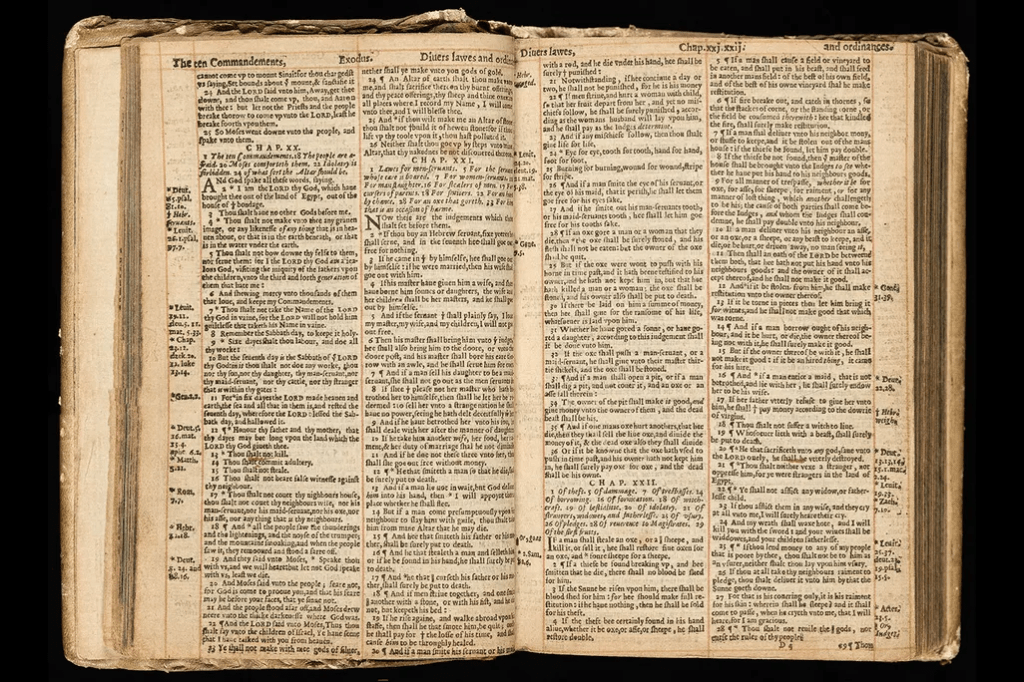
A 1631 copy of the Bible that includes the text “Thou shalt commit adultery.” Beinecke Rare Book and Manuscript Library
James Joyce wrote the manuscript of Ulysses with a steel pen over seven years. By his typists’ accounts, the Irish author’s penmanship was atrocious, and his revisions were overwhelming. When the book was published in 1922, it was full of mistakes. In a letter to his wife, he wrote, “The edition you have is full of printer’s errors.”
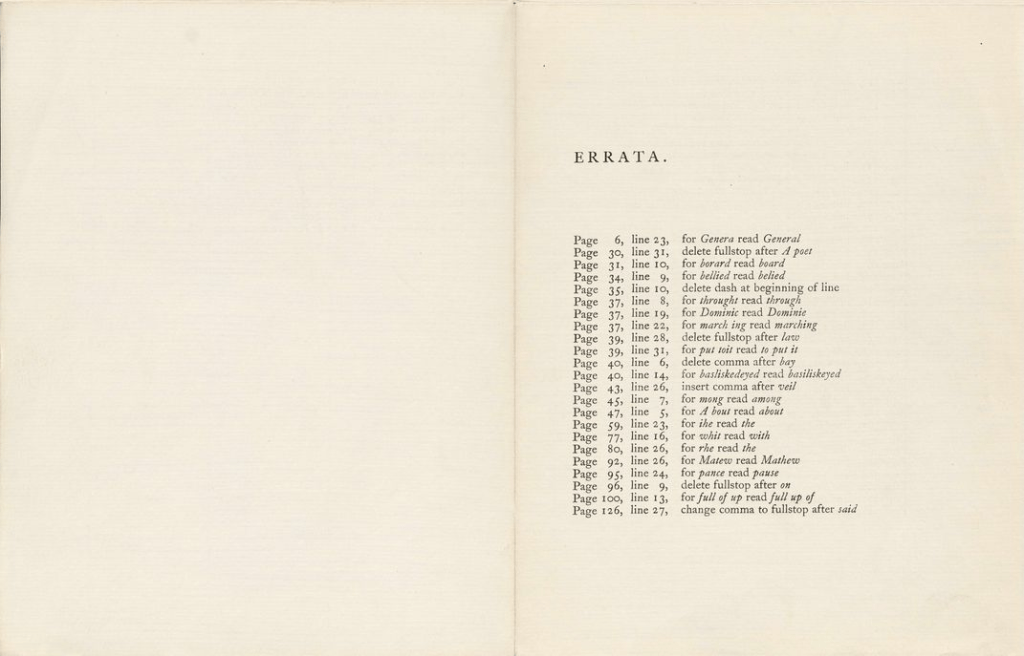
The following year, Joyce’s editors compiled a massive list of the book’s errors to be fixed in new editions. Joyce rejected some of the corrections, saying, “These are not misprints but beauties of my style hitherto undreamt of.” Even so, some future printings of the book came with a seven-page errata sheet listing more than 200 mistakes.
Errors like those in Ulysses are the subject of a new exhibition at Yale. “‘Beauties of My Style’: Errata and the Printed Mistake,” which opens at the university’s Sterling Memorial Library on March 30, examines the history of typos across five centuries.
“What we found was that errata sheets were not only spaces for corrections but also sites of humor, legal maneuvering and reinterpretation,” Rachel Churner, a visual studies scholar at the New School and the exhibition’s co-curator, tells Artnet’s Min Chen. “With this exhibition, we wanted to share ways in which even small corrections can reshape meaning and authority.”
According to a statement from the library, “errors committed” lists first appeared in the 15th century. Authors slipped these lists—containing typos, additions and apologies—into the backs of books after publication. The exhibition examines errata lists alongside their companion texts, examining themes of “censorship, misrepresentation, intervention and instability,” per the statement.
An errata slip from an early printing of James Joyce’s Ulysses Beinecke Rare Book and Manuscript Library
The exhibition spotlights around 30 artifacts from the collection of Yale’s Beinecke Rare Book and Manuscript Library. Items on display include “inaccurate maps, book corrections and religious texts with very grave typographic blunders,” reports Artnet.
In addition to the errata slip from Ulysses, visitors can see several other 20th-century examples, including a self-published copy of Upton Sinclair’s 100 Percent: The Story of a Patriot, in which he “mistakenly identified a founding member of the Communist Party of America as a government agent,” per Fine Books & Collections. Also on view is a fold-out errata from Allen Ginsberg’s 1968 Airplane Dreams. According to the statement, he included the error sheet as a “legal strategy for political resistance.”
Churner and her co-curator Geoff Kaplan, a graphic designer at the Yale School of Art, co-founded the publishing company No Place Press. As they researched errata at the Beinecke, they found “unexpected poetry,” Churner tells Artnet.
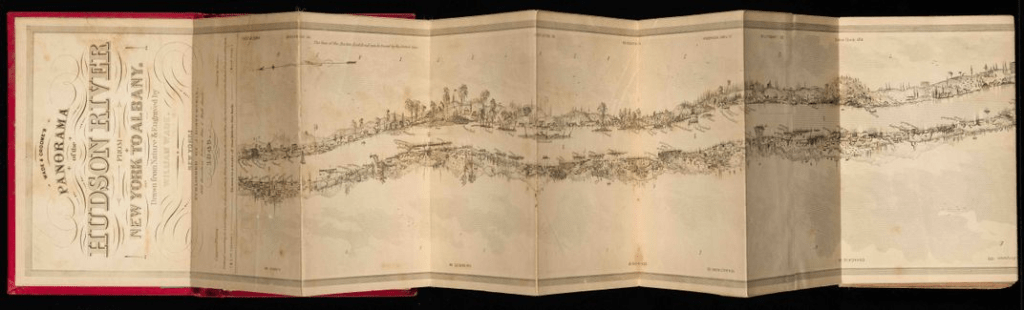
Wade & Croome’s Panorama of the Hudson River From New York to Albany, published in 1846, listed Fishkill Village’s population as 11,000 instead of 800. Beinecke Rare Book and Manuscript Library
The exhibition features an infamous 1631 edition of the Bible, which lists “Thou shalt commit adultery” as the Seventh Commandment. (The omission of the word “not” earned this edition the nickname “the Wicked Bible.”) By the time the mistake was discovered, 1,000 copies had been printed. The British king Charles I reprimanded the publishers, fined them £300 and stripped them of their printing license. In the centuries that followed, rumors circulated speculating that a rival printer had introduced the error. But as Chris Jones, a medieval studies scholar at the University of Canterbury in New Zealand, told the Guardian’s Eva Corlett in 2022, the more likely explanation is that the printers hadn’t wanted to spend money on copy editors.
Nearly all the Wicked Bibles were destroyed, and only about 20 known copies survive. In the copy on view at the Beinecke, someone fixed the error by hand, adding “not” to “Thou shalt commit adultery.”
In some cases, corrections have been used to influence public perception. During the Reformation in the 16th century, books were released describing “mistranslations” of Protestant and Catholic Bibles, “mobilizing the errata well beyond a list of typographic corrections,” Churner tells Artnet.
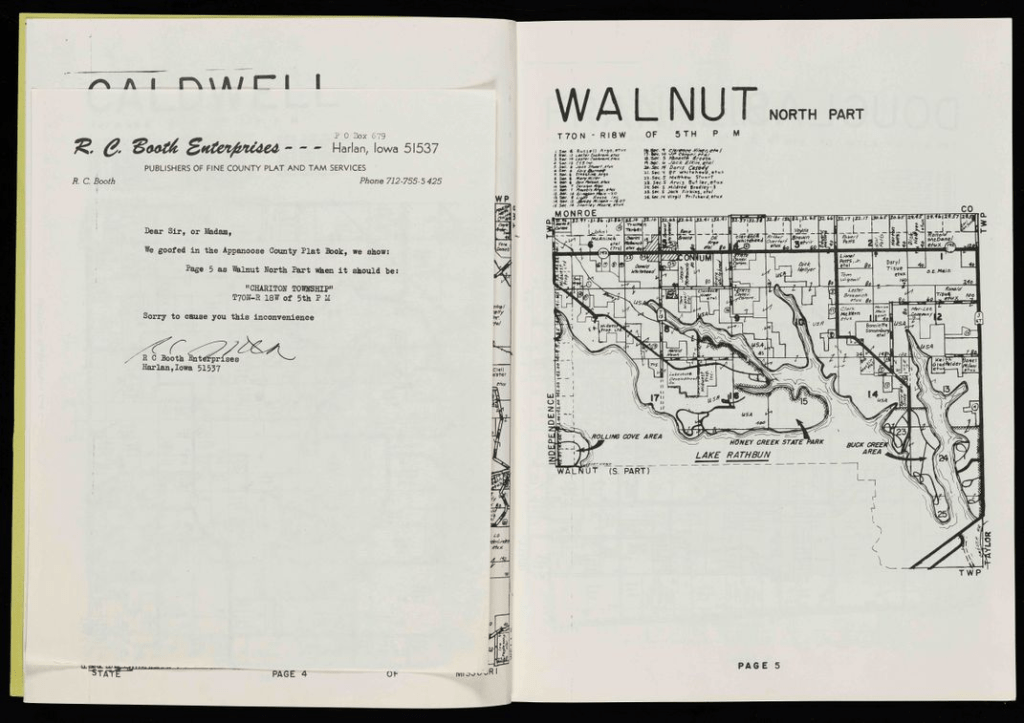
Plat Maps of Appanoose County, Iowa, 1986 Beinecke Rare Book and Manuscript Library
Many other errors, however, are simple mistakes. For example, the exhibition features a 1986 book of Iowa maps with a note correcting a mislabeled township. “Dear Sir, or Madam,” it reads, “We goofed in the Appanoose County Plat Book.”
Hello all. Ron has been having some issues with memory, thinking, and staying awake. Last year his doctor sent him to a neuro doctor to see if he had dementia or alzhimors. The tests showed no real issues. Ron has been gone for about three months and when he got home a few weeks ago I noticed a huge change in him. He was struggling with remembering anything, he had no energy, and he was falling asleep in the middle of conversations.
So last week he saw his primary care doctor who is a really good doctor who cares. He sent Ron for a heart and artery CT scan. On Monday he saw the doctor for the scan and on tuesday he had the CT scan. Thursday evening Ron’s doctor called my phone. He knew me as I was once his patient and from my working in the ICU. He was trying to contact Ron and apologized for calling me but Ron was not answering his phone and he really needed to talk to him.
Ron has 4 major blockages in and around his heart. One is the left descending artery and is called the widow maker. The others are the arteries that feed the heart. He is at serious risk of a heart attack and death of at least parts of the heart muscle. As it is a serious blockage / narrowing / hardening of the arteries he is not to exert himself or get upset in any way. It took several days to get the medication he needs to help keep the arteries open. Ron read a bunch of stuff on it but failed to send it to me and is talking to his sister so I can’t ask him. When I know more I will share it with you. As I will need to go with him and drive him to appointments posting will be sporadic at best. Hugs
for a fine Spring this year. As I type, the Equinox will occur in 54 minutes. This is a striking photo!
Astronomy Picture of the Day
Discover the cosmos! Each day a different image or photograph of our fascinating universe is featured, along with a brief explanation written by a professional astronomer.
Explanation: The defining astronomical moment of the equinox today is at 14:46 UTC (March 20). That’s when the Sun crosses the celestial equator moving north in its yearly journey through planet Earth’s sky, marking the beginning of spring for our fair planet in the northern hemisphere and fall in the southern hemisphere. Then, day and night are nearly equal around the globe. In fact, both day and nighttime exposures from a spring equinox at the Observatorio del Teide in Tenerife, Canary Islands, Spain, are used in this composited skyscape. Over 1,000 images were taken with a fisheye lens and merged in the ambitious equinox project. The apparent motion of the Sun setting along the celestial equator on the equinox date follows the bright linear, diagonal track from the sequence of daytime exposures taken over 6 hours. After sunset, nighttime exposures recorded startrails, with the celestial equator as a linear track and concentric arcs circling the north celestial pole near Polaris at upper right and the south celestial pole beyond the lower left edge (and below the Teide horizon). The foreground includes the distant Teide volcano peak and the observatory’s pyramid-shaped solar laboratory building.
This is the answer to yesterday’s Free The Ocean Trivia. I got it correct, but it was a guess because the other ones didn’t really seem correct. Anyway, it’s good eco news for Tuesday, taken from nature!
In the shallows of Papua New Guinea’s Kimbe Bay, scientists have documented a surprising adaptation among one of the ocean’s most recognizable fish. During a 2023 marine heatwave, orange clownfish—familiar to many as the inspiration behind *Finding Nemo*—began shrinking. Not just slimming down, but actually shortening their bodies to weather the rising temperatures of their coral reef home, as reported by AP News.
This previously undocumented response was observed across dozens of breeding pairs tracked over several months. The findings, now published in *Science Advances*, offer rare insight into how marine species are physically changing to survive extreme climate conditions.
Clownfish are shrinking their bodies during marine heatwaves.
The Heatwave That Triggered a Transformation
Between February and August 2023, researchers repeatedly measured 134 clownfish as ocean temperatures soared to levels resembling a “hot bath,” according to Newcastle University doctoral researcher Melissa Versteeg, whose team led the study alongside local organizations Mahonia Na Dari and Walindi Resort. The scientists discovered that nearly three-quarters of the adult fish shrank at least once during the period, decreasing in total length by several millimeters. These changes happened in mere weeks—not over a lifetime, as previously assumed in similar cases, according to Vox.
Unlike earlier studies that linked climate to stunted growth in birds and mammals over generations, this was physical shrinkage in mature individuals. The observation challenges assumptions about static adult body sizes and opens new possibilities for understanding animal adaptability.
This size reduction is a physical adaptation, not just weight loss.
A Strategy Rooted in Survival and Social Balance
The shrinking wasn’t random. It was synchronized, particularly within breeding pairs. Versteeg’s team found that pairs where both fish shrank together had better odds of surviving the heatwave. The behavior, documented in the wild for the first time in reef fish, helps sustain clownfish social structure, Sustainability Times reports.
Clownfish live in tight-knit social hierarchies, often with one dominant breeding pair and several subordinate members. Size plays a critical role in that hierarchy. When heat stress reduced food availability or oxygen levels, shrinking may have reduced the energy and oxygen needs of the fish. Coordinated downsizing likely helped avoid social conflict and maintain reproductive bonds.
Speaking to the The Washington Post, Newcastle marine ecologist Dr. Theresa Rueger emphasized how this size shift offered advantages: smaller fish may manage heat stress better and require fewer resources—both of which are scarce in warming seas.
The phenomenon was discovered during a 2023 heatwave in Papua New Guinea.
Beyond Clownfish: A Broader Pattern in a Warming Ocean
Clownfish aren’t alone. Scientists have linked higher global temperatures to shrinking trends in a range of species, from birds to mammals. A 2019 study showed that North American birds shrank by an average of 2.6% over several decades. But the clownfish response is distinct because it occurs rapidly, during the adult life stage, and in direct response to a single environmental event.
Thermal stress may trigger these changes by limiting the availability of oxygen and nutrients. Smaller bodies have less demand and are more efficient under strained conditions. There’s even speculation that clownfish, like marine iguanas, may be reabsorbing bone or fat tissue to reduce size, though more study is needed to confirm this hypothesis, BBC News reports.
Scientists measured 134 clownfish monthly and saw widespread shrinkage.
The Limits of Adaptation
Despite this remarkable display of flexibility, adaptation has its limits. The heatwave that prompted this discovery was the first of three consecutive ones in the region. Many of the clownfish studied didn’t survive them all. Coral bleaching—another side effect of heat stress—is stripping clownfish of their sea anemone homes. These vibrant, venomous hosts are essential for clownfish survival, offering shelter and protection. Without them, even the most adaptive clownfish may struggle to persist.
Moreover, this shrinking behavior is not a cure-all. As pointed out by University of Massachusetts fish biologist Joshua Lonthair in The Washington Post, if shrinking turns out to be a widespread response to environmental pressures, it may fundamentally alter how scientists understand growth and maturity in marine life.
Looking Ahead
The clownfish shrinking phenomenon marks a breakthrough in how marine biologists interpret resilience. It’s a glimpse into the extraordinary ways wildlife tries to keep pace with a planet in flux. While researchers continue to explore the exact mechanisms behind this body-size shift, one thing is clear: even iconic species like the clownfish are being reshaped by climate change—literally.
Understanding these changes is crucial, not just for preserving individual species, but for forecasting the health of entire marine ecosystems. In a world growing hotter by the year, adaptation may be the difference between survival and extinction.
Discover the cosmos! Each day a different image or photograph of our fascinating universe is featured, along with a brief explanation written by a professional astronomer.
2026 March 14
A Year for K2-315b Artist’s Illustration Credit: NASA Ames/JPL-Caltech/T. Pyle, Christine Daniloff, MIT
Explanation: Want to visit a planet that has 3.14 days in a year? Then plan a trip to K2-315b, an earth-sized planet orbiting around a cool, red, M dwarf star about once every 3.14 days. The exoplanet’s discovery, based on publicly available data from the planet-hunting Kepler Space Telescope’s extended K2 mission, was announced in 2020. K2-315b’s measured orbital period in days is nearly equal to the extremely popular irrational number Pi. That puts the exoplanet so close to its parent star that its surface is likely very warm, baking-hot in fact. And this Pi planet is over 185 light-years away. So instead of trying to arrange for an interstellar vacation to K2-315b, there may be easier and more comfortable ways for you to celebrate Pi day on planet Earth.
The Speckled Tanager is a preternaturally beautiful bird, even among the other stunning Central and South American tanagers of the family Thraupidae. The black speckles that give this species its name come from black feathers with brightly colored edges, giving the impression of scales over the bird’s body. The edges blend together to create a palette of iridescent yellow-green and green-blue over the body of the bird.
Striking as these patterns and hues may be, they actually provide good camouflage for this bird up in the green, backlit forest canopies where it spends most of its time. The tanager’s speckles, like the spots on a jaguar or the camo pattern on a hunter’s jacket, are a form of disruptive patterning, a camouflage strategy that breaks up or obscures an animal’s outline, allowing it to blend with its background. Up among the bright green leaves, these birds can easily go unseen. Up close, however, their plumage is hard to ignore.
Threats
Birds around the world are declining, and many of them face urgent threats. The Speckled Tanager lives primarily in old-growth forest, and healthy populations depend on the persistence of forests throughout their range in Central and South America. Though not considered a species of conservation concern, this bird is declining, and deforestation is one likely cause. (snip-MORE)
I emailed this to me on Sunday, but have only just gotten back to it to post here. My apologies on that, but it’s been both busy and stormy here! Anyway, I haven’t heard anything about the status of this; I hadn’t heard anything about it at all until I read it in Kansas Reflector. With no further ado:
LAWRENCE — Kansans won’t know until at least Tuesday if a judge will delay implementation of the state’s new “bathroom law,” but a concession by Attorney General Kris Kobach means key components of the law can be delayed until March 26.
Douglas County District Judge James McCabria heard arguments Friday about Senate Bill 244, the controversial new law that forces people to use bathrooms in government buildings and gender markers on driver’s licenses based on sex assigned at birth.
The three-hour hearing focused on technicalities, including whether the law meets any one of five specific criteria that would lead the judge to approve a temporary restraining order and pause enforcement of the law for up to 14 days.
Attorneys with the American Civil Liberties Union and the Kansas Department of Administration said the law’s speedy implementation provided no grace period to Kansans needing a new driver’s license and for government leaders statewide to put a system in place for tracking bathroom usage.
The law took effect Feb. 26, a little over a week after the GOP-led Legislature overrode Gov. Laura Kelly’s veto. Kansans who held driver’s licenses with a gender marker that didn’t match their sex at birth were told their licenses were immediately invalidated and government leaders statewide were told they had to immediately enforce the bathroom portion of the bill.
Kobach told McCabria he agreed to give Kansans who needed to update driver’s licenses until March 26 to complete that. He also said he wouldn’t enforce the law’s penalties — which could be as high as $125,000 per day for violations — for cities, counties, municipalities and schools that might violate the bathroom rules, as well.
Harper Seldin, senior staff attorney for the American Civil Liberties Union, talks to reporters after a Douglas County District Court hearing on March 6, 2026. Seldin asked the judge to place a temporary restraining order on the state to stop implementation of a new law that forces Kansans to use bathrooms and have documentation in their biological sex at birth. (Photo by Sherman Smith/Kansas Reflector)
Harper Seldin, an ACLU attorney representing the two Lawrence transgender men who brought a case against the law under pseudonyms Daniel Doe and Matthew Moe, told the judge the law violates the Kansas Constitution.
SB 244 infringes on the rights of personal autonomy, expectations of privacy, and equal protection under the law, and has other issues, he said.
“The attorney general is incorrect when he says that we’re asking the court to break new ground,” Seldin said. “This is not a novel set of theories that require the government to do anything. The thread through these individual rights claims is that this is about Daniel and Matthew’s right to be left alone by the government.”
Seldin also said the law targets transgender individuals, which can be shown by the results of its implementation even if it’s not stated outright. He said the way SB 244 was implemented violated the Kansas Constitution when the bathroom portion of the bill was “logrolled” into the bill that originally addressed driver’s license and birth certificate gender markers.
Logrolling refers to dropping a bill into an unrelated bill, sidestepping the opportunity for public input. Seldin said cramming two separate subjects into one law violates the Kansas Constitution, which has a “single subject” clause.
Kobach said the two issues are congruent in that they both deal with defining sex within Kansas government.
“It’s this idea that bills should mean what they say and say what they mean,” Seldin said. “There’s a particular perniciousness to a law that hides the law.”
Kobach told the judge that a driver’s license is a government document, used for government purposes, and the state has the right to define the information contained in the document.
McCabria questioned Kobach about briefs included in the plaintiff testimony outlining the negative psychological effects on transgender people being made to use documents that don’t match their gender identity.
“Whatever a person may feel about their need to be perceived by the world in a certain way, what right do I have to compel the government to identify me in that way?” McCabria asked.
Kobach said the driver’s license is a document that records pertinent information, and sex is one of the elements, along with eye color and birthdate, that doesn’t change over time.
Kobach said the bathroom portion of the bill maintains the status quo in Kansas, where he contended residents have always gone to the bathroom that matches their biological sex at birth.
Seldin said trans people in the state have been going to the bathroom without any harms for decades.
Kobach said women who hear a man’s voice or see a man in private spaces could become anxious about their safety.
He acknowledged plaintiff’s assertions about the psychological or emotional harm they may suffer but told McCabria that in a balance of equities, that didn’t outweigh the harms of “99-plus percent of the population.”
When McCabria asked him to substantiate that number, Kobach said he didn’t mean to imply that everyone outside of transgender individuals were harmed by the law.
“Many courts have recognized the fear that ‘biological females’ have when a ‘biological male’ is in the bathroom with them, and that is something that I think any Kansan can identify with, especially a female,” Kobach said after the hearing.
Asked how women would be affected by seeing or hearing a transgender man who now has to use a woman’s bathroom, Kobach said, “All kinds of hypothetical cases are possible.”
McCabria said he had hoped to make a ruling Friday but that he needs more time to study the filings in the case and examine constitutional issues. He said he expects to rule by Tuesday.
“I think most people want to be respectful,” Seldin said after the hearing. “I think most people don’t want to pry into other people’s private lives. I think a law like this suggests the opposite, that Kansans have some prurient interest in other people’s habits and private spaces. And I don’t think that’s right.”
Z Kemp attended the hearing because her partner and many friends are affected. She said the law has caused “a lot of stress and anxiety.”
“That’s just unnecessary because as they’ve stated before, there was — especially with the bathroom situation —- no prior problem,” she said. “It’s only a problem whenever you make it a problem. I don’t think it’s that radical to just let trans people be. Just let them go to the bathroom.”
Avie Fallis said she has been through a lot of physical and legal changes to find herself. She said she is tired of well-meaning people recommending that she leave Kansas, which is her home state where her family and loved ones live.
“I feel like it’s a fire that’s just growing,” she said. “I’m not going to run away from fire. I feel like it should be extinguished.”
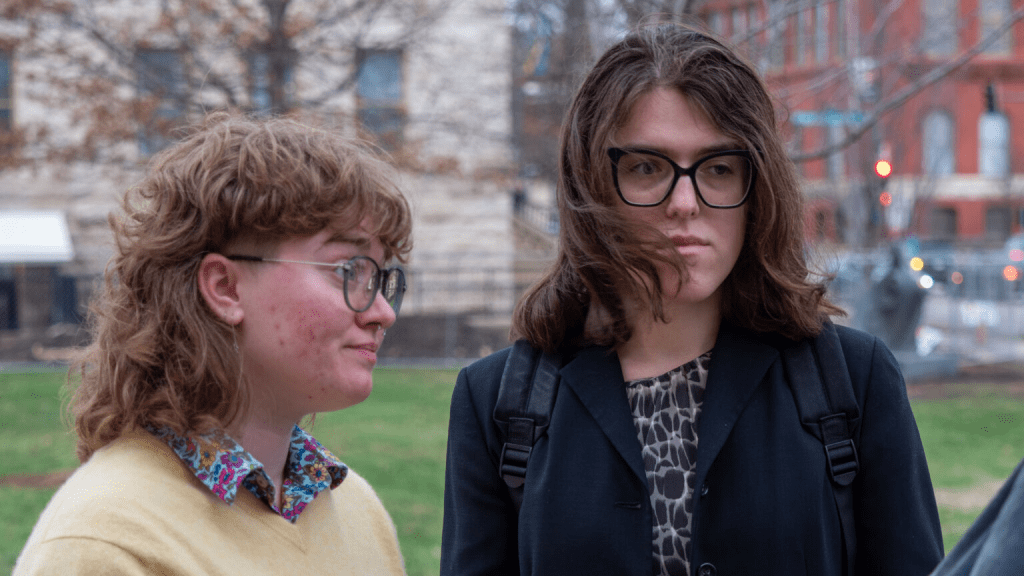
Z Kemp, left, and Avie Fallis attended a Douglas County District Court hearing March 6, 2026, about Kansas’ new law because it affects them and their loved ones. The law forces people to use the bathroom related to their biological sex at birth and to put that sex marker on their driver’s licenses and birth certificates. (Photo by Sherman Smith/Kansas Reflector)






 The phenomenon was discovered during a 2023 heatwave in Papua New Guinea.




 Scottie's Playtime