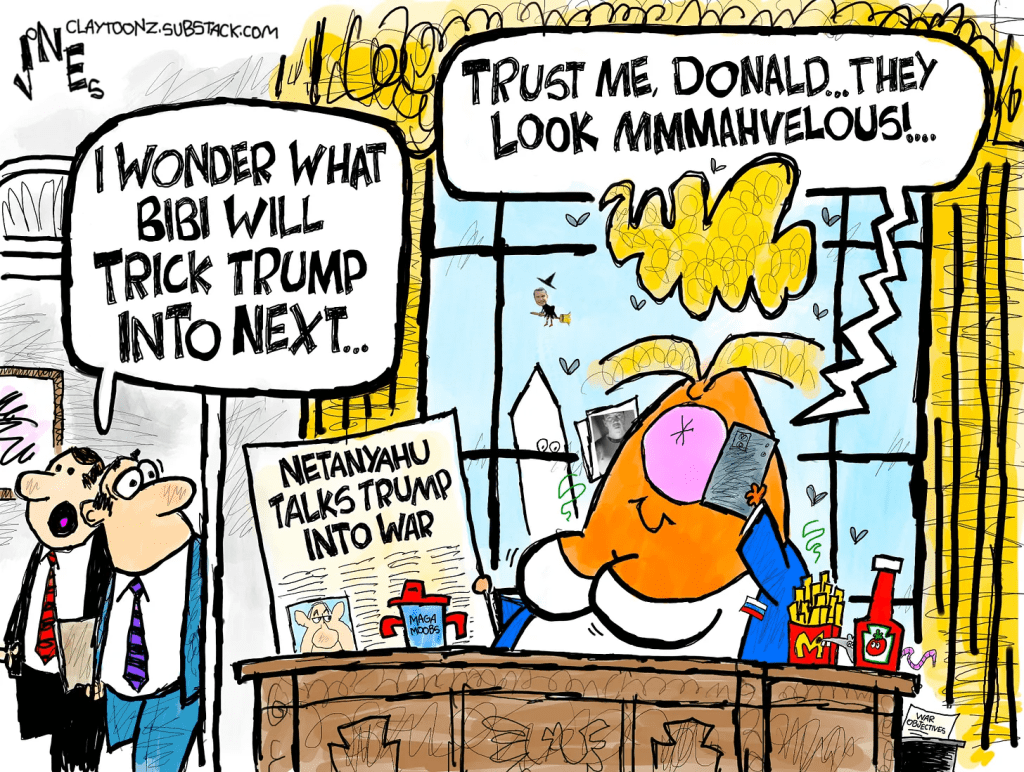
A new report by The New York Times details how Israeli Prime Minister Benjamin Netanyahu persuaded Donald Trump into going to war with Iran. Details in the story show that Donald Trump was oversold on the idea. But Trump wasn’t just oversold; he wanted to be told what he wanted to hear, even if it was wrong.
There was deep skepticism from his inner circle about going to war, and despite polling his top advisers, he often only heard “what he wanted to hear,” and his team wound up serving as an echo chamber for his gut instincts.
According to story written byJonathan Swan and Maggie Haberman, JD Vance was the most vocal in his opposition to the United States going to war with Iran, while CIA Director Jim Ratcliffe, Secretary of State Marco Rubio, and Gen. Dan Caine, Chairman of the Joint Chiefs of Staff, warned Trump that Netanyahu had “oversold” him on what could be achieved by the bombing campaign. Defense Secretary Pete Hegseth, on the other hand, was gung-ho on going to war. (snip-MORE, and it’s hot)
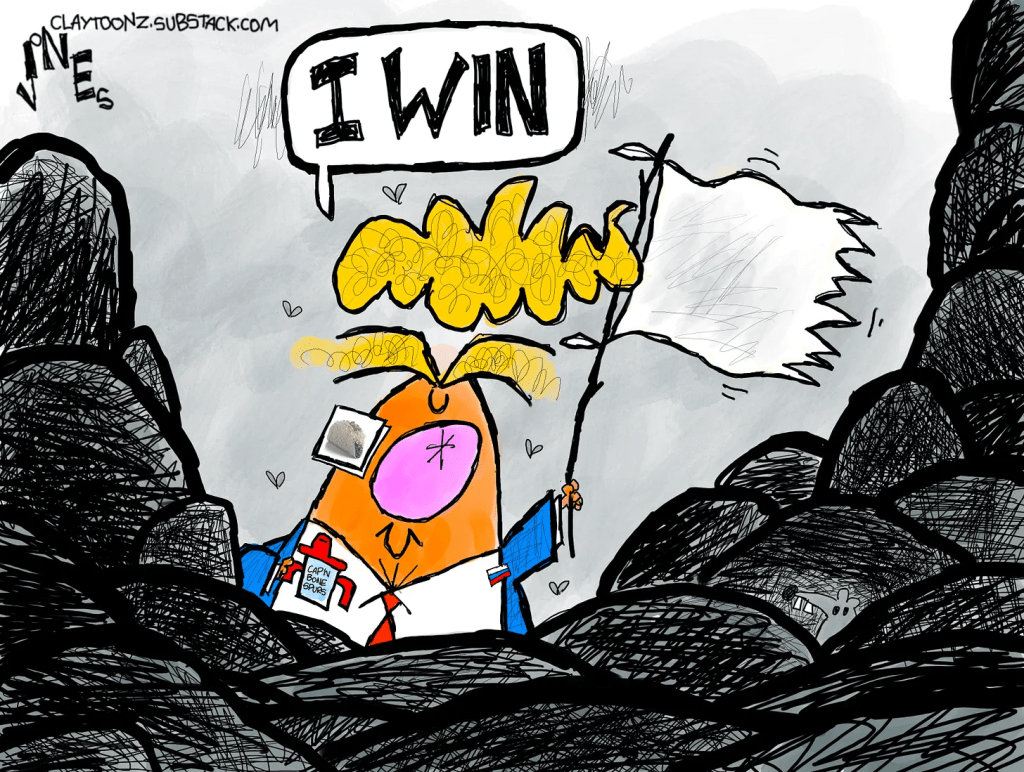
As predicted, Donald Trump taco’ed out again after threatening to commit genocide against the Iranian people.
Make no mistake about it, threatening to destroy an entire civilization is threatening genocide. Donald Trump was threatening to commit war crimes. (snip-MORE, also hot)
Ann Arbor (Informed Comment) – On Easter Sunday, God’s chosen in the White House issued a vulgar and unbalanced posting on his “Truth Social” that epitomizes the insanity of his Iran War. Attending to it closely will help us understand how Trump has strengthened the government of the Islamic Republic and put it in control of global energy. Trump fondly imagines that he can dislodge Iran from this new ascendancy, but he is wrong, since it depends on sabotage, a sabotage that cannot be policed.
This is embarrassing, Delete it, President @realDonaldTrump – unless you want everyone to think you’ve lost your marbles.
The foul language and clear mental imbalance visible in this announcement sparked a further round of calls for Trump’s removal under Article 25 of the Constitution, which is nothing more than an internet meme since Trump has surrounded himself on his cabinet with people even more certifiable than he is, and who wouldn’t dare move against him.
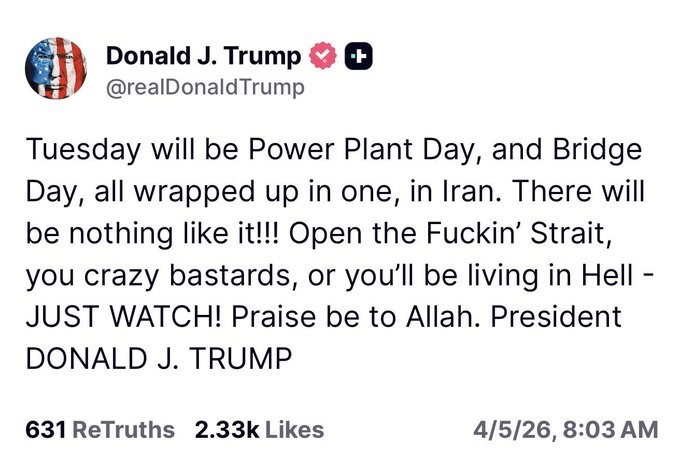
Trump, having imbibed whatever substance it is that makes him manic, announced that “Tuesday will be Power Plant Day, and Bridge Day, all wrapped up in one, in Iran. There will be nothing like it!!!”
He is repeating a threat he made previously, to bomb Iran’s civilian electricity-generating plants as well as its civilian bridges.
Iran has 98 major power plants fueled by fossil gas, which generate 85% of the country’s electricity. The largest, the Damavand power plant south of the capital, Tehran, has a generating capacity of over 2.8 gigawatts.
One of Iran’s power plants is nuclear, at Bushehr. If Trump or Israel bombs it, the consequent radiation pollution will deeply harm the Arab Gulf states, not only through airborne particles but also by contaminating sea water, which is drawn on by the region’s desalinization plants. This exposure to radiation would certainly increase cancer risk in the region. There are mountains between Bushehr and the Iranian interior, so the radioactive particles would be blown west toward other countries such as the United Arab Emirates, Saudi Arabia and Qatar.
Striking civilian power plants, and above all nuclear ones, endangers the noncombatant population of children, women and unarmed men and violates International Humanitarian Law.
In fact, the International Criminal Court in the Hague issued “warrants of arrest for two individuals, Mr Sergei Kuzhugetovich Shoigu and Mr Valery Vasilyevich Gerasimov, in the context of the situation in Ukraine for alleged international crimes . . .” on June 24, 2024. They were indicted for “for the war crime of directing attacks at civilian objects (article 8(2)(b)(ii) of the Rome Statute) and the war crime of causing excessive incidental harm to civilians or damage to civilian objects (article 8(2)(b)(iv) of the Rome Statute), and the crime against humanity of inhumane acts under article 7(1)(k) of the Rome Statute.”
Among the “civilian objects” that these Russian officials ordered attacked in Ukraine were power plants and structures such as the Kryukovsky Bridge.
So Trump is talking like a war criminal, which tells you why he has placed sanctions on International Criminal Court judges.
Trump already struck the unfinished B1 bridge linking Tehran to Karaj. Since it was not finished, it could not possibly have had a military purpose, contrary to the lies of the lying liars in the Trump administration who gave that as the excuse for hitting it.
Trump continued, “Open the Fuckin’ Strait, you crazy bastards, or you’ll be living in Hell– JUST WATCH!
It is not clear how a body of water such as a strait could copulate. However, it can engender revenue, and does so for Iran. A lot of revenue.
Iran has not actually closed the Strait of Hormuz entirely. It is exporting its own petroleum through that narrow aperture, mainly to China. Trump has been forced by the global oil shortage to lift sanctions on the Iranian tankers, and so Iran is also selling again to India. Before Israeli Prime Minister Benjamin Netanyahu rushed Trump into war on Iran on February 28, Iran was exporting about 1.4 million barrels a day to China. The price of petroleum was about $67 a barrel then, but Iran had to offer a steep discount to offset American sanctions, and so was probably only getting $57 or less a barrel. So Iran was getting something like $29 billion a year for its petroleum from China and a few other customers (90% goes to China).
China is now likely having to pay $110 a barrel for Iranian petroleum.
Iran’s oil income just went up to $55 billion a year if these prices and this volume of trade persists, which is plausible. So the “crazy bastards” in charge of Iran have nearly doubled their income off the Netanyahu-Trump war because of the fertility, under their control, of the “fuckin’ Strait.” The Iranian oil industry is state-owned, so all the money goes to the clerics and the Iranian Revolutionary Guards Corps, as well as to the conventional army and the elected institutions, the parliament and president. This extra income helps the government tamp down resistance, strengthening it against civil society. In any case, many Iranians under foreign attack are rallying around the flag. Of course there are also tax losses from the economic disruption of the war, but the vastly increased oil income helps make up for them as far as the government is concerned. If the price of oil goes to $200 a barrel, as it may well, Iran’s government could get $100 billion a year for its petroleum.
Not only that, but Iran has instituted a toll system, wherein countries that have good relations with Iran and pay a fee can transit the Strait without fear of an Iranian drone attack. In contrast, countries that Iran believes contribute to the American war effort against Tehran such as the Emirates and Kuwait, are blockaded by the threat of such strikes. These tolls could be an ongoing and lucrative source of income for the government. Before the war, 138 ships transited the Strait daily. If that traffic resumes but each has to pay Iran a $2 million toll, that would bring in $96 billion a year, i.e. four times what Iran was getting for its petroleum before the war.
So here’s the thing. With the advent of Iran’s Shahed drones, which can be manufactured inexpensively and of which it has tens and thousands, there is no way for anyone, including Trump and the US military, to stop Iran from sabotaging ships that won’t pay the $2 million. At least, I don’t see how it could be done. You’d need tens of thousands of interceptors, and we hardly have any left. Moreover, interceptors cost $1.5 million apiece, so it makes much more sense to allow each ship to pay Iran the $2 million.
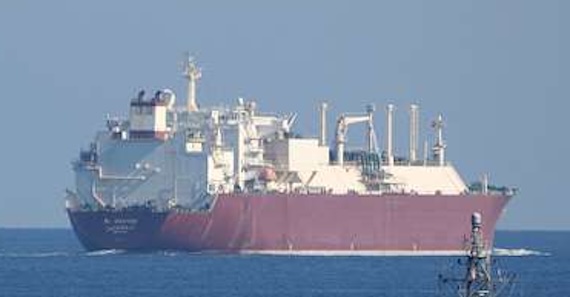
Container ship in Strait of Hormuz. (U.S. Navy photo by Mass Communication Specialist 2nd Class Indra Beaufort).Public Domain. Via Picryl .
Trump has shown Iran how it can go into the protection business in the Gulf for the long term. Nice oil shipping industry you have here, it would be a shame if anything happened to it. And off that, Iran actually increases its GDP substantially.
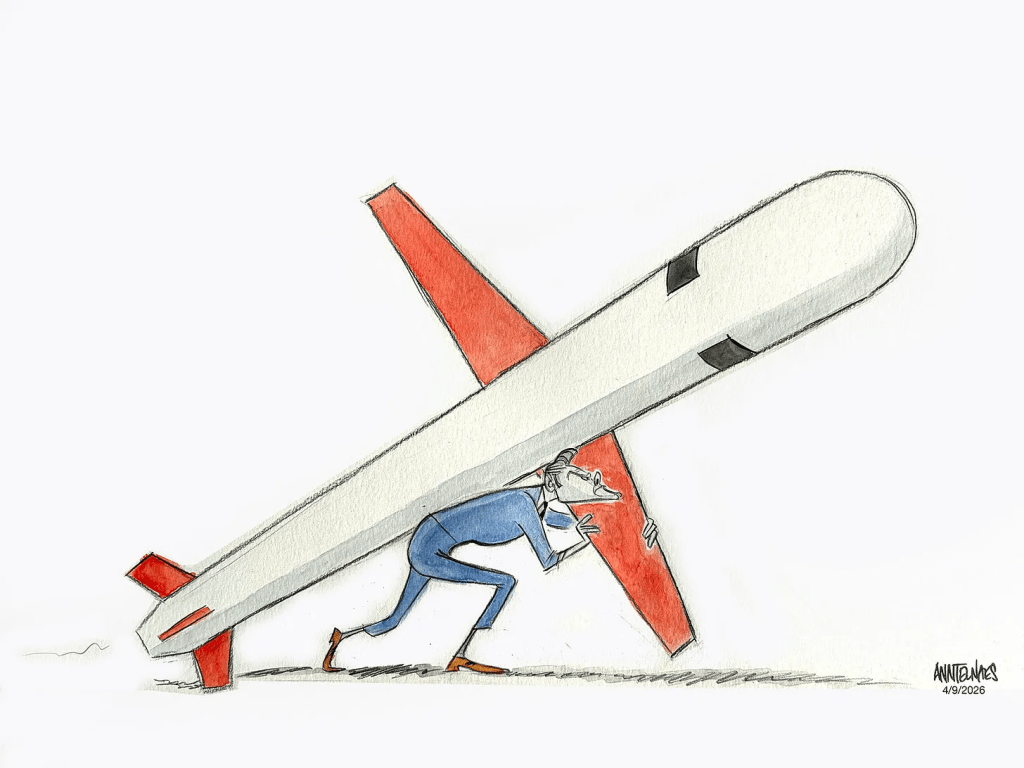
If Trump takes out Iran’s electricity and bridges, he can interfere with its economy and its society in a big way. But he can’t stop the drones or the protection racket that way. Moreover, Iran has made it clear that its response will be to take out the power plants in the Gulf Arab states as well as in Israel. Since the US and Israel are running low on interceptors, and since even small Shahed drones have great range and can do a lot of damage, Iran’s threat is credible.
If Trump takes out Iran’s petroleum-production capability, Iran will crash oil production in the Gulf, taking 20 million barrels a day off the market for years to come. That would certainly be another Great Depression and likely would spell the end of the oil industry, since everyone in the world would migrate to electric vehicles quickly.
So although Trump meant the phrase ironically and blasphemously, the Iranian authorities may well end up saying “Praise be to Allah” over Trump’s monumental stupidity.
I wish! 😄 Leading Kansas writes this time in regard to data centers, and about addressing our local governments in our own behalf.It works the same in every state.
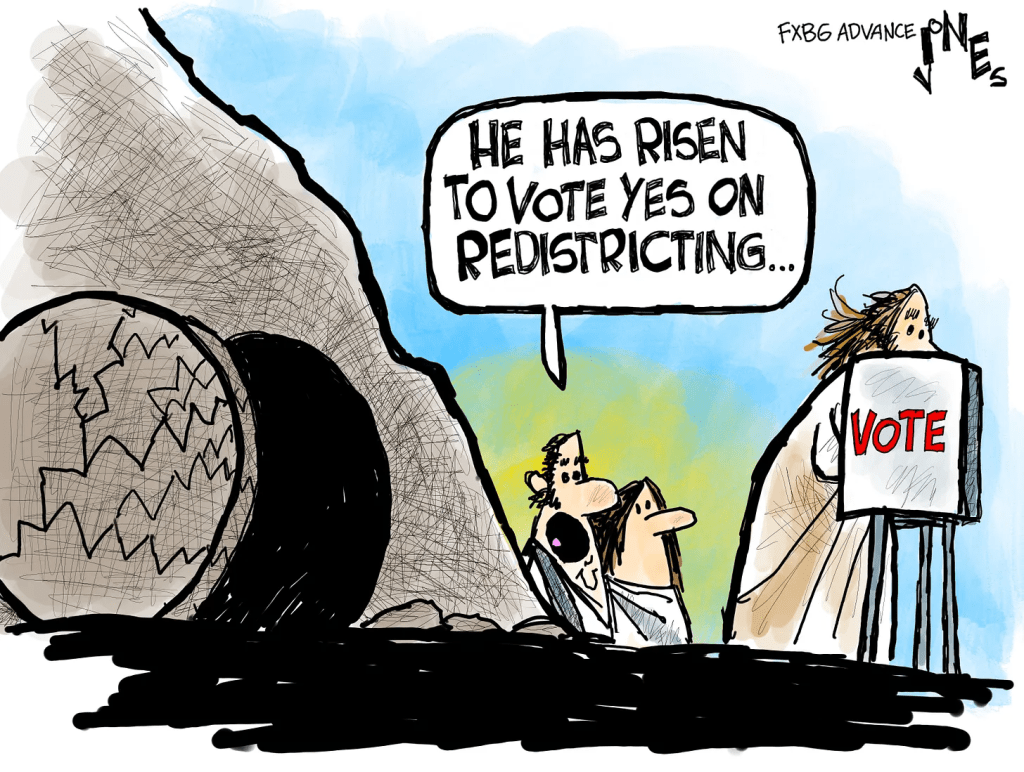
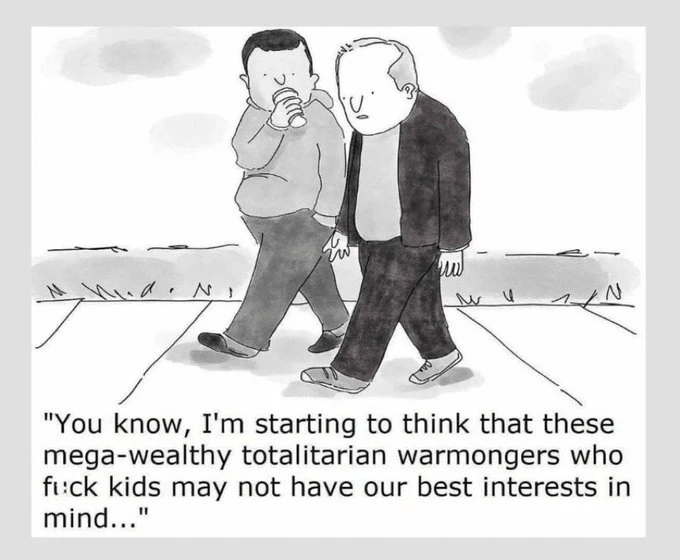
This cartoon was drawn for the Fredericksburg Advance. But don’t yell at them for it; you can yell at me.
If you live in Virginia, you have been bombarded with flyers about the special election on redistricting. And it’s not just flyers but also TV commercials, which are also popping up online. We are getting these things from both sides.
There is a special election in November on a state constitutional amendment that would give Democrats as many as four seats in Congress. The measure would also temporarily bypass the state’s redistricting commission to redraw maps in the middle of the decade.
The state’s Supreme Court approved the measure to be on the ballot less than a week before early voting began. State Republicans repeatedly tried to stop Democrats from moving forward with the referendum. The irony here is that Republicans claim that voting yes will disenfranchise voters, while they literally tried to keep this off the ballot so people couldn’t vote on it.
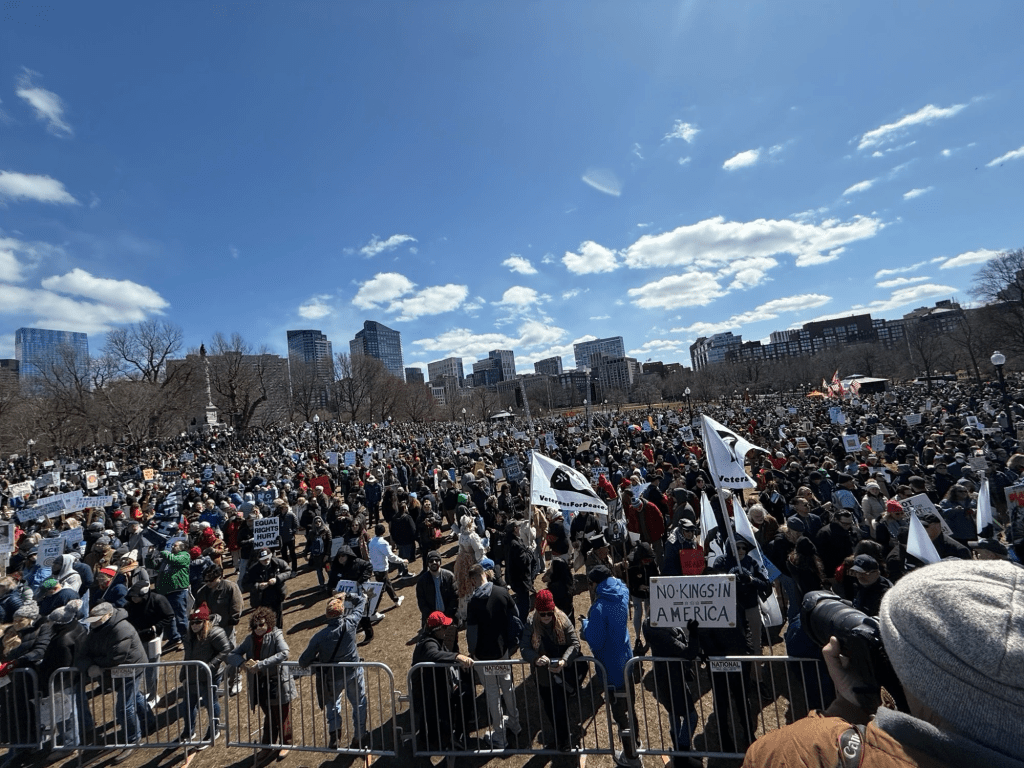
This is a direct response to Donald Trump and Republicans redistricting mid-decade to give themselves more seats. Donald Trump even said he was entitled to have more congressional seats. This is one reason why we need to No Kings protest. Donald Trump already believes he’s entitled to win elections he’s lost. (snip-MORE, and it’s on point)
Energy company Deep Fission is in the process of building a new and untested type of underground nuclear reactor in Parsons, KS
The Trump administration has reduced regulations to encourage nuclear power production
The reactor will likely power data centers for artificial intelligence
Large data centers consume huge amounts of water and energy and produce different types of pollution, leading to health risks for nearby residents
In November 2025 a two-year-old energy company called Deep Fission broke ground in Parsons, Kansas. They hope this project will enable them to install the second ever energy producing nuclear reactor in the state, after Wolf Creek, potentially with more reactors on the way in the future. If the early “characterization” drilling goes to plan, they claim the reactor could begin pumping electricity into the grid in the near future.
Parsons is a city of 10,000 in southeastern Kansas, near the Oklahoma border. I’ve lived in Kansas for most of my life and I had not heard of Parsons until last week. So, why is Deep Fission in Parsons, Kansas, and why now? Not coincidentally, the Great Plains Industrial Park, also located in Parsons, has lately been advertised as a prime location for new data centers to power the trillion-dollar (yes, trillion with a T) artificial intelligence boom forced upon us by large technology corporations and their venture capitalist backers. Which means the Parsons nuclear reactor project would likely come as a package with one or more new data centers, along with potential economic prosperity and a host of legitimate concerns that community members have already raised.
Part 2: The New Nuclear Power
While the Department of Energy set a goal for the Parsons reactor to go online in July of this year, Deep Fission themselves are aiming to connect to the grid by 2027 or 2028. Two years is still an unusually rapid rollout for a nuclear power plant, which usually takes 6-10 years from groundbreaking to full operation.
Nuclear energy is typically labeled as “clean” energy compared to coal, oil, and natural gas, meaning that it releases fewer pollutants into the air and water than fossil fuel consumption. Still, there are two main concerns. First is the disposal of nuclear waste, which ranges from the lightly contaminated clothing of plant workers to the lethally radioactive spent fuel a plant produces over time. This latter “accounts for just 3% of the total volume of waste, but contains 95% of the total radioactivity.”
A relatively new method in the US and Europe for disposing of our most dangerous nuclear waste is to bury it very deep underground, so that it can be surrounded by solid rock to provide the same level of pressure containment as required at structure at a surface nuclear reactor facility. The father-daughter team that eventually founded Deep Fission originally created Deep Isolation to dispose of nuclear waste. Deep Fission takes their concept a step further by placing the entire reactor, and therefore its most dangerously radioactive elements, into a borehole drilled one mile underground.
The second main concern related to nuclear energy production is, of course, accidents or attacks. It is true that large-scale nuclear accidents are very rare, but when they happen, they become instant, globally recognized disasters whose names we all know: Chernobyl, Three Mile Island, Fukushima. The effects are so widespread as to be practically impossible to quantify. The reactor explosion and meltdown in Chernobyl, for example, caused several dozen deaths directly related to radiation exposure, but various studies have predicted anywhere from thousands up to a million eventual additional cancer deaths. Not to mention the environmental and economic cost to the entire region around Chernobyl. And radioactive boars still terrorize people and farmland in the region around the Fukushima plant in Japan.
But those issues are known, and regulations have historically attempted to shore up potential dangers posed by new plants. In contrast, nothing like the underground nuclear reactor in Parsons, Kansas has ever been attempted before, and thanks to Executive Order 14301, will not need to go through long established design and testing phases that other types of nuclear reactors have been subject to in the past. John Young, a mining environmental regulatory specialist who lives in Sedgwick County, asks, “Why abandon the current regulatory process for something created out of whole cloth with no public input? And no one can define the current regulatory pathways for Federal and State authorizations.
“What,” Young asks in frustration, “could possibly go wrong?”
Part 3: Data Centers and Artificial Intelligence
So that is a glimpse into the nuclear energy side of things. Next we must address concerns around data centers and artificial intelligence. Data centers come in different sizes, like the smaller center being proposed in Wellington, KS, which would reportedly “use roughly 30% of the city’s electrical capacity while generating an estimated $1.3 million in annual electric utility revenue” while consuming only two gallons of water per day. Larger data centers consume resources less modestly. “Around the country, and the world, there is a land race among the big tech companies for sites for their data centers,” claims a November 2024 investigative report by Rolling Stone. Data centers are much newer than nuclear energy technology, yet the ways in which they harm communities near them have already become apparent.
Water: “Large data centers can consume up to 5 million gallons per day, equivalent to the water use of a town populated by 10,000 to 50,000 people,” according to a June 2025 study by the Environmental and Energy Study Institute (EESI). And data centers built explicitly to power AI represent the fastest growing portion of the market.
Last year, researchers at the University of California, Riverside calculated that ChatGPT—one of several popular Large Language Models (LLMs) vying for marketplace dominance—answered about 10,000 queries per second. The processing load to do so guzzled about 6,000 liters (or about 1,000 toilet flushes) of fresh water per second, all day, every day. That is only generating written text. AI photos require more water, and still more for AI video. “The extraction process is permanent,” explains the University of Alabama at Birmingham Institute for Human Rights. Water used to cool data centers evaporates as it cools hot components, meaning it can no longer be used by people in the region who need water for drinking, cooking, bathing, laundry, and general survival.
Pollution: Unfortunately, it is not only consumption of water to worry about. The evaporation of water cooling data centers leaves behind higher concentrations of nitrates and other contaminants leaked through agricultural fertilizers and pesticides into local water supplies, drastically increasing incidents of “rare cancers, muscle disorders, and miscarriages” among people who live nearby. Geographically, Parsons, Kansas sits atop the Alluvial and Ozark Aquifers.
Reports of noise pollution have increased near data centers as well. Residents in different Virginia towns experienced disturbing high and low frequency humming in a wide radius around two new data centers.
These same experts predict that the disempowerment will not only come at the individual level, but also at the societal level, as lawmakers turn their attention and favor even more toward tech companies and AI services that increasingly take over tasks that used to be performed by human beings.
The purpose of this article is not to overwhelm with doomsaying or inevitability. If the Deep Fission underground reactor works as advertised, it could genuinely provide cleaner energy than fossil fuel and mitigate some of the effects of climate change. But to get there safely, we need to demand transparency and regulatory protections from political and corporate leaders. If enough of us speak up in place like Parsons, Topeka, Sedgwick County, and every corner of our town, state, country, and world, we embolden those watching, each other, and ourselves to continue building the world we want and deserve.
Because of Mamdani’s policies being for the people to help the people and his huge popularity is going to affect or should affect how other democrats run their races. The people respond to taxing the wealthy more and using those funds to help the lower incomes. Maybe the young today don’t remember how it was before Reagan slashed the taxes on the wealthy when infrastructure was maintained, services for the public were available, when schools were properly funded and higher education was inexpensive and government offices to serve the public were fully staffed along with so much more. But the more the upper incomes take of the country’s money the less is available for the rest of the people. A large part of the democratic party became addicted to that big money from corporate and wealthy donors so they did not fight for the people as they should have instead helping companies and businesses to make more profit. The people saw the shift by the democrats and stopped supporting them. Mamdani has shown how to get the voters back on the democrats side again. Hugs
PUBLISHED: 31 March 2026 LAST UPDATED: 31 March 2026
“Everyone is on high alert, constantly watching the sky with fright and exhaustion […] We also keep our eyes on our mobile phone connections — the moment the signal drops, we immediately take cover in underground shelters. We’ve come to understand that a loss of communication signals an impending airstrike.— Humanitarian aid worker on the internet shutdown that took place in Myanmar during air strikes near Tamu township in the Sagaing region.
The 2025 data and analysis confirm a horrific reality: internet shutdowns are increasing, not decreasing — and their impact on people’s lives is devastating. Shutdowns reached a new record high in the past year, continuing the steady increase since 2020. Our new report, Rising repression meets global resistance: Internet shutdowns in 2025, documents how democratic and autocratic governments alike deploy them to silence, collectively punish, and terrorize populations, as well as to hide human rights violations and killings. At the same time, we highlight how resistance is growing and people’s power is rising, and offer recommendations for stakeholders to push back. From Myanmar to Iran, Tanzania to Nepal, communities are challenging repression, demanding accountability, and devising new ways to reconnect during blackouts.
In 2025, Access Now and the #KeepItOn coalition documented 313 shutdowns in 52 countries, surpassing the appalling records from 2024 (304) and 2023 (289). Seven new countries joined the offender list in 2025, meaning that people in 100 countries have now experienced a shutdown since we started tracking in 2016. As 2026 began, there were 75 shutdowns in 33 countries that persisted from 2025, a significant increase from the 54 shutdowns in 26 countries that were ongoing from 2024 into 2025. This shows that perpetrators are increasingly attempting to permanently block communications platforms or even keep entire populations cut off from the internet indefinitely.
If you can’t see the highlights below, please check your privacy-enhancing browser extensions. Open in desktop view for the best experience.
(snip-go see. The site is Access Now, it’s safe, the subject of this story (internet access) is its specialty, and my Ad Blocker even shows no blocked ads on the page! Go finish reading this, because forewarned should be forearmed, as to organizing locally.)
I read LGM when I have time; haven’t been there in a couple of weeks. But here is this. I thank another friend of the blog for the link to this. It’s concise.
Graham Platner, son of wealthy parents, is cosplaying as a salt-of-the earth oyster farmer who sells his product to his mother and is running to become the Democratic candidate for Senate in Maine, against Susan Collins. He was outed as having a Nazi tattoo, which he had tattooed over with a slightly less Nazi tattoo. His earlier writings and activities include slurs against women and wearing a Blackwater hat to own the libs.
He is now running ahead of Governor Janet Mills, who is an older woman but who actually has experience in government, something Platner lacks.
Why is Platner doing so well? We can look to Donald Trump for that.
All of our politics today are gender politics. It’s very difficult to talk about that, because it permeates everything we do, leaving us fish unaware of the water. The response is frequently that no, it’s something else, maybe power. But power is gender infused too. So let’s focus on gender if only for the amusement of seeing something through a new lens.
We have multiple models in our heads of what women and men are. Mute eye candy, intellectual, blue collar are some general descriptors, but more specifically, we associate particular groups of characteristics with particular manifestations of gender. Graham Platner and Donald Trump are avatars of a particular way to be a man. I will enumerate some of them.
Men tell it like it is. This means that they can say things that are associated with this type of masculinity, like referring to women by their genitals and using slurs against other groups that are not able-bodied white men.
Men are muscular and do hard work. This means that blue-collar men are Real Men™.
Men are strong. This is different from being muscular, but the two bleed into each other. A man can take on emotionally difficult tasks and bull his way through.
Men never apologize. From what I have read, Platner has acknowledged the tattoo and his earlier actions but has not apologized. Trump, well.
Men are by nature fit to lead. Platner has no experience in government, as was the case with Trump in 2016. But they were/are questioned very little on this issue.
Men may become violent. Platner was in the military and Blackwater, with a violent tattoo. Trump shouts, rages, and talks about violence all the time.
To my mind, this type of masculinity is disqualifying for elected office. But obviously others disagree.
He’s a plain-talking guy you could have a beer with. Or at least a man could have a beer with. The comfort factor is enormous, and Platner and Trump give people permission to be comfortable in a particular way. Ezra Klein interviewed (gift link) one of conservatism’s intellectuals, Christopher Caldwell. Caldwell writes at the Claremont Review of Books and is one of the New York Times’s resident conservatives.
One of the things he settles on as an aspect of Trumpism is what he calls free speech. He has felt throttled by woke and was delighted to be able to be comfortable in what he says. That banker interviewed by the Financial Times said it out loud: He can say the “r” word and refer to women’s bodies in conversation. It’s what all conservatives mean by “free speech,” sometimes with Nazi phrases or concepts thrown in. When they say “free speech,” they mean whatever speech white men in charge want to use.
Those “free speech” advocates are given permission to speak freely by Platner and Trump.
There are other reasons people vote for men displaying this cluster of traits considered masculine. It’s a comfortable stereotype – much in the media and what people who don’t have close contact with blue-collar men may believe of them.
Even Rahm Emanuel feels he has to put on a muscular performance of eating his salad.
Just a question to those who support this regime: Just what the hell is it going to take before reality makes it through whatever brainwashing happened to you?







 Scottie's Playtime