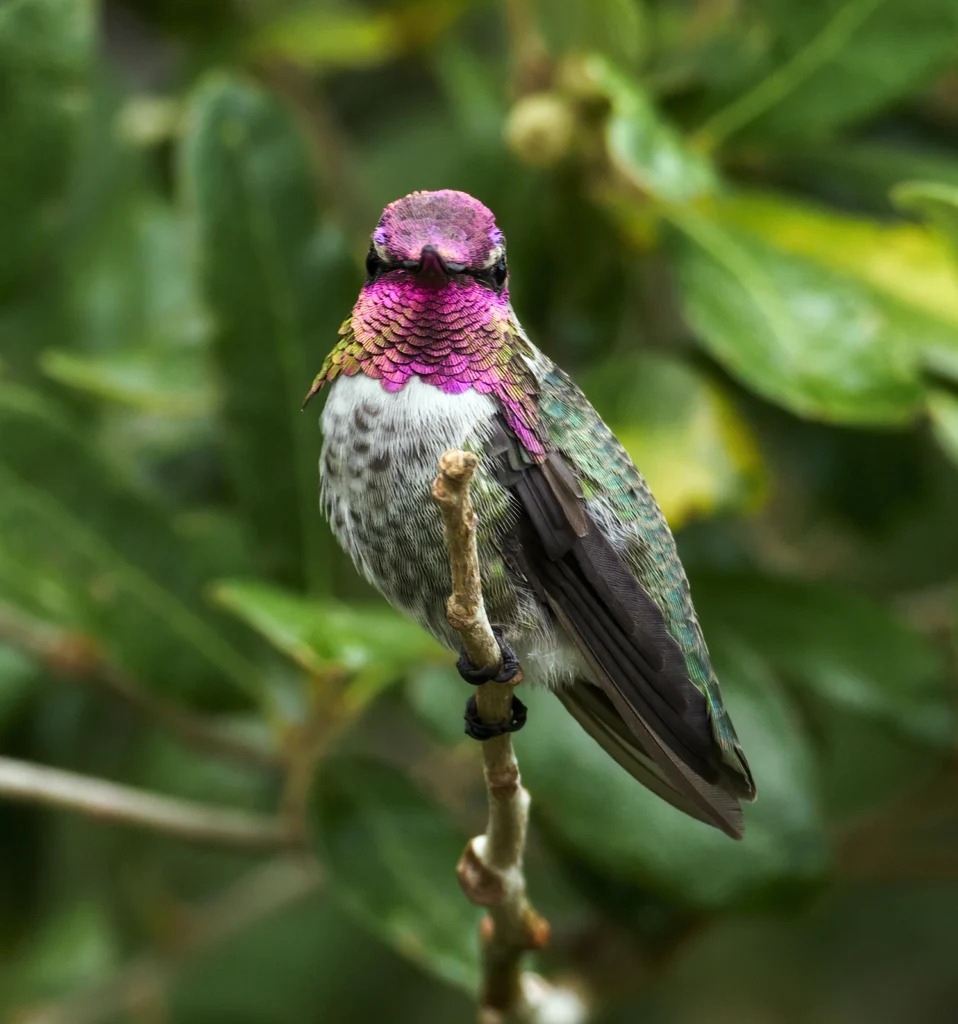
The Anna’s Hummingbird is a characteristic and charismatic species of coastal Central, Southern, and Baja California, although this species has expanded its range northward along the Pacific Coast and eastward into the Desert Southwest. Like the Rufous Hummingbird, Anna’s is well known for its aggressive territorial behavior. Males fiercely defend feeding areas, where they chase away other male hummingbirds and even large insects such as bumblebees and hawk moths that try to feed there.
Although the Anna’s Hummingbird readily feeds from non-native plants, wild plants are still crucial to these birds — and the birds are just as critical to these native plants. Anna’s Hummingbirds are important pollinators of the chaparral flora of coastal California. Many of these plants flower in the winter months, coinciding with California’s wet season. To take advantage of this boon of nectar, Anna’s Hummingbirds in coastal California breed in what is the nonbreeding season for most North American species, nesting as early as mid-December. After the rains end, many hummingbirds will move up into the mountains to take advantage of blooms at higher elevations.
The Anna’s Hummingbird is a highly vocal species, especially for a hummingbird. Males sing a complex, scratchy-sounding song while perched and during their high-flying courtship spectacles. The male performs this diving display by first ascending to 100 feet or higher, then swooping toward the ground. At the bottom of his dive, he will be moving at about 60 miles per hour, just overhead of a female (or intruding male). At the last minute, he banks upward and flares his tail, causing his modified tail feathers to produce an explosive, high-pitched chirp. The gravitational force (“G-force”) caused by this maneuver would cause a human pilot to lose consciousness, but these little hummingbirds do it again and again, up to about 40 times back to back, when trying to impress a female. He also orients his dives to maximize the reflectance of his beautiful gorget — the gem-like patch of tiny iridescent purple-pink feathers on his throat. According to researchers Christopher Clark and Stephen Russell, from the perspective of a female, he looks like a “tiny, glowing magenta comet” plummeting towards her. (Snip-More on the page. Actually hear a hummingbird!)
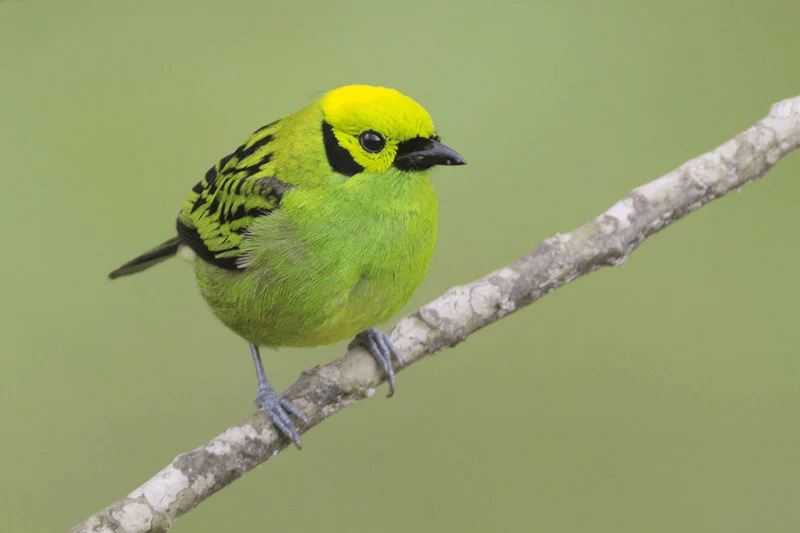
The Emerald Tanager is truly a gem of the forest, roaming through the canopy in search of fruiting trees in the humid montane forests of Central and northern South America. Although primarily a fruit-eater, this species is also adept at hunting insects and other invertebrates on tree branches, deftly manipulating mosses with its bill in search of prey. This behavior sets it apart from other tanager species it often flocks with, but outside of the Emerald Tanager’s range, other specialized tanager species may fill this niche.
The Emerald Tanager’s relationship with moss extends beyond its foraging habits. Though their breeding biology is largely undescribed in peer-reviewed literature, the nests that have been observed have either been made of moss entirely or thoroughly covered in it. This, of course, provides good camouflage on the mossy branches where these tanagers build their nests. (Snip; MORE, and hear the Emerald Tanager)
This is the answer to yesterday’s Free The Ocean Trivia. I got it correct, but it was a guess because the other ones didn’t really seem correct. Anyway, it’s good eco news for Tuesday, taken from nature!
In the shallows of Papua New Guinea’s Kimbe Bay, scientists have documented a surprising adaptation among one of the ocean’s most recognizable fish. During a 2023 marine heatwave, orange clownfish—familiar to many as the inspiration behind *Finding Nemo*—began shrinking. Not just slimming down, but actually shortening their bodies to weather the rising temperatures of their coral reef home, as reported by AP News.
This previously undocumented response was observed across dozens of breeding pairs tracked over several months. The findings, now published in *Science Advances*, offer rare insight into how marine species are physically changing to survive extreme climate conditions.
Clownfish are shrinking their bodies during marine heatwaves.
The Heatwave That Triggered a Transformation
Between February and August 2023, researchers repeatedly measured 134 clownfish as ocean temperatures soared to levels resembling a “hot bath,” according to Newcastle University doctoral researcher Melissa Versteeg, whose team led the study alongside local organizations Mahonia Na Dari and Walindi Resort. The scientists discovered that nearly three-quarters of the adult fish shrank at least once during the period, decreasing in total length by several millimeters. These changes happened in mere weeks—not over a lifetime, as previously assumed in similar cases, according to Vox.
Unlike earlier studies that linked climate to stunted growth in birds and mammals over generations, this was physical shrinkage in mature individuals. The observation challenges assumptions about static adult body sizes and opens new possibilities for understanding animal adaptability.
This size reduction is a physical adaptation, not just weight loss.
A Strategy Rooted in Survival and Social Balance
The shrinking wasn’t random. It was synchronized, particularly within breeding pairs. Versteeg’s team found that pairs where both fish shrank together had better odds of surviving the heatwave. The behavior, documented in the wild for the first time in reef fish, helps sustain clownfish social structure, Sustainability Times reports.
Clownfish live in tight-knit social hierarchies, often with one dominant breeding pair and several subordinate members. Size plays a critical role in that hierarchy. When heat stress reduced food availability or oxygen levels, shrinking may have reduced the energy and oxygen needs of the fish. Coordinated downsizing likely helped avoid social conflict and maintain reproductive bonds.
Speaking to the The Washington Post, Newcastle marine ecologist Dr. Theresa Rueger emphasized how this size shift offered advantages: smaller fish may manage heat stress better and require fewer resources—both of which are scarce in warming seas.
The phenomenon was discovered during a 2023 heatwave in Papua New Guinea.
Beyond Clownfish: A Broader Pattern in a Warming Ocean
Clownfish aren’t alone. Scientists have linked higher global temperatures to shrinking trends in a range of species, from birds to mammals. A 2019 study showed that North American birds shrank by an average of 2.6% over several decades. But the clownfish response is distinct because it occurs rapidly, during the adult life stage, and in direct response to a single environmental event.
Thermal stress may trigger these changes by limiting the availability of oxygen and nutrients. Smaller bodies have less demand and are more efficient under strained conditions. There’s even speculation that clownfish, like marine iguanas, may be reabsorbing bone or fat tissue to reduce size, though more study is needed to confirm this hypothesis, BBC News reports.
Scientists measured 134 clownfish monthly and saw widespread shrinkage.
The Limits of Adaptation
Despite this remarkable display of flexibility, adaptation has its limits. The heatwave that prompted this discovery was the first of three consecutive ones in the region. Many of the clownfish studied didn’t survive them all. Coral bleaching—another side effect of heat stress—is stripping clownfish of their sea anemone homes. These vibrant, venomous hosts are essential for clownfish survival, offering shelter and protection. Without them, even the most adaptive clownfish may struggle to persist.
Moreover, this shrinking behavior is not a cure-all. As pointed out by University of Massachusetts fish biologist Joshua Lonthair in The Washington Post, if shrinking turns out to be a widespread response to environmental pressures, it may fundamentally alter how scientists understand growth and maturity in marine life.
Looking Ahead
The clownfish shrinking phenomenon marks a breakthrough in how marine biologists interpret resilience. It’s a glimpse into the extraordinary ways wildlife tries to keep pace with a planet in flux. While researchers continue to explore the exact mechanisms behind this body-size shift, one thing is clear: even iconic species like the clownfish are being reshaped by climate change—literally.
Understanding these changes is crucial, not just for preserving individual species, but for forecasting the health of entire marine ecosystems. In a world growing hotter by the year, adaptation may be the difference between survival and extinction.
The simple ritual of going outside to welcome nightfall can be extremely relaxing. Of course, this has been done since the dawn of time. However, the practice of “dusking” has recently regained popularity and has become a trend for people looking to boost their mental well-being. The Dutch have been doing this for ages. In…
(I can attest to this; I go outside with Ollie while he does his night-night wee & poo, and while I wasn’t aware it’s an actual thing, it is a calming little ritual, to look at the sky and see what I see. There is more than one way to do it. Soon, it’ll be time to repel mosquitoes, of course, but right now, I just wear a little jacket because it’s nice and cool bordering cold outside.)
A person watches the sky as night falls. – Photo credit:Canva
The simple ritual of going outside to welcome nightfall can be extremely relaxing. Of course, this has been done since the dawn of time. However, the practice of “dusking” has recently regained popularity and has become a trend for people looking to boost their mental well-being.
The Dutch have been doing this for ages. In the Netherlands, dusking is referred to as “schemeren,” which translates to “be dusky, to be in twilight.” It’s the idea of letting the lights turn off while the starry night envelops the day. Watching the color of the sky subtly fade can do wonders for a busy mind.
In a piece for The Guardian, writer Rachel Dixon describes her time at the Dark Skies “dusking event” in the United Kingdom in February 2026. “The darkening sky is faintly illuminated by a sharp sliver of crescent moon and the first stars. Bats are swooping in search of supper, an owl is softly hooting, and the dark outline of a ruined castle looms beyond the walls.”
She explains how this ritual has resurged, writing, “The custom had all but died out until it was revived by Dutch poet and author Marjolijn van Heemstra a few years ago. Now she is encouraging other countries to adopt dusking, running events in Ireland, Germany, and here in Yorkshire.”
Dixon shares that van Heemstra also spoke at the event she attended. “Dusking is about looking at one point and seeing it fade. Don’t look around too much; focus. Trees are very good – they rise up for a moment and then fade away,” van Heemstra eloquently said.
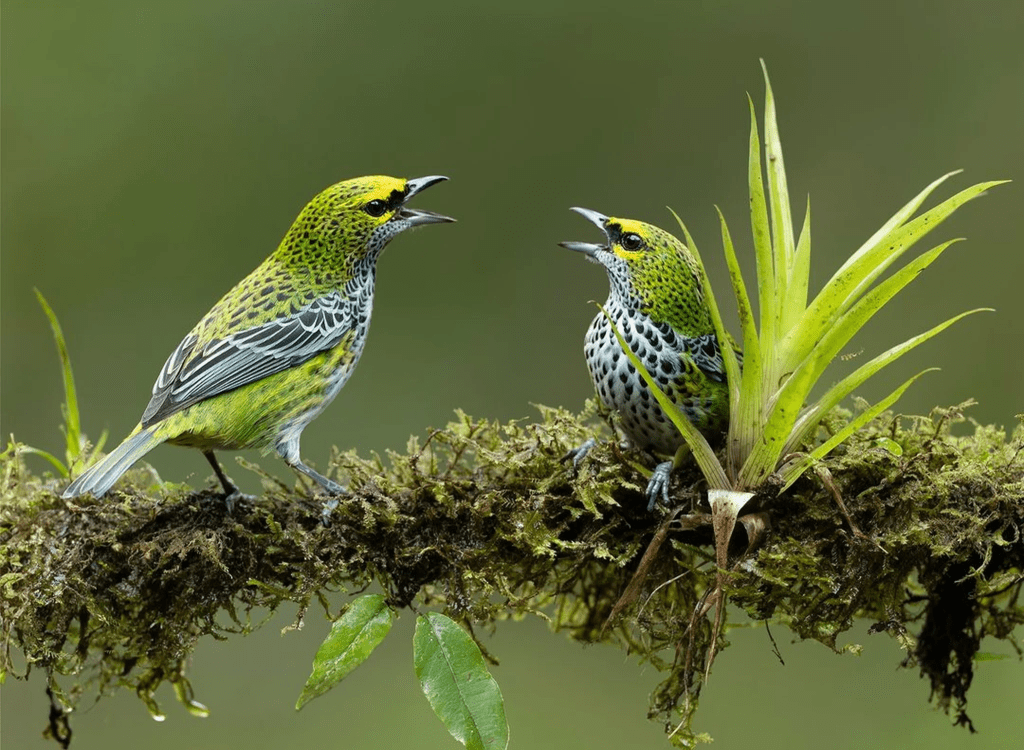
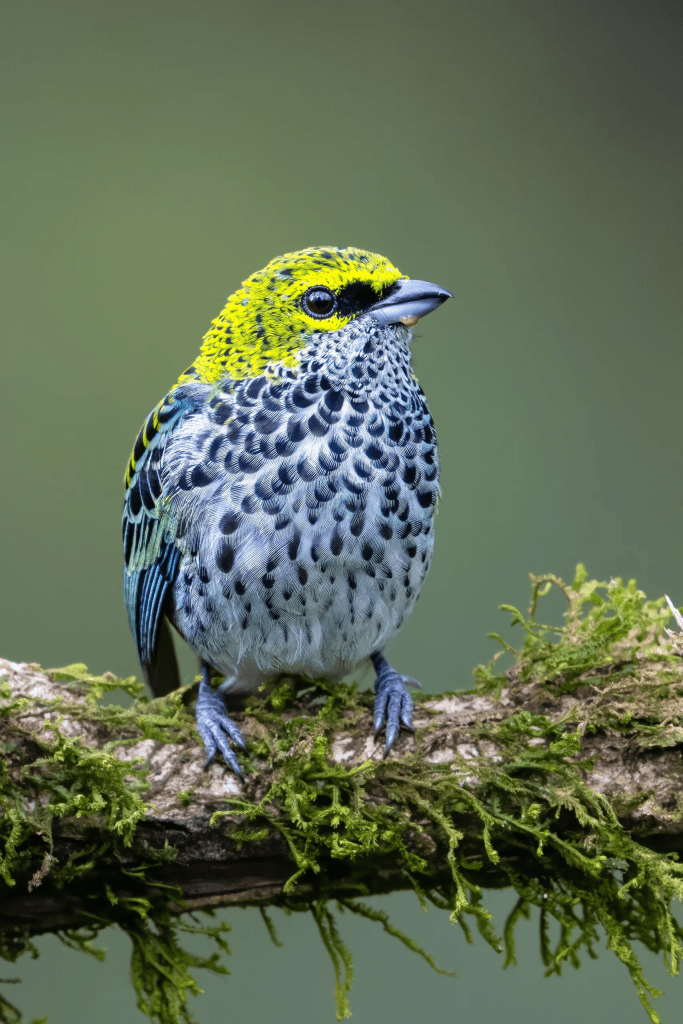
The Speckled Tanager is a preternaturally beautiful bird, even among the other stunning Central and South American tanagers of the family Thraupidae. The black speckles that give this species its name come from black feathers with brightly colored edges, giving the impression of scales over the bird’s body. The edges blend together to create a palette of iridescent yellow-green and green-blue over the body of the bird.
Striking as these patterns and hues may be, they actually provide good camouflage for this bird up in the green, backlit forest canopies where it spends most of its time. The tanager’s speckles, like the spots on a jaguar or the camo pattern on a hunter’s jacket, are a form of disruptive patterning, a camouflage strategy that breaks up or obscures an animal’s outline, allowing it to blend with its background. Up among the bright green leaves, these birds can easily go unseen. Up close, however, their plumage is hard to ignore.
Threats
Birds around the world are declining, and many of them face urgent threats. The Speckled Tanager lives primarily in old-growth forest, and healthy populations depend on the persistence of forests throughout their range in Central and South America. Though not considered a species of conservation concern, this bird is declining, and deforestation is one likely cause. (snip-MORE)
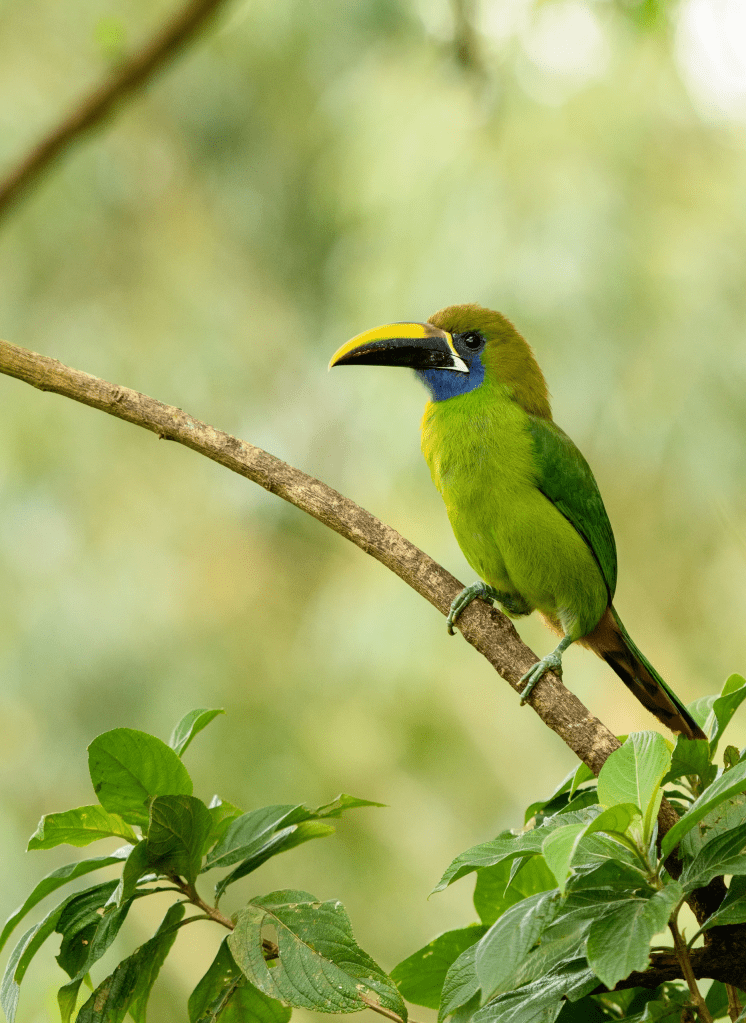
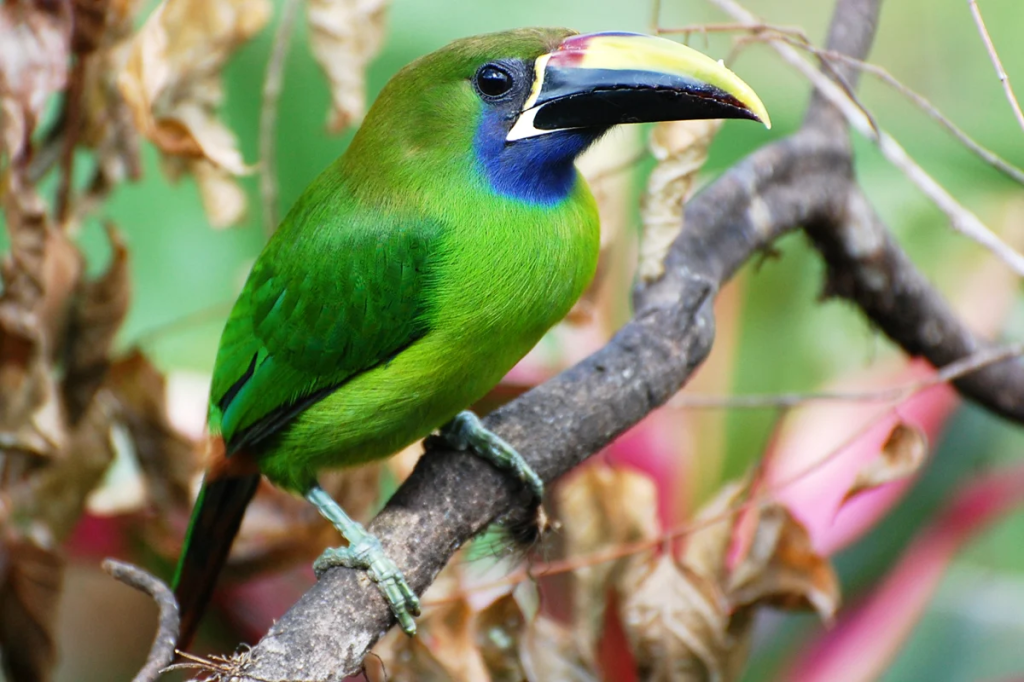
Aptly named for its striking green plumage, the Northern Emerald-Toucanet is actually quite camouflaged in the leafy forests where it makes its home. With its tropical take on countershading — darker green on the back and wings, lighter yellow-green below — this bird beautifully matches the color palette of forest leaves, whether seen from above or from below. With its accents of chestnut, blue, and white, and a large black and yellow bill, this pigeon-sized bird is a true beauty.
Similar to other toucans, Northern Emerald-Toucanets eat mostly fruit, capitalizing on the wide diversity of fruit-bearing trees in the humid forests of their home in Central America. These birds mostly swallow their food whole, including some larger-seeded fruits, which they repeatedly regurgitate and swallow until the flesh is consumed. Whether by regurgitation or defecation, these birds spread the seeds of their food trees throughout the forest. Many tropical trees have evolved to bear fruit specifically for this purpose, taking advantage of birds’ wings to spread their seeds far and wide. In fact, the process of moving through the digestive tract of an animal actually helps the seeds of many of these trees to germinate. In effect, these toucanets, along with a cohort of other fruit-eating birds and mammals, are gardeners of their own food forests. (snip)
Bird Gallery
The Northern Emerald-Toucanet is indeed a beautiful, vibrant green, top and bottom, with the back a deeper, darker hue and the underparts lighter and slightly yellowish. The long tail is iridescent blue and green, with a rusty or chestnut tip matched by the vent feathers beneath the tail. The eight subspecies across its geographic range vary in the coloration of the throat, either blue or white, and the bill. In all subspecies, the lower mandible is black. The upper mandible has some black as well, but may be almost entirely yellow. Some subspecies also have a reddish to brown patch near the nostrils.
This is horrific that a young person has had to live with racism all his life and now has to protect his family and others from a racist gang of thugs who only want to hurt brown people like him. He is doing a great thing but he shouldn’t need to do this in the land of the free. Hugs.
Cesar Vasquez, who has supported families of undocumented immigrants since age 14, has become a community lifeline – and a known ICE target
While most 18-year-olds worry about college papers and spring break plans, Cesar Vasquez drives through coastal California farm towns scanning for unmarked SUVs before dawn. He flips down his driver’s seat visor to look at a taped list of license plates he has already identified as Immigration and Customs Enforcement (ICE) vehicles, and jots down a few new ones he suspects could be. His phone buzzes constantly – tips from neighbors, text chains from volunteers alerting to ICE activity – all in an attempt to keep his community safe from being swept up in federal agents’ widening dragnet.
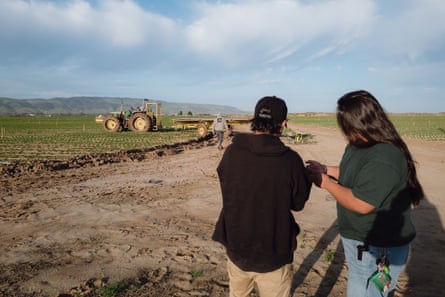
This is what organizing looks like for this son of undocumented immigrants. In his home town of Santa Maria, a small farming town on California’s central coast where over 80% of farm workers are undocumented, Vasquez has become both a crucial community lifeline and a known target of federal immigration enforcement.
Outside the ICE office in Santa Maria, California, Cesar Vasquez and a group of activists gather to decide who will patrol each neighborhood.
Vasquez began volunteering with the 805 Immigrant Rapid Response Network as a high school senior. Last August, he was hired full-time as a rapid response organizer, covering North Santa Barbara and San Luis Obispo counties, overseeing volunteers, supporting families and tracking ICE activity.
Routinely, he visits the families of detained immigrants. “There have been so many occasions where I walked through the door, and a kid was expecting their father or mother,” Vasquez said wistfully. “And it was just me, and I had to explain what happened to their parents.”
Other times, for Vasquez, the reality is personal. He recalled in December, speaking with families waiting for news about their detained relatives outside the immigration enforcement office in Santa Maria, when an ICE vehicle slowed down in front of them. The agent’s voice crackled from the car’s speaker, loud enough to carry through the open window: “How’s your mother, Cesar? We’ll go visit her soon.”
Vasquez drove straight home and found his mother washing clothes.
“I took her car keys and told her to stop everything she’s doing. My hands were shaking,” Vasquez said. “I then moved her to a secret location that I have precisely for this moment.”
As the sun rises in Santa Maria, Vasquez continues monitoring ICE activity in his neighborhood. The 18-year-old says he spends more time in his car than anywhere else these days.
Growing up as a birthright citizen of undocumented parents
Vasquez’s mother is one of the thousands of undocumented farm workers in Santa Maria whom he is trying to protect. She left her home in a tiny town in Mexico to cross the US-Mexico border at age 13 in search of a better life. Vasquez’s biological father was one of the first people she encountered – a Guatemalan American whose family was settled in California and who held US citizenship. He was also abusive and never legally married her, keeping her from accessing US citizenship, Vasquez said. When Vasquez was an infant, his mother ran away with her three children to Santa Maria, a town about 150 miles (240km) north of Los Angeles, where she found work in the strawberry fields. She has been trying to secure documentation for more than a dozen years now.
Vasquez distributes flyers on immigration rights to farmworkers in Santa Maria on 6 February.
Strawberry picking is physically demanding work, and the pay is minimal. Pickers spend hours bent over in the fields under the California sun, with no benefits, no sick days and no guaranteed work once the season slows between October and March. Climate change has made the labor even more precarious, disrupting growing cycles and shrinking paychecks. Rising costs of living – rent, food, transportation – have squeezed families further. In Santa Maria, where a two-bedroom apartment can cost $3,000 a month, many families crowd into single rooms or garages.
Built on an economy of strawberries, lettuce and wine grapes, Santa Maria has long depended on undocumented labor while rendering those workers largely invisible. Many arrived during waves of Mexican migration in the 1980s and 90s, settling into a community where immigration enforcement and workplace exploitation became routine. Before Donald Trump’s recent immigration priorities, ICE enforcement in the region tended to be more targeted – focusing on people with criminal convictions or referrals from local jails, rather than broad community sweeps. ICE didn’t even have a holding facility in Santa Maria until 2015.
But since 2025, enforcement has intensified dramatically with rapid‑response trackers documenting more than 620 immigration arrests across Santa Barbara, Ventura and San Luis Obispo counties, with Santa Maria often at the center of daily apprehensions. These high‑profile raids – often carried out with unmarked vehicles and tactical gear, drawing protests and criticism from community leaders – reflect a broader national surge in immigration enforcement under Trump.
Vasquez holds his mother along the river in Santa Maria. He keeps a feather with him, which he says brings spiritual cleansing when he burns sage.
When Trump was first elected, Vasquez was only nine years old. He was already well-acquainted with the repercussions of growing up in a mixed-status household.
“I mean, it’s common for most children of immigrants to be doing things for their parents like filling out their legal forms, right?” Vasquez said. “But in fourth grade, I had to learn what a warrant looked like and what rights I had.”
He was in a Halloween costume shop, age 14, when it clicked that his fears and concerns weren’t just his own. He overheard a woman at the register, saying she had saved all year to buy her son a costume, but it didn’t fit. The store wouldn’t take it back. Her shirt was stained with strawberries, her exhaustion visible. He’d seen his own mother do the same thing countless times, so he offered to buy the woman’s son the costume.
Building a network at 14
At age 14, Vasquez founded La Cultura Del Mundo, an entirely youth-led organization that eliminates what he calls the “red tape” associated with traditional aid. They prioritize direct, unrestricted support to families in need, asking, “How much do you need?” rather than requiring forms. The group then rapidly mobilizes whatever the family requests, whether that’s cash assistance, groceries, rent help or other essential support.
In August, La Cultura Del Mundo drew national attention when Vasquez organized La Marcha De La Puebla, a national protest against ICE raids that involved nearly 30 cities across 17 states, drawing about 10,000 participants.
Seventeen-year-old Claudia Santos is one of the many young people Vasquez has inspired. “My sister and I heard about a school walkout and just decided to go. After that, Cesar told us about a meeting at city hall, and that’s how I got involved,” Santos said. “I did it because I feel like the kids coming here from Mexico deserve a good future too.”
Vasquez packs up flyers to hand out to the immigrant community as they head to work in Santa Maria.
While Vasquez was organizing in high school, he was simultaneously struggling with his own mental health. He commuted by bus an hour each way to a school in a predominantly white neighborhood with good academic prospects.
When he told his counselor that he had anxiety, “she couldn’t understand that I was uncomfortable because I was brown in a white school, where the principal was racist and the students were racist. It led me to become really suicidal.”
Being misunderstood drove him closer to his community. He transferred to his local school and graduated early. Despite being accepted into San Diego State University, he deferred enrollment.
Most kids who grow up in Santa Maria look forward to leaving. One of Vasquez’s older sisters became a teacher in Los Angeles, the other a graduate student in the UK. But Vasquez likes that the impact of his work is immediate.
Tina van den Heever, one of his teachers from Santa Maria high school, said it was clear Vasquez was a leader with great potential: “To be honest, I worry about his safety, because as we’re seeing, the United States tends to silence people who stand up in the way that he does.”
‘I think about the kids being left behind’
During a four-day raid in late December, Vasquez’s uncle was among the 118 people detained.
“I think about the kids being left behind,” Vasquez said. “The children home for winter break whose parents never returned because of the December raids. And there was no way to know what happened to them because school didn’t reopen until days later.”
Vasquez distributes flyers on immigration rights to parents.
During the raids, flower vendors disappeared from the streets. When Vasquez later visited the area, the children of a family he had gotten close to told him they had gone inside after hearing his warning. They were safe.
The work – the constant alertness, the phone calls at all hours, the weight of knowing families depend on his network – has taken a toll. But he sees no alternative.
“I’m continuously preparing for the worst,” Vasquez said. He keeps a “to-go bag”, extra clothes and cash in his car.
Every time ICE picks up someone in the Central Coast valley, Vasquez plays the same song in his car: Hasta La Piel (Down to My Skin) by the Mexican American artist Carla Morrison. The lyrics speak to having and losing, wanting and not being able to say, intense love and desperate fear of loss – an homage to those who have been detained.
“They want us to be afraid,” he said. “But fear is what keeps people isolated.”
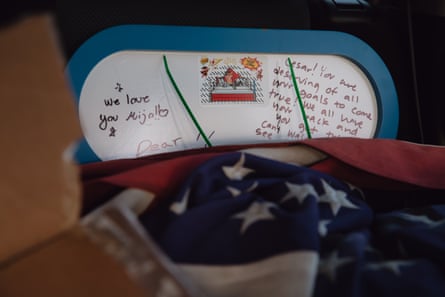
In the back seat of his car, a whiteboard filled with encouraging messages for Vasquez sits alongside an American flag.
Jennifer Chowdhury reported this story while participating in the USC Annenberg Center for Health Journalism’s Kristy Hammam Fund for Health Journalism



 The phenomenon was discovered during a 2023 heatwave in Papua New Guinea.


 Cesar Vasquez, who has supported families of undocumented immigrants since age 14, has become a community lifeline – and a known ICE target





 Scottie's Playtime