Right from the start of my leaving the military I vowed to be an out proud gay man. This was in 1986. It has lead to a lot of embarrassing conversations. People have asked me such personal questions on same sex actions and how gay feelings might differ from straight feelings. At first I found it weird and offensive, but as I got older I realized I brought a lot of straight cis people to be allies simply by being willing to answer sensitive or stupid questions. I remember one weekend a straight co-worker with two young children showed up at my house. Thankfully he had left his children at home with a sitter as he had lost his wife. After talking for a few minutes he got around to discussing gay sex and why I liked it. I struggled to understand his questions and to explain it to him. He then surprised me. He said show me. I was like what? He said let’s have sex. I thought oh shit a straight guy who just wants to fuck a gay guy and put that notch on his sex card. I was wrong. He started taking off his clothing and said to me, you say it feels good, it is like me with a woman, so it should be the same. He wanted to do oral sex and then anal, but wanted me to do anal with him being the bottom first. I was desperately trying to explain to him that the first time can be bad or painful and it is not just about sex. It is a need, and emotional feeling. He was like we are friends, I like you, you like me so it should be OK.
Let’s just say after that night he was still straight but he understood how two men had sex. I was surprised when after giving him oral he insisted on doing the same to me. But later I remembered my years in the military and how many straight young guys begged me to go with them on passes and have sex. It was never one sided. I have realized a lot of bigotry can be undone, can be reversed by simply sharing time with those that are the “other”. Everyone needs someone to hold, to touch, to feel a connection with. Hugs
Even though the school was started as a LGBTQ+ safe space they had to remove anything affirming the LGBTQ+ people. The goal of the republican right is to erase LGBTQ+ people from the public society. They don’t want us seen, they do not want us talked about. They especially don’t want kids to understand they can be themselves if they are not straight or cis. They want kids to feel they must fit the mold of straight and cis only. If you feel differently you must hide it and live miserably to make the snowflake Christian nationalist right feel comfortable. This will backfire on them. Just as the LGBTQ+ overcame the full force of the right’s bigotry once we can do it again. We have moved far too toward equality to let them push us from society again. The young people will not accept it nor tolerate the regression of freedoms to make a few bigots feel comfortable with the world around them. They also know that intolerant maga driven my the cult of tRump won’t last forever. Hugs
“We have had rainbows in our building because we are affirming to all people, and at some point our mission statement included a segment that said ‘We are affirming to LGBTQ people,’ but we have taken that out.”
Before the vote Wednesday, she said the school painted over rainbow colors and designs and replaced maps with ones that had a “Gulf of America” label. They revised the logo and reviewed textbooks and other documents.
Months after its contract was threatened over a rainbow mural and a map labeling the Gulf of Mexico, an Alabama charter school will stay open.
The state charter commission voted Wednesday to renew Magic City Acceptance Academy’s contract, allowing the school to operate for five more years. The school and its leaders came under fire this spring for allegedly violating aspects of Alabama’s new anti-DEI law, which prohibits so-called “divisive concepts” and other diversity and inclusion programming in public schools and colleges.
“I’ll say the thing that we’re all thinking,” said Karen Musgrove, the school’s CEO, after being pressed by one commissioner to address the “monster in the room.”
“We have had rainbows in our building because we are affirming to all people, and at some point our mission statement included a segment that said ‘We are affirming to LGBTQ people,’ but we have taken that out.”
“We’re affirming to all people. We’re affirming to our Black students. We’re affirming to our Hispanic students. We’re affirming to our LGBTQ students, which are in every school in the state.”
Magic City Acceptance Academy opened in 2021 in an effort to provide a supportive learning environment for LGBTQ students and other at-risk populations. Students and staff say they built a welcoming community in the Birmingham-area school, despite a firestorm of political backlash over the years.
In a plea to commissioners, one parent said “everything changed” for her son after enrolling at MCAA. He stopped skipping class, vaping and fighting, and he’s now excelling in college-level courses.
“Renewing Magic City’s charter means continuing to change lives like my son’s,” she said. “It means giving more kids the chance to discover their potential and their purpose.”
After a brief debate, the commission ultimately renewed the charter – on the condition that it agreed to maintain “strict adherence throughout its shorter term to Alabama laws, specifically including, without limitation, Alabama Code 41190,” the state’s “divisive concepts” law. If it fails to comply, Magic City could be subject to sanctions, said Lane Knight, the commission’s lawyer.
“They’ve got the financial support, they’ve got a good program, they’ve got the leadership,” said commission member Charles Knight. “And again, we all agree that we’re trying to create environments where students are educated, and obviously they’re doing a good job of that.”
Recent changes
According to emails obtained by AL.com, school officials contacted the charter commission in early 2025, just days after 1819 News ran an article claiming the school was violating the law by hosting a “radical LGBTQ+ anti-America author” and promoting diversity, equity and inclusion in its handbook.
Musgrove reached out to the commission’s director, Logan Searcy, for advice on January 24. She sent Searcy changes to the school’s mission statement a week later.
Between February and March, 1819 published a handful of articles about the school. Republican lawmakers threatened its funding and called for a state investigation.
In early February, the commission paid the school another visit.
“The goal here is to report our diligence in monitoring the school to hopefully alleviate concerns at renewal time,” the commission’s financial specialist, Douglas Riley, wrote to Principal Patton Furman on Feb. 4. “I suspect you will see much more attention from the Commission this spring with that goal in mind. Please understand the spirit in which these efforts are intended, we want to identify and fix problems before they grow into something serious.”
He wrote to school leaders again after the visit: “Y’all are making some strong moves and I hope we can put the recent press behind us and have a smooth renewal process later this year.”
That same day, the commission sent the school a letter, noting that it had received “various reports” that the school’s curricula and programming violated the new law.
Searcy visited the school, along with commission member Cynthia McCarty, on Feb. 20, according to emails.
On March 6, Musgrove issued a lengthy response to the commission’s letter, claiming that leaders had already taken steps to make changes to decor and programming, and that they had not received any negative feedback after members’ visits to the school.
Before the vote Wednesday, she said the school painted over rainbow colors and designs and replaced maps with ones that had a “Gulf of America” label. They revised the logo and reviewed textbooks and other documents.
“We don’t see ourselves as being divisive,” she said. “Because we did exactly what was asked of us.”
A new outlook
It is rare for an Alabama charter school to close down after its initial contract is granted. If the commission has any concerns about a school’s viability, they may issue a shortened two- or three-year contract.
The commission originally suggested a three-year contract for Magic City, but voted to approve a standard five-year one after some pushback.
With the greenlight from the commission, school officials plan to start work immediately on a new building, which will feature a large theater, band room and expanded mental health resources.
It plans to eventually serve up to 500 students.
“We are going to make you proud,” Musgrove told the commission. “We’re doing amazing things, and we want you to be a part of that relationship.”
The commission also approved a five-year extension for LEAD Academy in Montgomery and a three-year extension for Breakthrough Academy in Perry County.
—————————————————————————————————————–
Rebecca Griesbach
Rebecca Griesbach is a data reporter at AL.com, covering education and other issues across the state. She joined the newsroom in 2021 as a founding member of the Alabama Education Lab and a Report for America… more
Growing up as someone who is different from the majority is difficult no matter the circumstances. For the LGBTQ+ it is horrific when just your very existence is called an abomination and you are equated with the worst being in history. Especially when your parents and your god are pushing the idea that you are a monster who can only be cured if you follow their god, their church doctrines, have their feelings about everything in your life. Hugs.
A guest essay by Sean Robinson – Spencer’s boyfriend.
Subscribe
When I was around 10 years old, I remember horsing around in the grass with my oldest brother. I asked him the meaning of homosexuality, a word that I had heard from my parents and from the New Order Amish and Mennonite communities I was surrounded by growing up in upstate New York and rural Virginia.
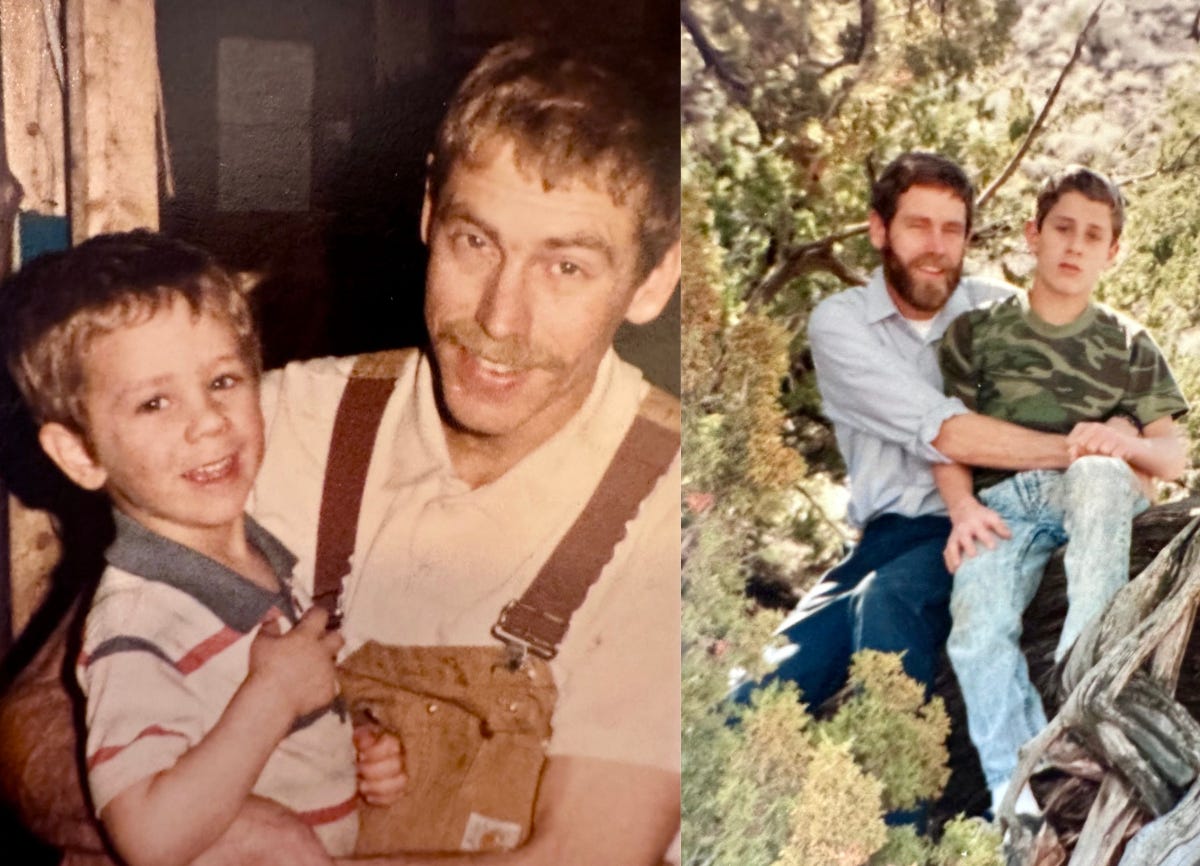
Sean and his dad Upstate New York. Photo courtesy of Sean.
While I wasn’t certain what the word meant, I knew it was bad and I was pretty sure it was me. So when my brother responded to my question by saying that homosexuality is “demonic,” I pushed those thoughts down.
A few years later, my dad told me that once someone becomes a homosexual, they will “want more and more and more” and it will lead to a sexual desire for “children, then animals, then blood.”
Sean and his dad through the years. Photos courtesy of Sean.
Subscribe
Hearing these ideas persistently and consistently made me feel like there was this horrible thing inside of me that I just hated. I had learned that it was akin to being a pedophile, and that’s how I felt about myself.
These feelings created so much shame and fear but most of all a level of embarrassment that was so intense that I vowed to myself I would take my secret to the grave.
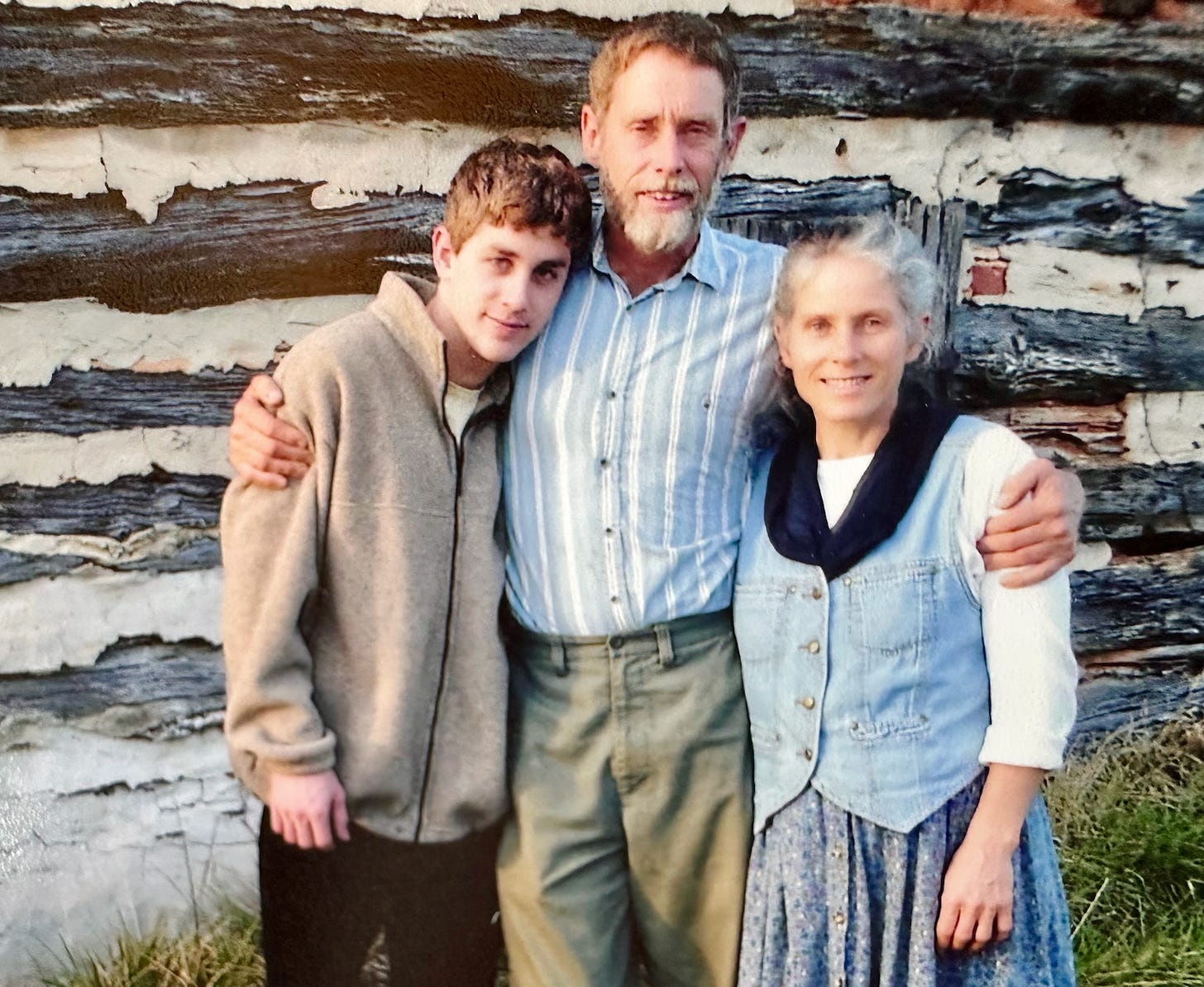
Sean and his parents. Photo courtesy of Sean.
Subscribe
But I didn’t. When I met just one gay person at Danville Community College, I felt a small but significant rumbling of hope. This encounter gave me the courage to leave. So at 17, I told my parents I was moving to New York City to pursue the performing arts.
While I was semi-interested in being on screen, I saw NYC as a symbol of a new life where I could be my authentic self. A few months after I moved, I came out to my mom over the phone, who later told me—through a puddle of tears—that I might as well have died in a car accident.
I had to dig to make a life for myself with few people in my corner. I utilized NYC social programs like SNAP benefits, free health care and low-income housing. These services gave me the bootstraps I needed to pull myself up.
The years of familial and community rejection and efforts to change me through conversion therapy took more than two decades of treatment, medication and supportive friendships to help me find a formula where today—at 40 years old—I can manage my depression, anxiety, tics (that were at one point debilitating), no-contact relationship with my parents and low self-esteem.
I am so grateful to the heroes who helped me through these years: Paul Warner, Jerry Meadors and countless others. You lifted me up, taught me the ropes, allowed me to couch surf and showered me with love.
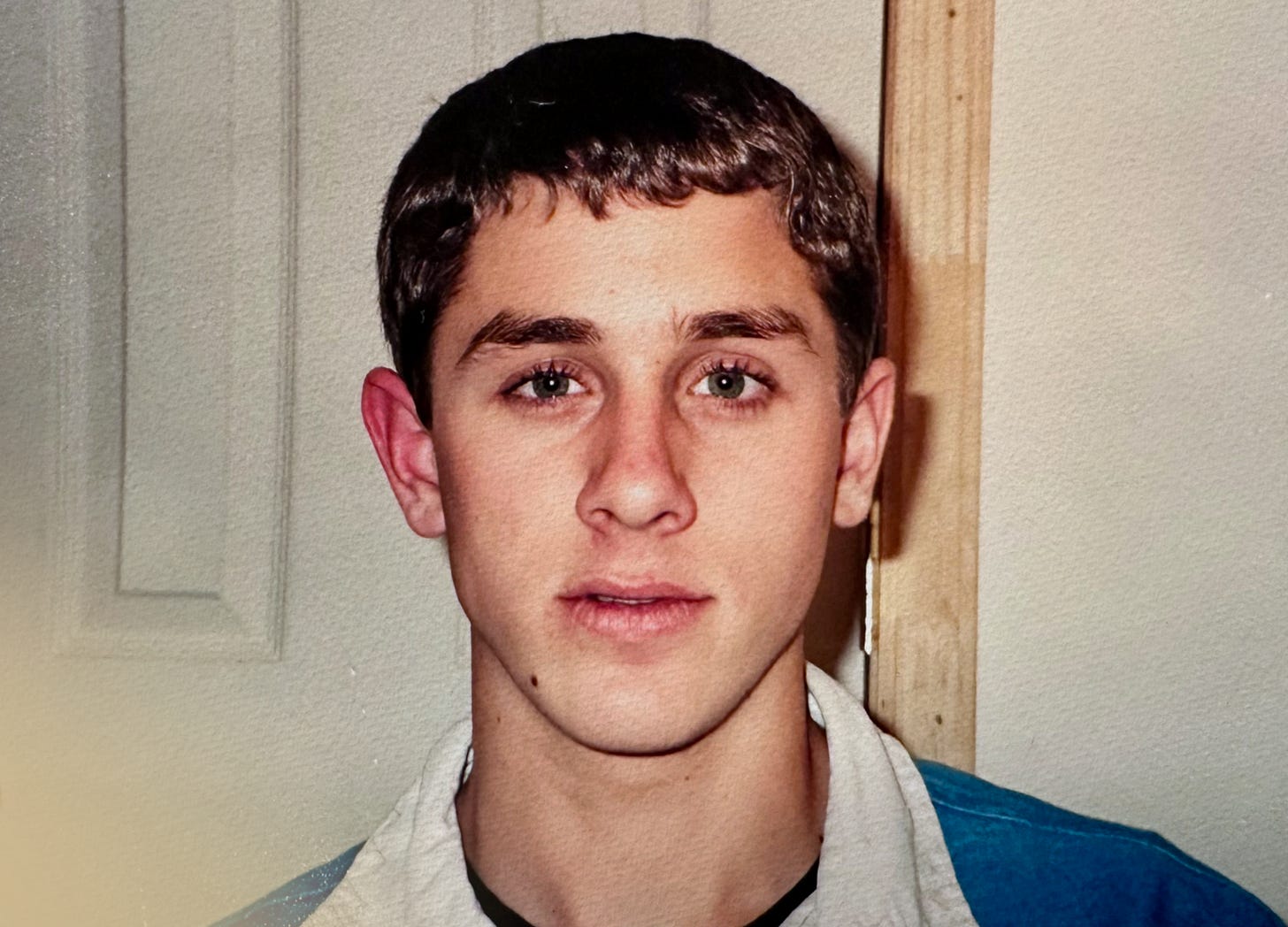
Sean in his teens. Photo courtesy of Sean.
Fighting the demons of my past, including years of religious trauma and physical abuse disguised as “corporal punishment,” is something I’d wish on nobody. When I read Uncloseted stories that discuss how nearly 40% of LGBTQ kids seriously considered suicide in the last year, my heart breaks because I know that could have been me if my path had veered a degree in a different direction.
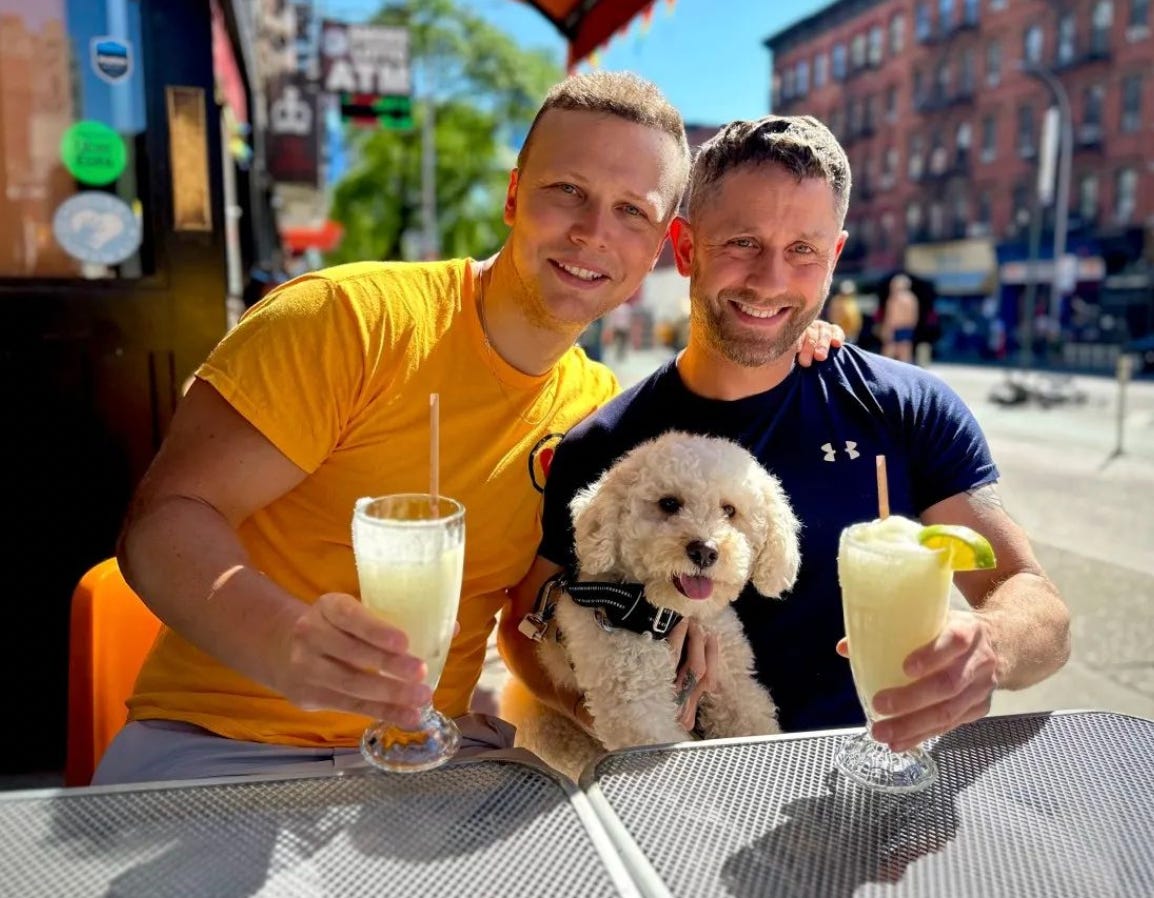
Sean with Spencer and his psychiatric service dog Carson. Photo courtesy of Sean.
Flash forward 20 years and I’m sitting next to Spencer, who’s helping shine a spotlight on the very thing I tried to suppress in the darkness of my mind. I am now a video editor at MTV, working on RuPaul’s Drag Race, the groundbreaking television show that has helped so many queer kids across America feel seen and feel safe—something every child deserves.
I’ve always been resilient and tough.
But finally, I feel calm and free.
Response from Sean’s Dad:
In a text message to Uncloseted Media, Sean’s dad, Chris Robinson, wrote that he remembers saying that “when the moral fabric of societies begin to decay it usually starts with the sin of not acknowledging Almighty God, the Giver and Sustainer of life. [If] that condition of man continues then more sin comes [including] adultery, fornication and general unfaithfulness. The next level is men allowing women and children to rule. This would have been the feminist movement of the 60’s. Next comes homosexuality then bestiality and finishing up with child and adult sacrifice and much shedding of blood. This progression is recorded in Genesis and through the Chronicles and Kings in the Bible.”
In response to Sean’s references to corporal punishment, his dad wrote that he remembers being “shocked at [Sean’s] fearless defiance to [his] authority … as being the one responsible for order in the home” and that he would punish him—after multiple verbal warnings for misbehavior—by giving him “4 or 5 good licks with the switch and [would then] give him a hug and prayer and hope he got the message.” His dad added that he and Sean had many good times too and that he “still shed[s] a tear at times in memory of [his] little Seany.”
Response from Sean’s Mom:
In a text message to Uncloseted Media, Sean’s mom, Michelle Robinson, does not remember telling Sean after he came out that he might as well have died in a car accident. “My mind is blank for anything specific,” she wrote.
In response to Sean’s reference to corporal punishment, his mom says that out of the hundred times where corporal punishment was administered correctly through biblical spanking done with love, there were “a handful of times when his father admits he acted more in anger as [an] immediate reaction because of Sean’s behavior and he realizes he should’ve done that differently [and that his dad] always immediately apologized and they always had special time together and they worked through that.”
“We believed in honoring God with our life. We were not perfect but our heart was to please God,” she wrote, adding that Sean was treated with love as a child and through adulthood.
Sean’s brother did not respond to Uncloseted Media’s request for comment.
If objective, nonpartisan, rigorous, LGBTQ-focused journalism is important to you, please consider making a tax-deductible donation through our fiscal sponsor, Resource Impact, by clicking this button:
At the South Louisiana Ice Processing Center in Basile, detainees say they were forced into hard labor – and sexually assaulted and stalked by an assistant warden
‘It is for my daughter and my family that I have endured everything that I have in this detention facility for the past 28 months.’ Illustration: Rita Liu/The Guardian
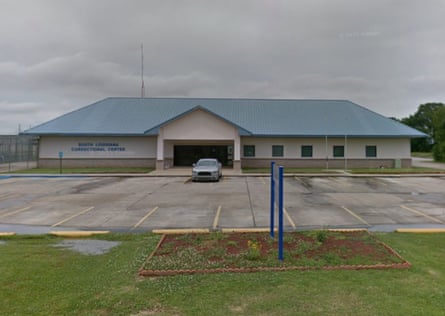
A Google Maps screenshot of the South Louisiana Ice Processing Center (SLIPC) in Basile, Louisiana.
Photograph: Google Maps
A spokesperson for Geo categorically denied the allegations detailed in the complaints.
Photograph: Patrick T Fallon/AFP/Getty Images
Queer and trans immigrants at a detention facility in south Louisiana have alleged that they faced sexual harassment and abuse, medical neglect and coerced labor by staff at the facility, and that they were repeatedly ignored or faced retaliation for speaking out.
In multiple legal complaints, immigrants detained at the South Louisiana Ice Processing Center (SLIPC) in Basile, Louisiana, said they were recruited into an unsanctioned work program that forced them to perform hard manual labor for as little as $1 per day. Detainees also alleged that queer people were targeted by an assistant warden who stalked, harassed and sexually assaulted them.
Three current and former detainees who spoke to the Guardian said that, between 2023 and 2025, they endured months of abuse from an assistant warden named Manuel Reyes and his associates. In their complaints to the Department of Homeland Security (DHS) and Immigration and Customs Enforcement (Ice), the detainees also said that they faced retaliation for reporting the abuse to authorities, alleging that Reyes and other staff beat them and denied them medical treatment.
“I was treated worse than an animal,” said Mario Garcia-Valenzuela, one of the detainees. “We don’t deserve to be treated like this.”
Garcia-Valenzuela, a trans man detained at SLIPC, has alleged that, as part of the unsanctioned work program, Reyes forced him to move heavy cabinets and cinder blocks, and to clean using industrial-strength chemicals without gloves or protective gear. When Garcia-Valenzuela complained of injuries from the work program, he said, Reyes and his associates forcefully stripped him naked and mocked him.
Kenia Campos-Flores, who is trans and non-binary, told the Guardian that they suffered from persistent migraines and chest pain after exposure to cleaning chemicals they were made to use during unofficial, overnight work shifts. Campos-Flores also alleged in a complaint they were persistently sexually harassed by Reyes, who entered their dorm and stole possessions including their boxers.
Another trans detainee, Monica Renteria-Gonzalez, complained that a stripper chemical he was told to use to clean the facility floors seeped through his fabric shoes and burned the skin of his feet. On more than one occasion, while Renteria-Gonzalez was bent over cleaning, he said, Reyes came up from behind and inappropriately touched him. The assistant warden also told Renteria-Gonzalez he was watching the detainee through security cameras, including while he was showering.
A fourth detainee, identified by the pseudonym Jane Doe, is a cisgender, queer woman who said that Reyes forced her to perform oral sex on him on a “near daily basis” between February and May 2024, threatening to kill her if she refused, according to her complaint.
Doe, who was deported to the Dominican Republic in January this year, has chosen not to share her name or speak publicly because she fears that Reyes will make good on his threat to find and harm her, her lawyer said.
Taken together, the detainees’ stories present a troubling pattern of mistreatment and abuse inside SLIPC, their attorneys said. Though the alleged abuse took place across two presidential administrations, advocates worry that conditions inside detention facilities could further deteriorate amid the Trump administration’s present push to arrest and detain a record number of immigrants. Trans and queer immigrants in detention are especially vulnerable, advocates said, given that the administration is also moving to roll back key civil rights protections for LGBTQ+ people in federal custody.
The detainees’ allegations are detailed in four separate administrative complaints filed under the Federal Tort Claims Act, which allows individuals to sue the government for injuries caused by federal employees. The government has six months to adjudicate the complaints, or the claimants could move forward with a federal lawsuit. They were submitted in September by Robert F Kennedy Human Rights, the American Civil Liberties Union (ACLU) of Louisiana and the National Immigration Project. Those groups have also submitted a civil rights complaint to the DHS oversight bodies, including the office for civil rights and civil liberties (CRCL), on behalf of the detainees.
“This was a sadistic late-night work program,” said Sarah Decker, a senior staff attorney with RFK Human Rights. “It was designed to target vulnerable trans men or masculine-presenting LGBTQ people, who [Reyes] coerced into participating.”
When detainees tried to report their abuse, Decker said, Ice officials repeatedly disregarded them. Officials dismissed multiple reports of abuse in accordance with the federal Prison Rape Elimination Act (Prea), Decker said, as well as complaints to the Ice office of inspector general (OIG), the department charged with oversight of Ice.
“These people screamed for help. They filed grievances. They filed complaints under the Prison Rape Elimination Act, they filed verbal complaints through the office of the inspector general. They did everything to get help,” Decker said. “And they were systematically ignored, and complaints were buried.”
The Guardian attempted to locate Reyes though multiple means, including public records and social media searches and were unable to contact him. Reyes is not facing criminal charges for the alleged sexual abuse at the facility.
He is no longer employed at SLIPC, Decker said – he left the facility in July 2024. But, Renteria-Gonzalez and Garcia-Valenzuela, who remain detained at SLIPC, told the Guardian other staff at the facility have continued to retaliate against them, placing them in solitary confinement and denying them full access to medical care.
The DHS and Ice did not respond to the Guardian’s queries about the detainees’ allegations, nor did the agencies address whether any of the detainees’ Prea complaints were investigated.
‘It’s devastating and heartbreaking, everything that they do to us in here’
Located about 90 miles (145km) from the Gulf coast in the rural town of Basile, Louisiana, SLIPC was once a correctional facility. But in 2019, it opened as an Ice detention facility, operated by Geo Group, one of the largest private prison and surveillance firms in the US.
Over the past several years, the detention center, which houses mostly women as well as a few trans people, has attracted a string of allegations of civil and human rights violations, medical neglect and poor hygiene. In 2022, an internal inspection by the office of the immigration detention ombudsman – an independent office within the Department of Homeland Security – found that the facility had insufficient medical staffing, and had been inconsistent in addressing the medical and mental health needs of detainees. A 2025 report by the Yale Law School also found that detainees were “left hungry, cold, and in an atmosphere detainees describe as abusive”.
A Google Maps screenshot of the South Louisiana Ice Processing Center (SLIPC) in Basile, Louisiana. Photograph: Google Maps
“It’s devastating and heartbreaking, everything that they do to us in here,” said Renteria-Gonzalez, who first arrived at the facility in May 2023. “We struggle on a daily basis.”
He said his decision to remain in detention while his immigration case is under review – rather than accept deportation – has been painful.
Renteria-Gonzalez came to the US when he was 12 and has been in the country for 31 years. His eight-year-old daughter is a US citizen. “It is for my daughter and my family that I have endured everything that I have in this detention facility for the past 28 months,” he said. “It’s so that I can make it back home to her.”
Renteria-Gonzalez said Reyes first recruited him to participate in the late-night work program in September 2023, according to his complaint. Reyes would often come into his dorm late at night – at around 2 or 3am – to wake him up for his night shift.
“It’s like he lived [at the detention center] 24/7,” Renteria-Gonzalez told the Guardian.
Each recruit worked alone, during different times or in different parts of the detention facility – meaning they were often alone with Reyes, the detainees allege. During these times, Renteria-Gonzalez said, he would watch them work and probe them with invasive and inappropriate questions. “It made me feel uncomfortable,” he said. “He used to sit on his phone and asked us for personal information to look us up on Facebook and stuff.”
Sometimes, he said, Reyes entered detainees’ dorms late at night for no particular reason, and would take their used underwear and personal hygiene products. On other occasions, Renteria-Gonzalez alleged in the complaint, Reyes would stalk him as he went to and from the showers and ask invasive questions: “And after, he would say: ‘Tell me what were you doing in the shower?’”
Twice, Renteria-Gonzalez said, Reyes came up behind him and touched him inappropriately. Another SLIPC officer, according to Renteria-Gonzalez, began to sexually harass him as well, sending him explicit notes and showing him pornographic images of herself.
“I just felt overwhelmed,” he said. “I thought enough was enough.”
Eventually, he realized he wasn’t alone.
After being detained at SLIPC in February 2024, Garcia-Valenzuela said he also found himself trapped in Reyes’s unofficial work program.
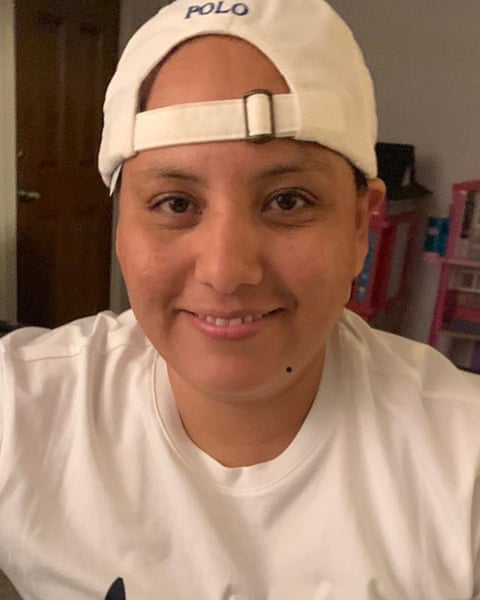
Mario Garcia-Valenzuela. Photograph: Mario Garcia-Valenzuela
Garcia-Valenzuela had fled to the US in 2014 from Mexico, where he was tortured by members of a drug cartel. “I have no choice, that’s why I’m fighting,” he said. “Because I know that as soon as they deport me, I’m going to be handed over to the cartels and I’m going to be tortured and killed – ripped into pieces.”
But in SLIPC he faced a new kind of horror. He alleged that on more than one occasion he was told to move heavy metal filing cabinets back and forth across a room. When he struggled to lift the furniture, Reyes would taunt him, he said, saying: “If you think you are a man, I’m going to treat you like a man.”
In the spring of 2024, Garcia-Valenzuela reported sexual harassment on the basis of his gender, in accordance with Prea. He said he felt targeted due to his gender identity and wanted the fact he is transgender removed from his file, as a measure of protection. But an Ice officer responded that “even if we take off your transgender marker, there is no hiding that you are transgender”, noting Garcia-Valenzuela’s physical appearance, he said. To Garcia-Valenzuela’s knowledge, no follow-up investigation into Reyes was conducted.
Renteria-Gonzalez’s complaints were dismissed as well, Renteria-Gonzalez said.
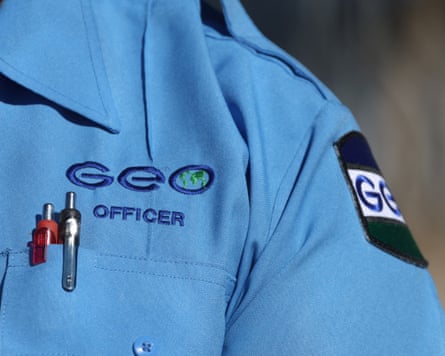
A spokesperson for Geo categorically denied the allegations detailed in the complaints.
“GEO strongly disagrees with these baseless allegations, which are part of a long-standing, politically motivated, and radical campaign to abolish ICE and end federal immigration detention by attacking the federal government’s immigration facility contractors,” said Christopher V Ferreira, a Geo group spokesperson.
Ferreira added that “GEO has comprehensive policies in place for the reporting and investigation of all incidents that occur at the Center, including instances of assault and/or sexual assault. These policies are governed by standards and requirements established by the US Department of Homeland Security.”
Geo did not respond to questions about Reyes’s employment status at SLIPC.
Harsh retaliation
The detainees who filed complaints against Reyes and other SLIPC staff said that they faced harsh retaliation for doing so.
When Jane Doe filed a Prea complaint with Ice using a paper form and through the phone hotline, detailing that Reyes had sexually assaulted her, she received no response, according to her legal complaint.
But afterwards, Reyes redoubled his efforts to stalk her, the complaint alleges – and forced her to perform oral sex on him, saying he had her cornered in the facility’s “camera blind spots” where no one would see them.
When she attempted to resist, Reyes told her he had found her mother’s home address in the Dominican Republic, Doe alleges in the complaint, and told her that if she were deported, he would follow her to her family’s residence where “you won’t have any protection”.
A spokesperson for Geo categorically denied the allegations detailed in the complaints. Photograph: Patrick T Fallon/AFP/Getty Images
Jane Doe said Reyes and other staff also blocked her from accessing medical treatment for her epilepsy, even as her seizures became more severe and frequent during her time in detention, the complaint states. He repeatedly cornered Doe as she was en route to the medical center to receive treatment, and told her he would watch her on cameras while she was receiving medical evaluation. On one occasion, he told Doe he was “masturbating to her because he saw her body in medical condition when she was in an observation cell”, the complaint alleges.
“We feel so vulnerable, impotent,” Renteria-Gonzalez said.
After he reported that Reyes had sexually assaulted him, Renteria-Gonzalez said, Reyes burst into his housing unit and yelled, “You should have never put my name on it!”, in reference to the complaint to Ice. Renteria-Gonzalez said he was then placed in solitary confinement for two weeks.
After Renteria-Gonzalez reported harassment from another officer, his complaint was dismissed as “unsubstantiated” and the officer came back and told him: “They can’t do nothing to me,” according to the complaint.
Meanwhile, Garcia-Valenzuela said he was repeatedly sent to solitary confinement, he believes in retaliation for speaking out. He said staff at the detention center falsely reported that he had attempted self-harm, and needed to be placed under suicide watch, even though he had not in fact tried to hurt himself.
At one point, while Garcia-Valenzuela was in the medical isolation unit, officers delivered him a meal that consisted of a few potatoes and a few grains of cereal. There was no spoon provided, he said, and there was a note that instructed him to eat it “like a dog”.
Shortly after that incident, he said, a doctor at the facility suddenly – without explanation – stopped providing him access to medication for hand pain that had been exacerbated by his working in Reyes’s night-shift program.
He has avoided making further complaints. He tries not to speak to or make eye contact with staff, and avoids leaving his dorm. He limits trips to the restroom, he said. And rather than go to the cafeteria to warm up his food and eat, he takes his meals cold, and dines in bed. “I have to stay in the back-most corner of my bed, and eat there,” he said.
“I don’t ever feel at ease.”
Trans people in federal custody under threat
The allegations of abuse at SLIPC come at a time when the health and safety of trans people in federal custody is especially under threat, advocates say.
On the first day of his presidency, Donald Trump unveiled a flurry of executive actions targeting trans rights, rolling back anti-discrimination protections and mandating that people in immigration detention be placed in facilities based on their sex assigned at birth.
On 16 January – the last day of Joe Biden’s administration – Ice reported that 47 trans people were in Ice detention facilities around the country and that 69 had been arrested since the start of the fiscal year. As soon as Trump took office, the agency began omitting data on the number of transgender people in immigration detention from its reports.
“The government is essentially refusing to acknowledge the existence of trans people, let alone their humanity,” Decker of RFK Human Rights said.
Although a federal judge has blocked enforcement of Trump’s ban on transgender healthcare in federal prisons, Decker told the Guardian that inside detention centers, guards and staff have been emboldened to deny healthcare to trans clients, or retaliate against them for requesting care.
“I worry that the situation will only get worse from here for trans people,” she added.
The administration also closed the civil rights division of the DHS, as well as the ombudsman office overseeing immigration detention, arguing that the staff in these congressionally mandated divisions were “internal adversaries that slow down operations”.
The divisions included employees tasked with regularly visiting detention centers, investigating complaints and preparing reports for Congress. Detainees facing discrimination, neglect and abuse now have even fewer options for recourse, Decker said.
LGBTQ+ Americans consider move to Canada to escape Trump: ‘I’m afraid of living here’
Read more
It’s a scary, difficult moment to speak out, said Campos-Flores, a 37-year-old single parent of two children who came to the US from El Salvador when they were 11 years old.
During the seven months that Campos-Flores was detained at SLIPC, they would call their parents every day, just to reassure them that they were still alive. Periodically, they would beg their family and their lawyer to find ways to get them out. “I asked them to try to book me into another facility,” they said. “It was too much – just too much.”
In November 2024, they were deported – and immediately they felt a sense of relief to be freed from Reyes, they said. But they couldn’t stay away from their children, who are US citizens – so they crossed back into the US and were again apprehended.
They are currently detained at a different correctional facility in Louisiana, serving a criminal sentence for illegal re-entry. But after finishing their sentence, it is likely they will be transferred back to SLIPC before deportation – and face the same officers who harassed them, or ignored their complaints.
“But I have my 12-year-old son. He is also gay, he likes boys, and I don’t want him to experience anything like what I have experienced,” they said. They want to fight for his rights, too, they said.
I am not trans even though I have been asked because of my super strong support of trans people. I have lost friends who wouldn’t accept trans people using a public bathroom with them even though all private functions happen in enclosed little stalls. I do have distant family members who are trans and fully supported by family. More important I can clearly see the same negative vile things said about trans people are the same things pushed against gay people when I was a struggling gay teen being pushed by the same groups on the same ideas of victimhood. They were mostly driven by hyper Christian Nationalist religious groups and those who demanded that traditions along with society never change from when they were young and happy. These same groups and feelings are in play against trans people. They are simply the homosexual aids scare of the 1980s. Just as I as a young gay person needed allies and support so do trans people today. Please give as much vocal and upfront support for trans people you can. It is easier to make progress as a society if we don’t have to undo hateful laws outlawing our very existence. Hugs
is today in Peace & Justice History. Feeding people is my main “thing,” so I’m featuring it today. There is so very much that has happened on October 16, and it can all be seen on this page.
October 16th every year
United Nations’ World Food Day is recognized every year.
Robin Abcarian, Los Angeles Times on Published in Op Eds
I had a difficult time reading the gut-wrenching accounts from the parents of gay children who are part of the Supreme Court case about conversion therapy bans and freedom of speech.
All claim their family relationships were seriously damaged by the widely discredited practice, and that their children were permanently scarred or even driven to suicide.
The case, Chiles vs. Salazar, arose from a 2019 Colorado law that outlaws conversion therapy, whose practitioners say they can change a minor’s sexual orientation or gender identity to align with heterosexual and cisgender norms. The therapy is considered harmful and ineffective by mainstream medical and mental health organizations.
At least two dozen other states have similar laws on the books, all of them good-faith attempts to prevent the lasting harm that can result when a young person is told not just that they can change who they are, but that they should change because God wants them to. The laws were inspired by the horrific experiences of gay and transgender youths whose families and churches tried to change them.
The case was brought by Kayley Chiles, a licensed counselor and practicing Christian who believes, according to her attorneys, that “people flourish when they live consistently with God’s design, including their biological sex.”
Colorado, incidentally, has never charged Chiles or anyone else in connection with the 2019 law.
Chiles is represented by the Alliance Defending Freedom, a conservative Christian law firm known for its challenges to gay and transgender rights, including one brought to the Supreme Court in 2023 by Christian web designer Lorie Smith, who did not want to be forced to create a site for a gay wedding, even though no gay couple had ever approached her to do so. The Court’s conservative majority ruled in Smith’s favor. All three liberals dissented.
As for conversion therapy, counselors often encourage clients to blame their LGBTQ+ identities on trauma, abuse or their dysfunctional families. (If it can be changed, it can’t possibly be innate, right?)
In oral arguments, it appeared the conservative justices were inclined to accept Chiles’ claim that Colorado’s ban on conversion therapy amounts to viewpoint discrimination, a violation of the 1st Amendment’s free speech guarantees. The liberal minority was more skeptical.
But proponents of the bans say there is a big difference between speech and conduct. They argue that a therapist’s attempt to change a minor’s sexual orientation or gender identity amounts to conduct, and can rightfully be regulated by states, which, after all, lawfully impose conditions on all sorts of licensed professionals. (The bans, by the way, do not apply to ministers or unlicensed practitioners, and are generally not applicable to adults.)
Each competing brief whipsawed my emotions. The 1st Amendment is sacred in so many ways, and yet states have a critical interest in protecting the health and welfare of children. How to find a balance?
After reading the brief submitted by a group of 1st Amendment scholars, I was convinced the Colorado law should be ruled unconstitutional. As they wrote of Chiles, she doesn’t hook her clients to electrodes or give them hormones, as some practitioners of conversion therapy have done in the past. “The only thing she does is talk, and listen.”
Then I turned to the parents’ briefs.
Linda Robertson, an evangelical Christian mother of four, wrote that she was terrified when her 12-year-old son Ryan confided to her in 2001 that he was gay. “Crippling fear consumed me — it stole both my appetite and my sleep. My beautiful boy was in danger and I had to do everything possible to save him.”
Robertson’s search led her to “therapists, authors and entire organizations dedicated to helping kids like Ryan resist temptation and instead become who God intended them to be.”
Ryan was angry at first, then realized, his mother wrote, that “he didn’t want to end up in hell, or be disapproved of by his parents and his church family.” Their quest to make Ryan straight led them to “fervent prayer, scripture memorization, adjustments in our parenting strategies, conversion therapy based books, audio and video recordings and live conferences with titles like, ‘You Don’t Have to be Gay’ and ‘How to Prevent Homosexuality.’ ”
They also attended a conference put on by Exodus International, the “ex-gay” group that folded in 2013 after its former founder repudiated the group’s mission and proclaimed that gay people are loved by God.
After six years, Ryan was in despair. “He still didn’t feel attracted to girls; all he felt was completely alone, abandoned and needed the pain to stop,” his mother wrote. Worse, he felt that God would never accept him or love him. Ryan died at age 20 of a drug overdose after multiple suicide attempts.
As anyone with an ounce of common sense or compassion knows, such “therapy” is a recipe for shame, anguish and failure.
Yes, there are kids who question their sexuality, their gender identity or both, and they deserve to discuss their internal conflicts with competent mental health professionals. I can easily imagine a scenario where a teenager tells a therapist they think they’re gay or trans but don’t want to be.
The job of a therapist is to guide them through their confusion to self-acceptance, not tell them what the Bible says they should be.
If recent rulings are any guide, the Supreme Court is likely to overturn the Colorado conversion therapy ban.
This would mean, in essence, that a therapist has the right to inflict harm on a struggling child in the name of free speech.
Miss Major Griffin-Gracy, a legendary transgender activist who had been in the movement since Stonewall, died Monday at age 78.
Her death was announced by the House of GG—Griffin-Gracy Retreat and Educational Center, which she founded. She died “in the comfort of her home and surrounded by loved ones in Little Rock, Arkansas,” says a statement from the center. “Her enduring legacy is a testament to her resilience, activism, and dedication to creating safe spaces for Black trans communities and all trans people — we are eternally grateful for Miss Major’s life, her contributions and how deeply she poured into those she loved.”
Miss Major had suffered from health problems for some time and had recently begun receiving hospice care.She spent more than 50 years fighting for the “trans, gender-nonconforming, and LGB community — especially for Black trans women, trans women of color and those who have survived incarceration and police brutality,” the statement continues. Major’s fierce commitment and intersectional approach to justice brought her to care directly for people with HIV/AIDS in New York in the early 1980s, and later to drive San Francisco’s first mobile needle exchange. As director of the TGI Justice Project, she’d return to prisons as a mentor to her ‘gurls’ inside.”
She founded House of GG in 2019 as “a space for our community to take a break, swim, enjoy good food, laugh, listen to music, watch movies, and recharge for the ongoing fight for our lives,” the statement goes on. “Miss Major fought tirelessly for her people, her love as vast and enduring as the universe she knew herself to be a part of. She was a world builder, a visionary, and unwavering in her devotion to making freedom possible for Black, trans, formerly and currently incarcerated people as well as the larger trans and LGB community. Because of her, countless new possibilities have been made for all of us to thrive — today and for generations to come. She affirmed that our lives hold meaning and that we stand on the shoulders of giants like her, whose courageous love and relentless fight assured our right to live with dignity. We will forever honor her memory, her steadfast presence, and her enduring commitment to our collective liberation.” (snip-MORE good history and story on the page)


 rgriesbach@al.com



‘It is for my daughter and my family that I have endured everything that I have in this detention facility for the past 28 months.’ Illustration: Rita Liu/The Guardian
A Google Maps screenshot of the South Louisiana Ice Processing Center (SLIPC) in Basile, Louisiana.
Photograph: Google MapsA spokesperson for Geo categorically denied the allegations detailed in the complaints.
Photograph: Patrick T Fallon/AFP/Getty Images




 Scottie's Playtime