
Putin must be so pleased with his US employee and asset. This thin skined ego managi in dementia with a cult following and a terrified Republican Party has ruined all efforts to rein in dictatorships and authoritarian countries. The only authoritarian country they attack is because it has the wrong religion for the religious part of the cult. This tRump guy wrote love letters to the dictator of North Korea and bows deeply metaphorically to Putin, talking lovingly about autocrats around the world who push white supremacy and the Christian family values talking points. But since his first term he has had it out for NATO seemingly at Putin’s behest. He has refused to provide Ukraine with weapons and support again something Putin has been demanding. tRump repeated Russian talking points of Ukraine starting the war with Russia. He has constantly attacked NATO partners about funding not understanding that funding is not money put into a pot for NATO to use, the funding was what each country could / would put into the group in weapons, people, and equipment. He is angry that NATO did not support the US illegal unprovoked war against a country who had not attacked the US. But the NATO charter specifically mandates that they wouldn’t be required to do so in that case. But the only time that article five was activated was for the US after 9-11 attack on the US. tRump is not allowed to remove the US legally from NATO so this is a way he can legally do it with out really removing us from NATO. I wanted to post the linked article but it required allowing adverts and I simply won’t do that. Hugs
Tag: Economics / Economy / Income / Financial
Some Good Climate News
Nobody Expected The Spanish (Energy) Transition!
The grid in Madrid is where prices have slid.
As we like reminding you, with Donald Trump trying to kill clean energy, Europe has become the source of much of our clean energy Nice Times lately. Here’s one more example: Spain is among the big sleeper hits on Europe’s energy transition pop chart. In just a decade, Spain has ramped up its use of wind and solar power, resulting in some of the lowest wholesale electricity prices on the continent.
Oxford prof and energy policy analyst Jan Rosenow gets into the details at his “Bright Spots” newsletter, which we’ll recommend for folks who need a dose of climate optimism about now:
In the first four months of 2026, the average wholesale electricity price in Spain was €44 per megawatt-hour. In Italy, it was €127. In Germany, €96. In the UK, €103. Spain is now cheaper than France, well below the central-European bloc, and within striking distance of the Nordic hydro-and-nuclear heavyweights that have always topped the cheap-power league.
The basic reason is pretty simple, Rosenow explains, although he also goes into further detail beyond this. “Spain increasingly pushed gas increasingly out of its electricity supply, and the price of electricity followed.”
Over the last 25 years, Spain has gone from getting a third of its electricity from coal to effectively having zero coal power. Spain replaced most of that capacity with cheaper (and relatively cleaner but still climate-unfriendly) fossil gas, and it’s now replacing gas with renewables. Gas peaked at about 30 percent of Spain’s energy mix near the end of the 2000s, and is now down to about 19 percent. Another 19 percent comes from nuclear, which hasn’t changed over the last few decades and 14 percent is from hydro and bioenergy. The rest has been solar and wind, which combined are up to 42 percent of the mix in 2026. Here’s a pretty chart, with cheerful yellow solar energy and cool blue wind energy growing, and icky grey coal rapidly fading into nothing.
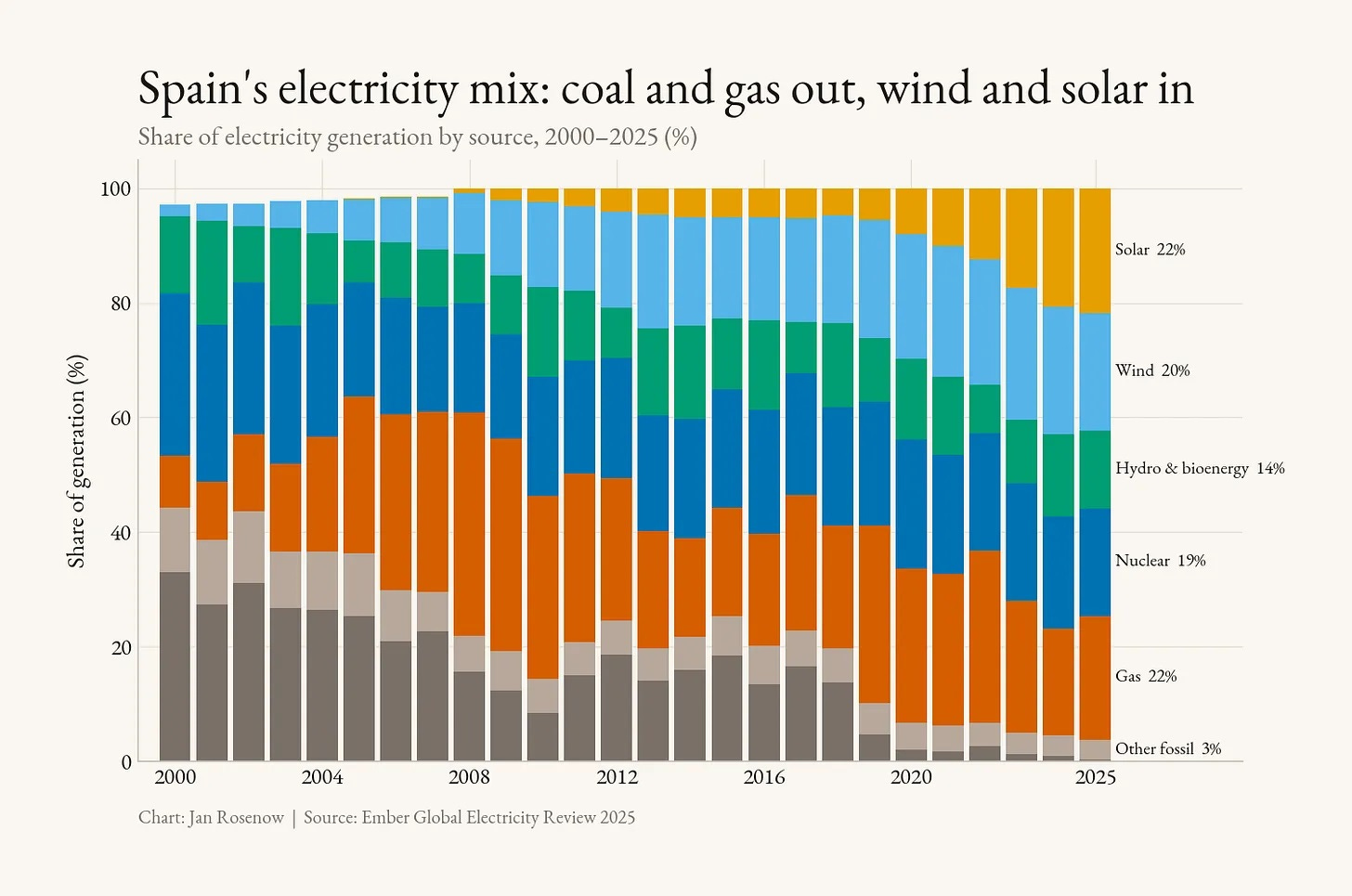
Here’s why the replacement of gas with renewables matters so much: Because wholesale electricity prices at any given time are set by the most expensive energy plants needed to meet demand, and gas is usually that most expensive source, getting more solar and wind on the grid during high-demand daylight hours brings down wholesale prices a lot. (snip-MORE)
Go and read, and click the links if you have time. It is heartening, even though it’s not happening here.
Union Activism
White Lion – When The Children Cry (Official Music Video)
I hate the YouTube algorithm and and myself more for giving into it and saving all the hateful abuse videos I get. I am crying now trying not to alert Ron who is in the next room with the door between us open. I had two open windows. In one I had so many tabs of abuse that the algorithm pushed them to me because I occasionally watch them. I deleted 8 of them before switching to the other open window. What does YouTube think I need to see / hear after all that deleting and not watching all those videos? The two videos below.
Am I the one to blame but if so what does that say about all the vulnerable children who are led down hate rabbit holes? At least the harm happening here is to me done myself aidded by the shit pushed into my feeds and I am so stupid that I click on them and leave the tab open while I try to move onto something else. But eventually I end up coming back to the ones that hurt me so much. Who is to blame? As always in my life, as in my childhood … I am, and I have always been according to those that hurt me. Goodnight. Scottie. Hugs
Political cartoons / memes / and news I want to share. 5-24-2026


Responding to bigoted claims of biblical morality
“Americans overwhelmingly oppose data centers. Women most of all.”
New polling shows women have stronger concerns than men over the implications of the massive and costly complexes used to power AI.
This story was originally reported by Jenae Barnes, Climate Reporter of The 19th. Meet Jenae and read more of their reporting on gender, politics and policy.
As data centers rapidly emerge at unprecedented rates across the country, they are being met with increasing opposition — particularly from women, according to a recent Gallup poll.
More than two-thirds of adults oppose the construction of the massive and costly complexes used to power artificial intelligence, with a majority saying they’d prefer to have a nuclear power plant in their backyard instead. While women and men overwhelmingly expressed opposition, women did so more intensely. Out of 1,000 adults surveyed, 55 percent of women said they strongly oppose data centers, compared to 43 percent of men. In fact, men were more likely to favor data centers, citing their economic benefits and job opportunities.
Jeffrey Jones, a senior editor at Gallup and the study’s author, attributed the distinction to women having more empathy for public-facing issues like the environment and healthcare, and favoring Democratic policies that protect the environment. Resistance to data centers often focuses on the imposition of environmental and financial problems, like water scarcity, noise and air pollution, and excessive energy use that can result in higher utility bills and increased health complications for the low-income communities of color who live near where they are usually built.
“A lot of the opposition is based on environmental concerns about using too many resources, especially water,” Jones added. “Centers need a lot of water to cool the computing machines that they’re using. Land, electricity, and resources are the most common concerns people have.”
Gendered fears about the environment are nothing new, experts say. Women are disproportionately impacted by environmental degradation and at higher risk of poverty, food insecurity and gender-based violence when displaced by climate change, the United Nations reports. Studies have consistently shown that women are also key to driving inclusive, effective action to address the impacts of climate change.
“I’ve been organizing for 15 years, and it’s always been the case that women are leading our fights,” said Danny Cendejas, a campaign specialist for MediaJustice, who works with grassroots movements across the country that are opposing data centers. “We are definitely seeing everyone join the fight, but we have to recognize the truth, and it’s women, trans, queer and nonbinary people leading the work.”
Cendejas pointed to environmental justice movements in places like Memphis, Tennessee, and Amarillo, Texas, which have already been overburdened by environmental pollutants and health impacts from gas and oil industries. Those impacts are now being exacerbated by data centers.
“There’s a big connection where big tech is targeting Black, Brown and Indigenous communities,” Cendejas said. “The progress that has been made over the years to shut down coal plants or gain protections… a lot of that is being undone, by big tech and the demand for data centers.”
Data centers have become an increasingly pressing issue for candidates and their campaigns heading into the midterms in November. They’re also a rare source of bipartisan concern in a polarized political environment.
“There are really strong feelings about this. I see this playing out as a political issue, and now people who are running for governor, Senate, or local offices, are having to take a position on this, whereas this is not something people were talking about two years ago,” Jones said. “And now politicians across both parties are coming out as against data centers, which seems like the more popular viewpoint.”
During a House hearing on Wednesday featuring the Environmental Protection Agency’s Assistant Administrator for Water Jessica Kramer, Democratic Rep. Alexandria Ocasio-Cortez of New York held up jars of an opaque, brown liquid that she said had come out of a rural community east of Atlanta where Donald Trump got 70 percent of the vote in the last election. Meta has disputed the claim.
“This is the current drinking water in Morgan County, Georgia, right after a data center was constructed, the Meta data center was constructed,” Ocasio-Cortez said. “The only difference between the clean water and this was that data center.”
In New Mexico, first-time candidate Daisy Maldonado is running for county commissioner in Doña Ana County on a platform that includes opposition to Project Jupiter, a $165 billion mega data center under construction in the area. Maldonado was recently endorsed by Sen. Bernie Sanders of Vermont, a proponent of data center regulation, adding to the national conversation about community resistance to AI infrastructure and environmental accountability.
Women are also at the forefront of the opposition in Pittsburgh, where the majority of the data centers in Pennsylvania are being built.
“I see a lot of moms concerned,” said Ana Carolina de Assis Nunes, a researcher at the nonprofit Data & Society Research Institute who studied Pittsburgh’s data center industry. “It’s very connected to ‘I want a good future for my kids and if things go this way, I don’t know what world we will have for them in 15 years.’”
To Nunes, the Gallup poll’s results serve as a reminder and reflection of the gendered impacts of AI in society.
“A lot of the interviewees we had in Pennsylvania, when it comes to developers, or people in government, are mostly men, but people who are activists and doing work on the ground, they are mainly women,” Nunes said.
Political cartoons / memes / and news I want to share. 5-23-2026





Republicans slow walk money for Sept 11 heroes, then gleefully and instantly overpay for an unregulated slush fund that mean reparations for criminal insurrectionist.

Tell me you’re guilty without telling me you’re guilty.

They embrace white supremacy.
Trump incompetence and corruption are an extention of white supremacy. MAGA may try to deny it, but they are the worst at judging their own racism.


Bezos is a free-loader. He pays nothing and takes everything.
















Political cartoons / memes / and news I want to share. 5-22-2026




















































Well, Here’s An Idea For Eco-Health:
Hair salons in Europe are dumping their clippings into forests and it’s miraculous
Deers don’t like it but trees absolutely love it.
By Heather Wake
Every day, hair salons sweep countless hair clippings off their floors and toss them into the trash without much thought. But in parts of France, Belgium, and Luxembourg, those discarded strands are finding an entirely different purpose: helping forests grow.
French recycling company Capillum has developed a surprisingly effective way to reuse human hair by turning it into biodegradable mulch that protects young trees from hungry deer. The company collects hair from participating salons and transforms it into flattened fiber sheets that can be wrapped around vulnerable saplings.
What sounds unusual at first actually solves several environmental problems at once.
A second life for salon clippings
Hair salons generate an enormous amount of waste each year. Most clippings are simply thrown away, even though human hair is remarkably durable because it is made largely from keratin, a fibrous protein that breaks down slowly over time.
Capillum saw potential in a material most people never think twice about. The company accepts hair regardless of texture, length, color, or whether it has been dyed. Once gathered, the hair is fed into a machine that minces everything together into dense fiber sheets that can be laid around the base of trees. The process transforms something typically viewed as garbage into a practical tool for conservation efforts.
Why young trees need protection
Many forests depend on saplings surviving long enough to mature and replenish the ecosystem. However, young trees often struggle in areas with large deer populations. Deer are known to chew on bark, especially during seasons when food is scarce. Because saplings have thin bark and delicate trunks, even small amounts of damage can stunt their growth or kill them entirely.
Foresters have historically relied on plastic fencing and tree guards to keep deer away. While those barriers can work well, they also create waste and require maintenance over time.
Capillum’s recycled hair mats offer another approach. The scent of human hair naturally discourages deer from getting too close to the trees, steering them toward other vegetation instead. The method protects saplings without harming wildlife.
A biodegradable alternative to plastic
Unlike plastic guards, the hair fibers gradually decompose and return nutrients to the soil. As the keratin breaks down, it releases nitrogen and amino acids that can support plant growth. That nutrient-rich quality is one reason some gardeners have long experimented with placing hair into compost piles or using it directly in garden beds. Knowing this, Capillum sells its eco-friendly hair mulch to home gardeners interested in more sustainable growing methods.
Human hair is more useful than most people realize (snip-MORE)
Surely there are people here in the US, in our profit-driven society, who could do this recycling, as well.

