Erin In The Morning is a reader-supported publication. To receive new posts and support my work, consider becoming a subscriber.
In the latest episode of their podcast A Touch More, all-star athletes Megan Rapinoe and Sue Bird denounced the International Olympic Committee’s new rule requiring sex testing for athletes competing in the women’s category.
The anti-trans policy will subject athletes competing in the women’s division—and only women’s, not men’s—to invasive sex testing to determine whether they have an SRY gene. Why this is where the International Olympic Committee chose to draw the gender line is arguably arbitrary.
No major medical organization endorses this litmus test as a reliable marker of athletic skill or “biological sex.” Even the scientist who discovered the SRY gene has slammed this practice in sports, saying “science does not support” this “overly simplistic” approach. Rather, it’s an arbitrary line in the sand used to cram unscientific ideas about gender and sex into manmade, binary boundaries.
Nonetheless, if a woman tests positive for the gene, she could be forced to compete in the “male” category. This has had dire consequences the last few times it was deployed against women’s athletes. From 1992 to 1999, cisgender women were forced into testing and found out, on the world stage, that they had intersex conditions they never knew about. The spectacle led to ostracization, disqualification, and at least one suicide before such testing was abolished.
“What we’re doing is subjecting everybody, all women and all people who are identifying as women, to this really invasive testing that only to me just says like, oh, so we’re just trying to whittle it down to a certain type of woman,” Rapinoe said.
Rapinoe is one of the most high-profile athletes in the country, a soccer player with three Olympic competitions under her belt and a decorated career in the U.S. Women’s National Team (USWNT). Bird, meanwhile, is among the most successful athletes in history—the retired WNBA legend spent her 20-season professional career as a point guard for the Seattle Storm, and is a record-breaking Olympian in her own right. The athletic power couple has been engaged since 2020. Together, they’ve long been outspoken advocates for the LGBTQ community.
Rapinoe connected the anti-trans vitriol in sports to the right wing’s broader attacks on queer and trans people, calling the push for sex testing “hateful.”
“They sort of like, lost the battle on gay marriage,” Rapinoe said. “So, it’s just like, we’re going to have this whole campaign for all these years to just hate trans people, which is such a small percentage of the population.”
Countless women, cisgender and transgender alike, have faced harassment and persecution because of the anti-trans athlete witch hunt.
“It’s just a total acquiescence to the Trump Administration,” Rapinoe said. “It’s just horrible, and I’m just sickened by it.”
The IOC rule is part of a broader pattern. In the United States, sports bans have served as a Trojan Horse for more sweeping anti-trans policies. The DOJ’s recent lawsuit over “women’s sports,” for example, also demands that transgender students be banned from bathrooms and locker rooms.
“Can we please stop obsessing over trans people and, I don’t know, maybe focus our time, energy, and resources into real problems women’s sports face?” Bird chimed in. She rejected the idea that sex testing, as the IOC claims, “protects women,” instead calling it a “fear-mongering” political ploy meant to generate support from conservative voters.
“That’s all this is,” Bird said. “If you crack this door open, it gets blown open. You’re now policing women’s bodies across the board.”
Erin In The Morning is a reader-supported publication. To receive new posts and support my work, consider becoming a subscriber.
Tomorrow is Ron’s heart catheterization. Today I have reached a breaking point. After I did the things that had to be done this morning I am dissociating. I find my mind simply shutting down. I am losing time not hearing or seeing anything. My mind keeps parking itself in neutral. I have to keep it together one more day. I made Ron his lunch and got him into bed making sure he had his CPAP on. I took out a pork tenderloin for supper, and I will make potatoes and what ever vegitable Ron wants for supper. I am so tired and sore. Hopefully one more day. Hugs
Kegseth our defense secretary is moving to make an all Christian white male military claiming he wants a warrior culture not a losing woke one. I don’t understand that as Russia has an all male white military and they are getting their asses handed to them in Ukraine. The idea that women are in any way inferior is wrong. Females are the same as males individually they all have different talents and abilities. This old time misogyny is rooted in keeping males in charge. Hugs
tRump couldn’thelp himself but he had to attack Obama making claims of how bad Obama’s library is. Then Sam describes tRump’s grift / scam on his library, using tax free dollars to build a hotel that he will make money from. Then Sam talks about the citizenship birthright case. Hugs
The library director who was fired for refusing to relocate LGBTQ children’s books has garnered substantial community support, with people donating over $84,000 to help her as she navigates the loss of her job. A GoFundMe launched by a community member says that the fundraiser for Luanne James is going “directly toward supporting her family’s basic living expenses during this time.”
James was the director of the Rutherford County Library until the board voted to fire her last week. The termination came after she refused to move 132 children’s books to another section of the library because the LGBTQ themes were deemed inappropriate for children. James said that she “had no choice” but to refuse the board’s request to move the books. She said that she believes librarians are being politicized and that “is not what we signed up for.”
Defense Secretary Pete Hegseth has taken steps to block or delay promotions for more than a dozen Black and female senior officers across all four branches of the military, some of whom are seen as having been targeted because of their race, gender or perceived affiliation with Biden administration policies or officials, according to nine U.S. officials familiar with the process.
The process within the Army, the Air Force, the Navy and the Marines is structured to ensure the most qualified officers get promoted. Hegseth’s decision to intervene in the process has raised concerns among some officials within those military branches and the White House, the nine U.S. officials familiar with the situation said.
“There is not a single service that has been immune to this level of involvement by Hegseth,” one of the U.S. officials said. Two of the officials said there are concerns in the military and the White House specifically that Hegseth is blocking or stalling some qualified officers from receiving promotions through the ranks of general and admiral because of their race or gender as he targets diversity, equity and inclusion initiatives at the Pentagon.
Defense Secretary Pete Hegseth has asked the Army’s top officer to step down and retire, defense officials said Thursday, an extraordinary move amid the war with Iran and the latest in a series of clashes between the Pentagon chief and the service’s senior leadership.
Gen. Randy George had been expected to hold the job of Army chief of staff for more than another year, until the fall of 2027, and complete what is typically a four-year assignment as a member of the Joint Chiefs of Staff. But Hegseth decided to go in another direction, representatives for the defense secretary said.
Two other Army generals were removed along with George, said two defense officials, who like some others spoke on the condition of anonymity to discuss the shake-up. They are Gen. David Hodne, who became the head of the service’s Training and Transformation Command in October, and Maj. Gen. William Green Jr., the chief of Army chaplains.
Read the full article. We can guess why the chief of Army chaplains has been removed.
Here’s one egregious example I just read about this morning in The Bulwark, concerning a Black, female major general. Not surprising. Still appalling.
“A few months earlier, Gen. George and [Army Secretary Dan] Driscoll had refused to accede to demands from Hegseth’s office to block the scheduled promotion of Maj. Gen. Antoinette R. Gant to take command of the Military District of Washington. The Washington District commander appears alongside the president at ceremonial functions in the D.C. area, for example at Arlington National Cemetery. Hegseth’s chief of staff reportedly told Driscoll that Trump would not want to stand next to a black female officer at military events.”
The article did not say whether Gant’s promotion ultimately went through.
I think the article is self explaintary and clear. The hate directed against the LGBTQ+ seems irrational and immoral. Why is it immoral if it is being done by religious groups? Because they have no qualms about lying, giving false and misleading information, and forcing their church doctrines on others who don’t agree with those doctrines. Below are just a few quotes from the article. The last one from florida would make pointing out the truth about how a person is acting or speaking illegal, but doing the racist bigoted stuff would stay legal. Hugs
Anti-trans bathroom bans made a comeback, with four passed in Alabama, Idaho, Ohio and South Carolina.
Policy changes enacted barriers to gender markers and name changes for IDs/personal documents in Arkansas and Florida.
Florida introduced a bill that limited free speech, making public accusations, whether true or false, of a person being homophobic, transphobic, racist or sexist equivalent to defamation and punishable by fine. The bill did not pass.
A central theme of anti-LGBTQ+ organizing and ideology is the opposition to LGBTQ+ rights or support of homophobia, heterosexism and/or cisnormativity, often expressed through demonizing rhetoric and grounded in harmful pseudoscience that portrays LGBTQ+ people as threats to children, society and often public health.
Top Takeaways
In 2024, the number of anti-LGBTQ+ groups increased by about 13% from the previous year. Anti-LGBTQ+ groups maintained a trend in heavy mobilization across multiple strategies with increasing political and financial support from the hard right.
Anti-trans narratives were instrumental to the 2024 election at all levels of government, especially at the local level where anti-LGBTQ+ and anti-inclusive education activism continue to heavily overlap. The politicization of gender-affirming health care and LGBTQ+-inclusive school curricula contributed to what has been characterized as the “most Anti-LGBTQ election in decades.” Republicans spent almost $215 Million on TV ads to smear trans people, surpassing ads on rival issues such as economy, immigration and housing. Another wave of anti-LGBTQ+ legislation broke records at state and federal levels, but such bills were not as nearly as successful as last year.
Anti-LGBTQ+ groups are heavily invested in the courts and pushing policy change by judicial decision. Hard right and anti-LGBTQ+ extremists on social media continue their campaign to “make pride toxic” by targeting inclusive business and marketing practices while anti-LGBTQ+ legal groups take up administrative law and lobbying strategies to eliminate diversity, equity, and inclusion practices in the public and private sectors under the guise of “viewpoint diversity” and “religious freedom” advocacy.
Key Moments
Throughout the state legislative sessions, anti-LGBTQ+ movement organizations continued their facilitation of a decades long effort to foment anti-trans moral panic in public discourse. Legislative assaults broke records for the fifth consecutive year, albeit with fewer successes.
Several factors slowed the trend, including coordinated community responses and reporting, such as the SPLC’s Project CAPTAIN, on the networks that perpetuate anti-LGBTQ+ talking points and legislation. Legislation trends of concern include:
A Florida bill promoted insurance coverage conversion therapy for detransition. The bill passed the House, but died in the Senate.
Anti-trans bathroom bans made a comeback, with four passed in Alabama, Idaho, Ohio and South Carolina.
Policy changes enacted barriers to gender markers and name changes for IDs/personal documents in Arkansas and Florida.
Florida introduced a bill that limited free speech, making public accusations, whether true or false, of a person being homophobic, transphobic, racist or sexist equivalent to defamation and punishable by fine. The bill did not pass.
In February 2024, anti-trans influencers spun a disinformation campaign to exploit the tragic shooting at Lakewood Church in Houston by alleging the shooter was trans. Hard-right social media influencers, equipped with talking points that help fuel gun purchases, used this and other mass shootings in 2024 to perpetuate anti-immigrant and anti-trans conspiracy theories. Despite claiming anti-trans activism helps “protect children,” the SPLC reported that in the wake of mass shootings, anti-trans extremists divert attention from meaningful reforms to prevent gun violence, which is the leading cause of death for children in the United States.
In response to online campaigns by hard-right social media personalities, many major brands scaled back Pride merchandise in 2024. Armed Conflict Location and Event Data (ACLED) reported anti-LGBTQ+ protests at Pride events decreased in 2024; however, GLAAD documented 110 anti-LGBTQ+ incidents during June 2024. In addition, the SPLC monitored at least 74 bomb threats targeting LGBTQ people and events between January 1 and June 30, 2024.
The Colorado Republican Party posted “Burn all the #pride flags this June” and shared a video clip titled “God Hate F__s.” There was no shortage of vandalism: In Poulsbo, Washington, 14 Pride banners were slashed, and over 200 pride flags were stolen from the town center in Carlisle, Massachusetts. Throughout June, SPLC tracked dozens of protests, bomb threats and harassment campaigns directed at civil society groups like Pride committees and LGBTQ+-inclusive religious congregations. Hate groups including MassResistance, Gays Against Groomers, Protect Texas Kids, White Lives Matter, and Aryan Freedom Network were active at Pride events in June 2024.
In July and August 2024, anti-trans influencers manufactured controversy over the gender identity of Olympic athletes Imane Khelif and Lin Yu-ting. This anti-trans controversy exclusively targeted Taiwanese and Algerian athletes, scrutinizing the legitimacy of their womanhood. The crux of arguments made by the anti-trans actors re-animated misogynoir stereotypes to exclude women of color from being considered women based on white Eurocentric beauty standards of femininity. The series of events suggests eugenics and racism underlie transphobia and exhibited how anti-trans hysteria disproportionately impacts women of color on an international scale.
In September 2024, the anti-LGBTQ+ hate group Family Research Council held its annual Pray Vote Stand conference. FRC hosted a variety of anti-immigrant commentary ranging from Katy Faust, president of the anti-LGBTQ+ hate group Them Before Us, urging attendees to “breed out” immigrants and trans people. At the conference, Oklahoma superintendent of public instruction Ryan Walters alleged illegal immigrants were bringing fentanyl into schools; and the summit featured population control myths espoused by both anti-abortion and anti-vax panelists. FRC devoted multiple plenary sessions to anti-trans, anti-abortion and anti-immigrant coded topics.
The election of the first trans member of congress, Sarah McBride, was immediately met with a trans bathroom ban on all restrooms on the House side of the Capitol complex. The resolution was introduced by Nancy Mace and supported by House Speaker and former Alliance Defending Freedom attorney Mike Johnson. Mace posted anti-trans slurs on X following a bathroom sit-in at the Capitol in protest of the bathroom ban. The protesters were arrested and taken to the Capitol Police station; Mace then posted a video showing her outside the stations saying, “Some tr——s got arrested protesting my ban.” She then began reading them their Miranda rights along with demeaning commentary about the protesters.
States will continue to be labs for experimenting with anti-LGBTQ+ public policy. The legislative early filing period in Texas shows 32 anti-trans bills already filed for the 2025 legislative session. This year will show a continued pressure on erasing trans people from public life. With Donald Trump’s re-election, federal civil rights enforcement litigation will likely swing against LGBTQ+ inclusion.
Authors of Project 2025 are being tapped as cabinet picks for the second Trump administration. Project 2025 is an authoritarian and theocratic road map, and anti-trans scapegoating makes up key policy recommendations.
Background
Anti-LGBTQ+ groups in the United States oppose LGBTQ+ rights but also generally support heterosexism, an ideology that assumes heterosexuality is the only “normal” sexuality, and/or cisnormativity, an ideology that assumes one’s gender identity always matches the sex one was assigned at birth. Anti-LGBTQ+ groups primarily consist of Christian Right groups but also include such organizations as the National Association for Research and Therapy of Homosexuality (NARTH) that purport to be scientific. Anti-LGBTQ+ groups in America have employed a variety of strategies in their efforts to oppose LGBTQ+ rights or support heterosexism and/or cisnormativity, including engaging in the crudest type of name-calling.
Anti-LGBTQ+ groups on the SPLC hate list often link being LGBTQ+ inherently to criminal behavior; claim that the marriage equality and LGBTQ+ people in general are dangers to children and families; contend that being LGBTQ+ itself is dangerous and support the criminalization of LGBTQ+ people and transgender identity. These groups also believe in a false conspiracy that LGBTQ+ people seek to destroy Christianity and the whole of society. More recently, hard-line anti-LGBTQ+ groups have promoted their discriminatory laws and policies that limit the rights of LGBTQ people under the guise of religion, blurring the lines between the separation of church and state and discarding anti-discrimination civil rights policies. These same groups have promoted legislative models to push anti-trans legislation into law under a conservative religious assumption that gender can only be understood as either “male” or “female.”
Many leaders and spokespeople of SPLC-designated anti-LGBTQ+ groups have used degrading and derogatory language to describe LGBTQ+ people. Others disseminate disparaging information about LGBTQ+ people that are simply untrue – an approach no different from how white supremacists and nativist extremists propagate lies about African American people and immigrants to make these communities seem like a danger to society. Viewing LGBTQ+ people as unbiblical or simply opposing marriage equality does not qualify an organization to be listed as an anti-LGBTQ+ hate group.
2024 Anti-LGBTQ+ Hate Groups
* – Asterisk denotes headquarters.
Abiding Word Baptist Church, Revival Baptist Church
Orange Park, Florida
Advocates Protecting Children
Arlington, Virginia
Alliance Defending Freedom
Scottsdale, Arizona
American College of Pediatricians
Gainesville, Florida
American Family Association
Indianapolis, Indiana
Tupelo, Mississippi *
Franklin, Pennsylvania
American Vision
Powder Springs, Georgia
Americans for Truth About Homosexuality
Columbus, Ohio
ATLAH Media Network
New York, New York
California Family Council
Fresno, California
The Campus Ministry USA
Terre Haute, Indiana
Center for Christian Virtue
Columbus, Ohio
Center for Family and Human Rights (C-FAM)
New York, New York*
Washington, D.C.
Chalcedon Foundation
Vallecito, California
Child and Parental Rights Campaign
Johns Creek, Georgia
Church Militant/St. Michael’s Media
Ferndale, Michigan
Concerned Christian Citizens
Temple, Texas
D. James Kennedy Ministries
Fort Lauderdale, Florida
Do No Harm
Glen Allen, Virginia
Faith2Action
North Royalton, Ohio
Faithful Word Baptist Church
Tempe, Arizona
Straight Paths Baptist Church
Tucson, Arizona
Family Action Council of Tennessee
Franklin, Tennessee
The Family Foundation of Virginia
Richmond, Virginia
Family Policy Alliance
Colorado Springs, Colorado
Family Research Council
Washington, D.C.
Family Research Institute
Colorado Springs, Colorado
Family Watch International
Gilbert, Arizona
First Works Baptist Church
Anaheim, California
Florida Family Voice
Orlando, Florida
Focus on the Family
Colorado Springs, Colorado
Frontline Policy Council
Atlanta, Georgia
Gays Against Groomers
Fountain Hills, Arizona
California
Georgia
Kansas City, Missouri
Monroe, North Carolina
Vancouver, Washington
Milwaukee, Wisconsin*
Generations
Elizabeth, Colorado
Genspect
Chicago, Illinois
Heterosexuals Organized for a Moral Environment (H.O.M.E.)
Downers Grove, Illinois
Illinois Family Institute
Tinley Park, Illinois
Liberty Baptist Church
Rock Falls, Illinois
Liberty Counsel
Orlando, Florida
Louisiana Family Forum
Baton Rouge, Louisiana
MassResistance
Torrance, California
Pocatello, Idaho
Idaho
Waltham, Massachusetts*
New Jersey
Fort Worth, Texas
Houston, Texas
Kenosha, Wisconsin
Gilette, Wyoming
Lander, Wyoming
Massachusetts Family Institute
Wakefield, Massachusetts
Mission: America
Columbus, Ohio
Montana Family Foundation
Laurel, Montana
Pacific Justice Institute
Sacramento, California
Santa Ana, California
Miami, Florida
Mississippi
Reno, Nevada
Salem, Oregon
Seattle, Washington
Partners for Ethical Care
Chicago, Illinois
Pass the Salt Ministries
Hebron, Ohio
Pennsylvania Family Institute
Harrisburg, Pennsylvania
Pilgrims Covenant Church
Monroe, Wisconsin
The Pray In Jesus Name Project
Colorado Springs, Colorado
Probe Ministries
Plano, Texas
Public Advocate of the United States
Merrifield, Virginia
Revival Baptist Church
Clermont, Florida
Ruth Institute
Lake Charles, Louisiana
Save California
Sacramento, California
Scott Lively Ministries
Springfield, Massachusetts
Society for Evidence-Based Gender Medicine
Twin Falls, Idaho
Stedfast Baptist Church
Oklahoma City, Oklahoma
Cedar Hills, Texas *
Strong Hold Baptist Church
Norcross, Georgia
Sure Foundation Baptist Church
Indianapolis, Indiana
Vancouver, Washington*
Seattle, Washington
Spokane Valley, Washington
Them Before Us
Seattle, Washington
Tom Brown Ministries
El Paso, Texas
True Light Pentecost Church
Spartanburg, South Carolina
United Families International
Gilbert, Arizona
Verity Baptist Church
Sacramento, California
Warriors for Christ
Mount Juliet, Tennessee
Westboro Baptist Church
Topeka, Kansas
World Congress of Families/International Organization for the Family
Rockford, Illinois
I am unable to figure out if the Florida Real ID driver’s license that the state forced everyone to get a bunch of years ago. I remember having to go to the driver’s license place with a folder of information including utility bills in my name and with my birth certificate and my marriage license. It was touted as the “Real Id” that was the only one we would need. It was OK even for flying. When I told Ron about this he was adamant that after his surgery we get me a passport no matter the cost. I explained that we both should have them in case our same sex marriage gets invalidated. We have one out that I am sure my abusive adoptive parents did not plan to give me. They were Canadian citizens here on green cards and my birth certificate shows me as their kid, something I have always hated. Current Canadian laws let me apply to Canada for asylum or simply to immigrate with my spouse. But it clearly shows this is an attempt to restrict those who have the right to vote to do so. Hugs
The law’s requirements for proof of citizenship to register to vote and stricter voter ID rules won’t take effect until next year.
Florida Gov. Ron DeSantis signed a bill into law that is akin to President Donald Trump’s SAVE America Act at the national level.Matias J. Ocner / Miami Herald via Getty Images file
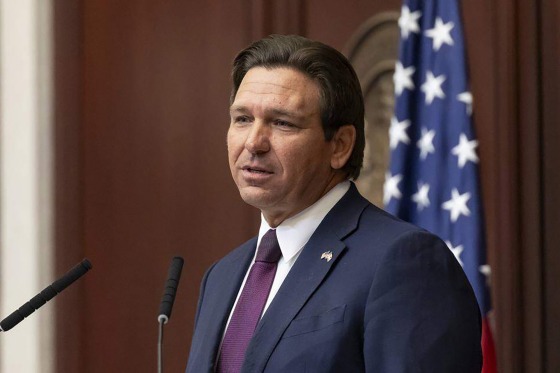
Republican Gov. Ron DeSantis signed a bill Wednesday that will require proof of citizenship to vote and impose stricter voter ID restrictions on Floridians.
The new law, most of which won’t take effect until after the midterm elections, is Florida’s version of the federal SAVE America Act, a bill President Donald Trump has championed. That measure is currently stalled in the U.S. Senate, where it lacks the 60 votes needed to advance under current rules.
“This bill protects and expands integrity in our voter registration process,” DeSantis said. “Our Constitution in the state of Florida says only American citizens are allowed to vote in our elections, so we need to make sure that is the law.”
Democrats and voting rights advocates warn Florida’s law will disenfranchise eligible voters who lack ready access to the documents that are needed to vote.
Already, the League of Women Voters of Florida and a coalition of advocacy groups, represented by the American Civil Liberties Union, have filed a federal lawsuit to block the law.
“We are most concerned about impact as it relates to the most vulnerable Florida voters,” said Jonathan Topaz, attorney at the American Civil Liberties Union. “This could mean older Black voters who grew up in Jim Crow South who don’t have access to birth certificates, this could be naturalized citizens — we know naturalized citizens are flagged as noncitizens all the time.”
Voters who were born in Puerto Rico, have changed their name or have lost documents may struggle to meet the requirements of the new law, he said.
Supporters of the legislation note that millions of Floridians have already shown government officials their passports or birth certificates when obtaining a REAL ID. They also argue the law is necessary to prevent voter fraud, despite little evidence of it occurring.
More than 9% of American citizens of voting age do not have proof of citizenship documents readily available, according to a study commissioned by the Brennan Center for Justice. Based on that metric, advocates fear that more than 1 million Floridians could struggle to cast a ballot starting next year, when the law will be fully implemented.
Other states have tried to impose documentary proof of citizenship requirements in the past, but courts have ruled they violate federal law. To comply with one such ruling, Arizona now has a bifurcated election system that allows those who haven’t proved their citizenship to only vote in federal elections.
The system offers a window into the kinds of people who do not have access to the documents required by proof of citizenship laws. In Arizona, they are disproportionately voters of color and younger voters, according to an analysis by the Brennan Center. Votebeat reported that Arizonans who are only eligible to vote in federal elections often live around college campuses, suggesting they are students without their citizenship documents on hand.
Florida’s law has different requirements than Arizona’s, however. It asks election officials to verify voters’ citizenship after registration. For Floridians who have shown their passport or birth certificate to government officials when getting a driver’s license, their citizenship will be affirmed and their registration approved.
Those without this information on file will be asked to prove their citizenship within a month or they could be removed from the voter rolls.
Wendy Sartory Link, the supervisor of elections for Palm Beach County, said implementing this law will be a major challenge for election officials, particularly those in larger, more diverse counties.
Link said her office will need to roll out new rules and forms — all of which do not yet exist and will need to be written by the state — and rush to begin preparing for the proof of citizenship requirements that go into effect in January.
She said that computer systems will need to be updated — the voter file doesn’t currently include a space for citizenship proof — and that new systems will need to be created among agencies to share data. Link also said she will need to hire new staffers to handle the increased workload, though the bill didn’t give her any additional funding to pay for it. Once voters are asked for proof, she said, she’s worried long lines will form with voters bringing proof of citizenship.
She also said she has many unanswered questions: Can she accept proof of citizenship over email even if she can’t touch the raised seal to be sure it’s an original document? Does she need to ask voters to prove their citizenship every time they update their voter registration? Does she need new trainings to evaluate the proof that voters may bring her?
“If somebody brings a birth certificate and it’s an Idaho birth certificate, I don’t know what that looks like. Am I supposed to know whether or not that’s a fraudulent birth certificate, or do I just accept it because it says Idaho birth certificate?” Link said.
Florida’s new law also restricts the kind of photo IDs that voters can use to prove their identities at the poll, eliminating the use of retirement community and student IDs.
At polling sites near college campuses and retirement communities, Link said, this change could trigger long lines as more students fill out provisional ballots and need to later affirm their identities.
Out-of-state students may struggle to obtain the required ID unless they plan months ahead, too. In her community, she said, it also takes time to get an appointment for a Florida driver’s license.
Lawmakers in a dozen states have advanced legislation this year that would require residents to prove their U.S. citizenship to register to vote or bring photo ID to the polls, according to the Voting Rights Lab, a nonpartisan group that tracks election legislation. Utah and South Dakota have also sent bills imposing a proof of citizenship requirement on to their governors.
Remember a couple of things as you read this below. First there is nothing wrong with being LGBTQ+ and the feelings associated with those letters. Second most children are desperate to fit in to the majority, to be “normal”. The country was well on the way to reassuring these kids / adults that those feelings were normal and OK. That the child was not damaged not an abomination to god, and did not need to be fixed. Then the right wing religious hate machine managed to pass don’t say gay laws, bathroom bills, and “lets make those who are not straight or cis be attacked outcasts again” laws.
There are two errors not really mentioned here. Minors who are going to these “religious anti-LGBTQ+ be straight cis only” therapest / religious leaders are normally forced there by parents who have been convinced by religious leaders in their church that their child is damaged and needs to be fixed as they are sinning just for feeling as they do and so will be going to hell. (Side note Jesus never said anything like that. I remember being told that I was “acting gay / doing gay things” because I liked sinning. To which I replied, You have it backwards. I was born gay and I like doing / being gay and so I don’t care that it is sinning to you.) The child is often told this to the point where even if they don’t fully hate themselves they are willing to do anything their parents want to “be normal” or get their parents off their backsides about it. And often the child is threatened with being thrown out of the home if they don’t go to conversion therapy. And then the religious therapist reinforces the message that they are damaged, broken, that they cannot be as they are but must be fixed, must be healed of the sin / feelings. Every major medical association has reviewed and studied conversion therapy and they conclude it is harmful, has no basis in science and those kids who go through it are far more likely to try to end their lives so they recommend helping young people to accept themselves and their feelings except for the minor one started by a religious group that has rejected all the studies and findings for the religious belief that god wouldn’t create anyone that way and because we are not that so those people / kids that feel that way must be forced to change to make them and their god happy.
There are facts, and then there are religious beliefs that disregard those facts. The fact is that the data and medical studies show that helping non-straight non-cis children accept that they are normal also shows that gender afirming care is the most beneficial way to help young people who are LGBTQ+ and struggling with the idea of wanting to be “normal” or like the other students are. I did not want to be gay as a kid growing up. I knew my attraction perhaps sooner than most kids due to my childhood situation. But all the time growing up I heard about how bad and horrible people who had the feelings I did were and how doing what I was being forced to do made me the worst possible human. I was attacked at school even though I was not out but some thought I was different and that was enough. When I had to join the church to get to leave my abusive home to get to safety I heard constantly how bad / sinfull / an abomination I and people like me were to god who wanted mankind to wipe me out… wait why does god need mankind to do that, especially white Christian men to do that, can’t he just stop making gay people with out a demon in them?
At my church school a lot of the boys were flirting with same sex attractions as they were horny teen boys separated from girls. Similar to the situation I found in the military where I had a group of “straight” guys asking me to go on passes with them. And it was very fun, but they always claimed not to be able to remember what happened on those trips. But each of those kids and some of those adults I had consensual fun with blamed themselves for failing god and failing to be normal. I had one really cute fun guy who I would go on passes with who couldn’t wait to get into the hotel room to have sex. And it was not just one way either. He received as he gave and what he enjoyed he returned if you catch my trying not to be too explicit. But that was the same with all the guys, they were not hung up on straight norms while in a hotel room with me. But this one guy would always on the way back to base tell me we couldn’t do that again. It was wrong. It was something we shouldn’t do. I did not argue. But 3 weeks or a month later he was begging me to go on a four day pass with him.
My point was this guy was 18 / 19 like me. I had already long accepted who I was and how I felt. He had taken the be normal message to heart. He could have used therapy to accept his feelings and needs. But the one thing he did not need and would have been harmful was conversion therapy. That guy was with me in Germany, after a wonderful weekend he again said we couldn’t do that again, He got married and it lasted a year, then he got divorced. I lost touch with him. But lives were harmed because he just couldn’t face he was gay, couldn’t tell his religious parents he was gay, and would have been placed in conversion therapy if his parents had known as a teen he struggled with same sex attraction and was not straight. Hugs
The Supreme Court on Tuesday delivered a major win for the free speech rights of counselors and therapists, ruling in an 8-1 decision that a Colorado law prohibiting licensed counselors from engaging in talk therapy to help a person “reduce or eliminate unwanted sexual attractions, change sexual behaviors, or grow in the experience of harmony with [their] bod[ies]” unconstitutionally violated the First Amendment right to freedom of speech.
FRC President Tony Perkins called the decision “A Supreme Court win for free speech and biological reality.”
“I’m encouraged to see the muzzle removed from therapists seeking to help willing patients come to terms with, and be at peace with, how God created them,” reflected Perkins in a statement to The Washington Stand.
“The Left is using the levers of government to block families and individuals seeking help. Under Colorado law, a girl could legally seek a therapist’s help to change her gender but could not seek help from that same therapist to align her identity with her biological sex. Where is the fairness or logic in that? I commend the court for striking down this deeply invasive and unjust law.”
Read the full article. In 2013, Exodus International – then the nation’s largest ex-gay group – disbanded. Its longtime president Alan Chambers declared that not one of his group’s thousands of victims had ever become heterosexual.
Conversion therapy is discredited junk science that inflicts harm on LGBTQ youth.The Supreme Court’s decision is disappointing and puts vulnerable kids at risk.
I got up at 3 am this morning and was able to respond to almost all the comments. That gave me a few minutes while I ate some apple oatmeal for breakfast to read some news from Joe My God that he posted yesterday. Here they are in no particular order. Hugs
Yes it would make me want to sign up to work grueling hours and possibly die for a country that wants to use my graduation to arrest and deport my family members. Great move. Hugs.
I wonder what makes a person so hateful, bigoted, and racist. How much do you fear not being in a super majority and why? Do they worry that the new majority will treat them the way they treated the minorities when they were the majority? Hugs
More racism. This program they are now stopping claiming it is DEI and woke is because the first program illegally excluded black people in an attempt to be racist. Hugs
I was not sure whether to put this under corruption or racism. But as they are clearly using race, skin color, and language/accents to stop and detain people, racism won the toss. Hugs
OK more bigotry if not racism. The joy these people get from forcing kids to be cis or straight rather than let people just express themselves as they are is something I don’t understand. Seriously, why the need to go against all the medical science, medical studies that show conversion therapy to not only not work but to be very harmful to those who experiance it. It is torture and child abuse. Kids who are forced into it, who have to suffer through conversion therapy are much more likely to try to commit suicide. For what goal, to please their god? Their god created the trans / gay person as trans or gay.
The Army felt it was important enough breach of regulations and rules along with a waste of taxpayer money to suspend and investigate those involved. Pete Kegseth our Fox host wannabe big time war general secretary of defense over ruled their decision and undermined their authority because it looked cool. He is acting like a 10 year old boy playing army with his toys. Kegseth also illegally removed 4 officers from being promoted to flag rank. Two because they were female and two because they were black. The rest he wanted to be promoted were white men of course. Hugs
More illegal actions by the wannabe dictator and his administration who believe anything tRump mumbles is the law of the land and they do not have to follow any rule or law. Hugs
tRump illegally deciding that his administration can decide who gets to vote and how voting is done. All by his decree. The dear leader has spoken. Hugs
More crime? Why am I surprised that people that rioted and attacked the US Capitol, breaking in and causing mass damage might not respect the laws? In that act they assaulted police, staff, and tried to kill congress members. Hugs










 Scottie's Playtime