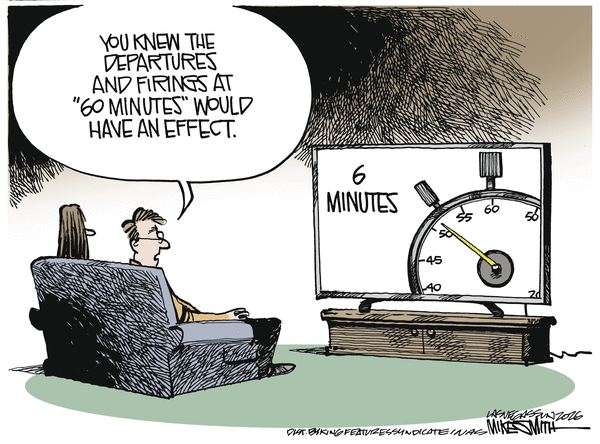
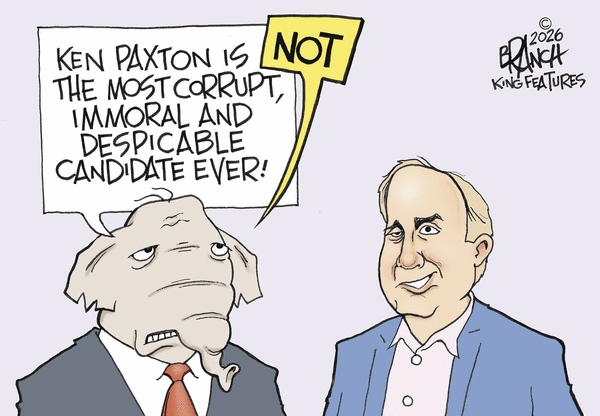
I am finding the coverage of this story an interesting example of the open bias and deliberate slanting of the story depending on who or which side is covering it. The same reports are covered with drasticly different tones, phrasing and include or exclude details depending on which group the reporter is either trying to promote or degrade. For example on This Week Martha Raddatz reported the story in the darkest most impassioned way to present Platner as an out of control phycotic abuser of women and repeatedly elaborated on his sexting of women while dating and slightly after he was married to his wife as a great moral failing making him not worth or qualified to serve in Congress. Yet she never faulted Ken Paxton or tRump the same way. During her report on this story she talked up Janet Mills praising her repeatedly while mentioning that she was the needed alternative to Platner. Her report made it sound like the entire state of Maine and all the Democrats did not want Platner but the majority of people she interviewed were supporting him. In the reporting of this by The Majority Report they take a different tact in the reporting on Platner. They report the facts in a less sensational manner and put everything in context to modern society. Below is just a clip of the transcript of the show. For those not wanting to watch this I recommend at least reading the transcript. There might be details, facts, or context not reported elsewhere. Sam askes where are the other accusers and their stories. Hugs
Um, and I’m also fascinated by the way this story has developed, like who is doing this? Uh, because the the timing of this stuff is strange. Um, and suggests that it’s not just a question of Republicans because Mhm. If the Republicans had this stuff, they would drop it uh you know in October. But why or or it could be about Republicans taking a different tact here and saying we need to get him out of the race as opposed to try and beat him because we may not be be able to beat him. The best thing is for us to get him out of the race. Yeah. And now is the most opportune time to do that. But uh regardless. So let’s put up this tweet from Lindsay Fitfield. She is the only person to suggest uh any type of physicality uh and again uh she wouldn’t have called it like abuse but any type of physicality from Platner and she also suggests that he knew uh what his tattoo
And the reason why she does that is because she wants the Times to carry the story as opposed to another outlet. And she is strategizing. The Times is are going to hit the audience. I want them to hit. If you wanted this on the uh, you know, on the right, you wouldn’t go to the Times. That’s what comms professionals do. We have this story. Where are we going to go? And she went to the Times and made a deal with them. You’ll get an exclusive when you write this.
Uh after the story went up, I began to ask them, “Wait, where are the stories from the other women? Where are their accusations of sexual assault? Why am I the focus? Why are there 11 paragraphs uh dedicated to detailing my work history?” Which is that hilarious because it was such a footnote in the story. It obscures the true nature of her collaboration with Republican operatives and her work in Republican politics. And she’s asking, “Where are their accusations of sexual assault?” Yeah, they probably just wanted to embarrass themselves by leaving those out like as if they actually existed.
Yeah. because in that instance it the whole thing sounds like a total hit job uh by these reports.Remember they’ve been working on this story for months according to her, right? I mean the dragged on and um and that’s just when they had her stuff. Keep put u why does uh it say nobody corroborate could corroborate when I offered them sources that could corroborate. They obviously went to these sources and those sources could not corroborate.
On Saturday night at the ICC’s Darling Harbour theatre, that idea became a reality for a 21-year-old university student who was thrust into the spotlight at a live performance of the movie’s score – and saved a concert from derailment.
Sterling Nasa was in the audience at La La Land in Concert, a touring production where the movie – which features Ryan Gosling and Emma Stone – is projected on to a screen while a live orchestra plays the musical score in synchronisation with the film.
The performance proceeded normally until the interval, which stretched out to 40 minutes. Then the film’s Oscar-winning composer and conductor, Justin Hurwitz, walked out alone to address the audience.
The orchestra’s keyboardist had suddenly fallen ill. Was there by any chance a pianist in the house? And one with exceptional sight-reading skills?
Speaking to Guardian Australia on Monday, Hurwitz revealed that behind the scenes, quiet panic had set in during that extended interval.
“Our first thought was, is there a string player who also knows keyboard? The answer was no.”
As the orchestra’s musicians frantically phoned local contacts, offers started rolling in of backup players who were 15 to 20 minutes away. But Hurwitz knew time had run out.
“I figured nobody’s as close as they say they are … so I just thought, well, we have 2,500 people in here …
“Yes, it was a gamble.
“That’s why I asked a few times. I wanted to make sure that somebody wasn’t just overly confident. I asked a couple of follow-up questions like, ‘Are you sure? Can you really sight-read? Can you play key signatures you’ve never played before?’”
Nasa, who plays piano and organ and is the bagpipes tutor at his old school, Scots College, hesitated when the call went out.
“I was a little bit tentative,” the University of Sydney politics and international studies student told ABC Radio on Monday morning. “I do owe a lot of the experience to my friend, Scarlett, who sort of … put my hand up for me. But I did end up finding the confidence and it was a very good decision to go down and volunteer myself.”
A longtime admirer of Hurwitz’s work, Nasa suddenly found himself sitting at an electric keyboard, staring at a complex score he had never rehearsed.
The ultimate test came during the performance of the John Legend piece Start a Fire, which features an intricate synthesiser solo designed to match the erratic hand movements of Gosling’s character on screen. It was the exact moment Hurwitz was most nervous about.
“The synth solo is really technical, and I thought, even a really high-level professional sight-reader would probably not be able to do it,” he said. “As it was coming up, I was thinking, ‘Oh no, how’s he going to be able to handle the solo?’”
Nasa told the ABC he was thinking the same thing.
“I saw it on the score and I thought, oh, I don’t know if I’m going to be able to sight-read that in one go,” he said.
Like Gosling’s jazz-pianist character Sebastian, the student had to decide whether to stay in the shadows or take a monumental leap of faith. With no time to overthink, he chose to trust his instincts.
“I took a little bit of a creative liberty and just decided to improvise, which I think ended up being a good choice.”
The gamble paid off, carrying the orchestra through the number – and earning Nasa a resounding ovation from the audience.
“He saw it coming up … and he just improvised,” Hurwitz said.
“That is a whole other skill on top of sight-reading. To be able to play a really cool solo in the right key, in the right scale, on the fly with no rehearsal – it was remarkable.”
The backstage debrief after the final bow was full of mutual disbelief.
“I just told him how blown away I was, and obviously how thankful I was,” Hurwitz said. “All of our heads were spinning a little bit because it was such a surreal moment.”
By Monday morning, the 21-year-old was experiencing a different kind of whirlwind, being ferried between breakfast television and radio studios to recount his sudden taste of showbiz fame.
Reflecting on the incredible turn of events, Nasa said it was an unforgettable privilege to play a soundtrack he had loved for years.
“It was quite a blessing to get to play a work that I’m in such admiration of,” he said.
While the production team is now scrambling to rehearse new keyboardists for the upcoming Melbourne and Brisbane legs of the tour, Nasa will be heading back to his regular university lectures.
But has the student missed his calling in life?
Hurwitz said that while the young Sydneysider certainly has the talent for a career in music, the choice is ultimately his to make.
“I don’t know what he’s most passionate about,” Hurwitz said. “Maybe he likes international relations a little more than music. But that’s what La La Land is about. You’ve got to do what you love the most.”
La La Land in Concert will play at the ICC Sydney on Monday, at the Brisbane Convention & Exhibition Centre on Wednesday and at the Hamer Hall in Melbourne from Friday 6 to 8 June.
The founder of a popular New York City LGBTQ+ book clubs talks queer literature, book clubs, and what she’s reading this summer for Pride Month.
“It’s so important for everyone to be reading queer books by queer authors,” Joey Lobel said. Envato/Cage Rivera/Rewire News Group
In late 2022, Joey Lobel was frustrated.
An avid reader, Lobel, a 31-year-old butcher in Brooklyn, was struggling to find queer books that didn’t have sad endings.
“I went on a little spiral and I thought, I’m sure other people are feeling the same way,” she said.
So Lobel decided to make a queer book club page on the social networking website Meetup, hoping to build community around LGBTQ+ reads. She wasn’t sure if people would show up. But “worst case scenario,” she recalled thinking, “I’m sitting at a bar with a book, which is completely fine.”
But people did show up. And in the nearly four years since the Queer Book Club started, Lobel’s book club has become a staple in New York City’s LGBTQ+ community—with monthly meetups at the Brooklyn bar Young Ethel’s and an average of between 15 and 30 participants. The book club’s one-off events, like book swaps, are popular and see upward of 60 attendees.
As summer gets underway, Lobel spoke to Rewire News Group about the importance of LGBTQ+ literature, generating a top-notch list of reads for Pride Month, and building community through books.
The following conversation has been edited for length and clarity.
What makes a book queer?
A book is queer if it’s written for queer people by queer people. There are so many books out there that have zero queer characters, or one passing queer character. And to me, that’s not necessarily considered a queer book. But any book written for us, with us in mind, I want to read.
Do you have an all-time favorite queer book or queer character?
That’s so hard. My all-time favorite queer book is In The Dream House by Carmen Maria Machado. … I read a lot of books. And a lot of times, I sort of forget immediately. Like, you’re out of that world and you’re back in your world, and you forget what happened. But In the Dream House has always stuck with me.
Is queer literature for everyone?
I definitely believe queer literature is for everyone. You can learn from anyone. You can be entertained by anyone. And it’s important that we’re able to look at viewpoints other than our own. The amount of straight books that I’ve read in my life that I’ve enjoyed is vast. I just feel like it’s so important for everyone to be reading queer books by queer authors.
And to remind publishers that queer authors are authors people want to read.
There’s such a big audience out there. There are so many queer shows right now being canceled. There are such audiences for them, and they’re still being cancelled. We have to support queer media. And straight people have to support queer media. It’s enjoyable for everyone.
How do you approach building a queer summer reading list?
The reason I love the book club for figuring out what you’re going to read is that I’m always reading books that I would never choose on my own. If it was up to me, we’d be reading cute little rom-coms where everyone falls in love at the end. I love those, and there’s definitely space in my reading list for those—a big, big chunk of space.
I also like being able to read books that other people recommend to me. I look at a lot of Instagram recommendations.
There’s just so many books out there, it’s hard to choose. I also read so much more in the summer. So I try and hoard all of the books that I want to read until it gets warm. And then I’m outside just reading all day.
Speaking of, what are three books on your summer reading list?
I read this book previously, and I definitely want to reread it. It was incredible. It’s called Fracine’s Spectacular Crash and Burn by Renee Swindle. It’s so good. It’s about a young woman who loses her mom. And there’s a really interesting relationship dynamic in there with her mom who has passed, and with this young boy that she meets that she’s protecting, and someone that she starts dating. There’s so many layers to it that I want to reread it, because I know I’m going to get more of it the second time.
Right now, I’m reading Nevada by Imogen Binnie. That’s June’s book club pick. I’m halfway through, and it’s a really great book. It’s so different from the way that I see the world. From this character’s perspective, it’s a little darker and a little chaotic—more chaotic than I’m used to—which I think makes for an interesting dynamic to read about.
I also want to read Mac Crane’s new book, A Sharp Endless Need. Their last book, I Keep My Exoskeletons To Myself, was hauntingly beautiful—and not something I would gravitate toward because it’s not the rom-com, two girls falling in love. But we read it for book club and I was entranced. And that’s why I’m so glad that I get to read books that aren’t just my normal go-tos.
But one that is my normal go-to, which I haven’t read yet, is Puck by Samantha Allen. It’s been pitched to me as a Midsummer Night’s Dream spinoff with reality TV. And I’m already invested.
What advice do you have for people who are unsure about whether book clubs are for them?
There’s a lot of reasons why people might be a little nervous to join a book club. I was worried that I would have to always public speak, which is a little tough when you’re not feeling up to it. I was also worried that it would be tough finishing a book on a timeline—it does remind me a little bit of school, in that way. (Editor’s note: Lobel’s club has a rule that not finishing the monthly book is totally fine, so long as you’re “fine with spoilers.”)
But book clubs are very welcoming. You can just go in, and talk to people.
What’s the worst that can happen? You’re surrounded by other queer people who love books.
I heard someone say the best thing they could do is offer their hand to those in need of a hand to grab on to, give support to those in need, to be the person I need others to be sometimes for me. Hugs
I read the article linked below. To show how badly these papers were done one paper used reports made in the Vaccine Adverse Event Reporting System (VAERS) to find what he said were “unusual patterns and safety signals highly suggestive of a causal relationship” between vaccination and Sids. VAERS is a vaccine safety monitoring program where anyone can submit a report about any suspected adverse health event that happens after a vaccination. Morgan McSweeney, a scientist who posts on social media as Dr.Noc said of the people running the CDC “They have a strong opinion about what is true. And then they go looking for whatever scrap of low-quality evidence they can find to support that opinion,” McSweeney said. “If that finding supports the story that they believe, they’re willing to overlook data points from hundreds of thousands or millions of children and go with the one that fits their story.” “This was a low-quality, very small study that was not replicated. So yeah, the CDC page now says that some studies supporting a link have been ignored by health authorities,” McSweeney said in the video, which now has more than 5m views between Instagram and TikTok. “And maybe that’s a little bit true, because the studies they’re showing here are worth less than a fart in the summer breeze.” Hugs
When approaching recent historical events, where the scope of destruction and loss can be unfathomable in scale, oral history can bring both connection and immediacy through individual stories of loss, grief, rescue, or triumph that would otherwise disappear in the grand sweep of “Great Men and their Deeds.”
[T]he method enables the documentation of certain aspects of historical experience that are often missing from other kinds of historical sources. Oral historians not only interview and engage in conversation with living sources, they also find themselves challenged in a unique way—the historian is transformed into a protagonist in the dialogue. Oral history is perhaps the only field where the sources talk back to the historian, confronting, disputing, disrupting, and sometimes resisting the historian’s understanding of the past (Frisch 1990; Shopes 2012). Oral history works with the interviewee as a partner in dialogue and the verbal form historical truth can take is always co-constructed (Cook and Goodall 2013; Goodall and Cadzow 2009; Portelli 1991).
Some of the most effective (and affecting) projects using this approach concern communities that may be far outside of the audience’s experience, whether due to time, geography, or identity. Works like Shoah by Claude Lanzmann, Hard Times by Studs Terkel, and Boots of Leather, Slippers of Gold by Elizabeth Lapovsky Kennedy document their subjects through the voices of those who lived through specific moments and events that can be overwhelming or remain unknown without a more interpersonal method.
“Many of the best works about this disease have been produced by people at various stages of HIV infection.”
The history of the HIV/AIDS epidemic has recently become the subject of numerous oral history projects, where the stories of survivors, caregivers, activists, and health care professionals have been collected and made available online, traditionally published, and edited into documentaries.
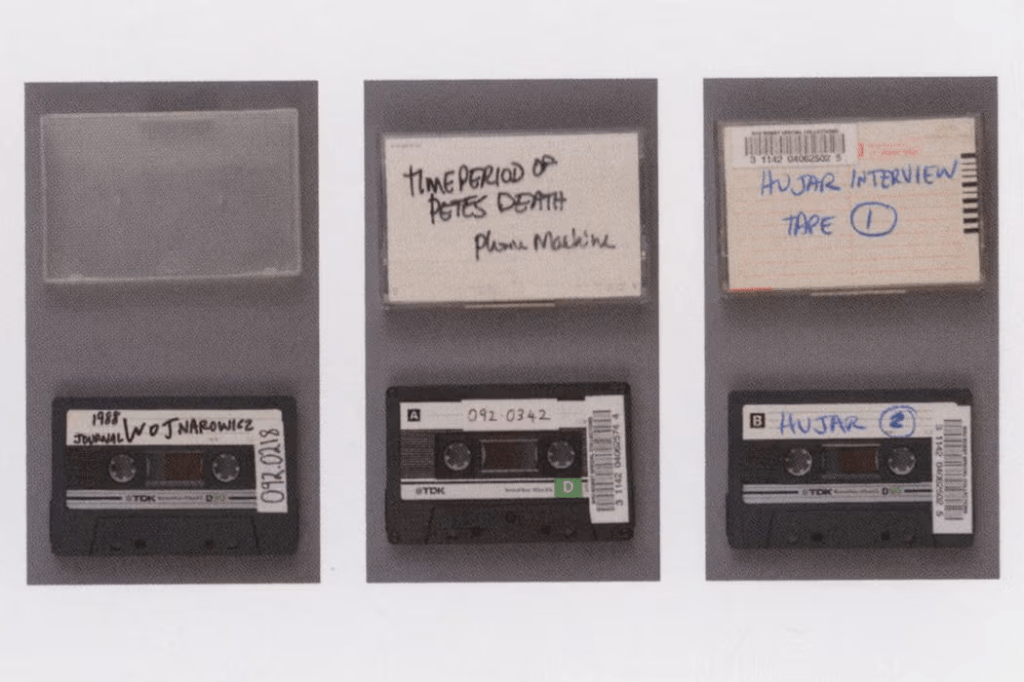
One such collection, Visual Arts and the AIDS Epidemic, was begun in 2015 by the Smithsonian Archives of American Art after receiving a grant from The Keith Haring Foundation. Haring founded the foundation in 1989, a year before his death from HIV-related illness, to maintain his artistic and philanthropic legacy. The project interviewed forty artists about their lives, their work, and how the AIDS crisis intersected and permeated both.
The interviews in the Visual Arts and the AIDS Epidemic collection cover wide ranges of personal and creative history, ranging from insider gossip and “name-dropping” to theoretical discussions of method and art history. They benefit from interviewers who bring their own experience as artists, art scholars, and historians to the conversation, with questions and insights that make this collection a rich multifaceted history of AIDS, the arts, and activism.
as if the artist were immersed in dealing with the epidemic—as so many are. Many of the best works about this disease have been produced by people at various stages of HIV infection. Perhaps they have lost a lover, nursed a dear friend, or attended a dozen funerals at a young age, and feel themselves to be, in every sense, set apart by the experience. They are implicated. Their art signifies a collective trauma—mass death in the midst of life.
Reveal Digital, an initiative “to amplify important, long-overlooked voices of the twentieth century,” has made these histories, and more, available in their developing open access collection HIV, AIDS and the Arts.
Artists in The Early Years of the Epidemic
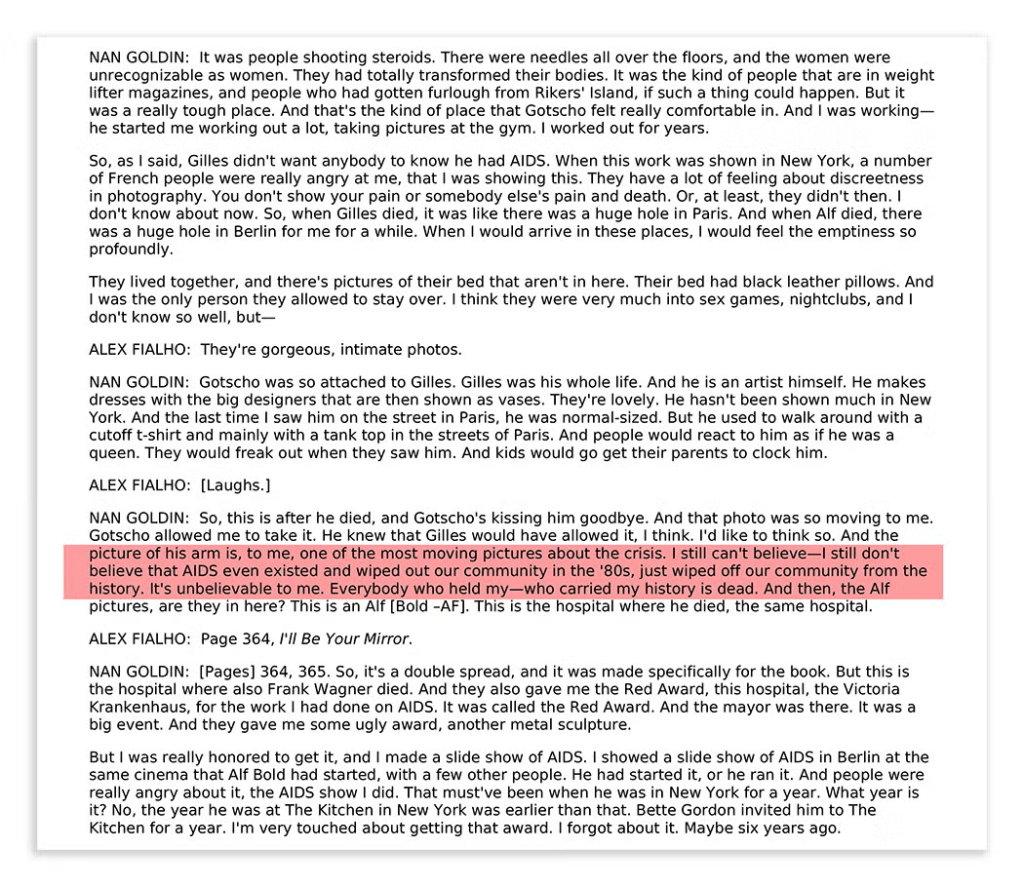
“I still can’t believe—I still don’t believe that AIDS even existed and wiped out our community in the ’80s, just wiped off our community from the history. It’s unbelievable to me. Everybody who held my—who carried my history is dead.” —Nan Goldin
One year later, William F. Buckley published a New York Times op-ed calling for HIV-positive people to be tattooed on the upper arm and buttocks to protect others (assuming that would protect both future sexual partners and intravenous drug users who might share needles). News reports about the disease largely focused on fear of contagion, the promiscuity and danger of gay men, and the threat of HIV to “normal” Americans.
In the interviews gathered in the Visual Arts and the AIDS Epidemic collection, artists describe how they first became aware of AIDS: from a loved one diagnosed after an illness; from hearing of a friend’s passing after not seeing them for a while; from a doctor telling them to stay with a partner because “there’s something going around”; or by learning of their own diagnosis. Friends were lost to the disease, and surviving family members denied the illness or sometimes actively excluded partners from funerals.
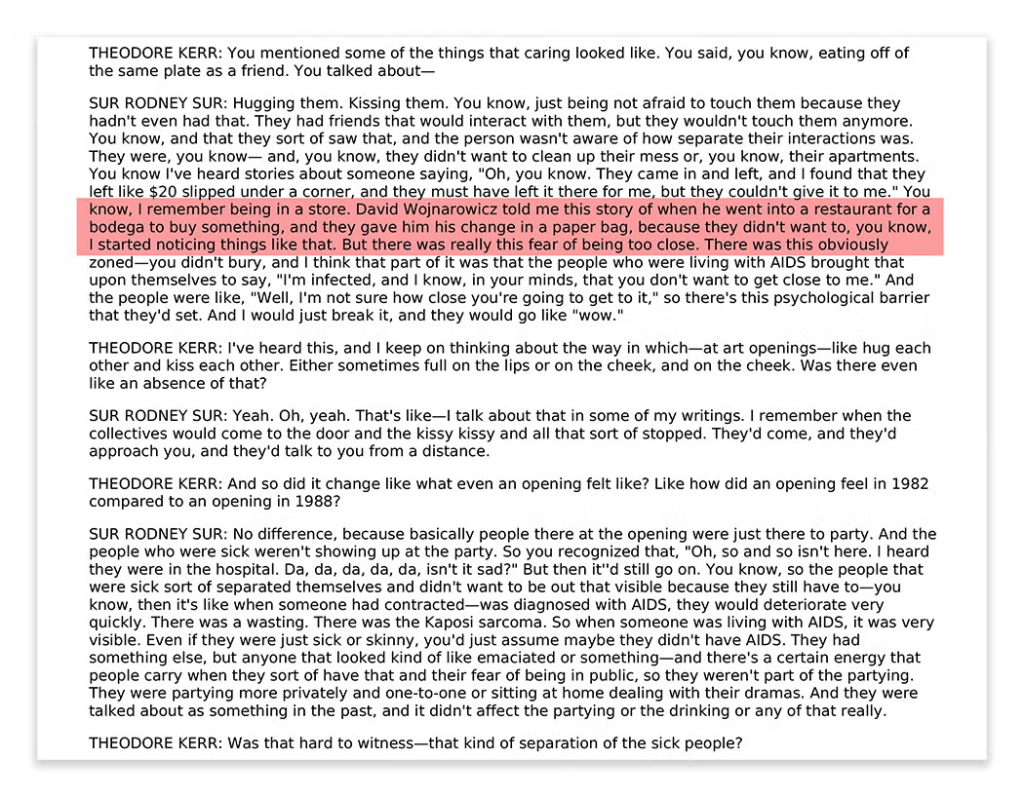
Sur Rodney (Sur), a New York City-based writer, gallery co-director, and archivist, relates that the late artist David Wojnarowicz would go to his local bodega in New York City where the clerks returned his change in a paper bag, out of fear. He describes his own anxieties when stepping in after a friend’s death to help save and archive their artworks and collections so they wouldn’t be destroyed (before there were nonprofit organizations to do so).
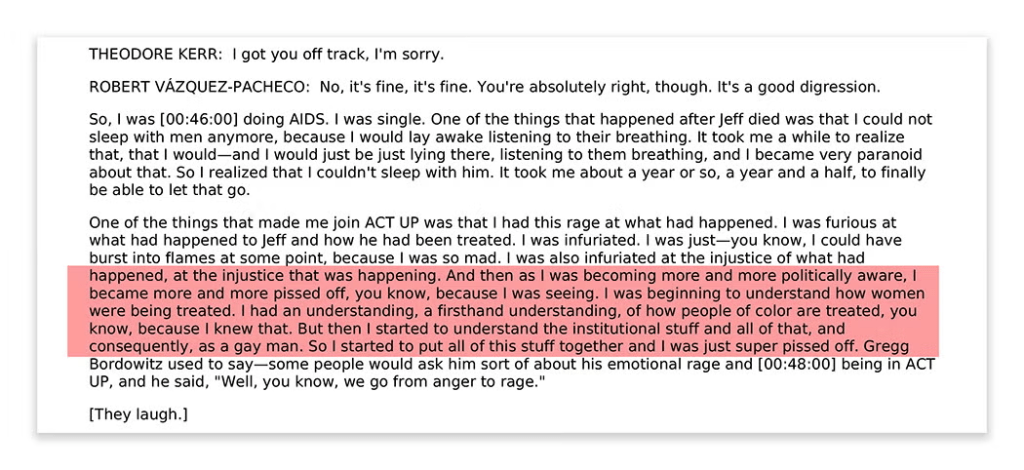
These personal experiences unfolded within the larger context of governmental indifference, active discrimination against people with the disease (or belonging to groups that were deemed “at risk”), and a growing consciousness of the political landscape of the epidemic. Robert Vasquez-Pacheco, a member of ACT UP and Gran Fury, recounts,
as I was becoming more and more politically aware, I became more and more pissed off, you know, because I was seeing. I was beginning to understand how women were being treated. I had an understanding, a firsthand understanding, of how people of color are treated, you know, because I knew that. But then I started to understand the institutional stuff and all of that, and consequently, as a gay man. So I started to put all of this stuff together and I was just super pissed off.
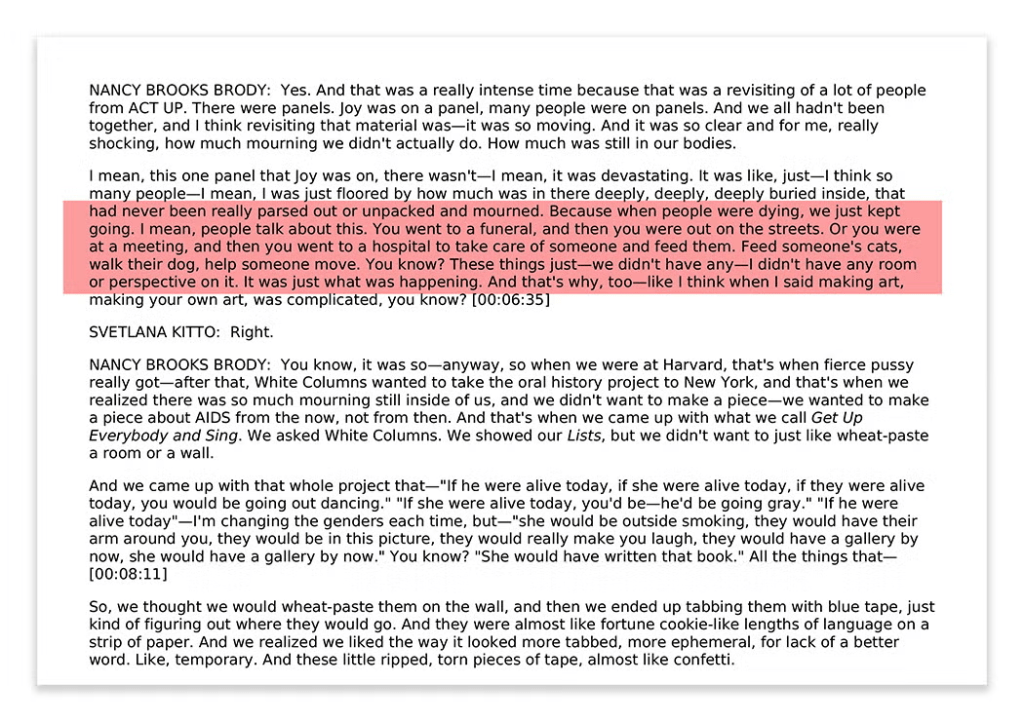
Some version of this process, repeated for many of the subjects, led people to activism, whether through art, volunteer work, protest, or sometimes all three. Nancy Brooks Brody (1962-2023), a visual artist and member of the fierce pussy collective, describes the progression in her interview.“Because when people were dying,” she explains,
we just kept going. […] You went to a funeral, and then you were out on the streets. Or you were at a meeting, and then you went to a hospital to take care of someone and feed them. Feed someone’s cats, walk their dog, help someone move. You know? These things just—we didn’t have any—I didn’t have any room or perspective on it. It was just what was happening.
The meetings she, and others, refer to were those of ACT UP New York (The AIDS Coalition to Unleash Power), which began in 1987 at a community meeting where Larry Kramer asked, “How long does it take before you get angry and fight back?” Kramer, a playwright and essayist who had been covering AIDS since the beginning through journalism, had co-founded the non-profit Gay Men’s Health Crisis in 1982. His play The Normal Heart, an impassioned call to action, spurred members of the audience to meet and subsequently take part in one of the most significant and effective activist movements of the twentieth century.
Creating Art in an Epidemic
The artistic works of those interviewed are diverse, both in media and approach: photographing people living with AIDS, using détournement to turn existing works into calls to action via graphic design, or using their body to confront audiences with the existence of the disease through performance. In some cases, their illness became an essential component of their art: John Dugdale, a former commercial photographer, began using nineteenth-century methods to capture and produce his work after HIV-related retinitis and a stroke left his sight significantly impaired. Ron Athey, one of the NEA Four, used his own HIV-positive body to create work exploring sex, trauma, and desire. The place of the artist within (or outside) a community could become a contentious issue, especially at a time when representation of people with AIDS was so fraught.
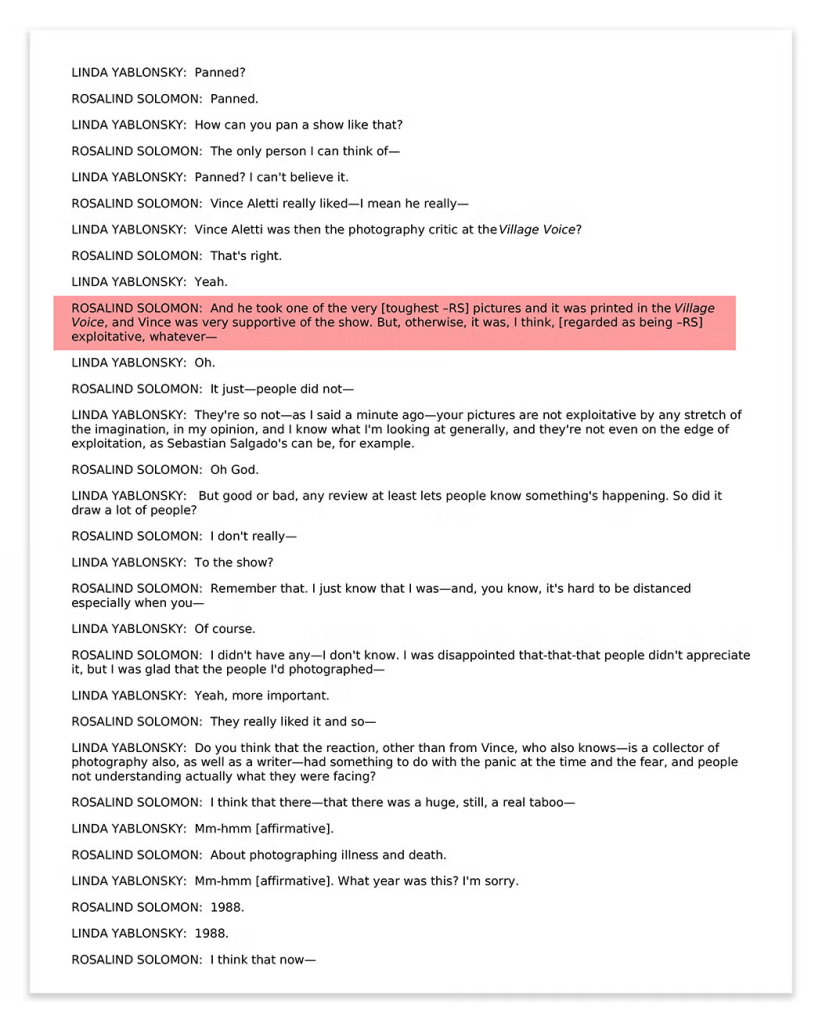
Rosalind Fox Solomon, whose 1988 show Portraits in the Time of AIDS featured photographs of the subject alone or with loved ones, some with visible lesions or in the hospital, relates that her project was critically panned and called “exploitative” at the time.
Some of the most vibrant, and now iconic, images of AIDS were created as (and for) protest: Silence = Death, the work of the Silence = Death Collective (and not ACT UP, as Avram Finkelstein relates in his interview) became the primary pictorial representation of ACT UP and a rallying slogan for the fight against the disease. Keith Haring did his own take on it for a poster, adding “Ignorance = Fear” to a “See No Evil, Hear No Evil, Speak No Evil” scene.
Collectives like Gran Fury and fierce pussy, which organized inside the ACT UP activist group, created posters for wheat-pasting that served as art, education, and calls to action around AIDS, homophobia, health care, and visibility. Whether newsprint works of text, guerrilla-installed bus station “ads,” or rolls of stickers of bloody hands announcing “One AIDS Death Every 10 Minutes,” the art of AIDS activism used any means available to communicate the urgency of the crisis.
The Visual Arts and the AIDS Epidemic collection demonstrates the power of oral history to preserve not just historical events, but what it felt like to live in the moment and survive it when so many people did not. Together with Reveal Digital’s HIV, AIDS, and the Arts archive, the collection ensures that these voices, experiences, and creative histories continue to be available to inform and educate future generations.
June is LGBTQIA+ Pride Month in the United States, so we’ve collected some of our most popular stories on a range of topics—from pronouns to politics—that highlight the history of the LGBTQIA+ community. As always, links to free JSTOR scholarship are included with each of these.
Remember this is a Christian nationalist who wants to push his version of religion on everyone else. He has denied promotion to women and black people. He is a radical religious crusader, which I know because he has a crusader tattoo. Years of trying to make the US military of which I was one and my dog tags read pagan for religion more inclusive are being destroyed by an administration that is filled with people who are driven to promote and push a religious domination on the military and country. It has long been known that religious zealots infected the Air Force Academy and were pushing the evangelical version of the Christian religion. In Germany I had to spend an uncomfortable 8 months when a fundamentalist religious group in our unit decided that as it was an open secret in the unit I was one of the gay members of the unit that was more open about it they needed to save me from my sins. Every time I went to the chow hall one of them cornered me at a table and started to preach at me. Not talk to me, not to offer friendship, but to tell me all about hell and how horrible I was and that their god hated how I was and that I was in willful disobedience to their great deity. They could save me from their already determined fate if I just joined them and gave my life to their god instead of the heathen sin some demons had infected me with.
I got so damn frustrated with them. Then my friends who had started eating with me to drive them away came up with a plan. We created a religion based on greek mythogoly that we called the “House of Aphrodite”. We drew up a few tenets of the region, one of which was that it was a sex religion and to worship everyone needed to do so with each other nude. The last time they saw me at the chow hall and several of them tried to sit with me and my friends, my friends sprung the trap. They told the guys we would gladly go to their church meetings and pray with them but only if they went to one of our religious meetings first. They did not know we were religious they claimed but we assured them we were very devout. Thinking we were talking about a “liberal” church they readily agreed and then my friends sprung the trap. They told them about our religion The House Aphrodite and the tenets. My friends emphasized how we all worshiped in the nude and some rituals enacted required people to touch each other even on their sexual organs to honor the goddess. My friends played it up and I could hardly keep from laughing at the horrified looks on their faces. Needless to say they declined our invitation to join us in worship. But after that they never bothered me again. Hugs