Just a short bit with the video for today from Bee. Same from me, below hers.
=====
I choose this one, because the music of it brings me peace. I bet I’m not the only one. It’s a peaceful song.
Just a short bit with the video for today from Bee. Same from me, below hers.
=====
I choose this one, because the music of it brings me peace. I bet I’m not the only one. It’s a peaceful song.
Bee brings us the Black Pumas, and a bit of commentary that begins, “One aspect of a peaceful existence is to consider our fellow humans as our family not our enemies.” Precisely!
My selection is this story, with The BeeGees performing Bob Dylan and then their own peace music. It’s an excellent story, and very good performances! Their own song is equal, at least, to Bob Dylan’s, but Barry Gibb discusses Bob Dylan’s influence on his music.
Barry Gibb recalls brave Bee Gees TV performance of Bob Dylan song to protest the Vietnam War

In 1962, the Australian Army began its formal military commitment to the U.S war in Vietnam. Two years later, young men were required to register for the National Service scheme and forced to fight in a bloody war that would enlist over 80,000 Australians. Over the next 11 years, 523 Australians died in battle and nearly 2400 were wounded before the country withdrew.
The fear of being sent to Vietnam to kill or be killed for the government struck fear into the hearts of many young Australians in 1963. That’s why three teenage boys, Barry (17), Robin (14), and Maurice (14) Gibb, The Bee Gees, took their big moment on Australian TV to speak truth to power by singing Bob Dylan’s “Blowin’ in the Wind.” The Bee Gees were relative unknowns that night on Bandstand, but by the end of the decade, they would be among the biggest acts in the world.
“Blowin’ in the Wind,” released earlier that year, asks fundamental questions about war, racial justice, and whether humanity will ever live in peace and equality. The song would become one of the most important anthems in the Civil Rights and peace movements of the ‘60s and beyond.
Barry Gibb, now 79, says that even as a teenager, he completely understood why Dylan’s song needed to be heard. “I was rapidly approaching the time when I would have to register for the draft,” he told Upworthy in an exclusive interview. “It’s hard to explain that period, except that everyone was very worried, very worried, and Bob Dylan was our hero.”
“The Vietnam War was such chaos to the Australian people that it shadowed everything. I wrote a song called ‘And the Children Laughing’ because of what Bob Dylan had written. It’s about life and dying, and the idea that you would die for your country or go and kill people you don’t know. And I don’t want to go kill people. It was not on the table for me. So everything he wrote touched me deeply,” Gibb continued.
Why don’t you get on your feet
It’s about time you got to think
Whatever happened to peace?
Well, open your eyes and you’ll see children laughing
Voices singin’, hearts a-beatin’ ah…
Barry Gibb has always believed in peace
(snip-there MORE; it’s not too long, but this is a long post with the music)
Bee’s post is eloquent! There is/was not a video in the post, but she named the song, and gives great background on the artist and the song. I checked YouTube, found the one I hope is the right one, and posted it beneath Bee’s entry here. She has posted this one in the past; I recall it. It’s beautiful and perfectly expressive. Well worth a repeat listen!
I can’t follow this one! I’ll do it tomorrow. ☮

PROVE ME WRONG by Jenny Lawson (thebloggess)
Read on Substack
Last week when I was flying home I was scanning the ocean because I’m always certain that I’ll see Godzilla or a sea serpent if I look hard enough, but instead I saw a rainbow from the plane window and it was a perfect circle over the ocean. I was so excited I hit my head on the window and scared the person behind me. I didn’t have time to capture it on my phone but I shook Victor awake and was like, “YOU’LL NEVER BELIEVE WHAT I JUST SAW OUTSIDE THE WINDOW” and he said, “Was it a colonial woman churning butter on the wing?” and I was like, “…yep…that’s exactly what it was” because a circular rainbow feels anticlimactic after that guess.
Aaanyway, that leads to this week’s drawing, which I’m fairly certain counts as a scientific illustration:

Sending you love, rainbows and godzilla hugs,
~me
(snip)

=====

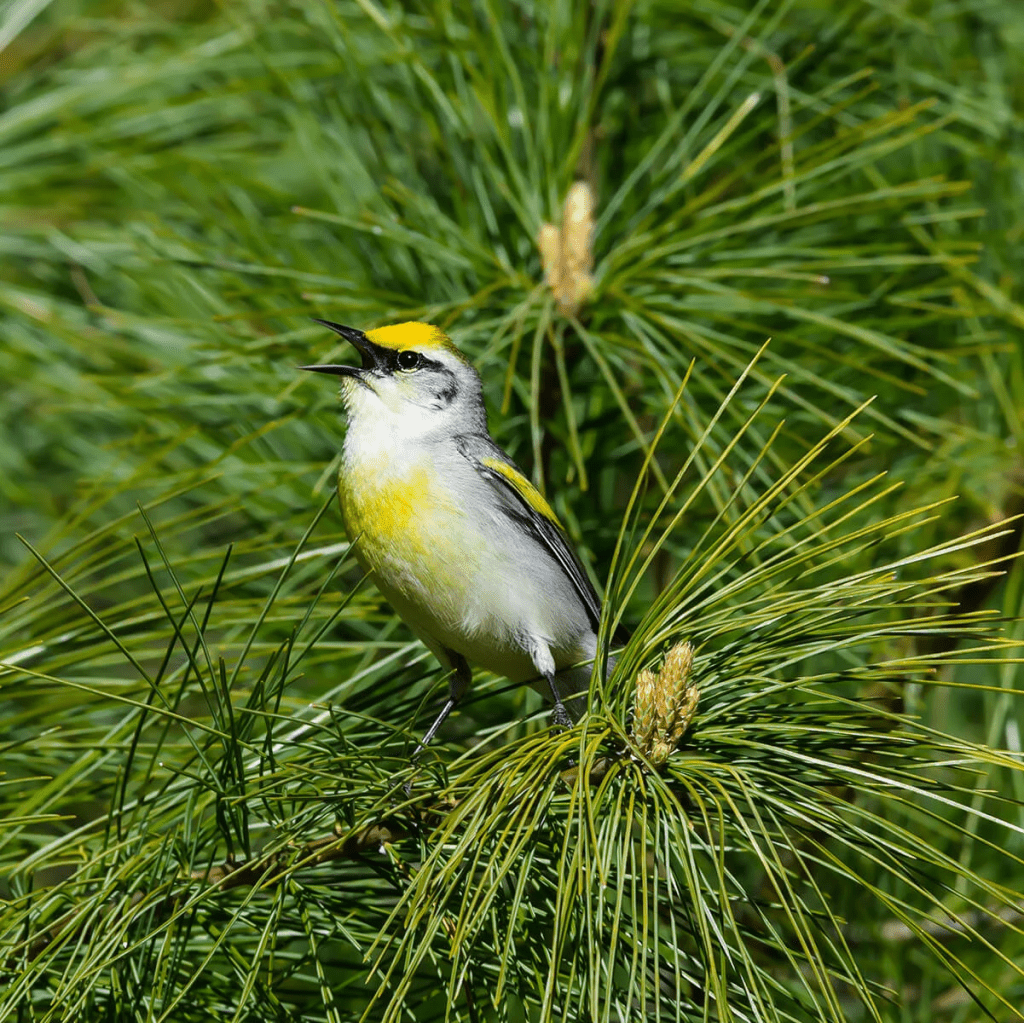
American Bird Conservancy has changed its page. It seems even easier to use. Here are some bits about this week’s bird.

Most woodpecker species in the United States and Canada display a mix of black, white, and red plumage, but don’t tell the Lewis’s Woodpecker. Its unusual mix of colors includes a red face, pink belly, glossy green back, crown, and nape, and silver-gray collar. The bird is simply stunning.
Lewis’s Woodpecker also differs from other members of its family in many of its foraging styles and food choices. In the summer, the bird eats mostly insects, catching them in flight by swooping out from a perch like a flycatcher or by foraging in flight like a swallow. Wide, rounded wings give the bird a buoyant, straight-line flight, more like a jay or crow than a woodpecker. The bird seldom excavates for wood-boring insects; unlike other woodpeckers, this species lacks the strong head and neck muscles needed to drill into hard wood.
In the fall, Lewis’s Woodpeckers switch to eating nuts and fruit, chopping up acorns and other nuts and caching them in bark crevices for later consumption. During the winter, they aggressively guard these storage areas against intruders, including other woodpecker species.
Ornithologist Alexander Wilson described the species in 1811 and named it for Meriwether Lewis, who observed the bird in 1805 during the Lewis and Clark expedition.
Birds around the world are declining, and many of them, like Lewis’s Woodpecker, are facing urgent, acute threats. Moreover, all birds, from the rarest species to familiar backyard birds, are made more vulnerable by the cumulative impacts of threats like habitat loss and invasive species.
Surveys indicate that Lewis’s Woodpecker populations may have declined by about 60 percent since the 1960s, and much of the reduction is likely due to loss or alteration of suitable nesting habitat. Like all other woodpeckers, the Lewis’s Woodpecker requires cavities in snags (standing, dead, or partly dead trees) for nesting. Logging, the suppression of wildfires, and grazing have altered many of the western forests where the species is found. The changes to the landscape often result in large areas dominated by trees that are the same age, leaving few dead or decaying trees available for the birds’ nests.
Pesticides take a heavy toll on birds in a variety of ways. Birds can be harmed by direct poisoning from pesticides, lose insect prey to pesticides sprayed on crops and lawns, or be slowly poisoned by ingesting small mammal prey that have themselves ingested rodenticides. Lewis’s Woodpeckers are likely exposed to pesticides in orchards and other agricultural settings.
Written by Matthew Russell
Off Trøndelag’s coast, long lines of kelp now do double duty. They grow fast. They also lock away carbon. A new pilot farm near Frøya aims to turn that promise into measurable removal of CO₂ from the air, according to DNV.
The site spans 20 hectares and carries up to 55,000 meters of kelp lines. First seedlings went in last November. The goal is proof of concept, then scale.

The three-year Joint Industry Project, JIP Seaweed Carbon Solutions, brings SINTEF together with DNV, Equinor, Aker BP, Wintershall Dea, and Ocean Rainforest, with a total budget of NOK 50 million, Safety4Sea reports.
Researchers expect an initial harvest of about 150 tons of kelp after 8–10 months at sea. Early estimates suggest that biomass could represent roughly 15 tons of captured CO₂. This is a test bed for methods that can be replicated and expanded, DNV explains.
There’s a second step, as kelp becomes biochar. That process stabilizes carbon for the long term and can improve soils on land, SINTEF’s team told Safety4Sea. The project is designed to test both the removal and the storage.

Seaweed isn’t new here. Norwegians have cultivated kelp since the 18th and 19th centuries for fertilizer and feed. Scientists advanced modern methods in the 1930s, laying the groundwork for today’s farms, according to SeaweedFarming.com. Cold, nutrient-rich waters support species like Laminaria and Saccharina. They grow quickly and draw down dissolved carbon and nitrogen.
The country’s aquaculture backbone also helps. Norway already runs one of the world’s most advanced seafood sectors. That expertise now extends to macroalgae.
Commercial cultivation began receiving specific permits in 2014, and activity has expanded across several coastal counties, according to a study in Aquaculture International. Researchers detailed the risks that accompany scale: genetic interaction with wild kelp, habitat impacts, disease, and space conflicts. Integrated Multi-Trophic Aquaculture, where seaweed grows alongside finfish, can recycle nutrients from farms and reduce eutrophication pressures.

Getting beyond sheltered bays is crucial. One path is the “Seaweed Carrier,” a sheet-like offshore system that lets kelp move with waves in deeper, more exposed water. It supports mechanical harvesting and industrial output without using land, Business Norway explains. The same approach can enhance water quality by absorbing CO₂ and “lost” nutrients.
The Frøya project is small in tonnage but big in intent. It links Norway’s long kelp lineage with new climate tech: fast-growing macroalgae, verified carbon accounting, and durable storage as biochar. If these methods prove reliable at sea and on shore, Norway will have more than a farm. It will have a blueprint for ocean-based carbon removal that others can copy.
from the end of the shutdown,-and I have huge hope that we the people will continue to stand together to help each other through the days!-we do get the Astronomy Photo of the Day again!

Orion and the Running Man
Image Credit & Copyright:R. Jay Gabany
Explanation: Few cosmic vistas can excite the imagination like The Great Nebula in Orion. Visible as a faint, bland celestial smudge to the naked-eye, the nearest large star-forming region sprawls across this sharp colorful telescopic image. Designated M42 in the Messier Catalog, the Orion Nebula’s glowing gas and dust surrounds hot, young stars. About 40 light-years across, M42 is at the edge of an immense interstellar molecular cloud only 1,500 light-years away that lies within the same spiral arm of our Milky Way galaxy as the Sun. Including dusty bluish reflection nebula NGC 1977, also known as the Running Man nebula at left in the frame, the natal nebulae represent only a small fraction of our galactic neighborhood’s wealth of star-forming material. Within the well-studied stellar nursery, astronomers have also identified what appear to be numerous infant solar systems.
Tomorrow’s picture: pixels in space
Two from Bee; she participates in the blog strike on Thursdays, for Gaza. Both excellent pieces; one from Pink, one from Alicia Keys, each with some info about the artist and her music.
Here’s my selection for today: