A Winding Literary Hoax

Many names in this story. You can listen to it on the page; it says it’s a 22 minute listen.

The erotic poems of Bilitis

A lush translation of this late-discovered lesbian poet added to the legacy of Sappho, but there was a trickster at work

In 1894, a German archaeologist named Herr G Heim made a groundbreaking discovery. On the island of Cyprus, he excavated a tomb that belonged to a hitherto unknown ancient female poet by the name of Bilitis. Carved on the walls surrounding her sarcophagus were more than 150 ancient Greek poems in which Bilitis recounted her life, from her childhood in Pamphylia in present-day Turkey to her adventures on the islands of Lesbos and Cyprus, where she would eventually come to rest. Heim diligently copied down this treasure trove of poems, which had not seen the light of day for more than two millennia. They would have remained little known – accessible only to a small, scholarly audience who could decipher ancient Greek – had a Frenchman named Pierre Louÿs not taken it upon himself to hunt down Heim’s Greek edition, hot off the press, and translated Bilitis’s poetry into French for a broader reading public that same year (published as Les Chansons de Bilitis or The Songs of Bilitis). Bilitis might have been an obscure historical figure – no other ancient author mentions encountering her or her poetry – but the cultural and literary significance of Heim’s discovery was not lost on Louÿs. For, in several of her poems, Bilitis revealed that she crossed paths with classical antiquity’s most renowned and controversial female poet: Sappho.
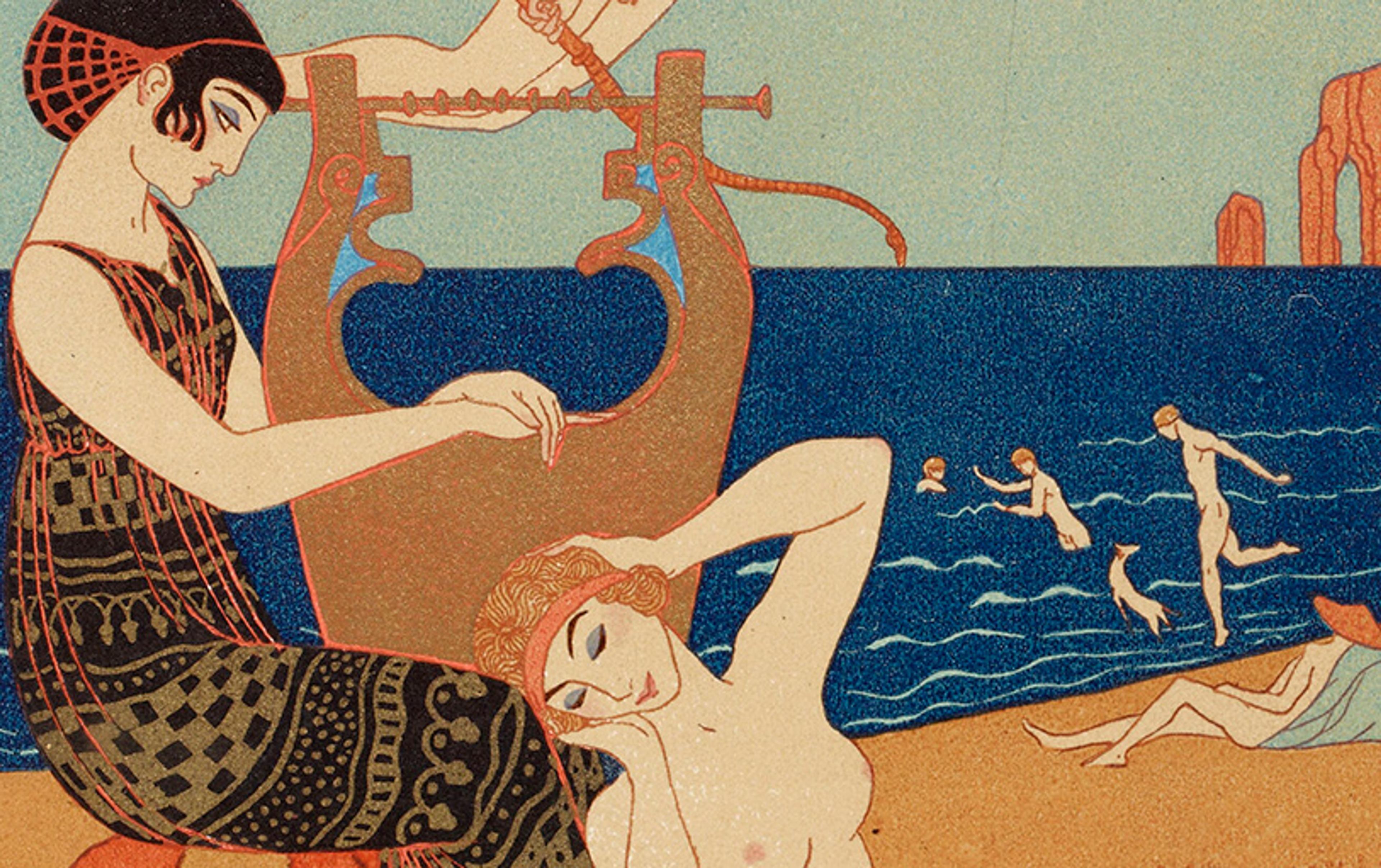
Art Nouveau painting of people by the sea, with a woman playing a lyre and others swimming and relaxing on the beach.
From The Songs of Bilitis (1922) by Pierre Louÿs, illustrated by Georges Barbier. Courtesy the BnF, Paris

Sappho (c630-c570 BCE) lived in the city of Mytilene on the island of Lesbos, where she composed lyric poetry – songs performed to the accompaniment of the lyre. Her poetry was widely admired throughout antiquity. Plato dubbed her ‘the tenth Muse’. In the 1st century CE, the Greek philosopher Plutarch recalled listening to Sappho’s poetry performed at symposia – wine-drinking parties – remarking that her words were so beautiful, he was moved to put his wine cup down while he listened.

Photograph of ancient papyrus fragments with Greek text displayed in a black frame on a white background.
A 3rd-century Egyptian fragment of Sappho’s poetry from papyri found at Oxyrhynchus (modern-day Al-Bahnasa in Egypt). Courtesy the Bodleian Library, Oxford, UK

Sappho was significant enough to have her work copied by scholars at the Library of Alexandria a few hundred years after she lived – the same scholars who first systematised Homer’s Iliad and Odyssey into the books we are familiar with today. Of the nine book rolls of Sappho’s work these scholars produced, only a sliver survives. There is one complete poem, the so-called ‘Hymn to Aphrodite’, in which Sappho prays to the goddess of love to bring a female lover back into her good graces. The rest are scraps. Our knowledge of her poetry relies largely on papyrus fragments and partial quotations from later authors. As the classicist Emily Wilson put it in the London Review of Books: ‘Reconstructing Sappho from what remains is like trying to get a sense of a whole Tyrannosaurus rex from one claw.’

Among these precious fragments, we find some of the most stirring and exceptional representations of desire in all ancient Greek literature. In fragment 31, for example, Sappho sees a man sitting across from a woman and listening to her sweet voice and lovely laugh. She compares him to a god, but then this man, ‘whoever he is’, quickly fades to the background, and Sappho spends the rest of the fragment expressing in hair-raising detail the effects that beholding this woman has on her:

… oh it
puts the heart in my chest on wings
for when I look at you, even a moment, no speaking
          is left in me

no: tongue breaks and thin
fire is racing under skin
and in eyes no sight and drumming
          fills ears

and cold sweat holds me and shaking
grips me all, greener than grass
I am and dead – or almost
          I seem to me …

(All translations of Sappho by Anne Carson)

Passionate desire, what the Greeks called eros, is no trifling matter for Sappho. In fragment 130 , Sappho calls eros the ‘melter of limbs’ who habitually stirs her, a ‘sweetbitter [glukupikron] unmanageable creature who steals in …’ If we are accustomed to think of love as bittersweet, Sappho inverts this: eros starts off sweet (gluku) but turns bitter (pikron), as some distance or barrier often comes between Sappho and her female loves, as in fragment 31 above.

We find expressions of the devastating stakes of eros among male lyric poets, too, but in those contexts, the poets sing of desire for beautiful male youths or ‘beloveds’. In classical Greek culture, this form of male homoeroticism, known as pederasty, is elevated as the most admired, virtuous, manly form of love, even superior to heterosexual relations. From our earliest Greek literary sources onwards, women’s desires and bodies are problematic. According to the poet Hesiod, Zeus invented the first woman – Pandora, a ‘beautiful evil thing’ – as a punishment for men. Her opening of the jar – not a box but rather a pithos, a giant storage jug as big as the human body – symbolises the misogynist view of women as leaky containers whose insatiable appetites, whether for food or for sex, must be controlled and regulated by men.
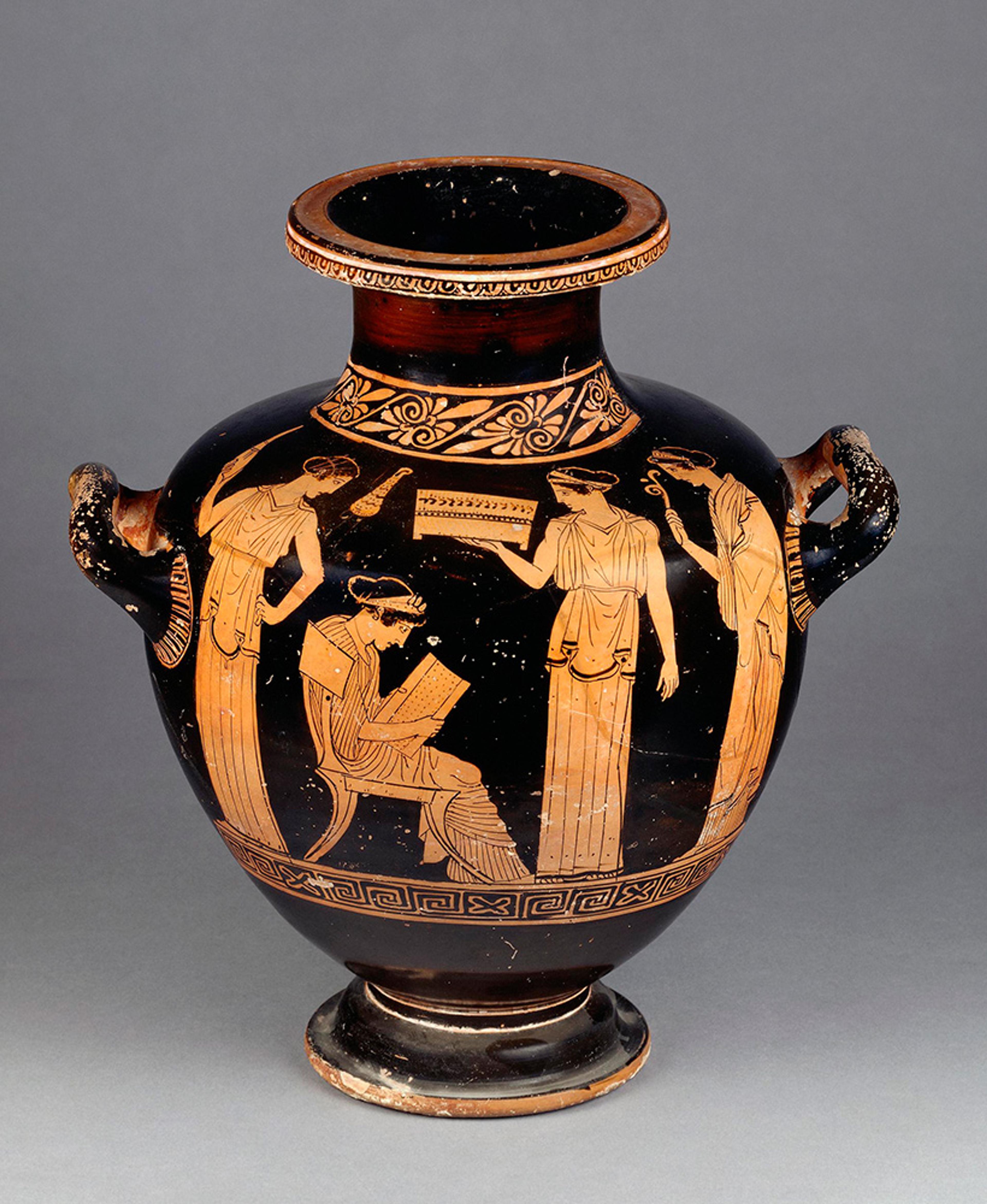
Ancient Greek pottery shows a seated figure reading and four standing figures, decorative red-figure design on a black vase.
A hydria (water jar) possibly depicting Sappho reading and surrounded by attendants. Greek, c450 BCE. Courtesy the British Museum, London

poem titled ‘Types of Women’, by Sappho’s contemporary Semonides of Amorgos, showcases this strain of misogyny on steroids. The poem attacks women through the form of a catalogue, listing different types of women and the animal-antecedents to whom they owe their shameful, negative traits. The only acceptable type of woman Semonides describes is the bee-woman, the ideal wife who directs her desire entirely towards enriching her husband’s household by bearing him legitimate children. This ideal woman never so much as mentions sex when in conversation with other women.

In comparison with this misogynist tradition, Sappho’s representation of women and desire could not be more different. Take fragment 16, which opens thus:

Some men say an army of horse and some men say an army on foot
and some men say an army of ships is the most beautiful thing
on the black earth. But I say it is
      what you love.

In these lines, Sappho articulates an expansive vision of beauty. She lists the different kinds of armies that men find the most beautiful, using the form of the catalogue to invoke Homer’s Iliad, a war story whose plot and heroic values are underpinned by the violent exchange of women as property between men. Sappho does not tell us whether or not she thinks armies are beautiful. She simply says that the most beautiful thing is what(ever) we love (and therefore subtly claims that men think armies beautiful because they love war).

Sappho recreates through memory a single person who is beautiful because she is loved

She then explains her point by citing the example of Helen, the wife of Menelaus, on behalf of whom the Greeks fight the Trojan War. Accounts differ as to whether Helen sailed to Troy willingly to be with the Trojan prince Paris or was forcibly taken. Rather than castigate Helen as the epitome of evil – female desire – as most traditions do, Sappho simply states that she left behind her husband, children and parents, and sailed to Troy, because something (the poem is fragmentary; perhaps desire itself?) led her astray.

Art Nouveau painting of two individuals playing a pan flute together against a backdrop of blue sky and clouds.
From The Songs of Bilitis (1922) by Pierre Louÿs, illustrated by Georges Barbier. Courtesy the BnF, Paris

The point is this: even she who ‘overcame everyone in beauty’ pursued what she found the most beautiful thing on earth, what(ever) she loved. And this, Sappho says, reminds her of a woman named Anaktoria, who is gone. Sappho says:

I would rather see her lovely step
and the motion of light on her face
than chariots of Lydians or ranks
         of footsoldiers in arms.

For Sappho, the beauty of armies pales in comparison with the beauty of Anaktoria because Sappho loves Anaktoria. ‘Ranks of footsoldiers’ behold women as exchangeable, dehumanised objects of beauty, not love. Sappho recreates through memory a single person, Anaktoria, who is beautiful because she is loved. What makes Sappho’s articulation of eros so exceptional, then, is how she challenges the dominating, misogynist attitudes about women and their desire as expressed by the male-authored Greek literary tradition. As the classicist Ella Haselswerdt writes in ‘Re-Queering Sappho’ (2016):

Sappho’s fragments show us eros and pleasure for their own sake, not as an exchange of property, the exploitation of one for the sake of the other, or in order to achieve virtue in the eyes of a moralising philosopher like Plato or Aristotle.

From antiquity onwards, however, Sappho’s expressions of lesbian eros attracted a medley of misogynistic and homophobic responses. In the 5th century BCE, following the tradition of pathologising women’s desires (whether homo or hetero), Athenian comic playwrights transformed Sappho into the stock character of a sex-crazed woman, insatiably hungry for men. In his Heroides, a collection of literary letters in which female heroines express their grievances to the men who have mistreated them, the Roman poet Ovid composed a letter in Sappho’s voice. His version of Sappho claims that her love for a young boatman named Phaon surpasses the thousands of loves she has had with girls on Lesbos. The ancient biographical tradition performs the ultimate act of heterosexualising Sappho by claiming that she leapt to her death from the cliffs of Leucas because Phaon would not reciprocate her love. Flash-forward to the late 19th century, when archaeologists were beginning to find papyrus fragments in Egypt containing new bits of Sappho: as Miriam Kamil writes in ‘I Shall — #$% You And *@$# You’ (2019), many English translators censored Sappho’s lesbianism by changing female pronouns to male.

Given this history, it is difficult to overstate the significance of Heim’s discovery of Bilitis’s poetry: here, at last, was the material evidence and textual perspective of a female contemporary to Sappho and her lovers.

The catch? ‘Bilitis’ was fake.

Bilitis’s poetry and the story of its discovery were all the invention of Pierre Louÿs, the man who purported to have translated her poems for the first time. We might be tempted to classify Louÿs’s concoction as a forgery, a text created by a person who intends to deceive an audience by passing it off as something other than what it is. However, upon closer inspection, The Songs of Bilitis is a thinly veiled literary hoax, a creation that is more of a literary game than a genuine attempt at deception.

Louÿs was no stranger to the contemporary literary scene as both a translator and an imitator of (authentic) ancient texts. He also happened to be close friends with Oscar Wilde, sharing with him literary interests in art’s power to imitate and deceive, as well as erotic interests in sexual tourism in French-colonised Algeria. Only one year before releasing The Songs of Bilitis, Louÿs had published a French translation of epigrams by the 1st-century BCE poet Meleager of Gadara (now the city of Umm Qais in Jordan). It is likely that Louÿs found inspiration for fabricating Bilitis in the genre of the epigram itself. Epigrams are short poems originally written upon objects such as pots, walls or tombs – the site of Bilitis’s discovery. As a ‘lower’ literary genre, epigrams are often sexually explicit. Louÿs lifted some of Bilitis’s songs wholesale (with minor tweaks) from the erotic Book 5 of the Greek Anthology, a collection of thousands of Greek poems. Finally, by composing epigrams under the name of Bilitis, Louÿs took his cue from an ancient authorial move associated with the epigram: some epigram authors, remaining anonymous themselves, composed epigrams pseudonymously, that is, by attaching someone else’s name (often that of a dead author) to their epigram. Some of the epigrams in the Greek Anthology purport to be composed by Sappho herself, something Louÿs no doubt had in mind as he chose ‘Bilitis’ for his authorial mask.

The book was published amidst intense cultural debates about the quality and nature of Sappho’s lesbian desire

Louÿs ‘plays’ the forger and wants his readers to appreciate the cleverness of his performance. One clear example of this lies in the fiction Louÿs creates around the poems’ provenance. In The Songs of Bilitis, Louÿs inserts a prefatory ‘Life of Bilitis’, in which he narrates how Herr G Heim excavated Bilitis’s tomb and brought her poetry to light. The choice of this name encodes a clever joke: when read with a German pronunciation, Herr G Heim becomes Herr Geheim, aka ‘Sir Secret’. The real origin of Bilitis’s poetry – not Herr G Heim’s pickaxe but Pierre Louÿs’s pen – is a secret lying in plain sight for clever readers to detect. We also learn from this preface that Bilitis had a Greek father and a Phoenician mother, but that she might have never known her father, given that he is nowhere mentioned in her poetry. It is tempting to see Bilitis’s dubious paternity as another place where Louÿs tips his hat as Bilitis’s literary progenitor.
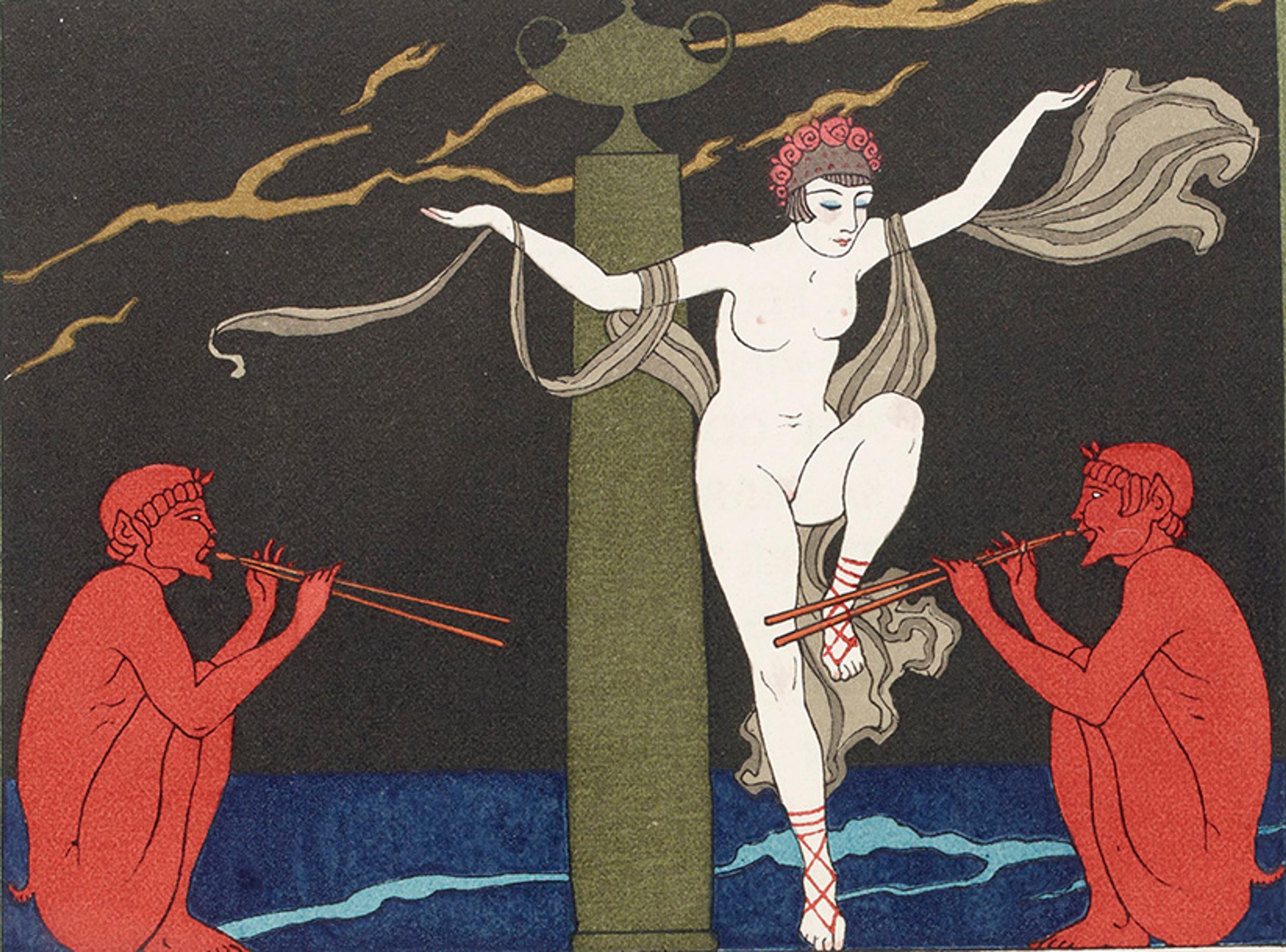
Art print of a nude dancer with flowing ribbons flanked by two red figures playing flutes against a dark sky.
From The Songs of Bilitis (1922) by Pierre Louÿs, illustrated by Georges Barbier. Courtesy the BnF, Paris

Another playful way that Louÿs generates an aura of mystery around Bilitis’s poetry is the inclusion of a table of contents that labels some of the poems ‘untranslated’. Readers who are taken in by the ruse might believe that, given the sexual nature of many of the songs, some of them were too explicit to translate for a popular audience. But for readers who get the game Louÿs is playing, this performance of self-censorship puts Bilitis in the same category as actual ancient writers such as Catullus, Martial or Juvenal, whose sexual obscenities were handled in 19th-century translations by leaving them in untranslated Latin.

Even if The Songs of Bilitis was more of a literary hoax than a forgery, Louÿs nonetheless followed the forger’s playbook in targeting the desires of his contemporary audience. Not only did his ‘discovery’ hit the shelves as new papyrus fragments of Sappho’s poetry were being excavated in Egypt, but the book was also published amid intense cultural debates about the quality and nature of Sappho’s lesbian desire. For Natalie Barney and Renée Vivien – two prominent lesbian intellectuals (and close friends of Louÿs’s) – it was irrelevant that Bilitis was fake: they praised Louÿs for representing an unequivocally lesbian Sappho, and they went on to publish their own translations and imitations of Sappho’s poetry.

The greatest badge of honour for Louÿs’s literary creation, however, came from its most incendiary critic: the German philologist giant Ulrich von Wilamowitz-Moellendorff. In 1896, Wilamowitz published a scathing 16-page review of The Songs of Bilitis. His ire did not mellow as time passed, for he reprinted this same review as the centrepiece to his monograph Sappho und Simonides (1913). The opening of the review is worth quoting in full (my translation from German):

A volume of French poetry, some of which is disgustingly lewd, may seem unsuitable for review in this place: but I find it worthy of consideration, and seize this opportunity to address matters long dear to my heart. I’m concerned with the purity of a great woman: I’m not afraid to put my hands in shit.

The ‘great woman’ Wilamowitz refers to here is not Bilitis, of course, but Sappho. Bilitis is the filth that has corrupted her ‘purity’, by which Wilamowitz means Sappho’s (hetero)sexual chastity. In this regard, Wilamowitz used his review of contemporary French poetry to rekindle an argument made about Sappho in the early 19th century by the scholar Friedrich Welcker. Welcker wrote a book called Sappho von einem herrschenden Vorurtheil befreyt (1816), or ‘Sappho: Freed from a Prevailing Prejudice’, in which he argued that Sappho was not, in the lingo of the time, a ‘tribade’, but rather a schoolteacher preparing girls for society and marriage with men. Wilamowitz follows the path paved by Welcker, claiming that it is later readers such as Louÿs who bring their own ‘unnaturalness’ (Unnatur) to Sappho’s poetry.

Wilamowitz’s fiery takedown did not succeed in quashing the hype

The motive of Wilamowitz’s review is to purify Sappho of lesbian eroticism via her association with Bilitis (whose primary female lover is not, in fact, Sappho, but rather someone called Mnasidika, whose beauty Sappho herself praises in fragment 82a: ‘Mnasidika more finely shaped than soft Gyrinno …’). Curiously, however, most of his review is spent criticising various poetic and linguistic aspects of Louÿs’s poetry. Wilamowitz plays the philological critic in unveiling the many anachronistic details littered throughout the poems, observing that they suit more the literature of the later Hellenistic and imperial period (when Greece was under Roman control) rather than the ‘true Hellenic’ (ie, classical) spirit of Sappho’s time. Wilamowitz is as upset at Louÿs’s anachronistic mixing of literary genres and language as he is by Sappho’s sexual mixing with Bilitis. For him, The Songs of Bilitis presents both a moral and textual threat to a supposedly pure Sappho. Wilamowitz’s review promulgates a misogynist, homophobic theory about Sappho, and it cloaks this mission in the seemingly objective rhetoric of classical philology.

Wilamowitz’s fiery takedown did not succeed in quashing the hype around The Songs of Bilitis. In fact, the opposite occurred. Louÿs himself cited Wilamowitz’s review in the bibliography to the expanded 1898 edition of The Songs of Bilitis. Why would Louÿs draw attention to such negative reception? Wilamowitz’s eye as a philologist laid bare for readers all the potential sources that Louÿs imitated as he composed his fake ancient poems, thus highlighting the scholarly work that went into making Bilitis. Wilamowitz takes Louÿs’s poems so seriously as imitations that he treats them as if they actually were translations of authentic ancient Greek poems. The critic’s takedown becomes the forger’s badge of pride.
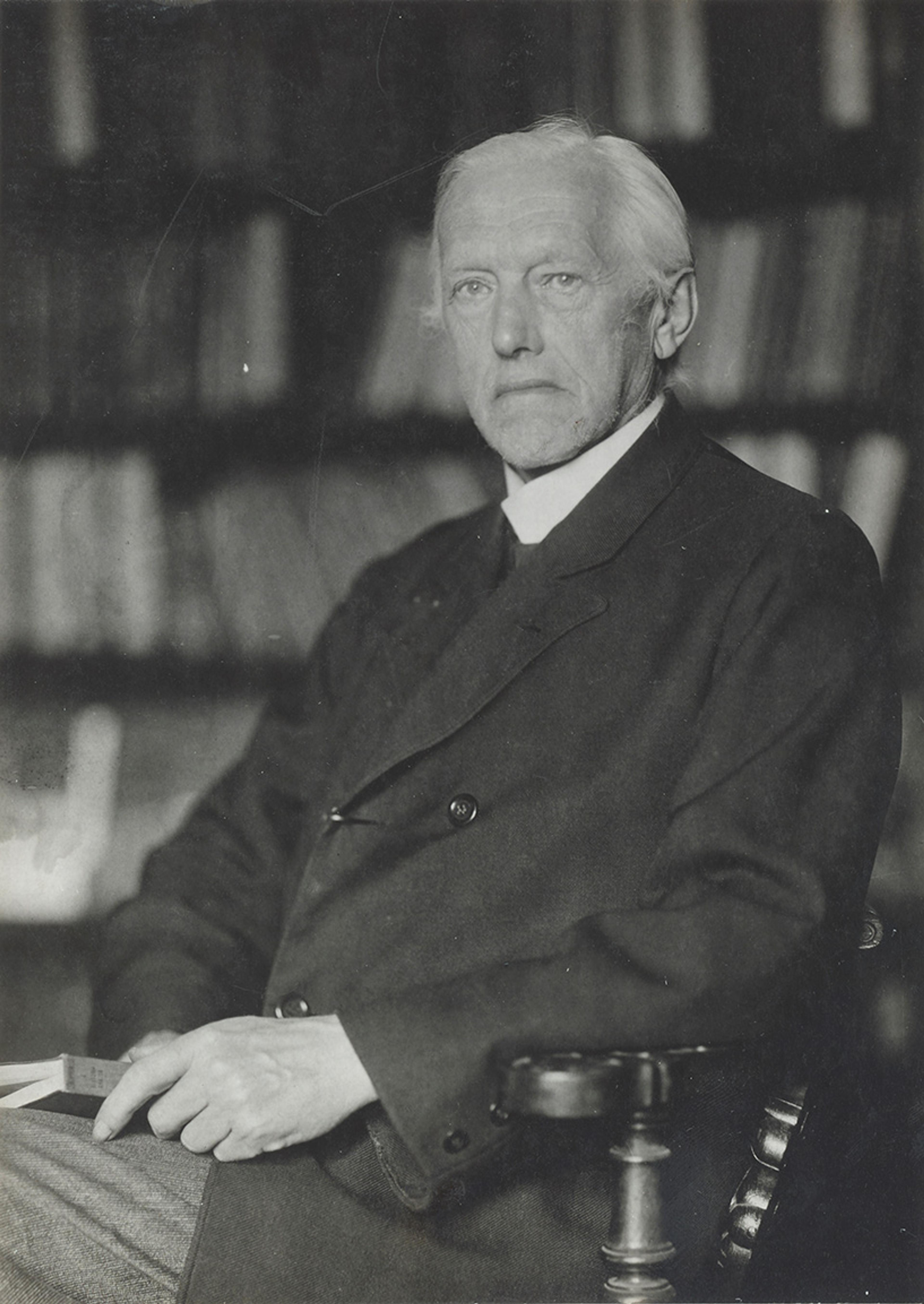
Black and white photo of an elderly man in a suit sitting on a chair in front of bookshelves.
Professor Dr Ulrich von Wilamowitz-Moellendorff, c1917. Courtesy Wikipedia

Still, Louÿs’s bold citation of Wilamowitz’s homophobic review should give us pause. If Wilamowitz was concerned to carry Welcker’s torch and purify Sappho from the taint of female homoeroticism, Louÿs did not exactly free Sappho from male-centred, misogynist approaches to her poetry, a tradition that, as we’ve seen, was underway already in classical antiquity.

Although he represented a homoerotic Sappho – and received praise from contemporary lesbian readers for doing so – Louÿs in fact had drawn inspiration for the character of Bilitis from his sexual involvement with a 16-year-old Algerian girl. Louÿs invented a literary fiction that fit squarely in a 19th-century French literary tradition of male-authored, voyeuristic, orientalising portrayals of lesbian desire, a tradition grounded in the material conditions and power dynamics of European colonialism and sexual tourism. In this regard, Sappho and Bilitis were simply springboards for Louÿs to cater to a European readership hungry for images of the exoticised lesbian other.

These lesbians took the licence that they, too, could participate in the contested afterlife of Sappho

But this is not the end of Bilitis’s story. Some 60 years after the ‘discovery’ of Bilitis, a remarkable coincidence occurred, igniting a new legacy for Bilitis that Louÿs could never have predicted. In 1955, The Songs of Bilitis, previously available only through limited, expensive and privately printed editions, was republished by Avon, a press that sought to rival Pocket Books (the first mass-market paperback publisher in the United States) by making a wider range of literature – from science fiction to smut – accessible to a popular audience in the form of cheap paperbacks. That same autumn, four lesbian couples gathered in San Francisco to form a secret club. They desired a space where lesbians could socialise beyond the surveillance of their parents, families and employers, and outside of gay bars, which were frequently subject to police raids.

When it came time to make a name for their group, they had to be careful not to pick anything that could put their members at risk, given the intense homophobia of the McCarthy era. Nancy, a factory worker whose last name we don’t know, suggested ‘Daughters of Bilitis’. She was met with blank stares. Nancy explained: she had encountered a translation of Bilitis’s poetry in a volume by Pierre Louÿs. She had brought that very volume with her to the meeting. What intrigued Nancy was that this Bilitis was a contemporary of the ancient Greek poet Sappho on the island of Lesbos in the late 7th century BCE. Nancy’s partner Priscilla chimed in: ‘“Bilitis” would mean something to us, but not to any outsider. If anyone asked us, we could always say we belong to a poetry club.’ The women agreed to name themselves after this obscure figure. Thus was born the ‘Daughters of Bilitis’ (or DOB), a group that would become the first lesbian social-political organisation in the US, active until 1995.

It is easy to take a cynical view of these lesbians’ decision to name themselves after a fictive ancient lesbian. The women were cognisant of the fact that Louÿs had invented Bilitis, but that did not deter them from making something out of what was available to them – and conducive to their precarious social conditions – at the time. If these lesbians took anything from Louÿs, it was the licence that they, too, could participate in the contested afterlife of the fragmentary Sappho. Unlike Louÿs, they would author a chapter under Bilitis’s name by and for lesbians.

Protest breaks out at Dilley immigration detention facility holding 5-year-old Liam Ramos

Please understand the horrific conditions these children are being held in.  Bug and dirt filled food, guards in these concentration camps they are held in tell the kids not to waste their oxygen by complaining or making the guard deny them.  While physical abuse and verbal abuse is a given there is no doubt that some sexual abuse is happening.  One boy had appendicitis and the guards refused him treatment until he was throwing up in a hallway that they even dealt with him and even then they kept him from medical attention for another 6 hours.  The boy barely survived.  First they don’t see these brown children as people and second the government has stopped paying for the medical care of the detained people in their care.  Hugs

https://www.tpr.org/border-immigration/2026-01-24/protest-breaks-out-at-dilley-immigration-detention-facility-holding-5-year-old-liam-ramos

Detainees held at the South Texas Family Residential Center wave signs during a demonstration in Dilley, Texas, Saturday, Jan. 24, 2026.

Brenda Bazán
Detainees held at the South Texas Family Residential Center wave signs during a demonstration in Dilley, Texas, Saturday, Jan. 24, 2026.

A protest broke out Saturday at the South Texas family detention complex in Dilley, about 70 miles south of San Antonio, after guards abruptly ordered attorneys to leave while detainees — many of them children — poured into open areas of the facility chanting “Libertad,” or “Freedom,” according to an immigration attorney who witnessed the event.

Immigration attorney Eric Lee said he was at the Dilley facility for a confidential visit with clients — an immigrant family of six, including five children — when guards began shouting for everyone in the waiting area to leave, citing what they described as “an incident.”

As the Michigan-based attorney walked toward his car, he said he heard what sounded like “hundreds of children” shouting, with voices he described as “high-pitched” and “urgent.” He said he could see children streaming from dormitory areas behind a chain-link fence and chanting “Libertad.”

Lee said clients he later spoke with told him the protest was triggered by concerns over the treatment of Liam Conejo Ramos, a five-year-old who was taken into custody with his father in Minnesota earlier this week and transferred to the Dilley facility.

ICE agents stand next to a boy, who a witness identified as Liam Conejo Ramos, a five-year-old that school officials said was detained in Minneapolis, Minnesota, U.S., January 20, 2026. Rachel James/via REUTERS THIS IMAGE HAS BEEN SUPPLIED BY A THIRD PARTY. MANDATORY CREDIT. Reuters verified the location from the road layout, buildings, and fence seen in the video and photographs which matched file and satellite imagery of the area. The date when the visuals were filmed was confirmed by the original file metadata. The school district officials said that a five-year-old was detained on Tuesday (January 20).
Lawmakers and advocates are calling for the child’s release, while the Department of Homeland Security disputes claims about how the boy was taken into custody and faces criticism over access to the facility.

School officials in Columbia Heights, Minnesota, have said federal agents took the child from a running car in the family’s driveway and directed him to knock on the door of the home — an action the superintendent described as “essentially using a 5-year-old as bait.”

The Department of Homeland Security has disputed that account, saying agents did not target the child, were focused on apprehending the child’s father—whom DHS said fled on foot—and attempted to have the child’s mother take custody of the boy.

Lee described Saturday’s action inside the facility as a peaceful demonstration, not a riot, and said the show of solidarity carried risk for detained families.

Lee said the protest unfolded against what he described as harsh day-to-day conditions inside the Dilley detention center. He characterized the facility as “a horrible, horrible place,” alleging that drinking water is “putrid” and often undrinkable, and that meals have contained “bugs,” dirt, and debris.

“The guards are just as tough as the guards at the adult facilities. This is not a place that you would want to have your child be for even 15 minutes,” Lee said.

Lee said the site does not operate as “civil detention,” arguing it functions like a punitive facility despite housing families.

CoreCivic, the private prison company that operates the site under federal contract, has previously said the facility is intended to provide an “open and safe environment” with access to services such as recreation, counseling, and legal resources.

Texas Public Radio reached out to Immigration and Customs Enforcement for comment on the disturbance and on Lee’s allegations regarding Liam Ramos’ treatment but had not received a response by Saturday evening.

The Dilley detention complex — known for years as the South Texas Family Residential Center — closed in 2024 and later reopened, as federal authorities expanded detention capacity for immigrant families, according to prior reporting and company statements.

Saturday’s episode comes amid heightened scrutiny of immigration enforcement nationally, including protests in Minneapolis following the January 7 killing of Renée Macklin Good during an ICE operation, and another fatal shooting involving federal immigration agents reported Saturday.

TPR was founded by and is supported by our community. If you value our commitment to the highest standards of responsible journalism and are able to do so, please consider making your gift of support today.

Info For Preparation

No doubt we’ve all seen that AG Bondi has contacted Gov. Waltz stating that if he will forward the MN voter rolls to her, the federal government violence will stop in MN. Last I knew, that offer was declined. Meanwhile, they’re still in MN, and now they’re raiding in Maine (I’m certain their Republican US Senator is deeply concerned, though not concerned enough to demand a turnaround.) Anyway, below are some links and snippets about preparation. The fact is that immigration enforcement has been around in every state for years, but they mostly haven’t been Gestapo-awful, or not at the massive numbers of people abused and killed, as they are currently. So, it isn’t as if things can’t happen instantaneously anywhere. If we still haven’t begun building local community, it’s definitely time. Aside from making sure we can take care of our neighbors and vice-versa, here are some good guidelines for dealing with our reality. We can do this. There is a place for everyone.

10 rules of resistance for #ICEOut

Americans can learn from the anti-Nazi leaflet “10 Commandments for Danes” by denying ICE everything it needs to function.

Rivera Sun January 21, 2026

snippet: Today, after a year of rapid, large-scale mobilizing, resistance to rogue immigration agents is seeing its own set of commandments emerge. From compiling strategies from across the United States, 10 Rules of Resistance for #ICEOut can be identified. Taken as a whole, they offer all of us a robust approach to denying ICE the basic necessities of their operation.

10 Rules of Resistance for #ICEOut

  1. No silence.
  2. No selling.
  3. No service.
  4. No hotel rooms.
  5. No entry.
  6. No informing.
  7. No looking away. 
  8. No collaboration.
  9. No transporting.
  10. No detention centers.

(You can add to this list, of course. There’s no limit to the ways we can resist.) 

Nonviolent movements succeed by strategically pressuring the pillars of support for an injustice to withhold or withdraw things like information, cooperation, funding, labor and more. These 10 Rules of Resistance for #ICEOut offer ways to deny immigration agencies the key resources they need to function effectively. ICE cannot function without detention centers, transportation of detainees, access to businesses and properties, staging areas in parking lots, surveillance, telecommunication, recruitment ads, deliveries, or even quiet and uninterrupted sleep at hotels.  (snip-more at link-the title above)

=====

What’s it going to take to get to mass strikes?

General strikes can have a tremendous impact, but to succeed they require an organized majority, networks of solidarity and resources to weather repression.

Daniel Hunter January 20, 2026

On Jan. 23, Minnesotans will witness a new tactical experiment in resisting authoritarian consolidation: a one-day call for no work, no school, no shopping — an economic blackout across the state (www.iceoutnowmn.com).

The call is coming from a rapidly growing coalition that includes the Amalgamated Transit Union Local 1005, Service Employees International Union Local 26, UNITE HERE Local 17, Communications Workers of America Local 7250, the Saint Paul Federation of Educators, the Minneapolis Federation of Educators, the Minnesota AFL-CIO, Sunrise Movement, and grassroots groups like Tending the Soil, among others.

That breadth matters — it’s not just a tiny group but an array of organized, powerful entities.

The action carries momentum. It follows the extreme violence carried out by ICE and other immigration agents in Minnesota — and the courageous, sustained pushback by Minnesotans who have stepped in to protect one another. The Jan. 23 one-day economic blackout is not the only tactic on the table. It sits alongside legal challengescorporate pressure campaigns targeting ICE enablers, mutual aid and direct servicesphysical interventions, and more.

This is how real movements tend to move: not in a straight line, but through overlapping experiments. (snip-see the rest by clicking the title above)

And more here:

Social strikes are emerging as a defense against ICE and authoritarianism

=====

And some progress:

Nonviolent discipline is helping turn the tide on ICE

Despite brutal provocation, the people of Minneapolis have been courageous and remarkably nonviolent, embodying the spirit of Martin Luther King Jr.

David Cortright January 19, 2026

The movement for justice and democracy is growing and has displayed significant political clout: mobilizing unprecedented millions in mass protest, resisting ICE attacks in Minneapolis and other cities, turning interim electoral outcomes against MAGA policies, and building pressure for National Guard withdrawals. Trump’s ratings have slumped to the lowest level of his second term. A recent poll shows a majority of Americans opposed to ICE’s aggressive tactics.

Now we are at a critical juncture, a moment of escalating risk, but also opportunity for political gain. Protests and protective actions have surged in Minneapolis, especially following the murder of Renee Nicole Good. Citizens and public officials in Minneapolis have condemned the brutality of ICE and Border Patrol operations and their blatant acts of racial and ethnic profiling. They are demanding the withdrawal of federal forces and a halt to the de facto military siege of city neighborhoods.

(snip-more on the page, not tl;Dr)

Anne Applebaum: The Trump WH appears to have given ‘masked thugs’ a sense of impunity

Very interesting report.  Seems that Noem and her boyfriend wanted wide spread round ups to create a spectacle because they felt it would look good for them on TV.  Others wanted to prioritize criminals which is what tRump kept saying.  Let’s be clear, Noem and that crew are die hard racists who want to terrorize nonwhite people and make sure that everyone understands that in their minds it is a white country with white people in charge.  They don’t see nonwhite people and immigrants as humans.   Hugs


“WHO ELSE IS GOING TO DO IT?” Regular Folks Standing Against ICE’s Inhumane Tactics

The Kids Aren’t Alright

A teacher calls in and explains to Sam that the kids are really scared.  Hugs

‘Heartbreaking’: Minnesota school officials speak out after having students detained by ICE

Yet another study proves puberty blockers are life-saving for trans youth

I have never understood the rights hate of LGBTQ+ people just for being different.  I used to think it was they couldn’t understand it because they did feel that way.  If they did not feel that way then it must be wrong or not exist.    The very same things they say about trans people they said about gay people when I was a school kid.  I remember that people were pushing to ban gay guys, and it was always gay guys just like it is always trans women, from teaching because they would molest the kids.  Now it is we can’t let trans people use the bathroom that corresponds to their gender identity because of some fear they will molest the little girls.  Always to protect the kids but if that was the goal then may I mention religious leaders?  I think also the fear some religious right wingers have is that they find trans women attractive and that terrifies them.  They want to force kids to go through the wrong puberty so it is harder for them to fit in with the stereotypes people have of what is masculine or feminine.   For some they think they are doing the bidding of their deity but I don’t remember reading Jesus saying anything about trans people.  But he did preach love and tolerance a lot.  Maybe the pain and cruelty is the point after all.  Hugs

https://www.thepinknews.com/2026/01/08/puberty-blockers-study-another-one/

Trans youth almost always feel less suicidal while undergoing treatment. (Getty)

Yet another study proving that trans youth almost always feel less suicidal on gender-affirming care has been thrown on the pile of evidence that puberty blockers are safe and effective.

Research set to be published in the Journal of Paediatric’s February volume has once again proved that trans adolescents show “meaningful reductions” in depression and anxiety after beginning clinically-endorsed hormone therapy.

Co-written by paediatricians in Nevada, Texas, and Missouri, the study examined the wellbeing of 432 patients before and after undergoing treatment.

The participants, aged 12 to 20, were surveyed on their mental health before and at least 364 days after beginning appropriate medical treatment such as puberty blockers and hormone replacement therapy (HRT).

Trans youth regularly come under attack by politicians. (Getty)

Using the Ask Suicide-Screening Questions (ASQ) toolkit – an internationally acknowledged assessment of suicidality in young people and adults – researchers found significant improvements in the mental health of patients across the board.

Suicidality among participants decreased significantly over time, according to the study’s results, with rates continuing to decrease as time went on.

The reductions, clinicians noted, were consistent regardless of gender identity, treatment duration, and, interestingly, the age at the start of therapy.

This not only once again proves that gender-affirming care is remarkably effective in improving the wellbeing of trans patients, but that its effectiveness in reducing suicidal tendencies does not diminish as patients get older.

Clinicians recommended following-up the study with a “larger sample and longer follow-up” to sufficiently prove the consistency of gender-affirming care’s mental health treatments.

Politicians continue to ban puberty blockers despite evidence

Numerous studies across the globe have proven that gender-affirming care is almost always a good thing for trans people, especially trans young people.

One study from October 2024 found that 97 per cent of trans under-18s were “highly satisfied” with the results of gender-affirming treatment, while another from March in the same year found that, out of 548 patients who accessed trans healthcare, just two regretted it.

Regret rates for gender-affirming treatment are very low according to a paper from May 2024, which found that patients are more likely to regret knee surgery, breast augmentation, and even having children than those starting gender-affirming care.

Despite the mountain of evidence proving that gender-affirming care can be, and almost always is, life-saving, anti-trans politicians and political pundits regularly claim trans young people shouldn’t be allowed to access clinically-approved medical treatment.

Wes Streeting, pictured.
Wes Streeting has routinely come under fire for his policies on trans people. (Getty)

At least 27 states in the US ban gender-affirming care in some capacity, preventing over 40 per cent of America’s trans youth population from accessing care. Puberty blockers are also banned for trans youth in the UK, despite being freely available for cisgender youth.

The Trevor Project, an LGBTQ+ suicide prevention organisation, warned these bans have “detrimental impacts” on the mental health of trans young people, who are already disproportionately likely to feel suicidal.

Research conducted by Dr Natacha Kennedy in the University of London found that Wes Streeting’s ban on puberty blockers for trans young people is “significantly, extensively, and relentlessly harming trans children and young people”.

She spoke to the parents of trans young people who were once “happy, well-adjusted, and little different from most cis children”, but who have now resorted to self-harm because of an inability to access care.

Suicide is preventable. Readers who are affected by the issues raised in this story are encouraged to contact the Samaritans on 116 123 (www.samaritans.org), or Mind on 0300 123 3393 (www.mind.org.uk). Readers in the US are encouraged to contact the National Suicide Prevention Line on 1-800-273-8255.

Why the right wants to ban Plato: It’s part of their war on being human


https://www.lgbtqnation.com/2026/01/why-the-right-wants-to-ban-plato-its-part-of-their-on-being-human/

Photo of the author

Alex Bollinger (He/Him)January 15, 2026, 3:30 pm EST
Statue of the great philosopher of ancient Greece Plato, on the background of a marble column.Shutterstock

Texas A&M University, earlier this month, banned a philosophy professor from teaching about Plato’s Symposium because it’s too gay (well, in their words, for discussing “gender ideology”), and, while obviously philosophy classes should be allowed to teach about Plato and state lawmakers and administrators shouldn’t be interfering in curricula… they are right that the specific texts that they banned are pretty gay.

If the legislators’ and administrators’ goal is to make LGBTQ+ people feel more isolated and alone as a way of getting them to conform and pretend to be cisgender and heterosexual, this won’t be enough to accomplish that goal — however, it’s a necessary step towards that goal.

I grew up in the ’90s in a conservative part of central Indiana, and I went to college on the other side of the country, determined to get away from everyone I knew and to live my life as I wanted. One of the classes I had to take in my first semester at college as an 18-year-old freshman was a survey of Western civilization-type class that included Symposium as one of its readings.

I still remember the professor warning us in the class prior to reading Symposium that the text was about “love” and that, for Plato, that very much included love between two men. This was 2001, pre-September 11, just a couple of years after Ellen DeGeneres came out, and at a time when homosexuality was illegal in many states, so, yes, we got a “trigger warning,” and the potential trigger was a discussion of homosexuality.

It’s hard to say what impact that book had on me. Pretty much the only mentions of homosexuality in grade school that I remember from Indiana were the slurs kids would throw around every other sentence, the jokes and insults that were never any deeper than calling someone gay, the Christians randomly arguing (against no one!) that homosexuality was sinful, the casual discussions of violence against gay people (I grew up in the days when fantasizing putting all gay men on an island and dropping a bombshell on them was just a normal thing for people to talk about, like the weather)… and here I was — a freshly minted adult among other adults — talking about Plato, the famous philosopher who (pretty much every adult my whole life had said) was an important historical figure. And Plato was gay. Maybe not “gay” in the modern sense, but he was writing books about loving men, and that was close enough for me.

[This] is why MAGA wants to end liberalism itself. To them, people are workers, soldiers, baby-producing machines, not human…. It’s a cold and sad way of looking at the world.

One of the passages that Texas A&M University had an issue with was Aristophanes’ speech about the origin of love. The short version is that, in the distant past, humans rolled around like balls with four arms and four legs and two faces. Some people were all male, some all female, and some a mix. They were powerful and a threat to the gods, so Zeus cut them all in half. Now they (we) spend our lives looking for our other half and holding on when we find them.

While the point of the story isn’t an explanation of why some people are gay and others are straight, it’s baked in, and modern readers are going to notice that Aristophanes is saying that same-sex love has the same origin as opposite-sex love. They’re all just normal variants of human sexuality, and it’s not something that anyone else in the book even comments on. That is, same-sex love is just another legitimate expression of love that comes from the same place, at least for Aristophanes. Others in the book have different opinions about male same-sex love, but none are disapproving.

I wasn’t the only one to take that message from that story. I have heard it mentioned by other queer people throughout my adult life. It featured prominently in the late-90s musical (and later film) Hedwig and the Angry Inch. It’s a part of the queer lexicon.

“The ‘gender ideology’ of this tale comes to us from the fourth century BC,” writes Guardian columnist Osita Nwanevu. “And philosophers in the many centuries since have examined it not only for what it tells us about the Greeks in Plato’s day but for what it might tell us, as far removed as we might be from ancient Athens, about sex, love, and longing. It is a tale about universal aspects of the human experience philosophers have examined in the service of understanding what it means to be a human being.”

Nwanevu’s larger point is that the underlying ideology of the presidential administration — as shown in Stephen Miller’s claim that the world is “governed by strength” and Vice President J.D. Vance’s statement that America is nothing more than a “homeland” for “people with a shared history and a common future” — is really selling people short. What it means to be human is much more than mere strength and domination, and America is supposed to be an idea and an ideal, not just a piece of land where we live.

LGBTQ+ rights flourished in the post-war world, as did other human rights protections; ending the constant spats over pieces of land inspired people to understand that there’s a lot more to being human…

That is, America is supposed to be about all people’s inherent value and right to “Life, Liberty and the pursuit of Happiness,” not Miller’s “iron laws of the world” — those of “might makes right” — that Nwanevu rightly calls “the laws of animals.”

This is fundamental to how the global neo-fascist movement sees the world: For them, everything is about domination and resource-hoarding. All other considerations are secondary.

It can be seen in the attacks on LGBTQ+ rights that are often justified by pointing to a decline in the birthrate, or in the attacks on humanities and social sciences at universities, degrees that many claim (often incorrectly) don’t pay well. This can be seen in the complaints that schools shouldn’t teach kids to be more tolerant of diverse people — a necessary skill in a multicultural world where we all get along — and should instead teach them the bare minimum of reading, writing, and arithmetic (and, since it’s the 21st century, how to code). It can be felt in the right-wing mockery of art and arts funding when they never have complaints about spending money on military equipment that will never (and should never) see combat.

And it’s in this horrifying Greenland business, which is what Miller was talking about when he was discussing “the iron laws of the world.”

A hand holding a smartphone displaying a resource map of Greenland with exploration details, while two monitors show Donald Trump pointing and a map of Greenland
| Shutterstock

On the one hand, invading Greenland would end NATO, end all sorts of ties between the U.S. and Europe, and end the peaceful world created in the latter half of the 20th century that led to prosperity in the West and an end to the wars for territorial expansion that defined Europe for millennia.

On the other hand, Greenland looks kinda big on Mercator-projection maps, and adding a big splotch to the part of the world labeled “United States” would make the president feel like he actually accomplished something of value in his life.

It shouldn’t be surprising that LGBTQ+ rights flourished in the post-war world, as did other human rights protections; ending the constant spats over pieces of land inspired people to understand that there’s a lot more to being human, to be concerned with their own and other people’s happiness, and to try to live up to the ideals laid out in previous centuries.

Which is why MAGA wants to end liberalism itself. To them, people are workers, soldiers, baby-producing machines, not human. Our worth is measured in terms of how much stuff we can produce, how much we can contribute to our nation’s domination over other nations. Individuals’ fulfillment and happiness are secondary. It’s a cold and sad way of looking at the world.

So Plato, of all people, is taking a beating in Texas. Learning about philosophy opened my mind when I was young and taught me to ask questions about what life could offer. (The part of Symposium about how homosexuality results in intellectual reproduction instead of biological reproduction like heterosexuality wasn’t even on the syllabus at Texas A&M, but I still haven’t forgotten about it.)

In the war on human-ness itself, LGBTQ+ identities will always be one of the first victims. That’s why they don’t want us learning about ourselves.

Subscribe to the LGBTQ Nation newsletter and be the first to know about the latest headlines shaping LGBTQ+ communities worldwide.


A veteran online reporter, Alex Bollinger has been covering LGBTQ+ news since the Bush administration. He’s now the editor-in-chief of LGBTQ Nation. He has a Masters in Economic Theory and Econometrics from the Paris School of Economics. He lives in Montpellier.

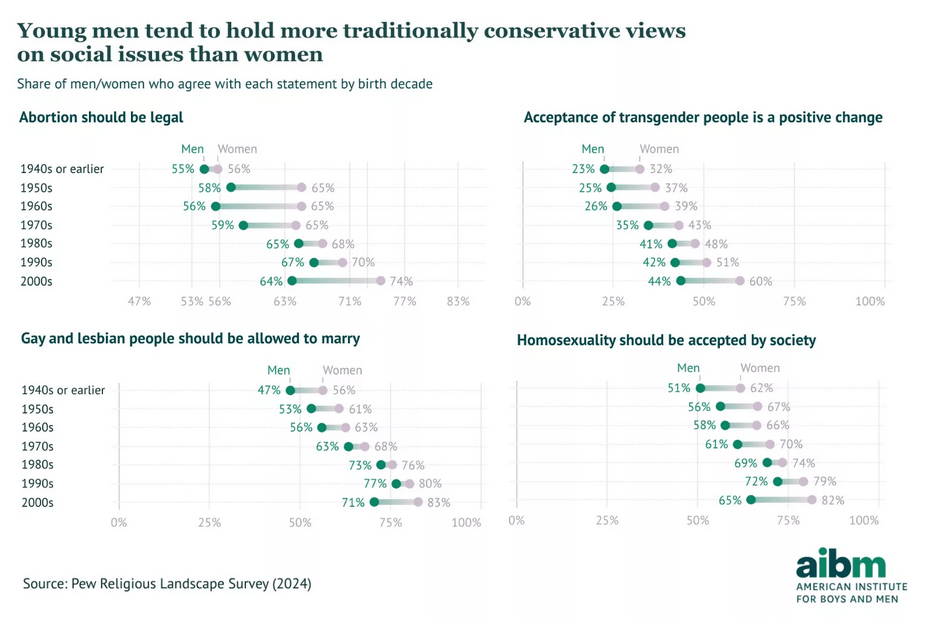
Men under 24 returning to homophobic views of past generations, study suggests

That is because of the constant refrain they are hearing from the right.  If they hear hate all day they start to hate.  That is why anti-bullying campaigns were so important in schools.   They taught kids young that it was OK to be different and not everyone is straight or cis.  Hugs


https://www.thepinknews.com/2026/01/16/young-men-anti-lgbtq/