Exclusive: largest data analysis of its kind counters Trump’s aggressive efforts to deny trans minors’ existence
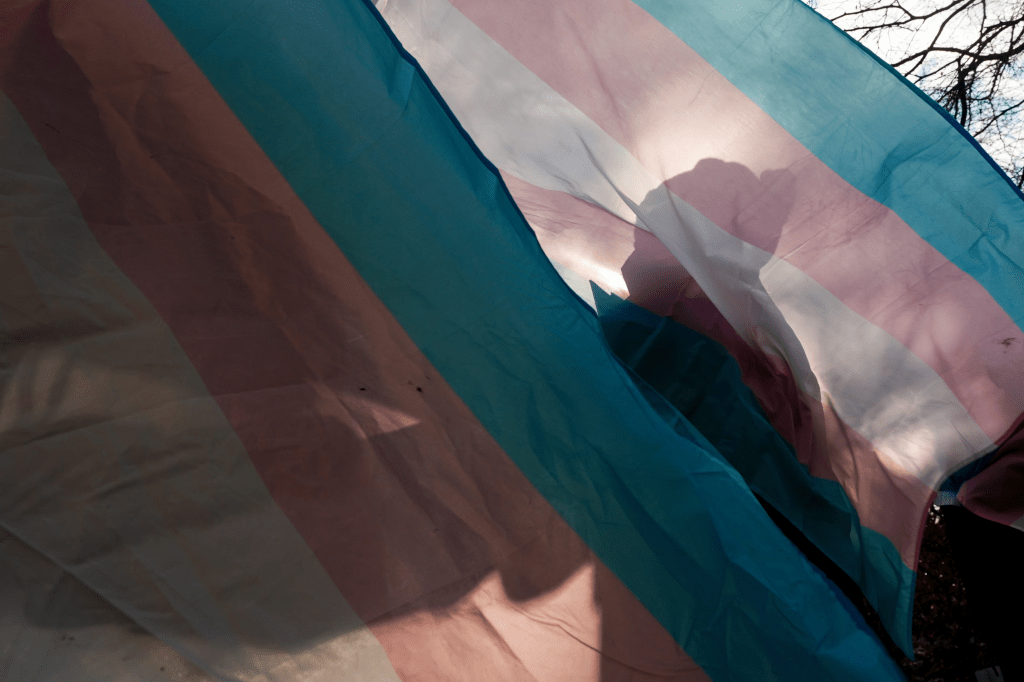
View image in fullscreen A protester is silhouetted against a trans pride flag during a pro-transgender rights protest outside of Seattle children’s hospital on 9 February. Photograph: Lindsey Wasson/AP
More than 2.8 million people now identify as transgender in the US, including an estimated 724,000 youth, according to a new data analysis that is the largest of its kind to date.
Researchers from the University of California, Los Angeles (UCLA) Williams Institute used federal surveys and data from state health agencies to identify the size and demographics of the trans population in each state.
The analysis, shared with the Guardian and released on Wednesday, documented thousands of trans youth living in all 50 states and the District of Columbia. The findings counter Donald Trump’s aggressive efforts to deny the existence of trans minors, as his administration removes references to trans people across federal agencies and widely erodes protections and programs for LGBTQ+ communities.
The report builds on federal data collection efforts that the White House is now eliminating. The authors warn their study could be the last comprehensive portrait of the nation’s trans population for a decade or more as trans people are erased from vital US surveys, including health reports and crime data analyses.
The Williams Institute primarily relied on data from 2021 to 2023 from Centers for Disease Control and Prevention (CDC) surveys and records disclosed by state health agencies. Some of the key findings include:
1% of the total US population ages 13 and older identifies as trans, including 0.8% of adults (more than 2.1 million people) and 3.3% of youth ages 13 to 17 (roughly 724,000 people).
Young adults ages 18 to 24 are significantly more likely to identify as trans (2.72%) than those 35 to 64 (0.42%) and those 65 and older (0.26%).
Of the 2.1 million trans adults, 32.7% (698,500) are trans women, 34.2% (730,500) are trans men and 33.1% (707,100) are trans non-binary people.
The trans populations are fairly consistent across regions, with 0.9% of adults in the west, midwest and north-east identifying as trans, compared with 0.7% of adults in the south.
Minnesota had the highest rate of adults who identify as trans (1.2%), and Hawaii had the highest rate of trans youth (3.6%), though the ranges were similar across states.
“Trans people live everywhere and are represented in every state,” said Dr Jody Herman, senior scholar of public policy at the Williams Institute and co-author of the report, noting the total US trans population was greater than the individual populations of more than a dozen states. “This is a substantial population that has unique concerns and barriers to getting their needs met, and lawmakers need to keep that in mind.”
The Williams Institute, a leading LGBTQ+ policy research center, has published national trans population counts since its 2011 report, which was the first of its kind as state-level data on gender identity became available. The estimates are considered the best available data and were cited by the US supreme court in its recent majority opinion upholding Tennessee’s ban on trans youth healthcare.
The quality and sources of the researchers’ data have improved from one report to the next, the researchers said, making it difficult to assess changes over time. But the researchers noted that the overall estimates of trans adults have remained relatively steady, while the latest data shows how younger people are now significantly more likely to identify as trans than older groups.
There are many factors contributing to youth identifying as trans at higher rates, including that younger people are more likely to answer these kinds of survey questions, said Dr Andrew Flores, Williams Institute distinguished visiting scholar and associate professor of government at American University.
“Younger people are growing up among other younger people who already hold more accepting attitudes toward LGBT and transgender people more broadly,” said Flores, a report co-author, citing increasingly visible signs of support, such as student walkouts in Florida in protest of anti-trans policies. “In this generation, they might be more willing and safe to identify that they are transgender, because they don’t see as much of a harm or threat as older generations.”
While some conservatives and anti-trans advocates have presented a reported rise in trans youth as a “social contagion”, suggesting youth are copying their peers, “the growth comes as people are now in an environment that allows them to fully express who they are,” Flores said.
Shifting language also affects generational differences, he said, noting how older groups were more likely to identify as lesbian or gay while younger people are more likely to identify as bisexual or pansexual. And while older trans people are more likely to identify as men or women, younger trans people more frequently identify as non-binary.
The report also found that the race and ethnicity of trans people was largely similar to broader US demographics, with Indigenous, Latino and multiracial adults slightly more likely to identify as trans than other groups.
The Trump administration, which has widely attacked data collection efforts across government, has moved to remove trans identity questions from two critical CDC behavioral health surveys and from Department of Justice surveys on crime victimization and sexual violence. The US Census Bureau has also taken steps to exclude gender identity from multiple surveys, according to the former director who resigned in February.
Those efforts followed Trump’s day-one executive order “restoring biological truth” to the government, which suggested that trans identity was “false” and directed the state department to deny trans people accurate passports.
The data loss will make it impossible for the Williams Institute to continue its analyses in their current form, and even if the next administration restored the surveys, the public would still be losing up to 10 years of data, which would be a devastating erosion of knowledge, the researchers said.
“We didn’t really have decent national data until around 10 years ago, so we just very recently got a grasp on how many people identify as trans in the US and what their characteristics are,” said Herman. “For these data sources to just suddenly disappear, it is a major setback. The population is not going to go away; we’re just not going to know more about them than what we have from our current sources.”
The data has frequently been cited by journalists, school boards, public health experts, civil rights lawyers, advocates fighting discriminatory legislation and lawmakers expanding trans rights. The researchers had hoped federal data could help illuminate how trans people were moving within the US as some have fled red states due to anti-trans laws, but that will be hard to track without national surveys, they said.
“In some policy circles, they say if you can’t be counted, you don’t count,” Flores added. “And for members of the LGBTQ+ community, to be able to see numbers that reflect their lived experiences is quite important.”
Imara Jones, founder of news organization TransLash Media, said there was no easy fix for the loss of national data backed by federal resources.
“It is meant to erase, and that erasure is meant to have real-world impacts, making it harder for people to be who they are,” Jones said.
Flores said the institute and others were discussing ways to fill the gaps and continue data collection without the federal government: “We’re not just going to close up shop. We’re going to try to find a way to keep telling these stories and be persistent.”
This is why the administration is blocking legal oversight and demanding illegally to have three days prior warning for inspections. They are keeping these kidnapped victims in horrific conditions to force them to agree to deportation. The facility in Florida a former worker admitted that and said it worked.
“Under such conditions, some of those arrested are pressured into accepting voluntary departure,” the lawsuit stated.
——————————————————————————————————————
Dakota Smith
5 min read
Rep. Jimmy Gomez (D-Los Angeles) stands outside the Edward R. Roybal Federal Building downtown earlier this summer. On Monday, he was allowed to enter the ICE processing facility in the basement. (Carlin Stiehl / Los Angeles Times)
More
For two months, several Democratic members of Congress have been unable to enter a downtown L.A. processing center run by U.S. Immigration and Customs Enforcement, prompting widespread complaints and a federal lawsuit.
On Monday, the Congress members got their first look at the basement facility known as B-18.
But Reps. Brad Sherman, Judy Chu and Jimmy Gomez said that they were left with more questions than answers — and accused the government of sanitizing the center.
Advertisement
“They wanted to show us nothing,” said Gomez, whose district includes downtown L.A. “It was nothing, it was like no one was there. It was deliberate so members of Congress cannot conduct oversight.”
Scores of migrants, as well as some U.S. citizens, have been taken from Home Depot parking lots, car washes and other locations by masked and heavily armed agents and brought to B-18 since early June. Some detainees have complained of overcrowding and being held for multiple days.
The facility can hold up to 335 migrants, but there were just two people in one of the holding rooms Monday, the members said at a news conference in downtown L.A. after their visit.
The group’s previously scheduled visit was canceled by ICE. Monday’s visit took days of planning and advance notice, according to the politicians.
They described a sparse scene inside B-18, with nine holding rooms, each with two toilets.
Chu, whose district includes Monterey Park, described the floors as concrete and said that there were no beds. She said ICE detainees are supposed to be held at the facility for only 72 hours, but she has heard stories of people kept there for 12 days.
Some detainees have reported receiving one meal a day, she said. On Monday, she visited the food pantry at B-18, which Chu described as “scanty.”
Advertisement
“I am deeply disturbed by what I saw and what I heard,” Chu said.
Chu also said she has been told that detainees have no soap or toothbrushes.
“It’s alarming that it’s taken so long for congressional members to gain access to this site,” said Sergio Perez, executive director of the Center for Human Rights and Constitutional Law, a nonprofit that seeks to protect the rights of immigrants.
Perez was able to visit Narciso Barranco, a Mexican national whose three sons are U.S. Marines, in June. Perez said he saw Barranco after he’d been held at the facility for three days. Perez said Barranco, who was punched and pepper-sprayed during his arrest, did not receive medical attention.
Advertisement
The Department of Homeland Security shared video of his arrest on social media and said Barranco attacked an agent with his gardening tool.
Barranco told Perez that each of the rooms held 30 to 70 people at the time and that some had to sleep standing up, Perez said. Food was scarce and they didn’t have access to showers.
The ICE facility was designed as a processing center, not a detention facility, Perez said.
Department of Homeland Security Assistant Secretary Tricia McLaughlin denied that individuals don’t receive medical care. She also disputed Chu’s suggestion that an individual was held at the facility for 12 days.
Advertisement
Addressing the politicians’ other complaints about B-18, McLaughlin wrote, “Now, politicians are complaining about ICE processing facilities being TOO CLEAN.”
McLaughlin said that claims of poor conditions at ICE facilities are false and that the agency “has higher detention standards than most U.S. prisons that hold actual U.S. citizens.”
“Ensuring the safety, security, and well-being of individuals in our custody is a top priority at ICE,” she said.
Sherman, who represents parts of the San Fernando Valley and Pacific Palisades, said that one of the two detainees at B-18 on Monday rested with his head on a table.
Advertisement
Sherman said he “illegally” took a picture during his visit and that he shouted out to several people being brought into the facility for processing, asking them whether they were U.S. citizens or green card holders. No one replied, he said.
Sherman, Chu, Gomez and Rep. Maxine Waters (D-Los Angeles), who joined the group after their visit, criticized the ongoing immigration enforcement, and in particular the use of masked, roving agents.
A federal judge last month temporarily barred the government from mass sweeps in Los Angeles and seven nearby counties without first establishing reasonable suspicion that the targets are in the U.S. illegally.
The American Civil Liberties Union of Southern California, which sued the federal government over the sweeps, described B-18 as “dungeon-like” and accused the administration of failing to “provide basic necessities like food, water, adequate hygiene facilities, and medical care.” Detainees were allegedly subjected to overcrowding and did not have adequate sleeping accommodations.
Advertisement
“Under such conditions, some of those arrested are pressured into accepting voluntary departure,” the lawsuit stated.
On Monday, Chu said that she asked ICE representatives during the tour why people were jumping out of vans with masks, and no identification.
She said the representatives replied, “That’s not us, and we go in if there’s probable cause, if there’s a warrant out there.”
Gomez, who has been repeatedly turned away from entering the B-18 facility since the crackdown started this year, is part of a group of Democratic House members suing the federal government over the lack of access.
Advertisement
The lawsuit, filed last month in U.S. District Court in Washington, said the individuals attempted to visit a detention facility, either by showing up in person or by giving Homeland Security Department officials advance notice, and were unlawfully blocked from entering.
ICE recently published new guidelines for members of Congress and their staff, requesting at least 72 hours’ notice from lawmakers and requiring at least 24 hours’ notice from staff before an oversight visit.
Times staff writer Andrea Castillo contributed to this report.
It’s important to remember things, and to keep “issues” in context.Also, who have we asked for the Epstein files today? 😂
No, Rightwing Sh*tbirds Didn’t Pressure Costco Out Of Selling Abortion Pill by Rebecca Schoenkopf
Let’s not give a bunch of hate groups a win they didn’t earn. Read on Substack
With the neverending firehose of incredibly disappointing information, it’s easy to assume that everything is garbage and everything sucks all of the time. Yesterday, I yelled “Well, fuck Costco!” after reading a Reuters article titled “Costco to stop selling abortion pill mifepristone at its US pharmacy stores” — because that’s some bullshit, right?
Well, it was, just not in the way you might immediately assume. Costco never actually sold mifepristone, so they couldn’t “stop” selling something they never sold to begin with.
Stories later in the day did get it right (our link is to the archived very wrong version!). Costco had apparently been deliberating on whether or not to sell abortion medication at their pharmacies (it requires a certification to be able to carry it), and decided against.
Reuters and several other sources noted that the move came after “pressure” from anti-abortion groups, as well as Southern Poverty Law Center-designated hate groups like Alliance Defending Freedom, which even went so far as to issue an utterly insipid victory statement.
“We applaud Costco for doing the right thing by its shareholders and resisting activist calls to sell abortion drugs. Retailers like Costco keep their doors open by selling a lifetime of purchases to families, both large and small. They have nothing to gain and much to lose by becoming abortion dispensaries. Retail pharmacies exist to serve the health and wellness of their customers, but abortion drugs like mifepristone undermine that mission by putting women’s health at risk,” said Michael Ross, the group’s legal counsel.
For the record, mifepristone has an extremely low rate — 1 percent — of complications. It is more safe than Viagraor even Tylenol. Abortion is not the only use for the drug, either. It is also used to help safely expel a miscarriage so that one does not become septic (and perhaps require penicillin … yet another drug that is less safe than mifepristone). Groups like the ADF think that if they just keep confidently repeating blatant lies about abortion medication like they are universally accepted as true, that everyone will just go along with them. Just like maybe they’ll believe that the ADF and other groups are so influential that they actually did successfully push Costco to refuse to sell mifepristone.
But there is no reason to believe, without evidence, that Costco’s decision actually had anything to do with “bending the knee” to them or any other insane religious organizations dedicated to making life hell for women, LGBTQ+ people, and anyone who doesn’t share their religious beliefs.
Why? Because the company has no history of doing that, at all, for any reason. In fact, the company has notably refused to “bend the knee” to Republican Attorneys General and whiny conservatives across the land who have been demanding they ditch their DEI policies.
“If these are the policies you see as offensive, I must tell you I am not prepared to change,” CEO Richard Vachris wrote to a “concerned” customer who emailed him, upset about the company’s DEI policies and demanding to know if the company was hiring people based on “skin color” or “gender identification.”
“Attacks on DEI aren’t just bad for business — they hurt our economy. A diverse workforce drives innovation, expands markets, and fuels growth,” Costco board member Jeff Raikes wrote on social media.
Why would a company willing to risk the ire of these groups in that way suddenly decide to capitulate to them in another?
While it’s certainly disappointing that they didn’t change their policy of not selling mife, and those of us with Costco memberships should let them know that, the company has not said that this decision had anything at all to do with wanting to put a smile on the faces of the bigots at the ADF.
Rather, they said they didn’t think there was a demand for it.
“Our position at this time not to sell mifepristone, which has not changed, is based on the lack of demand from our members and other patients, who we understand generally have the drug dispensed by their medical providers,” Costco said in a statement. It’s not what we want to hear, obviously, but it doesn’t necessarily mean that they did this because of pressure from the Right.
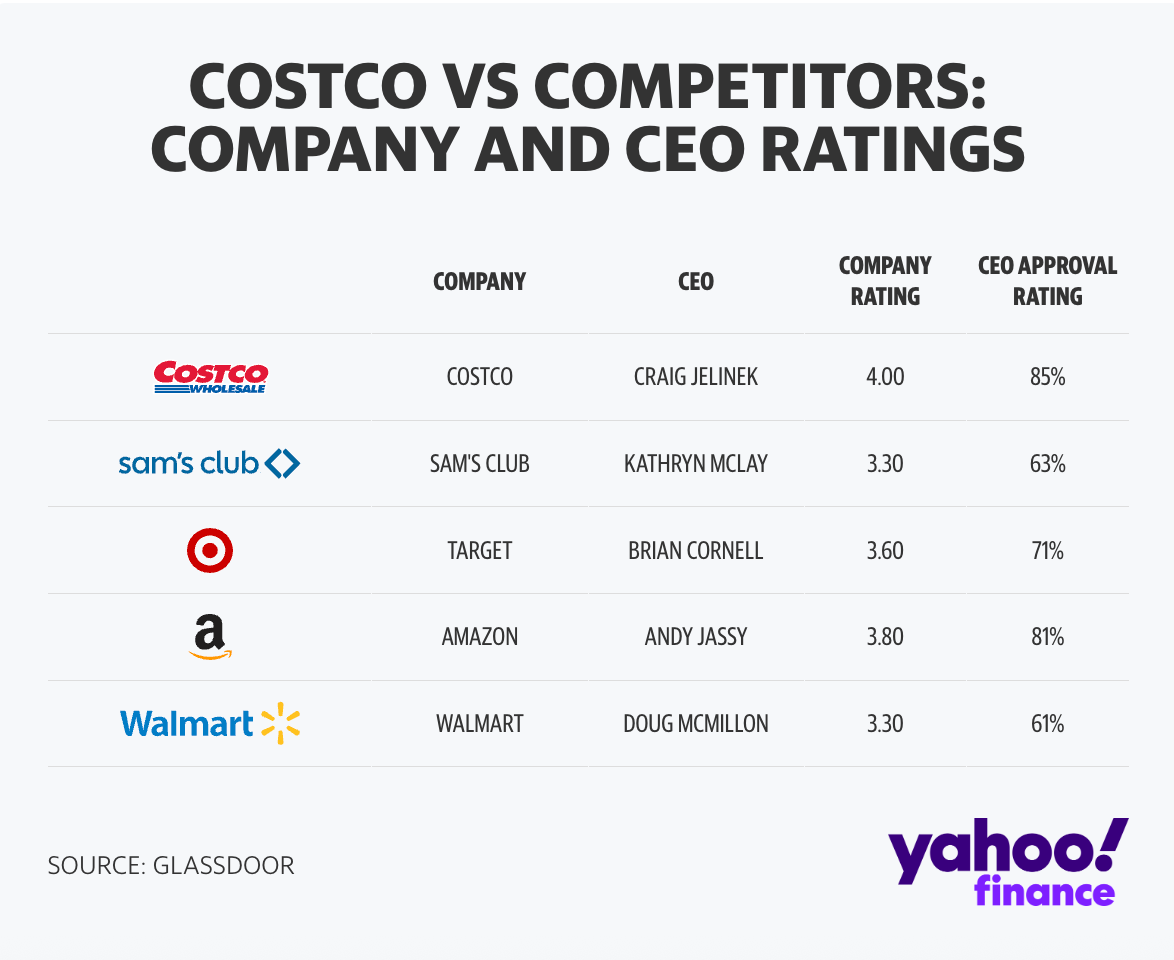
It’s also worth noting that Costco is known to treat their workers well, paying them, on average $31 an hour with good benefits — quite a bit higher than many of their competitors.
They also have a strong history of not being shitty in this way.
It would be a mistake to roll over on one of the few companies out there that isn’t completely evil. In addition, we shouldn’t hand groups like ADF an unearned “win,” which they have made clear they want to use to pressure other companies — including CVS and Walgreens, which are certified to dispense mifepristone — to stop selling abortion medication, as well as to make the rest of us feel that they are winning the culture war.
It’s like when the One Million Moms (one mom) take credit for getting TV shows canceled or commercials pulled off the air when those decisions actually had nothing to do with them at all. Claiming victory, for these groups, is a way for them to rally their base and to make other companies think they have more influence than they actually do.
The majority of Americans believe that abortion should be legal, and they’ve demonstrated this by voting in favor of keeping it legal in their states at practically every turn (not in Florida, because Florida requires 60 percent of the population to approve a ballot measure, which is some bullshit).
If Costco thinks there isn’t enough demand for mifepristone (which, yes, is a weird thing to say because it’s not like a medication anyone gets on a regular basis), then we should convince them that there is, by encouraging them to change their mind and get the certification necessary to sell abortion medication. You can go directly to their website and click the “Feedback” tag on the right side of your screen, call them at 1-800-774-2678, or send them a letter at Costco Wholesale, P.O. Box 34331, Seattle, WA 98124.
This is an interview with two doctors who served in Gaza. They tell of Israeli soldiers taking the baby formula the doctors tried to take in. They talk of the starving babies they can’t feed because Israel refuses any baby formula into Gaza. They talk of the systemic targeting of women and children by drone copters. The male doctor describes a game the IDF plays with using teenaged boys 11 to 16 for target practice. One day they would target heads, the next day they targeted chest, then abdomens, then arms, then legs. The most horrifying was the days the hospital was brought teenagers again 11 to 16 who had been shot in the testicles. Yes Israeli soldiers felt it was a great idea to shoot boys in the balls and dicks to make sure they couldn’t create any more Palestinians. I have no use for the government of Israel nor any use for the people of the country who support this. The public knows what is happening, the military knows what they are doing. This is a genocide of the Palestinians so that Jewish people can have the land. Jewish people of all people should understand this is wrong. Never again did not mean just never again to the Jews, it means never again for any genocide. Yes the US government is complicit in this act and should be held to account, but while we did not do enough at least democrats were willing to try to stop it, tRump and the republicans endorse it. There are chapter markings on the progress bar to help you get to the most damning parts of the interviews. Israel is not letting new doctors go in to help. They are killing the doctors and aid workers. Hugs
At an elementary school in Washington, D.C., the speaker at the podium wanted to talk about children’s health and the impact of childhood obesity.
“Our generation is facing so many devastating health problems because of how we live and how we eat — illnesses like diabetes and heart disease and cancer — that cause so much suffering and cost our economy billions,” the speaker said. “And today, we need to ask ourselves: Are we going to hand down these problems to our next generation? Or are we going to do what we’ve always done in this country and leave something better for our children and our grandchildren?”
Someone could mistake these words as being spoken in 2025 by a Trump administration official advocating to “Make America Healthy Again” — the catch-all agenda that has zeroed in on kids’ health and in particular, chronic disease and childhood obesity.
Obama was promoting “Let’s Move!,” her initiative aimed at improving children’s nutrition at home and school and encouraging them to exercise more. The initiative is credited with making improvements to school lunch standards, creating more transparency in food labeling and bringing more awareness to childhood obesity.
But the first lady drew widespread partisan backlash for her efforts, as right-wing media personalities and Republicans vehemently criticized related regulation as government overreach. They have been more muted as the Trump administration, led in part by Health and Human Services Secretary Robert F. Kennedy Jr., now adopts similar messaging about children’s health.
“I do think that there’s a double standard going on, especially with RFK Jr.,” said Sydney Carr-Glenn, a political science professor at the College of the Holy Cross in Massachusetts who studies the intersectionality of race and gender for Black women in politics, including in the media. “People seem to be a little bit more accepting or a little bit more on board with this whole ‘Make America Healthy Again’ initiative.”
Last month, President Donald Trump announced he would revive the presidential fitness test, a once ubiquitous staple of school gym class. Just a few years ago, Let’s Move! offered programming to educators to encourage physical activity at school for at least 60 minutes each day.
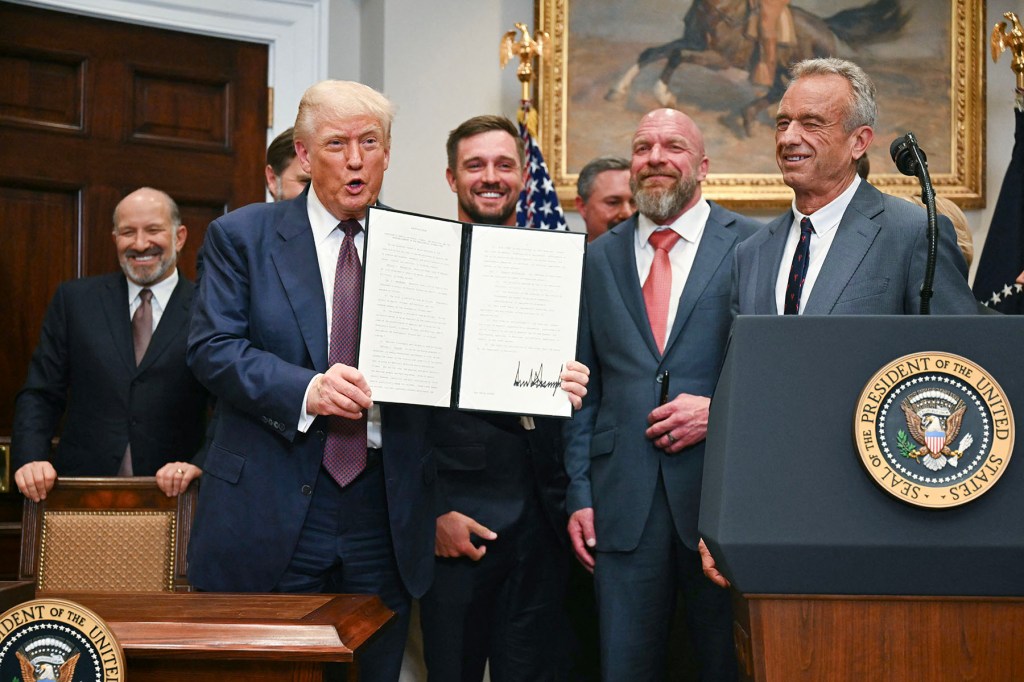
President Donald Trump stands, flanked by Secretary of Commerce Howard Lutnick, golfer Bryson DeChambeau, WWE CCO Triple H and Secretary of Health and Human Services Robert F. Kennedy Jr., after signing an executive order restarting the Presidential Fitness Test in public schools in the Roosevelt Room of the White House in Washington, D.C., on July 31, 2025. (JIM WATSON/AFP/Getty Images)
In some ways, Michelle Obama’s health policy efforts walked so MAHA could run. But you won’t find many Republicans acknowledging that.
“We live in such polarized times now that you would think the Trump administration would look at the things that Michelle Obama achieved and maybe try to build upon that,” said Sharon Wright Austin, a political science professor at the University of Florida. “But there is no collaboration. There are no coalitions. I’m sure if you were to say to Trump, ‘You’re doing the same thing that Michelle Obama originally started doing when Barack Obama was president,’ he would probably not only deny it, but he probably would be pretty offended.”
Obama’s motivation to launch Let’s Move!, the first lady explained, was rooted in her experience as a working mother trying to feed her kids nutritious food. The self-described “mom-in-chief” recognized that if she struggled with what to feed her children, other families with fewer resources might, too.
Within months of moving into the White House, the first lady started a vegetable garden to help teach children about locally grown food and to start a conversation about their health. She launched “Let’s Move” in early 2010, and her husband issued a directive to establish a task force on childhood obesity. Michelle Obama was present months later when the task force released a report assessing how to reduce childhood obesity within a generation. It included roughly 70 voluntary recommendations.
First Lady Michelle Obama and White House Chefs join children from Bancroft and Tubman Elementary Schools to harvest vegetables during the third annual White House Kitchen Garden fall harvest on the South Lawn, on October 5, 2011. (Chuck Kennedy/The White House)
Zinga A. Fraser studies African American history and gender politics as an associate professor at Brooklyn College of the City University of New York. She noted that while Obama’s nutrition plans worked within a domesticated and gendered framework, her garden and health initiative was also part of a long history of Black women taking care of their communities through food sustainability.
“She understood what being a Black woman in that space looked like,” Fraser said of Obama’s role as first lady. “How she had to navigate and what it would be perceived as.”
Let’s Move! had several areas of focus: providing information to families about healthy food, improving the quality of food in schools, expanding access and affordability of healthy foods in communities, and increasing physical activity for children.
The first lady sought buy-in from key stakeholders early on. The American Beverage Association, a government lobbying group representing soft-drink makers, committed immediately to member companies voluntarily putting front-of-pack calorie labels on cans, bottles and vending machines within two years. Food service companies that operated in schools pledged to reduce the amount of fat, sugar and salt they put in kids’ meals over the next five years.
But the first lady was also politically savvy in broadening her initiative’s appeal to the general public. She danced on “The Ellen Degeneres Show” and did “mom dancing” on “The Tonight Show” with Jimmy Fallon. She released a “focus group” video with kids that featured comedian Will Ferrell. She shared a fitness video of herself working out. She appeared with members of the Miami Heat, including dunking a ball with LeBron James.
“She was strategic,” said Fraser, who is also director of the Shirley Chisholm Project on Brooklyn Women’s Activism. “She strategically used her positionality in many ways to move a needle, whether people saw it as influential or important at the time or not.”
It didn’t seem that Michelle Obama was entering controversial politics at first. She had settled on an area of public interest — children’s wellness — that was politically viable for a first lady, said Laurel Elder, a political science professor at Hartwick College in New York who has researched public opinion about presidential candidates and their spouses. There had already been a history of first ladies with projects like an anti-drug campaign and expanding literacy.
Elder noted that Obama was promoting a form of “new traditionalism” in the role of first lady.
“[The public] wants them to be traditional, but also the ‘new’ part is they really do have an expectation that the first lady should be out there and visible and should be leading campaigns in appropriate areas,” she said.
But as regulation policy emerged, so did the criticism. A child nutrition law passed at the end of 2010 included a phase-in of new federal school nutrition standards for milk, whole grains and sodium. The narrative that emerged was that the government was telling people what health choices to make.
“Your America is turning into a nanny state thanks to the Obama administration’s efforts to rein in the junk food industry,” said Sean Hannity on Fox News in 2010.
Glenn Beck, also on Fox News, described Michelle Obama’s efforts in 2010 as the beginning of efforts to police people for not eating healthier.
“You’re going to have to tax, you’re going to have to make it more and more difficult. But when those options don’t work, how do you get people to stop eating french fries, because french fries still beat carrots. What’s left? Well, now you have to start thinking about punishments — maybe a fine, maybe even jail. But it always starts with a nudge,” he said.
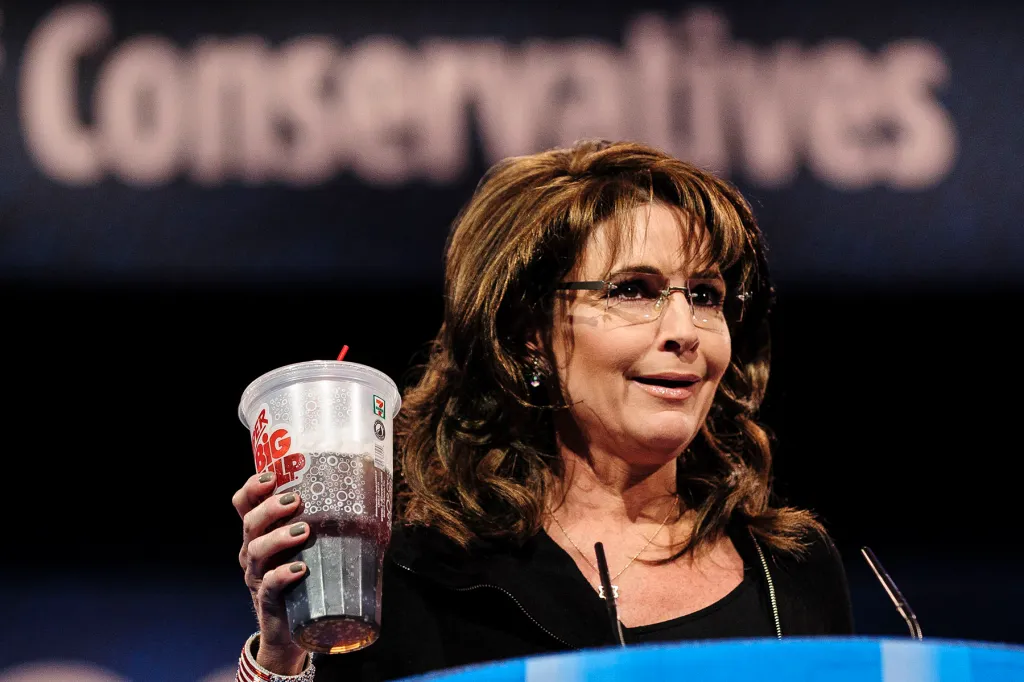
In 2013, former Republican vice presidential candidate Sarah Palin sipped a large soda during an appearance at the Conservative Political Action Conference, known as CPAC. She was responding to a proposed ban of large sodas by then New York City Mayor Michael Bloomberg, but the stunt became part of a larger commentary on the government’s role in people’s health choices.
Sarah Palin holds up a large soda as she speaks about New York City Mayor Michael Bloomberg’s proposed large soda ban, at the 2013 Conservative Political Action Conference, on March 16, 2013, in National Harbor, Maryland. (Pete Marovich/Getty Images)
A MAHA commission released a report this spring for addressing “the childhood chronic disease crisis.” Among its future policy focus will be poor diet, the “aggregation of environmental chemicals,” a lack of physical activity and chronic stress, and “overmedicalization.”
Kennedy told Fox News host Laura Ingraham earlier this year that while he didn’t want to take away “choice” from people, he believed in making changes to food assistance programs and school lunches. Several Republican-led states have recently begun restricting whether people on food assistance programs can buy processed foods and soda.
“We shouldn’t be subsidizing people to eat poison,” said Kennedy, who has separately started promoting that people should track their health metrics via “wearable” technology.
“You can’t cut benefits — Medicare, Medicaid, SNAP benefits, all of those things — to children and families and then still have an initiative where people are saying that they are about creating healthy environments for Americans,” Fraser said.
Natalia Mehlman Petrzela, a history professor at The New School in New York City, noted that when Beyoncé shot a related music video for the Let’s Move! initiative in 2011, she surrounded herself with young children dancing in a school cafeteria. It was common imagery for the first lady as well, as Michelle Obama swayed with kids to get them excited about nutrition and health. Trump’s recent announcement about the presidential fitness test featured former WWE wrestler and current Chief Content Officer Triple H doing a signature water spit at the White House.
First Lady Michelle Obama exercises with students and Olympic athletes during a “Let’s Move” event at the River Terrace Elementary School in Washington, D.C., on April 21, 2010. (Samantha Appleton/The White House)
“To me, that arc kind of says a lot about what’s changed in our wellness and fitness environment,” said Petrzela, who is author of “Fit Nation: The Gains and Pains of America’s Exercise Obsession.” “That now there’s this highly individualistic, ‘strong man’ approach to things, and I think, even more interestingly, it’s tied to that anti-institutional critique, which used to be coded as really left, and in the intervening years, has become, almost completely seen as right wing.”
Austin at the University of Florida said that while Michelle Obama has never been an elected official, she held immense power in her role as first lady and left the White House with high polling. Austin believes the first lady balanced the political challenges of intersectional identities, and her mission to help children continues to resonate 15 years later — even though the messengers have changed.
“It just goes to show that as a Black woman, you’re never going to get the respect that you deserve,” she said.
(Seriously, go read this. You’ll get great laughs, and the oxygen will be so good for the brain! -A)
Snippet:
Amanda: Does she have to pee?
Claudia: Yes! Also, his left pant leg is missing?
Sarah: Why is the perspective weird? Their legs look so short and their heads are so large?
Okay taking another look, I think the angle of her hip looks too low.
So it looks like her legs are short and her midsection is bizarro long, and her head is sized correctly, just looks out of whack with the leg. (snip-I cannot overstate the gold: go read it! And no drinks over your keyboard… )





 Scottie's Playtime