Republican FCC Reviews TV Ratings System In Regard To Trans/Non-Binary Characters & Content

Trump’s FCC Targets Parental Rating System Over Transgender TV Characters

The FCC is seeking comment on whether the TV Parental Guidelines rating system needs to be changed to penalize shows for transgender or nonbinary content.

Erin Reed Apr 22, 2026

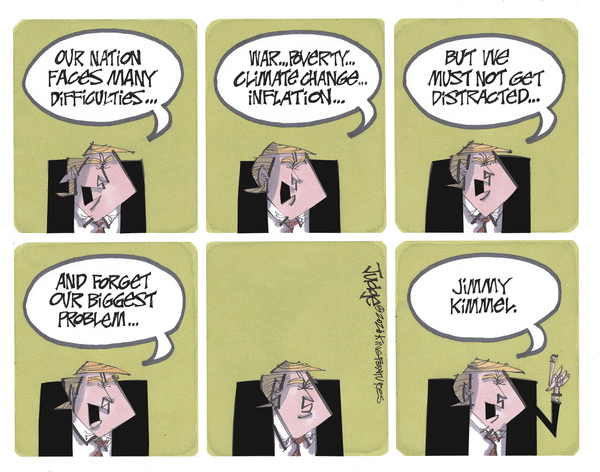
Today, FCC Chairman Brendan Carr announced that the FCC would be seeking comment on whether the TV Parental Guidelines rating system needs to be changed to address shows with transgender or nonbinary characters. The public notice, which Carr posted on twitter this morning, seeks to weaponize the TV ratings system to restrict shows that include such characters—asking whether programs that contain “the discussion or promotion of gender identity themes” should “be rated differently or contain relevant descriptions.” Though the FCC’s direct authority over the TV ratings system is limited—the system is voluntary and industry-run, and streaming platforms like Netflix and Disney+ can maintain their own standards—the FCC retains enormous coercive power over broadcast networks and their parent companies, many of which also operate streaming platforms. The move comes after a series of attacks on network television weaponizing the FCC for political purposes, including Carr’s threats to revoke broadcast licenses over news coverage of the Iran war and his targeting of ABC over late-night host Jimmy Kimmel. It appears to be an attempt to extend “Don’t Say Gay”-style policies—which have restricted discussion of LGBTQ+ people in classrooms across red states—to national television ratings.

“Years ago, Congress passed a law that empowers parents to decide the types of TV programs that are appropriate for their kids by standing up a TV show ratings system. But recently, parents have raised concerns with the industry’s approach—including with ratings creep. Specifically, they argue that New York & Hollywood programmers are promoting controversial issues in kids programming without providing any transparency or disclosures to parents. This undermines the whole point of the law and the ratings system parents rely on. The FCC is now seeking comment on whether the industry’s approach provides parents with the types of information and disclosures relevant to them today,” Carr wrote on twitter. However, the actual document posted alongside his statement tells a more specific story—it primarily centers on gender identity. (snip-MORE on the page)

Most US Voters Support Trans Rights, Even Republicans

This video explains what everyone on the real left already knew instead of forgetting the trans  / woke culture wars and moving right, the center left keeps demanding which is simply code speak for leaning right.  While all the same democratic strategists since the Bill Clinton days demand candidates move to the right to “triangulate” to capture republican voters these polls show what we already knew.  The culture wars are losing for the republicans.  After republicans spent nearly 3 million dollars in ads against trans people the polls showed almost no one felt those adverts influenced their vote.  Even as red states rail against higher education, acceptance, and tolerance of people who are different it is losing them votes.  Some thing the Christian nationalists who are in the height of their influence now in political circles don’t understand is that people who grew up with LGBTQ+ classmates, friends, and even dated some do not find them the evil that these hate religions preach they are.  

*** Personal note.   I explained to Ali in an email that I am not functioning.  For what ever reason wheither it be anemia or something worse I am desperately tired from the time I manage to get up.  I often get up only to a few hours later go back to bed for four or more hours.  I have started taking vitamin B-12 and a woman’s one-a-day vitamin.  That with more red meat which was recommended to me in the past every time I go into anemia.   How ever I get up, I have coffee and stuff with Ron then I need to go back to bed for normally 4 hours, get up and do dishes while watching The Majority Report.  How ever some days like yesterday I did not even get that far, going to back to bed by 2 pm only to have Ron wake me and beg me to eat.

I have done better today only going back to bed for 3 hours later in the morning.  I wanted to go to bed two hours ago, but Ron was all upset he couldn’t sleep due to the neighbors having new skirting put around their home outside our bedroom.  So I got him in his recliner and moved his CPAP out to his chair.  Still he was not tracking.  Good news as I was falling asleep at my desk he woke up and is fixing supper.  At this point I am so tired I don’t really care whether I eat or not.  

I tried to reply to comments, but I couldn’t.  I even started to move old saved open tabs out by making a new cartoon / memes post but I simply couldn’t do it.  Right now the best I can do to function is make doctors appointments and watch videos that don’t take too much thought to understand.  That means most political videos are outside my ability.  I am sorry but right now I am functioning at the level of a confused grandpa.  Sorry.  I hope to get better soon.  Ron says if I don’t clear up by next week we will demand the primary care see me and deal with it. I’m not sure if I want that as my last visit he was insisting I think  about getting a colonoscopy.   Anyway.  This is a good video and one I watched several hours ago when I was much sharper than I feel now.   ***  Hugs


Funny Gay Commercials

Canada’s Proposed Hate Speech Law – Don’t worry you can still humiliate, discredit, hurt and offend

I have the same idea as the Reverend on this issue.  It is how I handle my comments on my blog.  Attack the ideas, not the person expressing them.  Hugs

Trans Children’s Lives Were Endangered Based on a Lie

I did some reviews on the Cass report because it was supported by so many anti-trans bigots. Turns out there were so many lies and errors in the report that it became clear the purpose was to discredit the clinic and get it shut down.  The report was driven by anti-trans people and even Cass herself was well known to be anti-trans.  But what is so irksome is the lies still get told and circulated repeatedly even when they are pointed out.  The idea of social contagion was found to be entirely made up by people desperate to keep their child from transitioning.  The idea came from a website set up for parents that had kids transitioning and they hated it.  The Cass report used lies from that site as if they were medical facts saying that parents were not told and children were being rushed to transition, when even the parents admitted they had all the information in writing that they had to sign and the biggest complaint was how long it took to get seen by the clinic with many kids going through puberty before they got gender affirming care.  The idea of large amounts of detransitioners is totally made up as real studies have found it is less than 2% and the regret levels are well below any other medical procedure.  I wish haters and bigots would understand if they have to make up stuff and lie to prove their point then they have no point to make.  They just hate the idea of people not accepting they are the gender / sex assigned at birth and don’t want to accept new medical data.  Hugs

Staying Safe Online

A ‘Self-Doxing’ Rave Helps Trans People Stay Safe Online

Janus Rose ·Apr 8, 2026 at 10:18 AM

At a New York party, attendees spent Trans Day of Visibility dancing, DJing, and learning how to become less visible online.

Imani Thompson, digital security trainer and organizer of the event / Photo by Janus Rose

It’s Trans Day of Visibility, and I’m at an event space in the heart of New York City’s Commie Corridor to learn how to become less visible online.

The crowd gathered at the aptly-named Trans Pecos in Ridgewood, Queens is here for “404: Deadname Not Found,” a digital self-defense workshop which promises to teach trans people how to find and remove their sensitive personal information from the internet (and which also has no relation to this website). The vibe is giving OpSec rave happy hour—attendees sip colorful drinks, groove to DJ sets, and huddle around laptops using online tools to track down their own digital footprints.

The goal of the exercise is to find holes in your digital defenses, a practice cybersecurity folks call “red-teaming.” A slide deck guides participants through this “self-doxing” ritual, instructing them to use websites like IntelBase, PimEyes, and haveibeenpwned to find addresses, selfies, passwords, old names and aliases, and other personal info that might have been left sitting around on the open internet.
It makes for great cocktail party banter. One participant raises their arms in triumph upon receiving a clean bill of health while checking if their information was leaked in a data breach. Others swivel laptop screens and compare notes on the various places their digital detritus had cropped up. In my case, I was lucky: I mostly found data brokers with incorrect information, a long-forgotten MySpace page, and a woman whose spam calls I’ve been receiving for the past 10 years. Finally, participants are directed to various pages where they can request data to be removed, or sign up for discounted services like Kanary and DeleteMe that do the removals on your behalf.

Behind the fun and light atmosphere, everyone here knows the unspoken reality that drives tonight’s activities: an unrelenting wave of discriminatory bills and executive orders that are rapidly demolishing trans rights across the US. “Trans Visibility” is a nice idea, but it turns out it really sucks to be visible in a fascist surveillance state where the highest levels of government are obsessively trying to destroy your ability to live.

“In this world of hyper-surveillance, I want to make sure all my stuff is safe and that no one is trying to harvest my data for anything,” Anna, a workshop participant, told 404 Media. Anna asked to use a pseudonym to protect her identity, which is not surprising given that the goal of the workshop is to make it harder to be doxed. “Especially now that there’s lots of incentives for the federal government to get into that business, I just wanna make sure all of that is under wraps.”

Like the event’s name suggests, many attendees are looking for traces of their “deadnames,” which is how some trans folks refer to the names they were given pre-transition. Trans people face a disproportionately high risk of being doxed online, and deadnames and other sensitive info are frequently dug up on right-wing hate forums like KiwiFarms and social media sites like Elon Musk’s X, where harassment campaigns and hate speech are allowed and even encouraged.
“We have to protect ourselves,” said Ryan, who also used a pseudonym. “It’s great to know how to find stuff like this, because you never know what’s still out there.”
Imani Thompson, a digital security trainer who organized the event as part of her series Cache Me Outside, says she started hosting the free workshops at queer bars in Brooklyn a year ago, after noticing trans and intersex friends who were noticeably shaken by the opening salvos of the second Trump administration.

“I hadn’t seen cybersecurity events that looked like they would attract or resonate with the crowds I felt needed this information the most,” she told 404 Media. “I wanted to make this fun and un-intimidating and doing digital security training at the bar is kind of silly and fun and gives us a built-in VPN and protection from sensitive convos being recorded.”
There are specific reasons many trans people are anxious about their personal data and online presence these days. For one, trans identities often don’t fit neatly into government boxes, and the name and gender they are assigned at birth may or may not match their government-issued IDs. Recently, a new law in Kansas resulted in hundreds of trans people being told that their drivers licenses and IDs had been invalidated overnight, forcing them to obtain new documents that revert to the sex marker assigned at birth. Journalist Marissa Kabas later reported that the 300 trans IDs in question had been flagged and not immediately invalidated, but the goal of the law and its ensuing chaos was clear: requiring trans people to have IDs that don’t match their appearance or lived reality, forcing them to out themselves and introducing friction and discrimination into their everyday lives.

The same Kansas law also implemented the first state-level “bathroom bounty,” making it a crime for trans people to use appropriate bathrooms and changing rooms and promising rewards to random passersby who feel “aggrieved” by someone they think might be trans. Lawmakers in Idaho have passed an even harsher bill, which would charge repeat trans bathroom-users with a felony and up to 5 years of jail time. These bills threaten not only trans people, but anyone whose appearance might fall outside of someone’s normative expectations of “male” and “female.” And they are especially dangerous at a time when facial recognition can near-instantly identify someone with a quick search.

Thompson also worries about the information that queer folks can reveal while asking for help online. Trans people experience unemployment, housing insecurity, and violence at exponentially higher rates than cis people, and it’s not uncommon to see Gofundme pages and Venmo accounts flooding social media feeds. These posts will sometimes include personal details like a person’s name, face, transition status, location, immigration status, and even how much they have in their bank account—great for getting donations, but not so great for the doxable breadcrumbs they leave behind.

“I think the risk is tenfold for the dolls and Black trans siblings because of disproportionate scrutiny in light of these bathroom bills and also how we do mutual aid,” said Thompson. “Whenever I see a mutual aid request being reposted or processed it makes me nervous, because we’re basically doxing our most vulnerable friends.” To reduce risk, she recommends people take down mutual aid posts as soon as needs are met and set their Venmo activity to private. “I feel like the intention in listing off how all these systems of oppression impact our friends are meant to create a sense of urgency and care, but then months later it’s still floating around and is a goldmine for someone who wants to claim they were made to feel unsafe in a bathroom so they can claim $3k or further an agenda.”

The privacy attitudes on display at the event contrast with the dominant media narratives about trans communities a decade ago. Fresh off the Supreme Court victory in Obergefell vs. Hodges that legalized same-sex marriage, many at that time were convinced that trans visibility would pave the way to equality, as glossy magazine covers featuring stars like Laverne Cox declared a “Trans Tipping Point.” But while conditions for some trans people marginally improved, we all know what happened next: a wave of reactionary anti-trans state laws, culminating in the re-election of Donald Trump and a series of executive orders aimed at destroying trans peoples’ access to healthcare, sports, bathrooms—essentially the ability to live a normal life.

At the same time, protection can’t be a retreat back into the closet. “It’s still important for trans voices to be heard in online spaces,” said Anna. “It’s not like I wanna go into the shadows or anything. I just don’t want people to know my personal data, my personal records, any of that.”

“Being Black, I also understand the distinction between visibility and hypervisibility and the precarity and lack of agency that hypervisibility creates,” said Thompson. “It’s tricky to find language around digital security that doesn’t imply queerness is something to hide or a shameful thing, because of course it’s not. I think having agency and purpose in how we can show up online and interact with tech as well as literacy around how technology and surveillance operates makes us better equipped.”

Janus Rose is New York City-based journalist, educator and artist whose work explores the impacts of A.I. and technology on activists and marginalized communities. Previously a senior editor at VICE, she has been published in digital and print outlets including e-Flux JournalDAZED MagazineThe New Yorker, and Al Jazeera.

Federal court OKs Iowa’s “cruel” book ban law in stunning LGBTQ+ defeat

The idea behind these laws seems to be if they can hide that LGBTQ+ people / kids exist they can prevent the acceptance and tolerance of LGBTQ+ kids / people. In the minds of the haters who write these bills hopefully that will force people who are not straight or cis to stay hidden from society.  They are desperate to return to the 1950s when LGBTQ+ people had to stay hidden or risk losing everything they had, their job, housing, and friends.   They are pathetic in their need for everyone to be the same as they are, feel the same as they do, and to live as they do.  Why I did not know or understand.  The irrational hate for LGBTQ+ kids is really weird.  That they would rather have kids hurt, harmed, assaulted, ostracized, and possibly driven to suicide rather than give them acceptance or simply tolerance.   I don’t undestand what their gain is in this?   Hugs  

https://www.lgbtqnation.com/2026/04/federal-court-oks-iowas-cruel-book-ban-law-in-stunning-lgbtq-defeat/

April 2026

Photo of the author

John Russell (He/Him)April 7, 2026, 1:00 pm EDT· Updated on April 8, 2026
An empty classroomShutterstock

The U.S. Court of Appeals for the Eighth Circuit has ruled that Iowa can enforce a 2023 law restricting classroom instruction on LGBTQ+ topics and access to certain books while legal challenges against the law proceed.

On Monday, the three-judge panel overturned injunctions previously issued by lower courts in two separate lawsuits challenging aspects of the Senate File 496, according to the Associated Press and The Des Moines Register.

Passed by the Iowa state legislature and signed by Republican Gov. Kim Reynolds in 2023, the law prohibits “any program, curriculum, test, survey, questionnaire, promotion, or instruction relating to gender identity or sexual orientation” in kindergarten through sixth grade. It also bans materials featuring “descriptions or visual depictions of a sex act” from school libraries and classrooms — a provision which critics say is intended to ban books featuring LGBTQ+ characters and themes.

The law went into effect on July 1, 2023. The following November, the ACLU of Iowa and Lambda Legal sued the state on behalf of LGBTQ+ advocacy organization Iowa Safe Schools and seven students and their families, challenging SF 496’s classroom instruction ban.

Last May, a federal judge issued a split decision, upholding the law’s ban on discussion of gender identity and sexual orientation in K–6 classrooms, but blocking its ban on school “promotions” and “programs” that acknowledge the existence of LGBTQ+ people. U.S. District Judge Stephen Locher also blocked a provision of the law banning schools from providing “accommodation that is intended to affirm the student’s gender identity” without notifying their parents, writing that S.F. 496 was impermissibly vague about what constitutes an “accommodation.”

Writing for the Eighth Circuit on Monday, Judge Ralph Erickson held that the state’s interpretation of the law as requiring school “programs” and “promotions” to only encompass curricular activities does not violate the U.S. Constitution. However, the court did not address whether it is constitutionally permissible for the state to ban specific groups and extracurricular programs, such as Gender & Sexuality Alliance groups, because the Iowa Safe Schools lawsuit did not challenge specific applications of the law, according to the Register.  

The court also disagreed with Judge Locher’s ruling that the law’s language around “accommodations” was too vague, restoring S.F. 496’s ban on schools accommodating students’ gender identities without outing them to their parents.

In a separate November 2023 lawsuit, the Iowa State Education Association was joined by publisher Penguin Random House and several prominent authors of banned books in a challenge to S.F. 496’s book-banning provision. Last March, Judge Locher sided with the plaintiffs, issuing a preliminary injunction preventing schools from removing books it considers “obscene” from classrooms and libraries.

Again, writing for the Eighth Circuit in a separate decision Monday, Judge Erickson disagreed w  ith Locher’s ruling that school library books are not part a school’s curriculum. Erickson wrote that a school’s library catalogue constitutes government speech and can be restricted by state law, according to the Register.

The decisions on both cases send them back to the district court. But as the Register notes, the Eighth Circuit indicated in both rulings that the plaintiffs could not show a “likelihood of success on the merits” in their challenges to S.F. 496.

At the same time, in a joint press release the ACLU of Iowa and Lambda Legal noted that the rulings narrow “where and how the law may be applied.”

“The prohibition regarding sexual orientation and so-called gender theory applies only to specific, mandatory instruction on these topics during class time. The law, as currently interpreted, does not require schools to prohibit student expression of LGBTQ+ identity nor does it limit the sponsorship or promotion of GSAs,” ACLU of Iowa Senior Staff Attorney Thomas Story said.

“The court’s interpretation of the provision on banning books is that it applies only to those that specifically describe or depict one of those sex acts defined in Iowa’s criminal law. And with the forced outing provision, a report would be made to parents or guardians only if a student specifically requests a school accommodation for the stated purpose of affirming a gender identity different from their registration forms,” Story added.

In a statement responding to the court’s decision, Iowa State Education Association president Joshua Brown told the Register that the case was “about much more than legal technicalities.”

“It is about protecting the freedom of speech and the right to share ideas — values guaranteed by the First Amendment,” Brown said. “Our schools should be safe spaces where students are free to learn, teachers can use their professional expertise without fear, and families can trust that education is based on open inquiry rather than government censorship.”

A spokesperson for Penguin Random House indicated in a statement to the Register that the company intends to keep fighting against S.F. 496. Similarly, Lambda Legal Senior Attorney Nathan Maxwell called the ruling “a setback,” but noted that “it is not the end of this fight.”

“Iowa’s SF 496 is a cruel and unconstitutional law that silences LGBTQ+ children, erases their existence from classrooms, and forces educators to expose vulnerable students to potential harm at home,” Maxwell said in a statement. “We will continue to use every legal tool available to protect these young people. They deserve nothing less.”

Subscribe to the LGBTQ Nation newsletter and be the first to know about the latest headlines shaping LGBTQ+ communities worldwide.


John Russell is a writer and editor based in New York City. In addition to covering politics and entertainment for LGBTQ Nation, he has written for Vanity Fair, Slate, People, Billboard, and Out. He also writes about film, TV, and pop culture in his free newsletter Johnny Writes…

Over $84,000 Raised So Far For Tennessee Librarian Fired For Refusing To Remove LGBTQ-Themed Books

Over $84,000 Raised So Far For Tennessee Librarian Fired For Refusing To Remove LGBTQ-Themed Books

Nashville’s NBC affiliate reports:

The library director who was fired for refusing to relocate LGBTQ children’s books has garnered substantial community support, with people donating over $84,000 to help her as she navigates the loss of her job. A GoFundMe launched by a community member says that the fundraiser for Luanne James is going “directly toward supporting her family’s basic living expenses during this time.”

James was the director of the Rutherford County Library until the board voted to fire her last week. The termination came after she refused to move 132 children’s books to another section of the library because the LGBTQ themes were deemed inappropriate for children. James said that she “had no choice” but to refuse the board’s request to move the books. She said that she believes librarians are being politicized and that “is not what we signed up for.”

Read the full article.

Check out the protest crowd in the video below!


About Conversion Therapy

A Christian ‘Conversion Therapy Dropout’ on the Supreme Court’s Decision

By Tyler Huckabee

On March 31, the Supreme Court sided with a Christian therapist in Colorado and tossed out the state’s ban on conversion therapy for minors. The therapist, Kaley Chiles, challenged the state’s ban on the grounds that it violated her First Amendment rights. The Court agreed with Chiles by an 8-to-1 vote.

Conversion therapy is a practice that generally involves treatment intended to “cure” same-sex attraction or gender dysphoria. Every major medical study has determined that conversion therapy does not work and often leads to serious mental health problems for patients who are subjected to it. Timothy Schraeder Rodriguez knows that from personal experience.

Rodriguez is the author of Conversion Therapy Dropout: A Queer Story of Faith and Belonging, which will be released on May 5. The memoir unpacks the eight years Rodriguez spent in conversion therapy, struggling to reconcile the tension between the version of Christianity he had been taught growing up and his sexual identity. For Rodriguez, the path to healing began when he accepted that there was no tension.

Rodriguez told Sojourners the Supreme Court’s decision is deeply personal and painful, and he hopes that his story will both help LGBTQ+ Christians feel a little less alone and help convince non-affirming Christians to rethink their convictions.

This conversation has been edited for length and clarity.

Tyler Huckabee, Sojourners: When critics talk about the harm that conversion therapy can cause, particularly for minors, what sort of harm are we talking about?

Timothy Schraeder Rodriguez: Where to begin? There’s documented research to show that anyone who experiences conversion therapy, especially as a minor, is subject to higher rates of depression and anxiety. The suicidal ideation rate nearly doubles for LGBTQ+ youth who have experienced conversion therapy, and then the long-term effect of it tends to show up in the inability to create lasting relationships, substance abuse, all those kinds of things. It’s a very devastating practice in the sense that it attacks body, mind, and spirit. When all three of those parts of yourself have been attacked, disengaging from the harm that that causes takes a lot of time and a lot of real therapy. But a lot of folks who have experienced conversion practices are untrusting of therapeutic spaces.

What arguments did conversion therapy advocates use that convinced the Supreme Court to side with them?

They were able to successfully reduce the idea of what the role of a therapist in a therapeutic setting is: that it’s just a space for conversation, that this is a free speech zone, that this is a space where we should all be allowed to say what we believe. Really, it shifted the definition of what happens in therapists’ office from approved therapeutic practices, to saying, “Well, actually, if a therapist has a different viewpoint, they should be allowed, with their First Amendment right and religious freedom, to be able to interject their own thoughts and go against what has been the conventional therapeutic practices.”

Tell me about your experience with this practice. You call yourself a conversion therapy dropout.

Yeah, I grew up in an evangelical Christian home in Illinois and was insulated in the evangelical Christian culture of the late 1990s and 2000s. Not much was said about homosexuality, but everything around me led me to believe that to be anything but straight was a problem.

So, when I was 19-years-old, I finally admitted for the first time that I was “struggling with same sex attraction,” as I called it back then. I was working at a church in Washington state and was dismissed on the spot for even admitting that it was a struggle that I had. I was told that I was broken and that there was no place for people like me in churches.

I was 19. 

No one forced me in [to conversion therapy]. I opted myself in because I thought that was the only option someone like me had to maintain my relationship with God, my family, my community, the church.

I first was involved with the organization under the umbrella of Exodus International. It was an online forum that existed for folks who didn’t have access to a local ministry in their area. I was a part of that for about a year. I did talk therapy with a therapist for eight years, and then when I moved to Chicago and had access to in-person ministries, I started going to in-person support groups. And then all throughout that, I also attended an annual conference put on by Exodus that was their flagship event. It took a lot of different forms over eight years. It was a wild journey.

When somebody like me hears about conversion therapy, we assume a lot of Jigsaw-type Saw torture traps with gay people being violently forced to recant their sexuality. But in reading your book, you describe it as a process that can be deceptively gentle and cloaked in the language of love and acceptance. You even found some community there.

The experiences that people see portrayed in movies or documentaries—just the lore of conversion therapy—those do exist. But when I encountered conversion therapy, it was much more insidious. I was in talk therapy. I thought I was talking to someone who was trying to help me process my past, but all the information that I gave my therapist was weaponized against me and used as proof as to why I was struggling with what I was struggling with.

And so, from that side, you know, I was trained to moderate myself, to police my mannerisms, to change my behaviors, to change my interests, to try to be more like a man, all those kinds of things. And then there was a spiritual component to it: Pray, seek God, do what all good Christians are supposed to do.

And there was a community component to it. I think it was probably the thing that I’m most grateful for that I got out of it, but also the most dangerous. Most of us were on our own little islands and had no one around us who knew what we were going through. And when we’d go to these groups or go to these events, we’d be around hundreds or thousands of people who were facing the same struggle. There was a camaraderie in the community that formed. Most of us didn’t realize it then, but that was the first time we were ever really, truly experiencing queer community and what it was like to be around others who are like us. Even though we were trying to do all we could to not be ourselves, there was still that underlying connection that bonded us all together. As harmful as all of it was, some of the closest friends that I have in my life today are people that I met in conversion therapy. We were in the trenches together.

But there was an underlying sense throughout all of it that I didn’t measure up, that something was wrong with me because I wasn’t experiencing the change that other people experienced. They were really good in those settings at bringing people out to share their testimonies: “Hey, I went from darkness to light, and here’s my wife and kids! God really can work miracles!” There was this whole system of shame, self-hatred, and self-doubt. But on the surface, it was hard to see that at first.

What was your breaking point with this process?

After eight years, I had done everything. I followed the rule book, and I was also working in evangelical Christian megachurches. I was becoming a rising star in that space for helping churches understand digital marketing and communication. The whole time, I never questioned the program. I was always taught to question myself. If there was something that I wasn’t experiencing, it wasn’t because the program was wrong; it was that there was something in me that wasn’t adding up.

So that was just this constant state of depression and anxiety and fear and all those things raging. I started drinking a lot. I was just a shell of a person. I threw myself into my work, and thought maybe if I just work hard enough, God will finally do the work that I wanted God to do in me.

I was at a big Christian conference—Catalyst—and there was a pastor speaking there, talking about how we needed to fight against gay marriage, that we needed real men, no more sissies, that we needed to fight the gay agenda. And I watched this whole stadium of people erupt and stand on their feet and cheer, knowing that they were talking about me. That led me to have a nervous breakdown.

It just came to a point where I thought I would rather end my life than keep going. But thankfully, I chose to end the way I had been living my life and decided to figure out how I could integrate my faith and sexuality, quit conversion therapy, and figure out what it could look like to become a gay Christian.

There were—especially during the late 2010s—not a lot of openly gay Christian blueprints to follow. Today, many parts of the church obviously remain very hostile to the LGBTQ+ community, and that feeling is often understandably reciprocated. What’s it like having a foot in both worlds?

It’s the weird experience that we carry. I understand why queer people leave the church when they come out, because they’ve been told their whole lives by this particular religious community that they’re broken, that God doesn’t love them, that there’s not a place for them. Why would you want to stay there?

Thankfully, right after I dropped out of conversion therapy, I was connected with Q Christian Fellowship—it was called the Gay Christian Network back then—but it’s one of the leading organizations that’s working with queer Christians to help them reconcile their faith and sexuality.

I went to one of those conferences in 2010, and it was such a weird experience, because it felt just like Exodus or any of the other conferences I had gone to, except it was OK for me to have a crush on other attendees and admit it [laughs]. 

It just exposed me to a whole new way of reading the Bible, understanding what scripture says, and just seeing other folks who were still engaged with their faith. It gave me the hope and courage that I could find affirming spaces where I could be loved and accepted just as I was as a gay man.

So, given all of that, tell me about how it feels to see this ruling come from the Supreme Court, largely on the pretext of religious freedom. I imagine this feels like the war that you experienced within yourself for so long made manifest in the legal system.

It’s disheartening, but it’s not surprising. As long as the church continues to other people and to draw lines around who is accepted, this will, sadly, be a fight we’ll have. I am grateful, though, for the churches that have made room at the table for queer people and that have courageously gone against the conventional wisdom.

But the Christian nationalism that we’re experiencing today is emboldening people to do a lot of horrible things in God’s name. I think people like me are very frustrating to them, because it would be a lot easier for their narrative if I were a person who had been in the church and left it because now I’m gay and hate the church.

But there’s a growing number of us where that’s not the case. We still love God. My relationship with God is stronger today than it ever was when I was in conversion therapy. I’m being fully honest with who I am and who God created me to be.

I hate that my story and my book are very relevant right now, but I’m grateful too. I didn’t have those mentors or those people or that guidebook to follow when I was on this journey early on. I can hopefully help others like myself—that younger version of myself—to know that you know who they are, loved just as they are.

For any queer people reading this—maybe they’re out, maybe they’re not—who are scared or alone, what would your message be?

Take care of yourselves, keep your chosen family close. There are affirming church communities out there. Church Clarity is a great resource that can help you connect with those if you feel like you need that kind of support.

But church can be complicated. Tony Campolo said at that Q Christian conference I went to that the church may be a whore, but she’s your mother. And so remember that what the church did to you is not how God feels about you, and it’s not the truth. Remember that God is love, and God loves you just as you are.

And for folks who have experienced conversion therapy, this is a time for all of us to be emboldened to share our stories. Our lived experience is the thing that can counter all the narratives that are out there now. We can bring a human face and voice to what this decision means, and hopefully, our experience can help the next generation.

I get the sense that there are a lot of Christians who, inside, wish they could be affirming, but don’t feel like they can, maybe because of their jobs, or their community, or just because they feel that the Bible doesn’t allow them to be. That’s a place I know that you yourself were in for quite a while as well. What would you say to them?

Listen to our stories. Talk to queer Christians who have walked this path. Matthew Vines’ book God and the Gay Christian is an excellent starting point just to understand how you can start to look at scripture in a different way and examine all the things that were shoved down all our throats about how we were taught to believe.

Also, look at churches that are affirming and learn from them. See what they’re doing and how they’ve chosen to read scripture and care for and love people.

I didn’t know that affirming denominations existed. I mean, I knew that they did in the ether, but it was a foreign world to me. And I think one of the challenges, particularly for those churches now, is to really become bold in their stance and in how they are speaking about these issues. It is a life-or-death issue, and I think many mainline denominations that have historically been affirming can tend to rest on their laurels. You just start thinking: “Hey, we’ve got this. We’re good. Everyone’s welcome.” But someone like me, who’d never set foot in a church like that, doesn’t even know how to even begin to navigate that space. We see your rainbow flags. We see the “All Are Welcome” signs. But I think that we need some love and coaxing in, just because it feels like we’re crossing an enemy line going into those churches. It felt that way for me at first.

https://sojo.net/sojoshare/MTUyNXwyMzgzOTl8MTc3NTI0MzM0M3w5

A central theme of anti-LGBTQ+ organizing and ideology is the opposition to LGBTQ+ rights or support of homophobia, heterosexism and/or cisnormativity,

I think the article is self explaintary and clear.  The hate directed against the LGBTQ+ seems irrational and immoral.  Why is it immoral if it is being done by religious groups?  Because they have no qualms about lying, giving false and misleading information, and forcing their church doctrines on others who don’t agree with those doctrines. Below are just a few quotes from  the article.  The last one from florida would make pointing out the truth about how a person is acting or speaking illegal, but doing the racist bigoted stuff would stay legal. Hugs


  • Anti-trans bathroom bans made a comeback, with four passed in Alabama, Idaho, Ohio and South Carolina.


  • Florida introduced a bill that limited free speech, making public accusations, whether true or false, of a person being homophobic, transphobic, racist or sexist equivalent to defamation and punishable by fine. The bill did not pass.


https://www.splcenter.org/resources/extremist-files/anti-lgbtq/

A central theme of anti-LGBTQ+ organizing and ideology is the opposition to LGBTQ+ rights or support of homophobia, heterosexism and/or cisnormativity, often expressed through demonizing rhetoric and grounded in harmful pseudoscience that portrays LGBTQ+ people as threats to children, society and often public health.

Top Takeaways

In 2024, the number of anti-LGBTQ+ groups increased by about 13% from the previous year. Anti-LGBTQ+ groups maintained a trend in heavy mobilization across multiple strategies with increasing political and financial support from the hard right.

Anti-trans narratives were instrumental to the 2024 election at all levels of government, especially at the local level where anti-LGBTQ+ and anti-inclusive education activism continue to heavily overlap. The politicization of gender-affirming health care and LGBTQ+-inclusive school curricula contributed to what has been characterized as the “most Anti-LGBTQ election in decades.” Republicans spent almost $215 Million on TV ads to smear trans people, surpassing ads on rival issues such as economy, immigration and housing. Another wave of anti-LGBTQ+ legislation broke records at state and federal levels, but such bills were not as nearly as successful as last year.

Anti-LGBTQ+ groups are heavily invested in the courts and pushing policy change by judicial decision. Hard right and anti-LGBTQ+ extremists on social media continue their campaign to “make pride toxic” by targeting inclusive business and marketing practices while anti-LGBTQ+ legal groups take up administrative law and lobbying strategies to eliminate diversity, equity, and inclusion practices in the public and private sectors under the guise of “viewpoint diversity” and “religious freedom” advocacy.  

Key Moments

Throughout the state legislative sessions, anti-LGBTQ+ movement organizations continued their facilitation of a decades long effort to foment anti-trans moral panic in public discourse. Legislative assaults broke records for the fifth consecutive year, albeit with fewer successes.

Several factors slowed the trend, including coordinated community responses and reporting, such as the SPLC’s Project CAPTAIN, on the networks that perpetuate anti-LGBTQ+ talking points and legislation. Legislation trends of concern include:

A Florida bill promoted insurance coverage conversion therapy for detransition. The bill passed the House, but died in the Senate.

  • Anti-trans bathroom bans made a comeback, with four passed in Alabama, Idaho, Ohio and South Carolina.
  • Policy changes enacted barriers to gender markers and name changes for IDs/personal documents in Arkansas and Florida.
  • Florida introduced a bill that limited free speech, making public accusations, whether true or false, of a person being homophobic, transphobic, racist or sexist equivalent to defamation and punishable by fine. The bill did not pass.

In February 2024, anti-trans influencers spun a disinformation campaign to exploit the tragic shooting at Lakewood Church in Houston by alleging the shooter was trans. Hard-right social media influencers, equipped with talking points that help fuel gun purchases, used this and other mass shootings in 2024 to perpetuate anti-immigrant and anti-trans conspiracy theories. Despite claiming anti-trans activism helps “protect children,” the SPLC reported that in the wake of mass shootings, anti-trans extremists divert attention from meaningful reforms to prevent gun violence, which is the leading cause of death for children in the United States.

In response to online campaigns by hard-right social media personalities, many major brands scaled back Pride merchandise in 2024. Armed Conflict Location and Event Data (ACLED) reported anti-LGBTQ+  protests at Pride events decreased in 2024; however, GLAAD documented 110 anti-LGBTQ+ incidents during June 2024. In addition, the SPLC monitored at least 74 bomb threats targeting LGBTQ people and events between January 1 and June 30, 2024.

The Colorado Republican Party posted “Burn all the #pride flags this June” and shared a video clip titled “God Hate F__s.” There was no shortage of vandalism: In Poulsbo, Washington, 14 Pride banners were slashed, and over 200 pride flags were stolen from the town center in Carlisle, Massachusetts. Throughout June, SPLC tracked dozens of protests, bomb threats and harassment campaigns directed at civil society groups like Pride committees and LGBTQ+-inclusive religious congregations. Hate groups including MassResistance, Gays Against Groomers, Protect Texas Kids, White Lives Matter, and Aryan Freedom Network were active at Pride events in June 2024.

In July and August 2024, anti-trans influencers manufactured controversy over the gender identity of Olympic athletes Imane Khelif and Lin Yu-ting. This anti-trans controversy exclusively targeted Taiwanese and Algerian athletes, scrutinizing the legitimacy of their womanhood. The crux of arguments made by the anti-trans actors re-animated misogynoir stereotypes to exclude women of color from being considered women based on white Eurocentric beauty standards of femininity. The series of events suggests eugenics and racism underlie transphobia and exhibited how anti-trans hysteria disproportionately impacts women of color on an international scale.

In September 2024, the anti-LGBTQ+ hate group Family Research Council held its annual Pray Vote Stand conference. FRC hosted a variety of anti-immigrant commentary ranging from Katy Faust, president of the anti-LGBTQ+ hate group Them Before Us, urging attendees to “breed out” immigrants and trans people. At the conference, Oklahoma superintendent of public instruction Ryan Walters alleged illegal immigrants were bringing fentanyl into schools; and the summit featured population control myths espoused by both anti-abortion and anti-vax panelists. FRC devoted multiple plenary sessions to anti-trans, anti-abortion and anti-immigrant coded topics.

The election of the first trans member of congress, Sarah McBride, was immediately met with a trans bathroom ban on all restrooms on the House side of the Capitol complex. The resolution was introduced by Nancy Mace and supported by House Speaker and former Alliance Defending Freedom attorney Mike Johnson. Mace posted anti-trans slurs on X following a bathroom sit-in at the Capitol in protest of the bathroom ban. The protesters were arrested and taken to the Capitol Police station; Mace then posted a video showing her outside the stations saying, “Some tr——s got arrested protesting my ban.” She then began reading them their Miranda rights along with demeaning commentary about the protesters.

On Dec. 4 the Supreme Court heard a challenge to the Tennessee ban on gender-affirming care for minors. Over 20 anti-LGBTQ+ and antigovernment groups filed amicus briefs in support of the ban, including Gays Against Groomers (GAG), American College of Pediatricians (ACPeds), American Family Association (AFA), Family Research Council (FRC) and Alliance Defending Freedom (ADF). Groups and individuals associated with a network of anti-LGBTQ+ pseudoscience purveyors filed another 10% of the amici opposing gender-affirming healthcare.

What’s Ahead

States will continue to be labs for experimenting with anti-LGBTQ+ public policy. The legislative early filing period in Texas shows 32 anti-trans bills already filed for the 2025 legislative session. This year will show a continued pressure on erasing trans people from public life. With Donald Trump’s re-election, federal civil rights enforcement litigation will likely swing against LGBTQ+ inclusion.

Authors of Project 2025 are being tapped as cabinet picks for the second Trump administration. Project 2025 is an authoritarian and theocratic road map, and anti-trans scapegoating makes up key policy recommendations.

Background

Anti-LGBTQ+ groups in the United States oppose LGBTQ+ rights but also generally support heterosexism, an ideology that assumes heterosexuality is the only “normal” sexuality, and/or cisnormativity, an ideology that assumes one’s gender identity always matches the sex one was assigned at birth. Anti-LGBTQ+ groups primarily consist of Christian Right groups but also include such organizations as the National Association for Research and Therapy of Homosexuality (NARTH) that purport to be scientific. Anti-LGBTQ+ groups in America have employed a variety of strategies in their efforts to oppose LGBTQ+ rights or support heterosexism and/or cisnormativity, including engaging in the crudest type of name-calling.

Anti-LGBTQ+ groups on the SPLC hate list often link being LGBTQ+ inherently to criminal behavior; claim that the marriage equality and LGBTQ+ people in general are dangers to children and families; contend that being LGBTQ+ itself is dangerous and support the criminalization of LGBTQ+ people and transgender identity. These groups also believe in a false conspiracy that LGBTQ+ people seek to destroy Christianity and the whole of society. More recently, hard-line anti-LGBTQ+ groups have promoted their discriminatory laws and policies that limit the rights of LGBTQ people under the guise of religion, blurring the lines between the separation of church and state and discarding anti-discrimination civil rights policies. These same groups have promoted legislative models to push anti-trans legislation into law under a conservative religious assumption that gender can only be understood as either “male” or “female.”

Many leaders and spokespeople of SPLC-designated anti-LGBTQ+ groups have used degrading and derogatory language to describe LGBTQ+ people. Others disseminate disparaging information about LGBTQ+ people that are simply untrue – an approach no different from how white supremacists and nativist extremists propagate lies about African American people and immigrants to make these communities seem like a danger to society. Viewing LGBTQ+ people as unbiblical or simply opposing marriage equality does not qualify an organization to be listed as an anti-LGBTQ+ hate group.

2024 Anti-LGBTQ+ Hate Groups

Map outline of US states with number of anti-lgbtq+ hate groups.

* – Asterisk denotes headquarters.

Abiding Word Baptist Church, Revival Baptist Church
Orange Park, Florida

Advocates Protecting Children
Arlington, Virginia

Alliance Defending Freedom
Scottsdale, Arizona

American College of Pediatricians
Gainesville, Florida

American Family Association
Indianapolis, Indiana
Tupelo, Mississippi *
Franklin, Pennsylvania

American Vision
Powder Springs, Georgia

Americans for Truth About Homosexuality
Columbus, Ohio

ATLAH Media Network
New York, New York

California Family Council
Fresno, California

The Campus Ministry USA
Terre Haute, Indiana

Center for Christian Virtue
Columbus, Ohio

Center for Family and Human Rights (C-FAM)
New York, New York*
Washington, D.C.

Chalcedon Foundation
Vallecito, California

Child and Parental Rights Campaign
Johns Creek, Georgia

Church Militant/St. Michael’s Media
Ferndale, Michigan

Concerned Christian Citizens
Temple, Texas

D. James Kennedy Ministries
Fort Lauderdale, Florida

Do No Harm
Glen Allen, Virginia

Faith2Action
North Royalton, Ohio

Faithful Word Baptist Church
Tempe, Arizona

Straight Paths Baptist Church
Tucson, Arizona

Family Action Council of Tennessee
Franklin, Tennessee

The Family Foundation of Virginia
Richmond, Virginia

Family Policy Alliance
Colorado Springs, Colorado

Family Research Council
Washington, D.C.

Family Research Institute
Colorado Springs, Colorado

Family Watch International
Gilbert, Arizona

First Works Baptist Church
Anaheim, California

Florida Family Voice
Orlando, Florida

Focus on the Family
Colorado Springs, Colorado

Frontline Policy Council
Atlanta, Georgia

Gays Against Groomers
Fountain Hills, Arizona
California
Georgia
Kansas City, Missouri
Monroe, North Carolina
Vancouver, Washington
Milwaukee, Wisconsin*

Generations
Elizabeth, Colorado

Genspect
Chicago, Illinois

Heterosexuals Organized for a Moral Environment (H.O.M.E.)
Downers Grove, Illinois

Illinois Family Institute
Tinley Park, Illinois

Liberty Baptist Church
Rock Falls, Illinois

Liberty Counsel
Orlando, Florida

Louisiana Family Forum
Baton Rouge, Louisiana

MassResistance
Torrance, California
Pocatello, Idaho
Idaho
Waltham, Massachusetts*
New Jersey
Fort Worth, Texas
Houston, Texas
Kenosha, Wisconsin
Gilette, Wyoming
Lander, Wyoming

Massachusetts Family Institute
Wakefield, Massachusetts

Mission: America
Columbus, Ohio

Montana Family Foundation
Laurel, Montana

Pacific Justice Institute
Sacramento, California
Santa Ana, California
Miami, Florida
Mississippi
Reno, Nevada
Salem, Oregon
Seattle, Washington

Partners for Ethical Care
Chicago, Illinois

Pass the Salt Ministries
Hebron, Ohio

Pennsylvania Family Institute
Harrisburg, Pennsylvania

Pilgrims Covenant Church
Monroe, Wisconsin

The Pray In Jesus Name Project
Colorado Springs, Colorado

Probe Ministries
Plano, Texas

Public Advocate of the United States
Merrifield, Virginia

Revival Baptist Church
Clermont, Florida

Ruth Institute
Lake Charles, Louisiana

Save California
Sacramento, California

Scott Lively Ministries
Springfield, Massachusetts

Society for Evidence-Based Gender Medicine
Twin Falls, Idaho

Stedfast Baptist Church
Oklahoma City, Oklahoma
Cedar Hills, Texas *

Strong Hold Baptist Church
Norcross, Georgia

Sure Foundation Baptist Church
Indianapolis, Indiana
Vancouver, Washington*
Seattle, Washington
Spokane Valley, Washington

Them Before Us
Seattle, Washington

Tom Brown Ministries
El Paso, Texas

True Light Pentecost Church
Spartanburg, South Carolina

United Families International
Gilbert, Arizona

Verity Baptist Church
Sacramento, California

Warriors for Christ
Mount Juliet, Tennessee

Westboro Baptist Church
Topeka, Kansas

World Congress of Families/International Organization for the Family
Rockford, Illinois